Investment Insurance · Singapore 2026
Singapore Savings Plans 2026: Single Premium vs Regular Premium — Which Should You Choose?
Choosing a savings plan in Singapore comes down to one question: lump sum now, or monthly contributions over time? Both structures build your wealth with insurance protection — but they work very differently, especially in 2026’s post-rate-hike environment. This guide explains each structure, compares returns, and helps you decide which fits your situation.
Data verified as at 25 September 2026. Rates change frequently — always confirm current figures directly with the insurer or a licensed financial adviser before committing. This article is for informational purposes only and does not constitute financial advice.
Table of Contents
Jump to a section
- What Is a Single Premium Savings Plan?
- What Is a Regular Premium Savings Plan?
- Key Differences: Single vs Regular Premium
- Who Should Choose Single Premium?
- Who Should Choose Regular Premium?
- How Returns Compare to Other Products
- Par vs Non-Par: Does It Matter?
- Which Is Better in 2026?
- Frequently Asked Questions
What Is a Single Premium Savings Plan?
A single premium savings plan (also called a single premium endowment plan) requires a one-time upfront payment. You pay once, and the insurer commits to returning your capital plus a guaranteed yield at maturity — typically 1 to 5 years later.
These plans became popular in 2025–2026 because insurers can now invest your lump sum at elevated short-term rates, passing a portion of that yield back to you as a guaranteed return. Many single premium plans are non-participating (non-par), meaning the return is fully locked in from day one — no bonus uncertainty.
Common single premium plans available in Singapore include offerings from DBS (SavvyEndowment series), Singlife, Manulife, and AIA. Guaranteed rates for currently open plans range broadly depending on tenor — shorter tenors (1 year) offer lower rates, while 2-to-3-year commitments attract higher guaranteed yields. Most plans require a minimum of S$5,000 to S$20,000 and are eligible for SDIC protection up to S$100,000 per policy owner per insurer.
The key limitation: once you commit the lump sum, accessing it early typically incurs surrender charges or forfeits the guaranteed return. Liquidity is low.
What Is a Regular Premium Savings Plan?
A regular premium savings plan requires consistent monthly or annual contributions over a defined premium payment period — often 5, 10, 15, or 20+ years. Over this period, your plan builds up a guaranteed cash value and, for participating (par) plans, accumulates non-guaranteed bonuses from the insurer’s par fund.
Unlike single premium endowments, regular premium plans are more closely linked to whole-life or endowment-style products with a longer time horizon. They typically include life insurance coverage, meaning your dependants receive a payout if you pass away during the term. The total projected payout at maturity combines guaranteed cash value plus accumulated non-guaranteed bonuses.
Examples include NTUC Income’s Gro Saver Flex Pro, Great Eastern’s GREAT Wealth Advantage, and Manulife’s Goal series. Entry points are much lower — some plans start at S$100–S$300 per month — making them accessible to monthly savers who do not have a large lump sum.
The main tradeoff: regular premium plans are long-term commitments. Missing premiums in the early years — before the plan builds sufficient cash value — can result in a policy lapse, meaning you may lose money. The guaranteed return only becomes clear when you see the full policy illustration.
Key Differences: Single Premium vs Regular Premium
The table below summarises the structural differences between the two savings plan types.
| Feature | Single Premium | Regular Premium |
|---|---|---|
| Payment Structure | One lump sum upfront | Monthly or annual payments |
| Typical Tenor | 1–5 years | 10–30 years |
| Minimum Entry | S$5,000–S$20,000 | S$100–S$300/month |
| Life Coverage | Minimal or none | Yes, typically 101%–105% of premiums paid |
| Guaranteed Returns | Clear rate quoted upfront | Guarantee builds over time via cash value |
| Non-Guaranteed Bonus | Usually non-par (none) | Often par — bonus from insurer’s fund |
| Liquidity | Low — early exit loses yield | Very low in early years; better after year 5+ |
| SDIC Protection | Up to S$100,000 | Up to S$100,000 |
Who Should Choose a Single Premium Plan?
A single premium endowment plan makes the most sense if you have a specific lump sum sitting idle — perhaps from a bonus, maturing fixed deposit, or SSB redemption — and you want a simple, guaranteed return over 1 to 3 years without the complexity of managing monthly contributions.
Single premium plans are well-suited for:
- Short-to-medium term goals: Saving for a property down payment, renovation, or wedding in 2–3 years.
- Rate-lock strategy: Locking in today’s elevated guaranteed rates before potential rate cuts reduce what insurers offer.
- Retirees or near-retirees: Parking a portion of retirement savings in a capital-guaranteed structure with a defined payout date.
- SRS account holders: Deploying Supplementary Retirement Scheme (SRS) funds into a guaranteed product — see our guide on Singapore Savings Plans 2026: 7 Types Ranked.
The caveat: these plans are almost never the right fit if you need the money before maturity. An early exit typically triggers a surrender charge or means receiving less than the total premiums you paid.
Who Should Choose a Regular Premium Plan?
A regular premium savings plan is a better fit if you are building savings from monthly income rather than a lump sum, and if you are comfortable with a long-term commitment of 10 years or more.
Regular premium plans suit:
- Young working adults: Starting early maximises the compounding of par fund bonuses over a long premium payment term.
- Parents saving for children: Aligning the policy maturity with a child’s university age (e.g., a 15-year plan started when the child is born).
- Disciplined savers who need structure: The regular premium commitment acts as a forced savings mechanism — useful if you tend to spend idle cash.
- Those who need life coverage bundled in: Regular premium plans often provide a meaningful death benefit (typically 101%–105% of premiums paid) — a consideration if you are underinsured.
The main risk is commitment: if your financial circumstances change and you stop premiums early, the surrender value in the first few years may be significantly less than premiums paid. Always check the policy illustration for the break-even point.
How Returns Compare to Other Savings Products
To put both savings plan types in context, here is how they compare to other popular safe-return options in Singapore as at September 2026. These benchmarks are based on publicly available and recently verified figures.
| Product | Indicative Rate | Term | Flexibility |
|---|---|---|---|
| Single Premium Endowment | ~1.44%–3.00% p.a. guaranteed | 1–5 years | Low |
| Regular Premium Savings Plan | Guaranteed cash value + par bonus (see policy illustration) | 10–25 years | Very low early years |
| 6-Month T-Bill | ~3.50% p.a. (Sep 2026 cut-off) | 6 months | High (re-bid each auction) |
| Singapore Savings Bond | ~3.0% avg p.a. (10-year) | Up to 10 years | High — redeem any month |
| Fixed Deposit (12-month) | ~2.80% p.a. at major banks | 6–24 months | Low — break fee applies |
| CPF Ordinary Account | 2.5% p.a. (guaranteed) | Until withdrawal age | None (restricted) |
| CPF Special Account | 4.0% p.a. (guaranteed) | Until 55 | None (restricted) |
T-bill rate from MAS Sep 2026 auction. CPF rates are statutory rates per CPF Board. Bank FD rates vary by bank and promotion period. Endowment plan rates vary by insurer, tranche and tenor — check insurer websites for live figures.
Key observation: T-bills and SSBs offer higher flexibility and comparable or better short-term rates. Where savings plans win is in their combination of guaranteed returns, insurance coverage (for regular premium plans), and SDIC protection that banks do not offer.
Par vs Non-Par: Does It Matter for Your Choice?
For single premium plans, most short-term offerings are non-participating (non-par) — meaning 100% of the return is guaranteed. This is a significant advantage when rates are elevated: you know exactly what you will receive at maturity.
For regular premium plans, most are participating (par) plans. The par fund’s performance influences the non-guaranteed bonus — which historically has comprised a significant portion of the total projected payout. In 2026’s rate environment, par fund performance has been relatively strong, but it is important to note that these bonuses can be revised downward by the insurer at any time.
For a detailed comparison of par vs non-par mechanics, see our article: Par Fund vs Non-Par Endowment Plan Singapore 2026.
Which Is Better in 2026’s Post-Rate-Hike Environment?
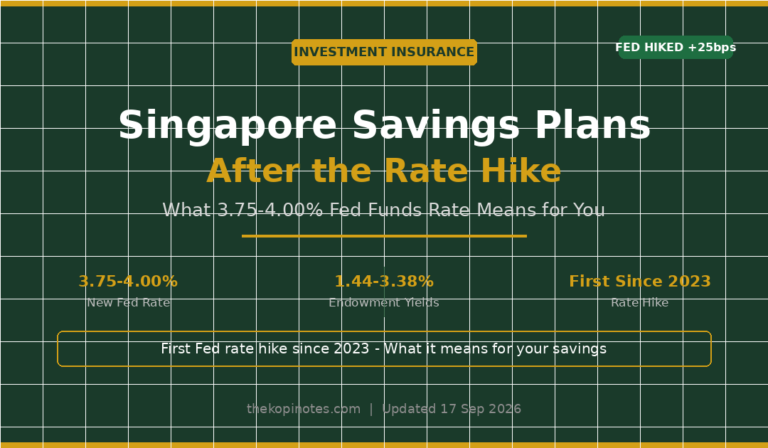
The Fed hiked rates sharply in 2025–2026, and Singapore rates followed. As of September 2026, guaranteed rates on short-term single premium plans have risen meaningfully compared to 2022–2023 levels. For a saver with a lump sum and a 2–3 year horizon, locking in a guaranteed rate now makes sense if rates are expected to plateau or ease in 2027.
The argument for single premium in 2026:
- Rates are elevated relative to historical norms — locking in now is a rate-hedging move.
- Non-par structure means no bonus uncertainty.
- If the Fed cuts rates in 2027, future tranches will likely offer lower guaranteed yields.
The argument for regular premium in 2026:
- If you do not have a lump sum, regular premium is the only practical option.
- Par fund bonuses for long-duration plans are less rate-sensitive in the short term — they smooth returns over cycles.
- Regular premium suits savers who want forced discipline and a long-term goal (e.g., a 20-year education savings plan).
For Q4 2026 tenor-specific guidance on endowment plans, read: Endowment Plan Singapore Q4 2026: Which Tenor to Lock In.
For a broader look at all savings plan types, see: Singapore Insurance Savings Plan Guide 2026.
Frequently Asked Questions
Is a savings plan the same as an endowment plan in Singapore?
Can I use my SRS funds to buy a single premium savings plan?
What happens if I stop paying premiums on a regular premium savings plan?
Are Singapore savings plans protected if the insurer fails?
Is single or regular premium better for CPF top-ups?
How do I compare savings plan quotes in Singapore?
Get Free Insurance Advice
Speak with a licensed insurance advisor. No obligation, no cost.
By submitting this form, you agree to our Privacy Policy.
This article was researched with the help of AI. While we strive to keep all information accurate and up to date, there may be errors. If you notice any discrepancies, please contact us.