Keppel DC REIT Share Price 2026: What the September Rate Cut Means for Your DPU
Updated: August 2026 | Category: S-REITs | Est. read: 8 min
Table of Contents
Keppel DC REIT (SGX: AJBU) delivered a strong first-half in 2026, with Distribution Per Unit (DPU) rising 11.3% year-on-year to 5.714 Singapore cents. With the Federal Reserve widely expected to cut rates on 17 September 2026, the question for investors is straightforward: does the rate cut cycle make KDC even more attractive, or is the good news already priced in at S$2.31?
Not financial advice. All figures are for educational reference only. Data as at August 2026 unless noted. Past performance is not indicative of future results.
- KDC’s 1H2026 DPU surged 11.3% to 5.714 cents — best half-year result in years.
- The September FOMC rate cut could reduce KDC’s cost of debt, providing an estimated 0.15–0.38 cents of additional DPU per year depending on cut depth.
- Fair value under a base scenario (two 2026 cuts) sits around S$2.35; the bull case (four cuts) points to S$2.55.
Keppel DC REIT at a Glance
Keppel DC REIT is Singapore’s first and largest pure-play data centre REIT, listed on the SGX in 2014. It holds 23 data centres across Singapore, Australia, China, Japan, the Netherlands, Germany, the United Kingdom, Italy, and Ireland.
Unlike retail or office REITs, KDC’s tenants are predominantly hyperscalers, cloud providers, and large financial institutions — customers with multi-year, triple-net lease contracts. That means occupancy and income tend to be highly stable even in economic downturns.
| Metric | Value (Aug 2026) |
|---|---|
| SGX Ticker | AJBU |
| Unit Price | ~S$2.31 |
| 1H2026 DPU | 5.714 cents (+11.3% y-o-y) |
| Annualised DPU Yield | ~4.9% (at S$2.31) |
| No. of Data Centres | 23 |
| Gearing Ratio | ~34% |
Source: KDC 1H2026 Results (July 2026), SGX filings. Figures are approximate.
1H2026 Results: DPU Up 11.3% — The Numbers Behind the Headline
KDC announced its 1H2026 results in July 2026 to widespread approval. Revenue climbed 14.5% to S$242.05 million. Net Property Income (NPI) rose 15.1% to S$210.38 million. Total distributable income was up 18.5% to S$150.67 million.
The main growth drivers were positive rent reversions, contributions from the acquisitions of Tokyo Data Centre 3 and the remaining interests in Keppel DC Singapore 3 and 4. These were partially offset by the absence of income from the divested Kelsterbach Data Centre in Germany, and higher finance costs.
| P&L Line | 1H2026 | 1H2025 (est.) | Change |
|---|---|---|---|
| Revenue | S$242.05M | ~S$211.3M | +14.5% |
| Net Property Income | S$210.38M | ~S$182.8M | +15.1% |
| Distributable Income | S$150.67M | ~S$127.1M | +18.5% |
| DPU | 5.714 cents | 5.132 cents | +11.3% |
Source: Keppel DC REIT 1H2026 SGX announcement (July 2026). Prior-period figures estimated from y-o-y change.
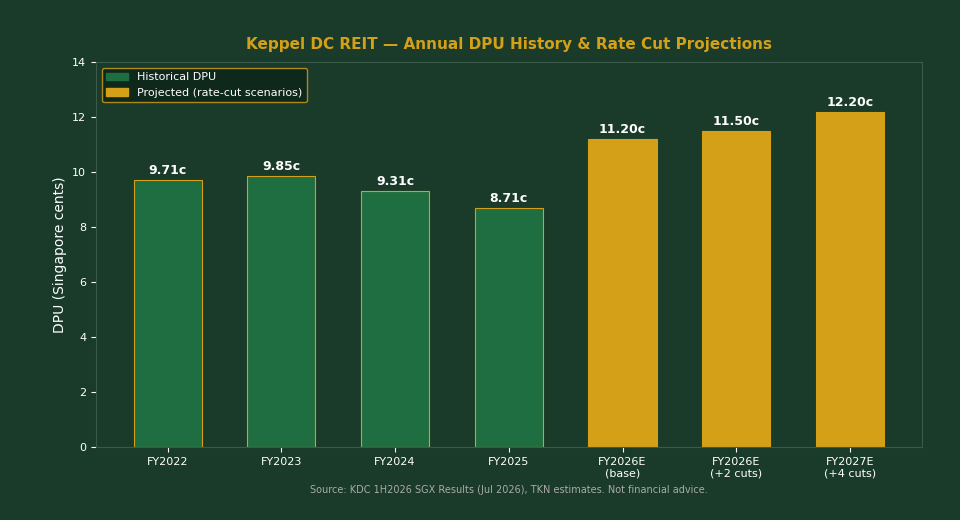
The 5.714-cent DPU for 1H2026 was paid on 18 September 2026. For comparison, the full-year FY2025 DPU was approximately 8.71 cents. That means 1H2026’s 5.714 cents represents a substantial acceleration in distribution growth — setting up H2 for potential further uplift if the rate environment cooperates.
How the September Rate Cut Affects Keppel DC REIT
The Federal Reserve is widely expected to cut its benchmark rate by 25 basis points at the 17 September 2026 FOMC meeting. Markets are pricing in at least two cuts before year-end. Here is how that flows through to KDC specifically.
Two channels: cost of debt and capital values
Rate cuts benefit KDC through two mechanisms. First, a lower risk-free rate reduces KDC’s borrowing costs when it refinances existing debt. Second, lower rates drive cap rate compression — the yield investors require from data centre assets falls, pushing asset values and NAV higher.
The cost of debt lever
KDC typically maintains roughly 75-80% of its debt on fixed rates. This means a rate cut does not immediately slash borrowing costs. However, when fixed-rate tranches come up for refinancing, they reset at prevailing rates — which will be lower in a rate-cut cycle.
If KDC refinances S$300M of debt from 4.2% to 3.6% in late 2026 or 2027, that is S$18M in annual interest savings — roughly translating to 0.3 cents of additional DPU per unit. Small, but meaningful on top of an already-strong operating result.
The valuation re-rating
The bigger impact is likely on share price, not DPU. When the risk-free rate falls, investors lower the required return from data centre assets. If the market cap rate drops from 5.5% to 5.0%, a data centre generating S$100M of NPI re-rates from S$1.82B to S$2.0B — a 10% uplift in asset value, directly flowing into a higher NAV per unit.
This is why KDC’s share price often moves sharply in anticipation of rate decisions. By the time the Fed actually cuts, much of the re-rating may have already happened.
KDC’s Debt Profile and Refinancing Lever
As of 1H2026, KDC’s aggregate leverage (gearing ratio) stood at approximately 34% — comfortably below MAS’s 50% regulatory limit. This gives KDC meaningful debt headroom to fund future acquisitions without raising equity that dilutes existing unitholders.
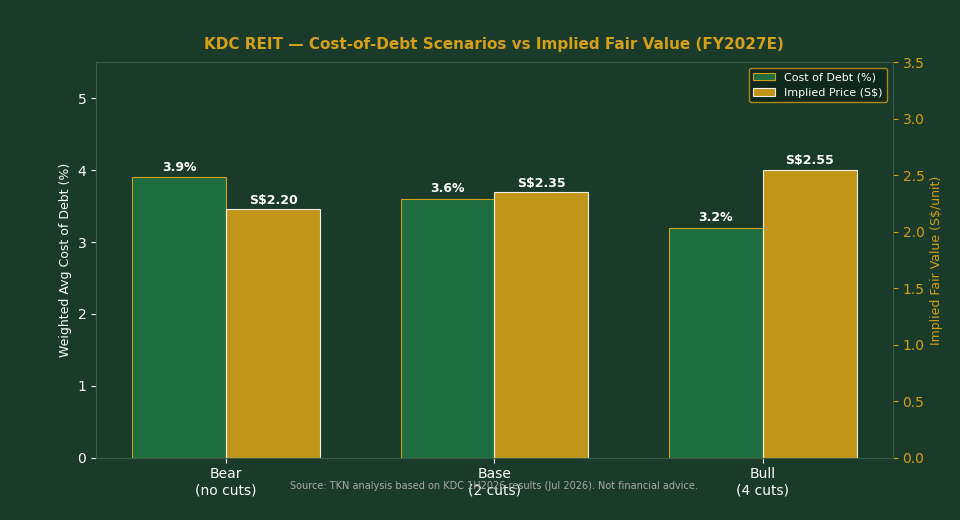
KDC’s weighted average cost of debt was approximately 3.7-3.9% as at mid-2026. When fixed-rate tranches mature in 2026-2027 and are refinanced at lower prevailing rates, the benefit flows directly to distributable income.
| Scenario | Cuts in 2026 | Est. Cost of Debt (FY2027) | Est. DPU Uplift |
|---|---|---|---|
| Bear (no cuts) | 0 | ~3.9% | — |
| Base (2 cuts) | 2 x 25bp | ~3.6% | +~0.15c/unit |
| Bull (4 cuts) | 4 x 25bp | ~3.2% | +~0.38c/unit |
Source: TKN estimates based on KDC 1H2026 results (Jul 2026) and CME FedWatch data (Aug 2026). Not financial advice.
AI Tailwinds and Occupancy Outlook
Rate cuts alone do not make a REIT investment thesis. The fundamental demand story matters equally — and for KDC, it remains compelling.
The global AI compute buildout is driving unprecedented demand for high-quality data centre space. Hyperscalers like AWS, Azure, and Google Cloud are expanding at scale across Asia-Pacific. KDC’s portfolio of institutional-grade data centres in Singapore, Tokyo, and key European hubs positions it at the centre of this demand wave.
Singapore’s position as the preferred APAC data centre hub — due to political stability, a robust power grid, and fibre connectivity — means KDC’s Singapore assets carry real pricing power. After the government moratorium on new capacity in 2019-2022, supply remains disciplined. New capacity is being absorbed quickly by AI-driven demand.
KDC’s acquisition of Tokyo Data Centre 3 in 2025 was strategically timed. Japan’s data centre market is growing rapidly, driven by AI adoption, cloud migration by Japanese enterprises, and the government’s push for digital infrastructure.
That said, KDC has FX exposure to EUR and AUD revenues that translate into SGD for distributions. A weaker EUR or AUD can drag on DPU even if underlying data centre performance is strong. The divested Kelsterbach DC (Germany) removed one underperforming asset, but European exposure remains. The capex requirements for AI-ready hyperscale facilities (higher power density, liquid cooling) are also significantly above traditional colocation — this can pressure near-term free cash flow.
Share Price Scenarios: Bear, Base, and Bull
| Scenario | Rate Cuts | FY2027E DPU | Target Yield | Implied Price |
|---|---|---|---|---|
| Bear | 0 in 2026 | ~11.0c | 5.0% | S$2.20 |
| Base | 2 x 25bp | ~11.35c | 4.8% | S$2.35 |
| Bull | 4 x 25bp | ~11.58c | 4.5% | S$2.55 |
Source: TKN estimates based on KDC 1H2026 SGX results (Jul 2026) and CME FedWatch implied probabilities (Aug 2026). Not financial advice. Implied price = FY2027E DPU / target yield.
The key insight: KDC at S$2.31 already prices in much of the base-case rate cut scenario. The bull case requires both aggressive rate cuts and a further re-rating of data centre cap rates — possible, but not guaranteed. For the best S-REITs in Singapore 2026 comparison, KDC currently ranks among the top data centre plays.
You can model this yourself with our S-REIT Dividend Discount Model calculator, or use the retirement planning calculator to see how a KDC allocation fits your broader financial goals.
How Singapore Investors Can Get Exposure to KDC
There are three main ways you can invest in Keppel DC REIT from Singapore.
Option 1: Buy KDC units directly via a broker
You can buy AJBU units directly on the SGX through any retail brokerage platform. Platforms like Interactive Brokers (IBKR) offer competitive commissions for SGX trades. You can also explore FSMOne (referral code: P0544985) which offers commission rebates on SGX stocks.
Option 2: Invest via a robo-adviser with REIT exposure
If you prefer a managed, diversified approach, Syfe (referral code: SRPRFFFCD) offers S-REIT portfolios that hold KDC alongside other data centre and industrial REITs. Syfe’s REIT+ portfolio captures broad S-REIT exposure with automatic rebalancing — suitable if you do not want to pick individual REIT stocks.
Alternatively, Endowus (referral code: 2V343) allows you to invest CPF OA funds into REIT-focused unit trusts that include KDC exposure. This is one of the most tax-efficient approaches for Singaporeans — your CPF OA earns only 2.5% by default, so REIT exposure can potentially enhance returns over a long horizon.
Option 3: Via a Singapore REIT ETF
KDC is a top holding in several Singapore REIT ETF products. These provide instant diversification across S-REITs for a single commission. For passive income seekers, check our full guide to passive income in Singapore 2026.
Frequently Asked Questions
What is Keppel DC REIT's current DPU and yield?
How does a Fed rate cut benefit Keppel DC REIT?
Is it too late to invest in Keppel DC REIT before the September FOMC?
What is Keppel DC REIT's gearing ratio and is it safe?
Can I use CPF OA funds to invest in Keppel DC REIT?
What are the main risks of investing in Keppel DC REIT?
How does Keppel DC REIT compare to Mapletree Industrial Trust for data centre exposure?
When is Keppel DC REIT's next results announcement?
This article is for educational purposes only and does not constitute financial advice. Always conduct your own research and consult a licensed financial adviser before making investment decisions. Past performance is not indicative of future results. Data sourced from KDC 1H2026 SGX announcements and public sources as at August 2026.
This article was researched with the help of AI. While we strive to keep all information accurate and up to date, there may be errors. If you notice any discrepancies, please contact us.