BHG Retail REIT 2026: Why the Dividend Just Got Cut in Half (SGX: BMGU)
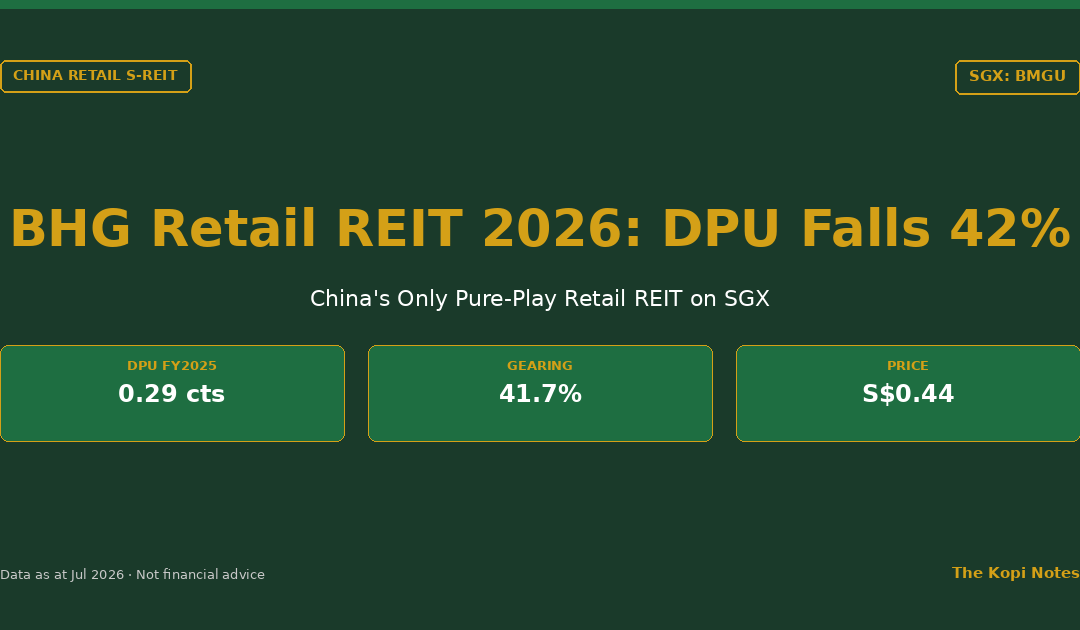
China’s only pure-play retail REIT on SGX just posted a 42% DPU decline in FY2025 — here is the full breakdown.
BHG Retail REIT (SGX: BMGU) is the only pure-play China retail REIT listed in Singapore, owning six shopping malls across Beijing, Chengdu, Hefei, Dalian and Xining. Its FY2025 distribution per unit fell 42% year-on-year to just 0.29 Singapore cents, hit by a weaker yuan, softer occupancy and rental support given to two struggling malls. At S$0.44 a unit, it now trades at roughly half of its estimated book value.
Not financial advice. All figures are for educational reference only. Data as at July 2026 unless noted.
- DPU fell 42% year-on-year in FY2025, from 0.50 cents to 0.29 cents, as revenue dropped and cash was retained for operating costs.
- Gearing sits around 41% and interest coverage around 1.8 times — inside MAS’s 50%/1.5x limits, but with less breathing room than most S-REITs.
- Units trade near S$0.44, an estimated 50%+ discount to net asset value. That is cheap for a reason, not an automatic bargain.
Table of Contents
What Is BHG Retail REIT?
BHG Retail REIT listed on the SGX Main Board on 11 December 2015. It was Singapore’s first pure-play China retail real estate investment trust (REIT) — a fund that pools investor money to buy income-producing shopping malls, then pays out most of the rental income as distributions.
Its sponsor is BHG Group (Beijing Hualian Group), a large Chinese retail and property conglomerate. The REIT owns six shopping malls in Beijing, Chengdu, Hefei, Dalian and Xining, with a combined net lettable area of about 180,350 square metres.
You may also see it quoted under the ticker BHGR on some platforms — the official SGX counter code is BMGU.
| Key Fact | Detail |
|---|---|
| SGX Ticker | BMGU |
| Listed | 11 December 2015 |
| Sponsor | BHG Group (Beijing Hualian Group) |
| Portfolio | 6 retail malls in China (~180,350 sqm NLA) |
| Unit Price (24 Jul 2026) | S$0.44 |
| Market Cap | ~S$228.6 million |
| Units Outstanding | ~519.6 million |
Source: SGX/StockAnalysis.com market data, close of 24 Jul 2026; BHG Retail REIT corporate filings.
The DPU Collapse: FY2024 vs FY2025
Here is the number that matters most if you are holding this REIT for income: distribution per unit (DPU) — basically how much cash each unit pays you.
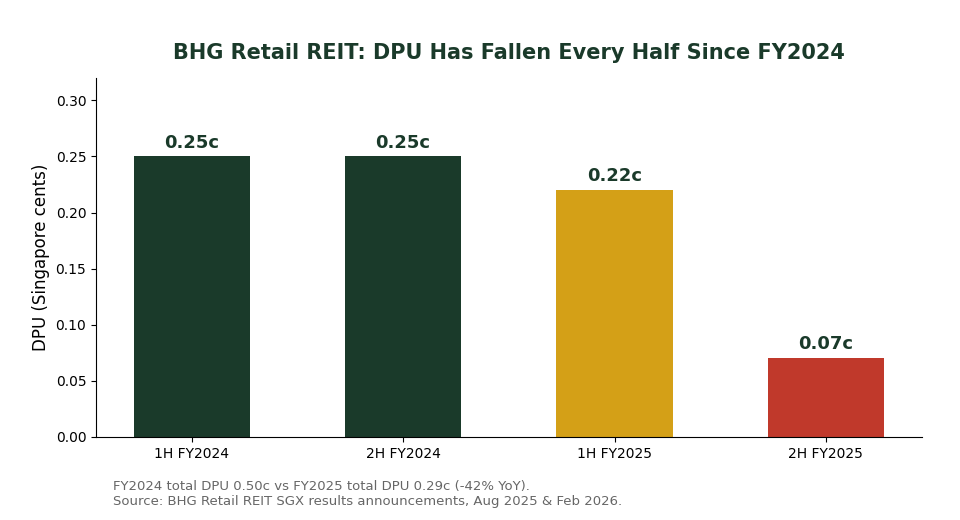
| Period | DPU (cents) | YoY |
|---|---|---|
| 1H FY2024 | 0.25 | — |
| 2H FY2024 | 0.25 | +16.3% (FY2024 total) |
| 1H FY2025 | 0.22 | -12% vs 1H FY2024 |
| 2H FY2025 | 0.07 | -72% vs 2H FY2024 |
Source: BHG Retail REIT SGX results announcements, 26 Feb 2025 (FY2024) and 6 Aug 2025 (1H FY2025); FY2025 full-year figures per Feb 2026 results release.
Put together, that is a full-year DPU of about 0.29 cents for FY2025, down from 0.50 cents in FY2024 — a 42% year-on-year cut. For a S$10,000 position at today’s price of S$0.44, that works out to roughly S$66 a year in distributions, versus about S$114 a year ago.
Why the Distribution Fell
Three things dragged the FY2025 numbers down, according to the REIT’s own results announcements:
1. A weaker Chinese yuan. BHG Retail REIT collects rent in RMB but reports and pays distributions in SGD. When the yuan weakens against the Singapore dollar, the same RMB rental income converts into fewer SGD cents for unitholders. This was flagged as a direct driver of the 10.4% revenue decline in 1H FY2025.
2. Softer occupancy and rental support. Portfolio occupancy slipped from 95.8% (31 Dec 2024) to 95.1% (30 Jun 2025) and further to 93.8% (31 Mar 2026). Two malls — Dalian and Xining — needed direct rental support from the manager to keep tenants, which eats directly into net property income.
3. Cash held back for operating costs. For 1H FY2025, the manager confirmed it kept back S$100,000 that would otherwise have been distributed, citing operational expenses and working capital needs. That is a small number in isolation, but it signals a REIT prioritising cash buffers over maximising payouts — usually not a great sign for income investors.
Balance Sheet: Gearing, ICR and MAS Limits
Since 28 November 2024, the Monetary Authority of Singapore (MAS) applies one uniform leverage framework to every S-REIT: a maximum gearing ratio of 50% of total assets, and a minimum interest coverage ratio (ICR) of 1.5 times. This replaced the old two-tier system where REITs could gear up to 50% only if their ICR was comfortably above 2.5 times.
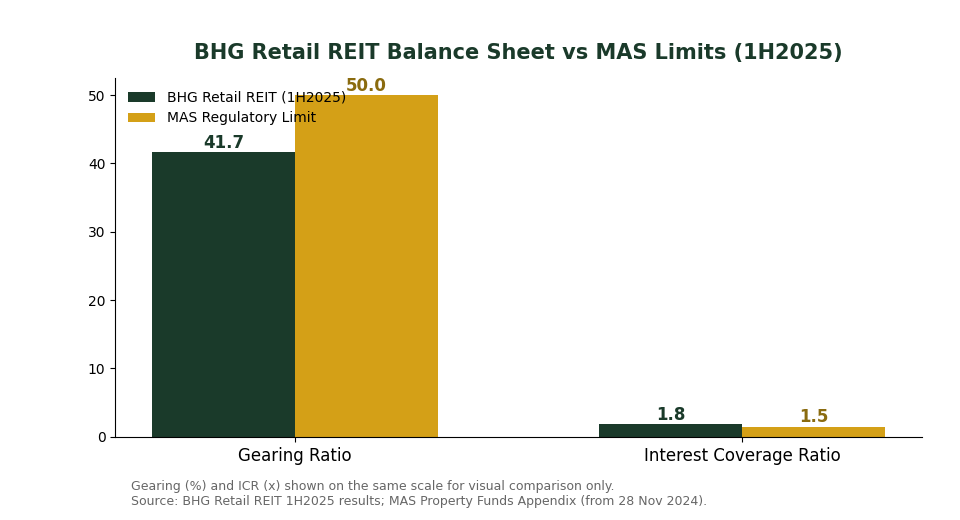
As at 30 June 2025, BHG Retail REIT’s gearing stood at 41.7% and its ICR at 1.8 times — inside both MAS thresholds. By the REIT’s April 2026 AGM update, gearing had eased slightly to 40.8% with an average cost of debt of 4.3% and an ICR of 1.7 times.
That still leaves less headroom than most larger S-REITs, which typically run gearing in the 33–38% range. About 80% of BHG Retail REIT’s borrowings are denominated in Singapore dollars, which limits (but does not eliminate) currency mismatch risk on the debt side, even though rental income is collected in RMB.
Valuation: Price vs Net Asset Value
Here is a worked example using the REIT’s own reported figures. As at 30 June 2025, BHG Retail REIT reported net assets of S$495.4 million against roughly 519.6 million units outstanding. Dividing the two gives an estimated net asset value (NAV) of about S$0.95 per unit at that date.
At the 24 July 2026 closing price of S$0.44, that implies a price-to-NAV ratio of roughly 46% — in other words, the market is pricing the REIT at close to a 54% discount to its last reported book value. (Note: this uses the 30 Jun 2025 net asset figure, the most recent one with a matching unit count publicly available at the time of writing; the REIT’s FY2025 annual report may show an updated NAV.)
A steep discount like this can mean one of two things: either the market is being irrationally pessimistic about a China retail REIT, or the market has correctly priced in further NAV erosion — through property devaluations, a weaker yuan, or both. Given the DPU trend above, this looks more like the second case than a screaming bargain. You can run your own numbers with our free S-REIT P/NAV calculator, which compares any S-REIT’s price against its reported NAV.
The Portfolio: Six Malls, Two Problem Children
BHG Retail REIT’s six malls sit across five Chinese cities, each anchored by supermarkets, cinemas and family-oriented tenants — a community-mall model rather than a luxury or tourist-mall one. This makes the portfolio more resilient to discretionary spending swings, but also more exposed to local competition from newer malls and e-commerce.
The two malls singled out for rental support in FY2025 — Dalian and Xining — are in smaller, lower-tier Chinese cities than the flagship Beijing and Chengdu properties. That is consistent with a broader trend across China’s retail sector: tier-1 city malls have generally held up better than tier-2/3 city malls through the post-pandemic consumption recovery.
The manager’s stated strategy is to reposition these malls as “community-centric” destinations — adding digital-first and lifestyle tenants alongside asset enhancement initiatives, while pursuing selective acquisitions as China’s consumption demand recovers.
Key Risks to Watch
- Currency risk. Rental income is earned in RMB but distributed in SGD. A weaker yuan directly shrinks what SGD unitholders receive, even if the underlying China business is stable.
- China consumption uncertainty. Retail spending recovery in China has been uneven across cities and income segments — tier-2/3 city malls like Dalian and Xining are more exposed.
- Limited gearing headroom. At ~41% gearing versus a 50% MAS ceiling, there is less room to fund acquisitions with debt compared to lower-geared S-REITs.
- Small size and low liquidity. With a market cap of roughly S$229 million and thin daily trading volumes, unit prices can swing sharply on small trades, and buying or selling a large position may move the price.
- Distribution retention. The manager has already shown willingness to retain cash instead of distributing it in full — a pattern worth monitoring in future results.
Our Verdict: Value Trap or Value Buy?
BHG Retail REIT is not a REIT we would recommend for investors who need reliable, growing income. The DPU trend is going the wrong way, and a fund manager retaining distributable cash for working capital is rarely a sign of underlying strength. Even as the broader S-REIT sector recovery lifts many SGX-listed peers, BHG Retail REIT’s own DPU trajectory has moved in the opposite direction this past year.
That said, it is not without merit for a specific type of investor. The steep discount to NAV, gearing that remains inside MAS limits, and a genuine (if patchy) China consumption recovery story mean this could interest contrarian, higher-risk-tolerant investors willing to watch closely for signs of a DPU trough — not a set-and-forget income holding.
For most Singapore investors focused on stable, growing distributions, our list of the best S-REITs in Singapore remain a more straightforward starting point, and another distressed S-REIT with a suspended distribution shows a similar cautionary pattern worth comparing against before adding any distressed, deep-discount REIT to a portfolio.
Frequently Asked Questions
What is BHG Retail REIT?
BHG Retail REIT (SGX: BMGU) is a Singapore-listed real estate investment trust that owns six shopping malls in China. It is the only pure-play China retail REIT on the SGX, sponsored by BHG Group (Beijing Hualian Group), and has been listed since 11 December 2015.
Why did BHG Retail REIT's dividend fall in 2025?
Full-year DPU fell 42% year-on-year, from about 0.50 cents in FY2024 to about 0.29 cents in FY2025. The manager pointed to a weaker Chinese yuan against the Singapore dollar, softer occupancy, rental support given to the Dalian and Xining malls, and cash retained for operating expenses.
What is BHG Retail REIT's gearing ratio?
Gearing was 41.7% as at 30 June 2025, easing slightly to about 40.8% by the REIT’s April 2026 AGM update. Both figures sit within MAS’s uniform 50% gearing limit for S-REITs, which has applied to all trusts since 28 November 2024.
Is BHG Retail REIT's interest coverage ratio healthy?
Its interest coverage ratio (ICR) was about 1.8 times as at 30 June 2025 and around 1.7 times by April 2026 — both above MAS’s 1.5 times minimum, but with less buffer than most larger S-REITs, which often run ICRs above 3 times.
What is BHG Retail REIT's estimated NAV per unit?
Based on net assets of S$495.4 million and roughly 519.6 million units outstanding as at 30 June 2025, estimated NAV works out to about S$0.95 per unit. At a S$0.44 unit price, that implies trading at roughly a 54% discount to book value.
Is BHG Retail REIT CPF or SRS eligible?
BHG Retail REIT trades on the SGX Main Board, which generally makes it eligible for SRS (Supplementary Retirement Scheme) investing through most brokers. CPF Investment Scheme (CPFIS) eligibility for individual counters can change and varies by broker, so always confirm directly with your CPF-approved broker before investing CPF funds.
When does BHG Retail REIT report its next results?
Its next scheduled results release is for 1H FY2026, expected around 7 August 2026, based on its published financial calendar as at the time of writing. Always check the REIT’s SGXNet announcements for the confirmed date closer to the release.
What are the main risks of investing in BHG Retail REIT?
Key risks include RMB/SGD currency exposure (rent is earned in yuan but distributed in Singapore dollars), uneven China retail consumption recovery across cities, limited gearing headroom versus the MAS 50% ceiling, small market capitalisation with thinner trading liquidity, and a manager that has already shown willingness to retain distributable cash.
How does BHG Retail REIT compare to other overseas S-REITs?
BHG Retail REIT is unique as the only pure-play China retail REIT on SGX. It shares some traits with other overseas S-REITs facing distribution pressure, but its China-specific currency and consumption risk profile differs meaningfully from the US office or European retail exposure seen in other overseas-focused S-REITs.
Keep Building Your Portfolio
If you are exploring building passive income in Singapore through S-REITs, BHG Retail REIT is a reminder to always check the DPU trend and balance sheet, not just the headline yield. Use our retirement calculator to see how any REIT allocation fits into your long-term retirement plan, and consider opening a brokerage account through one of our referral partners below.
This article was researched with the help of AI. While we strive to keep all information accurate and up to date, there may be errors. If you notice any discrepancies, please contact us.