ESR-REIT 1H2026 Results: DPU Up 2.4% to 11.51 Cents on Portfolio Upgrade (SGX: 9A4U)
Gearing falls to 41.4%, an Australian logistics buy adds 5.1% DPU accretion — here’s what the 28 July numbers mean for you.
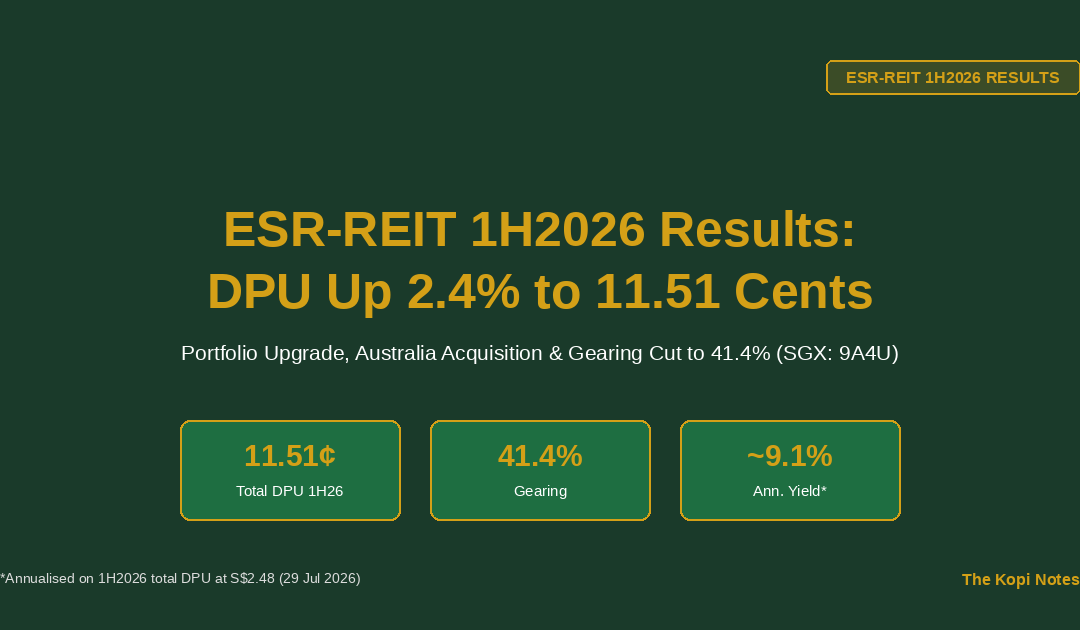
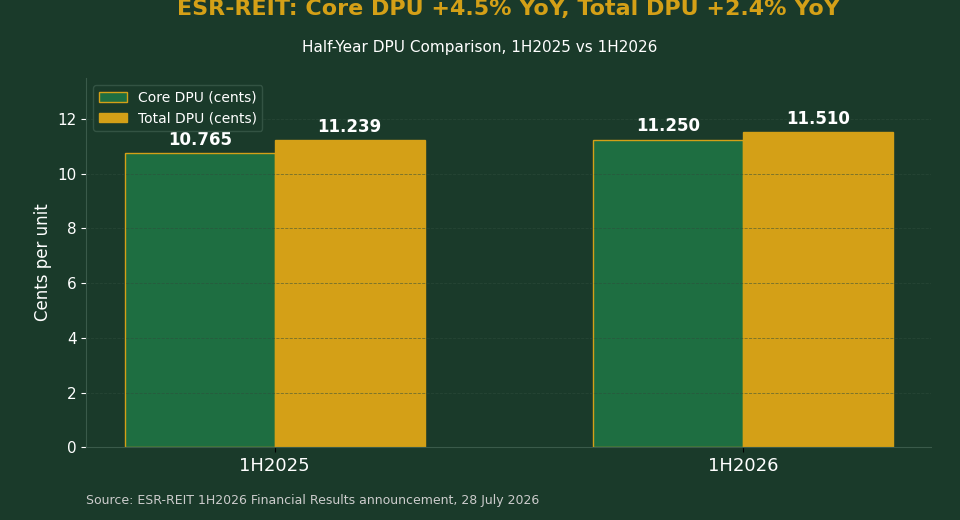
ESR-REIT (SGX: 9A4U) reported 1H2026 total DPU of 11.510 cents, up 2.4% year-on-year, even as revenue dipped slightly from divesting 10 non-core properties. Core DPU rose a stronger 4.5% to 11.250 cents. Gearing fell to 41.4%, and a new Australian logistics acquisition should lift future distributions by a further 5.1%.
Not financial advice. All figures are for educational reference only. Data as at 28 July 2026 unless noted.
- Total DPU came in at 11.510 cents, up 2.4% year-on-year. Record date is 5 August, paid 11 September 2026.
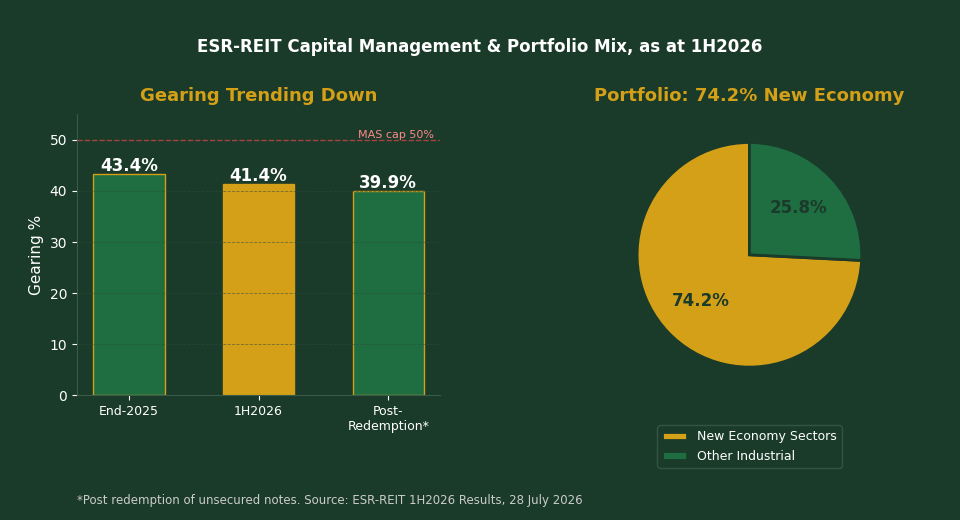
- Gearing dropped to 41.4% from 43.4%, and management expects it to fall further to 39.9% once unsecured notes are redeemed.
- A new A$341.1m Australian logistics deal is 5.1% DPU-accretive. At S$2.48, that puts the annualised yield around 9.1–9.3%.
Table of Contents
Contents — Click to expand
The Rename: From ESR-LOGOS REIT to ESR-REIT
If the ticker looks familiar but the name doesn’t, that’s because ESR-LOGOS REIT dropped “LOGOS” from its name in 2026. It’s now simply ESR-REIT, still trading under SGX code 9A4U.
The rebrand reflects a narrower focus. ESR-REIT is repositioning as a pure-play new economy industrial landlord — think logistics, high-specs industrial, and data centre-adjacent space — rather than a broad-based industrial trust.
If you already hold units and want the fuller dividend history under the old name, our ESR-Logos REIT Dividend & Yield Analysis 2026 guide covers the DPU track record leading up to this rename.
1H2026 Results at a Glance
ESR-REIT released its 1H2026 financial results on 28 July 2026, covering the six months to 30 June. Here’s the headline income statement, compared with the same period last year.
| Metric | 1H2025 | 1H2026 | YoY |
|---|---|---|---|
| Gross Revenue | S$222.9m | S$222.3m | -0.3% |
| Net Property Income | S$166.3m | S$162.7m | -2.2% |
| Core DPU | 10.765¢ | 11.250¢ | +4.5% |
| Total DPU | 11.239¢ | 11.510¢ | +2.4% |
Source: ESR-REIT 1H2026 Financial Results announcement, 28 July 2026
Notice something odd? Revenue and net property income (NPI — basically rental income after property expenses) both fell slightly, yet DPU still grew. That’s not a red flag. It’s the direct result of selling 10 non-core buildings during the period, which temporarily shrinks the top line while making the remaining portfolio leaner and more profitable per unit.
On a same-store basis — comparing only the properties ESR-REIT held throughout both periods — revenue actually grew 2.3% and NPI grew 0.7%. That’s the more honest measure of how the underlying portfolio is performing.
Where the DPU Growth Came From
Three things drove core DPU higher this half. First, positive rental reversion — when a lease renews at a higher rate than before — came in at a strong +9.8%. That means tenants renewing their leases are paying meaningfully more than they were three years ago.
Second, cost discipline. Management held operating costs steady while occupancy stayed high at 91.9%. Third, proactive refinancing trimmed some interest expense, even though the average all-in cost of debt ticked up slightly to 3.52% from 3.35%.
Here’s the distribution breakdown for 1H2026, so you know exactly what you’re being paid for:
| Component | Cents per Unit |
|---|---|
| Taxable income | 10.126¢ |
| Tax-exempt income | 0.050¢ |
| Capital distribution | 1.334¢ |
| Total DPU | 11.510¢ |
Source: ESR-REIT 1H2026 Financial Results announcement, 28 July 2026. Record date 5 August 2026, payable 11 September 2026.
The 1.334 cents “capital distribution” component is worth flagging. It’s a payout funded from capital (for example divestment gains) rather than rental income. It’s not unusual for S-REITs mid-repositioning, but it’s worth watching — a growing reliance on capital distributions to prop up DPU is a trend you’d want to track over future halves.
Divestments and the Australia Acquisition
ESR-REIT has been actively recycling capital — selling older, non-core assets and redeploying the proceeds into higher-quality logistics space. In 1H2026, it completed three divestments:
Eight non-core assets sold for S$338.1m, at a 2.0% premium to valuation. A hotel strata lot at Changi sold for S$101m, at valuation. And 12 Ang Mo Kio Street 65 sold at a 2.1% premium — a sign that buyers are still willing to pay up for quality industrial space in Singapore, even in a higher-rate environment.
On the buy side, ESR-REIT announced the acquisition of six freehold logistics properties in Australia for A$341.1m (about S$305.4m). Management expects this deal to be 5.1% DPU-accretive. The properties carry a weighted average lease expiry (WALE) of 3.5 years, and current in-place rents sit 12–17% below market — meaning there’s built-in upside as those leases renew.
Together, these moves pushed the portfolio’s weighted average lease expiry up to 4.8 years and its weighted average land lease tenure to 48.4 years. Freehold assets now make up 25.1% of the portfolio, up from before the transaction.
Gearing and Capital Management
Gearing — basically how much of the REIT’s total assets are funded by debt rather than equity — fell to 41.4% at end-1H2026, down from 43.4% at end-2025. Management expects it to fall further to 39.9% once outstanding unsecured notes are redeemed.
That leaves a comfortable buffer below the Monetary Authority of Singapore’s (MAS) 50% gearing limit for S-REITs, which you can verify directly via MAS’s REIT leverage rules. Interest coverage ratio (ICR) — how many times over the REIT’s earnings could cover its interest expense — improved to 2.6x, comfortably above MAS’s uniform 1.5x minimum ICR requirement for all S-REITs (in force since November 2024).
ESR-REIT holds a Fitch ‘BBB’ credit rating with a Stable outlook. That investment-grade rating helped it achieve roughly 30 basis points of margin compression on recent refinancing, even as benchmark rates stayed elevated. About 75.5% of its borrowings are hedged to fixed rates, which limits how much a future rate move could sting.
If you want to check gearing and interest coverage yourself for any S-REIT you’re comparing, our S-REIT Gearing Ratio & ICR Calculator does the maths for you.
Occupancy, Rental Reversion and Portfolio Quality
Occupancy held steady at 91.9%, and 74.2% of the portfolio now sits in “new economy” sectors — logistics, high-specs industrial, and data centre-adjacent space that benefit from e-commerce and AI-driven demand.
Management is also investing directly in the existing portfolio. Asset enhancement initiatives (AEIs) — essentially renovations that let a building command higher rent — are underway at 16 and 29 Tai Seng Street, with a further redevelopment planned at 2 Fishery Port Road.
On sustainability, ESR-REIT is progressively installing rooftop solar, targeting 30 MWp of capacity by 2030, alongside EV chargers and smart meters across its Singapore portfolio. It’s aiming for 80% of the portfolio to hold green building certification by 2030.
Geographically, the growth story now spans three markets. Singapore’s industrial market remains supported by AI-led manufacturing demand and tight new supply. Australia’s logistics market — where ESR-REIT just added exposure — is seeing tight supply and rental growth, especially in Melbourne. Japan remains resilient, with healthy rents in Tokyo offsetting some softness in Nagoya from new supply.
What Analysts Are Saying
Maybank initiated coverage with a BUY rating and a S$3.00 target price shortly after the results, implying roughly 21% upside from ESR-REIT’s S$2.48 price as at 29 July 2026. The thesis centres on disciplined capital recycling, improving portfolio quality, and sustainable DPU growth.
Maybank’s model pencils in FY2026E rental growth of around 8.5%, supported by continued AI-related demand for logistics and high-specs industrial space. Other desks covering the stock are similarly constructive, with a handful of analysts rating it a buy and none currently recommending a sell.
As always, sell-side targets are one input, not a guarantee. Treat them as a data point alongside your own read of the balance sheet and distribution quality.
Should You Buy ESR-REIT Now?
At S$2.48, ESR-REIT’s core-DPU annualised yield works out to roughly 9.1%, or about 9.3% if you annualise the total DPU including the capital component. That’s a high yield even by S-REIT standards, which typically run 5–7%.
The case for holding or buying: gearing is falling, not rising. The Australia deal is DPU-accretive from day one. Rental reversions are strongly positive, and the portfolio is shifting toward higher-quality, longer-leased assets. An investment-grade credit rating keeps refinancing costs manageable.
The case for caution: revenue and NPI are still shrinking on a headline basis, even if same-store numbers look better. Part of the distribution is capital-funded rather than purely rental income. And at a near-double-digit yield, the market may be pricing in more risk than the headline DPU growth suggests — so do your own diligence rather than chasing yield alone.
If you’re comparing ESR-REIT against other high-yield options, our Highest Yield REITs in Singapore 2026 roundup and best S-REITs in Singapore 2026 guide are good next reads.
Track Your REIT Income Alongside Your Retirement Plan
REIT distributions like ESR-REIT’s are one building block of a Singapore passive income plan. If you’re building toward retirement, it helps to see how dividend income fits into the bigger picture with our Singapore retirement calculator.
If you’re funding new REIT or ETF positions and want to compare brokers, TKN readers can check the Syfe referral code and sign-up bonus for current promotions.
Frequently Asked Questions
What was ESR-REIT's 1H2026 DPU?
ESR-REIT’s total distribution per unit (DPU) for 1H2026 was 11.510 cents, up 2.4% from 11.239 cents in 1H2025. Core DPU, which strips out one-off items, rose 4.5% to 11.250 cents.
When did ESR-LOGOS REIT become ESR-REIT?
ESR-LOGOS REIT rebranded to ESR-REIT in 2026, dropping “LOGOS” from its name. The SGX ticker remains 9A4U throughout.
When is the ESR-REIT dividend paid?
The 1H2026 distribution has a record date of 5 August 2026, with payment on 11 September 2026.
What is ESR-REIT's gearing ratio?
Gearing stood at 41.4% as at 1H2026, down from 43.4% at end-2025. Management expects it to fall further to 39.9% after redeeming outstanding unsecured notes. This is well within MAS’s 50% regulatory limit for S-REITs.
What is ESR-REIT's dividend yield?
Annualising the 1H2026 core DPU against a S$2.48 unit price (29 July 2026) works out to roughly 9.1%. Using total DPU, it’s closer to 9.3%. Yields move with the share price, so check the current price before relying on this figure.
Why did ESR-REIT's revenue fall if DPU grew?
Revenue and net property income dipped slightly year-on-year because ESR-REIT divested 10 non-core properties during the period. On a same-store basis (excluding divested and newly acquired assets), revenue actually grew 2.3% and NPI grew 0.7%.
What is the Australia acquisition and why does it matter?
ESR-REIT is acquiring six freehold logistics properties in Australia for A$341.1m (about S$305.4m). The deal is expected to be 5.1% DPU-accretive, with in-place rents currently 12–17% below market rates — giving room for future rental growth.
Is ESR-REIT a buy in 2026?
Maybank rates ESR-REIT a BUY with a S$3.00 target price, citing falling gearing, a DPU-accretive acquisition pipeline, and portfolio quality improvements. That said, this isn’t personalised investment advice — weigh the still-declining headline revenue and the capital-funded portion of the distribution against your own risk appetite.
Is ESR-REIT's credit rating investment grade?
Yes. ESR-REIT holds a Fitch ‘BBB’ rating with a Stable outlook, which helped it secure roughly 30 basis points of margin compression on recent debt refinancing.
This article was researched with the help of AI. While we strive to keep all information accurate and up to date, there may be errors. If you notice any discrepancies, please contact us.