TIPS ETF Singapore: How to Buy Inflation-Protected Bonds (2026 Guide)
A Singapore investor’s guide to ITPS on the London Stock Exchange — real yields, US withholding tax, and 2026 data.
TIPS (Treasury Inflation-Protected Securities) ETFs hold US government bonds whose principal rises with inflation. Singapore investors buy them through the iShares $ TIPS UCITS ETF (LSE: ITPS or IDTP), an Ireland-domiciled fund with a 0.10% expense ratio. Compared to buying the US-listed equivalent (TIP), ITPS carries a lower 15% US dividend withholding tax instead of 30%, and no US estate tax exposure above USD 60,000.
Not financial advice. All figures are for educational reference only. Data as at September 2026 unless noted.
- ITPS (LSE, UCITS, Ireland) tracks US TIPS with a 0.10% TER — cheaper and more tax-efficient for Singapore investors than the US-listed TIP (0.19% TER, 30% dividend WHT, US estate tax risk).
- TIPS protect your principal from unexpected inflation, but they can still lose money if real yields rise — they are not a risk-free parking spot.
- With US headline inflation still running near 3.4% y/y and the Fed’s rate path uncertain heading into the September 2026 FOMC meeting, TIPS are worth understanding even if you don’t buy them today.
Table of Contents
Contents -- Click to expand
- What Are TIPS, and How Does the Inflation Adjustment Work?
- ITPS Key Facts at a Glance
- Why Buy TIPS Through a London-Listed UCITS ETF
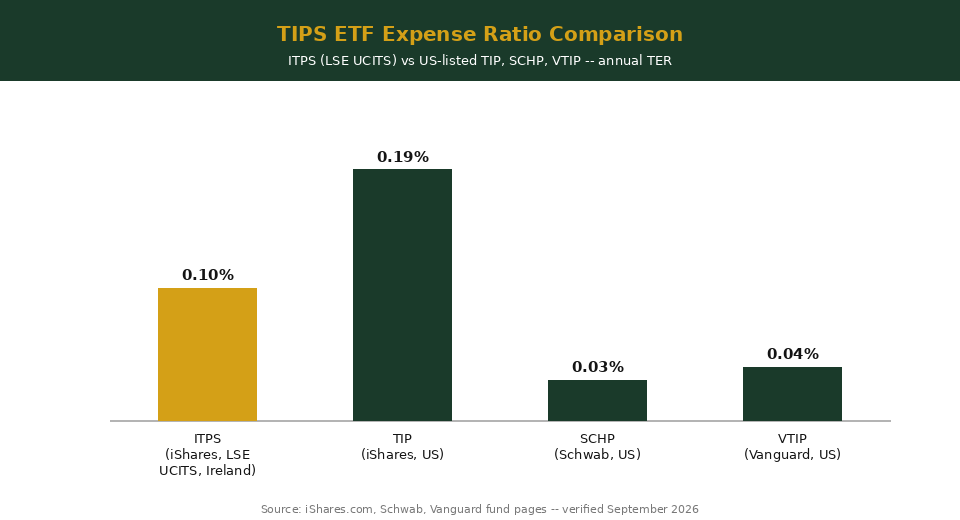
- Cost Comparison: ITPS vs TIP vs SCHP vs VTIP
- Why Inflation-Protected Bonds Matter Going Into the September 2026 FOMC
- How to Buy ITPS in Singapore (Step-by-Step)
- Who Should Buy TIPS ETFs — and Who Shouldn’t
- Frequently Asked Questions
What Are TIPS, and How Does the Inflation Adjustment Work?
Treasury Inflation-Protected Securities (TIPS) are bonds issued by the US government. Unlike a normal bond, the principal (the amount you get back at maturity) moves up and down with the US Consumer Price Index (CPI). If inflation runs at 3% this year, your TIPS principal grows by roughly 3%. The bond’s fixed coupon rate is then paid on this larger, inflation-adjusted principal — so both your interest payments and your final principal rise with inflation.
You don’t need to buy individual TIPS bonds to get this exposure. A TIPS ETF holds a basket of these bonds and lets you buy and sell it like any other ETF, with no need to manage individual bond maturities yourself.
Here’s the concept that matters most: the breakeven inflation rate. This is simply a normal Treasury bond’s yield minus a TIPS bond’s real yield of the same maturity. It tells you what average inflation rate the market expects over that period. If actual inflation ends up higher than the breakeven rate, TIPS beat regular Treasuries of the same maturity. If inflation comes in lower, regular Treasuries win. As at mid-September 2026, the 10-year TIPS real yield sits around 2.55%-2.57%.
ITPS Key Facts at a Glance
| Metric | Detail |
|---|---|
| Full Name | iShares $ TIPS UCITS ETF |
| Ticker (LSE) | ITPS (GBP) / IDTP (USD) — same underlying fund, different trading currency, both accumulating |
| Index Tracked | Bloomberg US Government Inflation-Linked Bond Index |
| Domicile | Ireland (iShares II plc, UCITS) |
| Structure | Accumulating (income reinvested automatically) |
| TER (Expense Ratio) | 0.10% p.a. |
| Fund AUM | Approximately USD 6.4 billion (as at 9 September 2026, ishares.com) |
| Weighted Avg Yield to Maturity | ~4.69% (nominal), ~2.29% real (as at 9 September 2026) |
| Effective Duration | ~6.55 years |
| Base Currency | USD (GBP- and EUR-hedged share classes also exist) |
Source: iShares.com ITPS product page, data as at 9 September 2026.
Why Buy TIPS Through a London-Listed UCITS ETF
You could technically buy the US-listed iShares TIPS Bond ETF (ticker TIP) directly through a brokerage that gives you US market access. Most Singapore investors shouldn’t, for two reasons that apply to any US-domiciled fund.
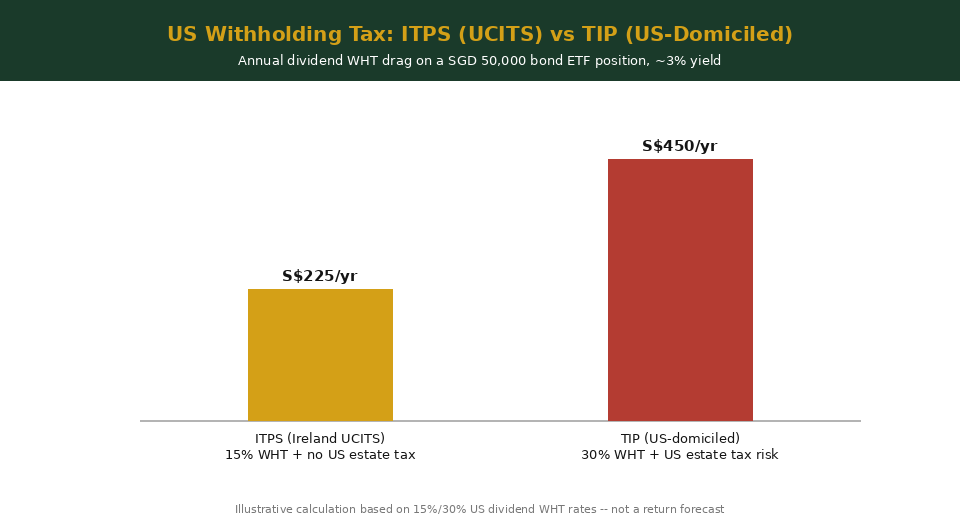
First, US-domiciled ETFs withhold 30% tax on any dividend distributions paid to non-US residents. Ireland-domiciled UCITS funds like ITPS benefit from the US-Ireland tax treaty, which caps this withholding at 15% — effectively halving your tax drag on income. Second, non-resident aliens holding more than USD 60,000 in US-situs assets (which includes US-listed ETF shares) face US estate tax exposure, with rates that scale up to 40% on the value above that threshold. ITPS, being Ireland-domiciled, sits entirely outside this regime.
| ETF Type | Domicile | US Dividend WHT | US Estate Tax Risk |
|---|---|---|---|
| ITPS (LSE) | Ireland | 15% | None |
| TIP (US-listed) | USA | 30% | Yes (above USD 60k) |
On a SGD 50,000 ITPS position yielding roughly 3% in distributed income equivalent, the 15% vs 30% WHT gap works out to about SGD 225 saved per year — money that compounds if reinvested and adds to your passive income Singapore strategy. See the chart below for the full comparison.
Cost Comparison: ITPS vs TIP vs SCHP vs VTIP
Expense ratio is only part of the picture, but it’s the easiest number to compare directly. Here’s how the main TIPS ETF options stack up.
| ETF | TER | Domicile | AUM | Best For |
|---|---|---|---|---|
| ITPS / IDTP | 0.10% | Ireland | ~USD 6.4bn | Singapore investors buying via IBKR/Saxo |
| TIP | 0.19% | USA | ~USD 14.6bn | US residents only (avoid if you’re not one) |
| SCHP | 0.03% | USA | ~USD 16.4bn | Cheapest headline TER, but same US-tax drawbacks |
| VTIP | 0.04% | USA | ~USD 19.3bn | Shorter duration (0-5yr), lower rate sensitivity |
SCHP and VTIP look cheaper on paper, but the 30% dividend withholding tax and US estate tax exposure typically outweigh the small TER saving for a Singapore-based, non-US-resident investor. Unless you specifically hold US tax residency, ITPS remains the more efficient net choice.
Why Inflation-Protected Bonds Matter Going Into the September 2026 FOMC
US headline CPI ran at 3.4% year-on-year in August 2026, unchanged from July, with core CPI easing slightly to 2.4%. That headline number is still meaningfully above the Fed’s 2% target, driven partly by a 16.3% year-on-year jump in energy prices.
The Fed held its funds rate at 3.50%-3.75% at its late-July 2026 meeting. Heading into the September 17-18 FOMC meeting, futures markets have been pricing a meaningfully higher chance of a rate move than a cut — a reminder that the rate path is genuinely uncertain this cycle, not a one-way bet in either direction. That’s exactly the kind of environment where TIPS earn their keep: they don’t require you to correctly predict which way the Fed moves, because their payout is linked to realised inflation, not to interest rate decisions.
This is also a good moment to be honest about what TIPS won’t do. If real yields rise further (which can happen even while inflation stays elevated, if the market demands more compensation for holding long-duration government debt), a TIPS ETF’s price can still fall. TIPS protect you from unexpected inflation eroding your purchasing power — they don’t protect you from interest rate risk more broadly. With ITPS’s ~6.55-year effective duration, a 1 percentage point rise in real yields would be expected to knock roughly 6.5% off the fund’s price, all else equal.
How to Buy ITPS in Singapore (Step-by-Step)
ITPS trades on the London Stock Exchange, so you’ll need a broker with LSE access.
Interactive Brokers (IBKR): Fund your account in SGD or USD, search “ITPS” or “IDTP” in the order entry screen, select the LSE listing, and place a limit order. IBKR is generally the most cost-effective option for larger, buy-and-hold positions given its low commission structure.
Saxo Markets: Similar process — fund your account, search the ticker, confirm you’re selecting the LSE-listed line (not a US or other exchange listing with a similar name), and place your order. Saxo’s platform fee structure differs from IBKR’s, so compare based on your expected trade frequency and account size.
Syfe Brokerage: If you prefer a simpler, app-based experience with zero platform fees on many trades, check whether ITPS or IDTP is available on Syfe’s supported instrument list before committing, since not every LSE-listed UCITS ETF is available on every Singapore broker.
Whichever broker you use, always confirm you’re buying the LSE-listed, Ireland-domiciled line before you click confirm — ticker collisions with other exchanges are a real risk with UCITS funds.
Who Should Buy TIPS ETFs — and Who Shouldn’t
ITPS may suit you if: you already hold a diversified equity portfolio built around a VWRA ETF Singapore guide-style allocation and want to add a genuine inflation hedge to the bond side of your allocation; you’re within a decade of retirement and want to preserve purchasing power rather than chase equity-like returns; or you’re specifically worried about a scenario where inflation runs hotter than the market currently expects.
Consider alternatives if: you want simple capital preservation with no duration risk (the Singapore T-bills 2026 guide or fixed deposits may suit you better); you’re decades from needing this money and can tolerate equity volatility for higher expected long-term returns; or you already have adequate inflation protection through S-REIT holdings, which have historically passed through some inflationary cost increases via rental reversions.
TIPS ETFs are not eligible for CPF Ordinary Account investment under the CPF Investment Scheme’s typical fund list, but ITPS can be bought using cash or, in some cases, SRS funds depending on your broker’s SRS-linked account offering — check with your broker directly, as SRS-eligible fund lists vary by platform.
Frequently Asked Questions
What is a TIPS ETF and why do Singapore investors buy it?
Is ITPS the same fund as TIP?
Can I buy ITPS using my CPF or SRS funds?
Do TIPS ETFs lose money if inflation falls?
Which broker is best for buying ITPS in Singapore?
Is a TIPS ETF safer than a regular government bond ETF?
Ready to Diversify Your Portfolio?
Open a brokerage account and add inflation protection to your fixed income allocation. Use our referral links for exclusive sign-up bonuses.
This article was researched with the help of AI. While we strive to keep all information accurate and up to date, there may be errors. If you notice any discrepancies, please contact us.