Digital Core REIT 2026: 1H Results Show 97% Occupancy, Flat 1.80¢ DPU — But Is It a Buy? (SGX: DCRU)
Singapore’s only pure-play US data centre REIT, sponsored by Digital Realty — full 1H2026 results breakdown, portfolio deep-dive, tenant concentration risk, and how it stacks up against Keppel DC REIT.
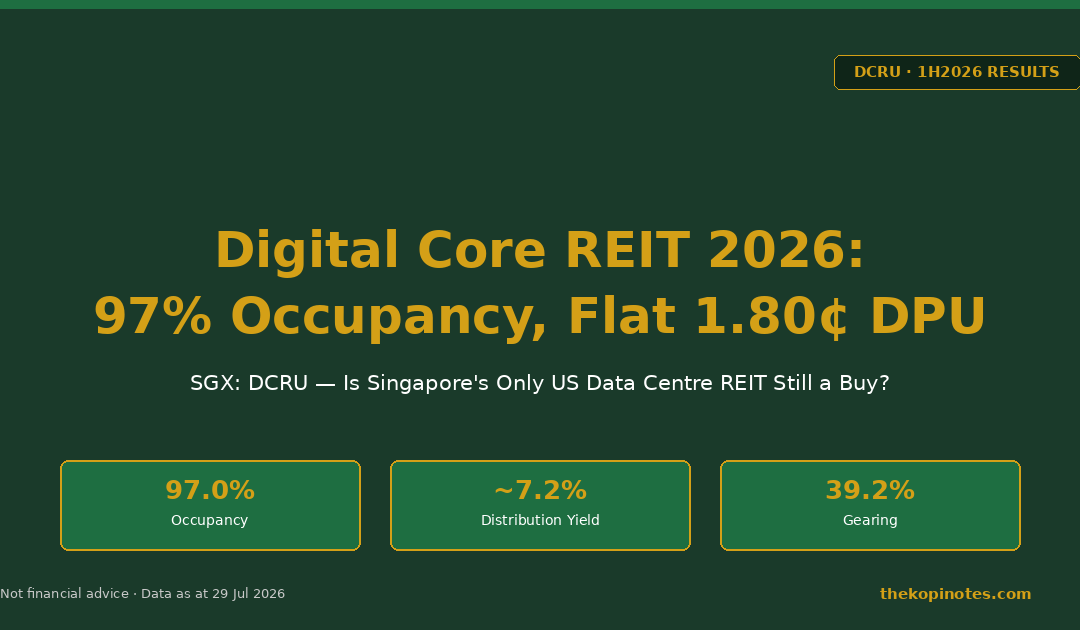
Digital Core REIT (SGX: DCRU) is Singapore’s only pure-play US data centre REIT, sponsored by Digital Realty. Its 1H2026 results (29 July 2026) showed 97% occupancy and a flat 1.80 US cents DPU, even as net profit fell 19.8% on higher costs. At ~7.2% distribution yield with 39.2% gearing, it’s a legitimate AI-demand play — but tenant concentration and USD-denominated payouts are real risks Singapore investors must weigh.
Not financial advice. All figures are for educational reference only. Data as at 29 July 2026 unless noted.
- DCRU’s 1H2026 DPU held flat at 1.80 US cents even though revenue and net property income (NPI) both dipped — buybacks and cost discipline offset the decline.
- Occupancy is strong at 97%, but nearly a third of rental income comes from one tenant — a concentration risk Keppel DC REIT doesn’t carry to the same degree.
- Distributions are paid in US dollars, not SGD — so your actual payout in Singapore dollars moves with the USD/SGD exchange rate, on top of the REIT’s own performance.
Table of Contents
Contents — Click to expand
- What Is Digital Core REIT?
- 1H2026 Results: What Actually Happened
- Portfolio & Occupancy Deep-Dive
- Tenant Concentration: The Real Risk
- Balance Sheet & Gearing
- Digital Core REIT vs Keppel DC REIT
- Why Your Dividend Comes in US Dollars
- Valuation: Is DCRU a Buy in 2026?
- Key Risks to Watch
- Frequently Asked Questions
What Is Digital Core REIT?
Digital Core REIT listed on the SGX on 6 December 2021 — Singapore’s first pure-play data centre REIT. Its sponsor is Digital Realty, the world’s largest data centre owner and operator, which injected a 90% stake in ten freehold US and Canada data centres at IPO.
Fast forward to 2026, and the portfolio has grown to 11 data centres, still 100% freehold, spread across the US, Canada, Germany (Frankfurt), and Japan. Total assets under management sit at roughly US$1.83 billion as at 1Q2026.
Here’s the part that trips up first-time buyers: DCRU reports and pays distributions in US dollars, not Singapore dollars. That’s unusual among S-REITs, and it matters for how you think about your actual take-home yield (more on this later).
1H2026 Results: What Actually Happened
Digital Core REIT released its 1H2026 results on 29 July 2026 — the same day this article was written. Here’s the headline: DPU held flat at 1.80 US cents, even though revenue and net property income (NPI) both fell.
| Metric | 1H2025 | 1H2026 | Change |
|---|---|---|---|
| Revenue | US$88.96m | US$88.57m | −0.4% |
| Net Property Income (NPI) | US$46.32m | US$43.67m | −5.7% |
| Distributable Income | US$23.15m | US$23.33m | +0.8% |
| DPU | 1.80¢ | 1.80¢ | Flat |
| Net Profit | — | ↓19.8% YoY | Lower |
| NAV per Unit | — | US$0.79 | — |
Source: Digital Core REIT 1H2026 results announcement, 29 Jul 2026
So how did DPU stay flat while NPI dropped 5.7%? Two things did the heavy lifting. First, management bought back about 8 million units in 1H2026 at an average price of US$0.488 — a move estimated to be roughly 0.4% DPU-accretive since fewer units share the same distributable pool. Second, lower finance costs and better capital management partly offset the weaker property-level income.
That said, net profit (as opposed to distributable income) fell 19.8% year-on-year, driven by higher property expenses and tax costs. This is a case where the headline distribution number looks stable, but the underlying earnings quality softened — worth knowing before you assume “flat DPU” means “nothing changed.”
Portfolio & Occupancy Deep-Dive
Committed occupancy across the 11-property portfolio stood at 97.0% as at 31 March 2026 — a strong number by any REIT standard. The weak spot is Los Angeles, where occupancy sits meaningfully lower at 84.7%, dragging on an otherwise tight portfolio.
Portfolio WALE (weighted average lease expiry) is short at roughly 4.3–4.4 years. That’s shorter than most S-REITs you’d find in a typical Singapore portfolio — it means more of DCRU’s leases come up for renewal (and renegotiation) sooner, which cuts both ways: faster reversion to market rents in a hot AI-demand market, but also faster exposure if a major tenant decides not to renew.
On the growth side, management completed a refurbishment at its Linton Hall facility that added roughly 13% more sellable capacity and lifted net rent by about 35% on the affected space. Separately, the REIT signed roughly US$5 million in new annualised rent during the period at a strong +25% cash rental reversion — a sign that demand for data centre space, driven by AI compute buildout, is still translating into real pricing power.
In December 2024, Digital Core REIT also increased its stake in the Wilhelm-Fay-Straße Frankfurt facility by another 15.1% (to 24.9% total) for €117 million, buying in at an 18% discount to the appraised value — a disciplined, accretive way to grow exposure to a market that’s structurally short of data centre capacity.
Tenant Concentration: The Real Risk
This is the section every DCRU investor needs to read carefully. Data centre REITs often lease entire buildings to a single large tenant — great for occupancy stability, but risky if that one tenant ever leaves or renegotiates hard.
DCRU’s largest tenant — widely referenced in analyst commentary as a Fortune 50 enterprise software company, though not explicitly named in official filings — accounts for roughly 30.5% of annualised rental income. Its top 10 tenants together make up about 86.4% of rent, across a base of 120-plus customers in total. On the positive side, roughly 79% of rental income comes from tenants considered investment-grade or investment-grade-equivalent, which does soften the credit-risk picture.
Still, having nearly a third of your rent riding on one company’s continued occupancy is a real concentration risk — and it’s structurally different from a REIT like Keppel DC REIT, whose properties more often house multiple tenants within the same building, spreading the risk across more parties per asset.
Balance Sheet & Gearing
Aggregate leverage came in at 39.2% as at 1H2026, up from 37.1% at end-2025 — still comfortably under MAS’s 50% regulatory ceiling for S-REITs, but the direction of travel (rising, not falling) is worth watching over the next few quarters.
| Metric | Value |
|---|---|
| Aggregate Leverage (Gearing) | 39.2% (up from 37.1% end-2025) |
| Interest Coverage Ratio (ICR) | 3.3x (LTM) |
| Average Cost of Debt | ~3.5% |
| Next Debt Maturity | December 2027 |
| Debt Headroom to 50% Cap | ~US$420 million |
Source: Digital Core REIT 1H2026 results announcement, 29 Jul 2026
The good news: there’s no debt maturing until December 2027, which removes near-term refinancing risk from the table. Interest coverage at 3.3x is healthy and comfortably above MAS’s 1.5x regulatory floor, giving management breathing room even if property income softens further.
Digital Core REIT vs Keppel DC REIT
Singapore investors chasing data centre exposure usually end up comparing DCRU against the much larger, more established Keppel DC REIT (SGX: AJBU). Here’s how the two actually differ once you look past the “both own data centres” headline.
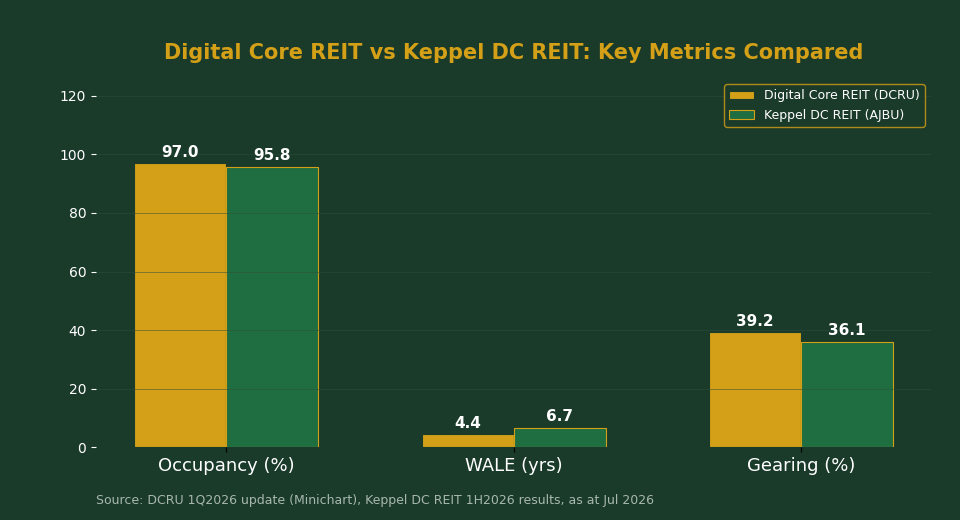
Digital Core REIT vs Keppel DC REIT — occupancy, WALE and gearing compared, as at Jul 2026
| Feature | Digital Core REIT (DCRU) | Keppel DC REIT (AJBU) |
|---|---|---|
| Number of properties | 11 | 25 |
| Ownership structure | 100% freehold | Mixed freehold / very long leasehold |
| Geography | US, Canada, Germany, Japan | Asia-Pacific & Europe (more diversified) |
| Occupancy | 97.0% | 95.8% (Dec 2025) |
| WALE | ~4.3–4.4 years | ~6.7 years |
| Tenant concentration | Higher (top tenant ~30.5% of rent) | Lower, more diversified per building |
| Distribution currency | US dollars | Singapore dollars |
Source: The Kopi Notes analysis of company disclosures and analyst notes, Jul 2026
Broadly: Keppel DC REIT wins on diversification, lease length, and SGD-denominated payouts — simpler for a Singapore-based investor to model. DCRU wins on 100% freehold ownership (no leasehold decay to worry about) and arguably purer, more direct exposure to US hyperscale and enterprise AI demand. Read our full Keppel DC REIT vs Digital Core REIT comparison for a side-by-side buy case, and see our NTT DC REIT guide if you want a third data centre S-REIT option to weigh.
[/et_pb_text][/et_pb_column][/et_pb_row][/et_pb_section]Why Your Dividend Comes in US Dollars
Most S-REITs pay you in Singapore dollars. DCRU doesn’t — its distributions are declared and paid in US dollars. That means your actual SGD income depends on two things moving together: the REIT’s own DPU, and the USD/SGD exchange rate at the time you receive (or convert) your payout.
At 1H2026, DCRU’s distribution yield works out to roughly 7.2% on a US-dollar basis, up from about 6.85% a year earlier — but that increase partly reflects the unit price falling, not necessarily the REIT getting more profitable. If the Singapore dollar strengthens against the US dollar between now and your next payout date, your effective SGD yield could be lower than the US-dollar number suggests, and vice versa if the USD strengthens.
This isn’t a reason to avoid DCRU outright — plenty of Singapore investors hold US-dollar assets for diversification. But you should treat it as a genuinely different risk profile from a typical SGD-paying S-REIT, not a minor footnote.
Valuation: Is DCRU a Buy in 2026?
At a unit price of roughly US$0.50–0.505 (52-week range approximately US$0.46–0.57), DCRU trades meaningfully below its US$0.79 NAV per unit — a discount of well over 30%. That’s a large gap, and it partly reflects the market pricing in the tenant concentration and shorter WALE risks discussed above, not just AI-driven enthusiasm.
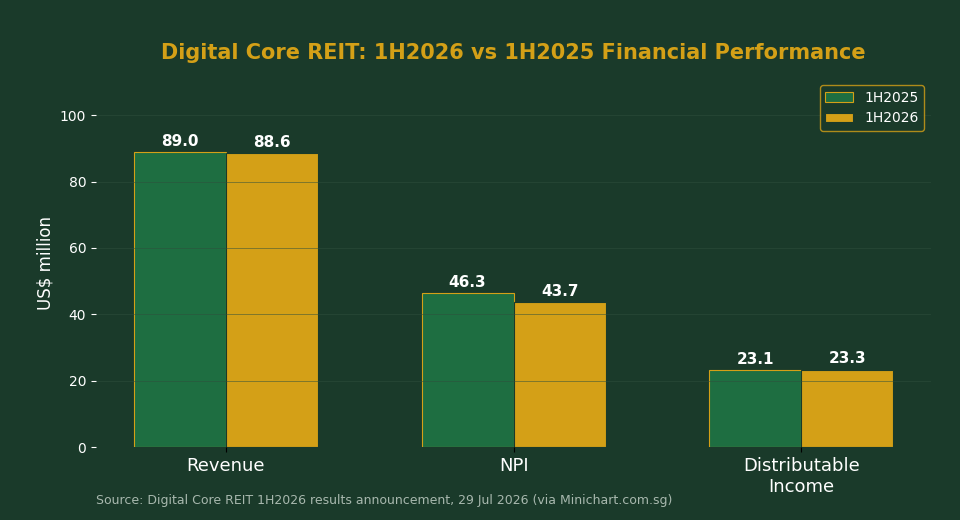
Digital Core REIT — 1H2026 vs 1H2025 revenue, NPI and distributable income, US$ million
The bull case: management is actively buying back units below NAV (an accretive move for remaining unitholders), the AI/hyperscale demand backdrop for US data centres remains strong, and the sponsor’s pipeline (targeting US$15 billion-plus AUM globally) suggests DCRU has a credible acquisition growth runway if it can fund deals sensibly.
The bear case: net profit is falling even as DPU holds flat, gearing is drifting upward, tenant concentration is real, and the discount to NAV may simply be the market correctly pricing in higher risk rather than a bargain waiting to be closed.
Our honest take: DCRU suits investors who specifically want direct, freehold exposure to US AI/data centre demand and are comfortable with USD income and single-tenant concentration risk. If you want a steadier, more diversified, SGD-denominated data centre REIT, Keppel DC REIT remains the more conservative pick. This isn’t a recommendation to buy or sell — do your own diligence, or work through the numbers with our S-REIT P/NAV Discount & Premium Calculator.
[/et_pb_text][/et_pb_column][/et_pb_row][/et_pb_section]Key Risks to Watch
- Tenant concentration: ~30.5% of rent from one tenant is a genuine single-point-of-failure risk if that relationship sours.
- Short WALE: At 4.3–4.4 years, more leases roll over sooner than at most S-REITs, cutting both ways on rent reversion.
- Currency risk: USD-denominated distributions mean your SGD income depends on the exchange rate, not just the REIT’s performance.
- Rising gearing: Leverage climbed from 37.1% to 39.2% in just two quarters — still safe, but a trend worth monitoring.
- Policy/regulatory risk: Reports flag uncertainty around Virginia data-centre tax exemptions and development restrictions in Los Angeles — both markets where DCRU has exposure.
- Falling net profit: A 19.8% YoY decline in net profit, even with flat DPU, suggests underlying earnings quality needs watching closely in coming quarters.
Frequently Asked Questions
What is Digital Core REIT?
Digital Core REIT (SGX: DCRU) is Singapore’s only pure-play US data centre REIT, sponsored by Digital Realty. It listed on 6 December 2021 and owns 11 freehold data centres across the US, Canada, Germany, and Japan.
Is Digital Core REIT a good buy in 2026?
It depends on your risk appetite. DCRU offers direct, freehold exposure to AI-driven US data centre demand at a meaningful discount to NAV, but carries tenant concentration risk, a short WALE, and USD-denominated distributions. It’s not a recommendation — assess your own risk tolerance first.
What is Digital Core REIT's dividend yield in 2026?
At 1H2026, DCRU’s distribution yield works out to roughly 7.2% on a US-dollar basis, up from about 6.85% a year earlier as the unit price declined.
Why did DPU stay flat while net profit fell?
Unit buybacks (about 8 million units repurchased in 1H2026 at an average US$0.488) and lower finance costs offset weaker net property income, keeping distributable income — and therefore DPU — roughly stable even as net profit fell 19.8% year-on-year.
Who is Digital Core REIT's largest tenant?
DCRU’s largest tenant is widely referenced in analyst commentary as a Fortune 50 enterprise software company, accounting for about 30.5% of annualised rental income, though the tenant is not explicitly named in official company filings.
Is Digital Core REIT's dividend paid in USD or SGD?
DCRU declares and pays distributions in US dollars, not Singapore dollars — unusual among S-REITs. Your actual SGD income will move with both the REIT’s DPU and the USD/SGD exchange rate.
What is Digital Core REIT's gearing ratio and is it safe?
Aggregate leverage was 39.2% as at 1H2026, up from 37.1% at end-2025, but still well within MAS’s 50% regulatory cap for S-REITs. Interest coverage of 3.3x is also comfortably above the regulatory 1.5x floor.
How does Digital Core REIT compare to Keppel DC REIT?
Keppel DC REIT is larger (25 properties vs 11), more geographically and tenant-diversified, has a longer WALE (~6.7 vs ~4.3–4.4 years), and pays in SGD. DCRU is 100% freehold (vs Keppel’s mixed freehold/leasehold) and offers more direct US AI-demand exposure.
What are the key risks facing Digital Core REIT in 2026?
Tenant concentration (~30.5% of rent from one tenant), a short WALE, USD currency exposure, rising gearing, and falling net profit despite a stable headline DPU are the main risks to monitor going into the second half of 2026.
Building a Diversified S-REIT & Passive Income Portfolio
If you’re weighing DCRU alongside other data centre and dividend plays, our S-REIT Recovery 2026 piece breaks down the sector-wide rally, and our Best S-REITs in Singapore 2026 guide ranks the top yield opportunities across the whole market. For a broader income strategy, see our guide to passive income in Singapore, and model your long-term numbers with our retirement planning calculator.
Ready to Start Investing?
Diversify beyond single-REIT bets with a low-cost broker or robo platform:
Sources: Digital Core REIT official portfolio overview, Digital Core REIT 1H2026 results summary, MAS. Data as at 29 July 2026. Not financial advice.
This article was researched with the help of AI. While we strive to keep all information accurate and up to date, there may be errors. If you notice any discrepancies, please contact us.