Mapletree Logistics Trust 1Q FY26/27 Results: DPU Dips 0.2% to 1.816 Cents as NPI Grows 3.3% (SGX: M44U)
A results breakdown for Singapore investors — headline numbers, the China drag, and what the 6% yield means for your portfolio.
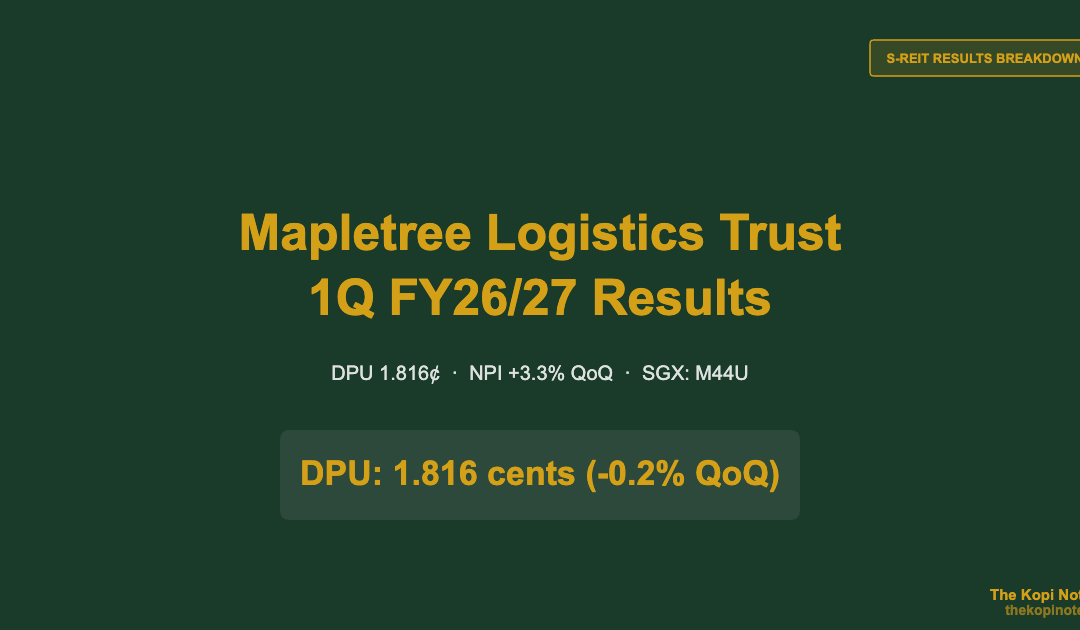
Mapletree Logistics Trust (SGX: M44U) reported 1Q FY26/27 net property income of SGD 156.4 million, up 3.3% quarter-on-quarter, even as its DPU edged down 0.2% to 1.816 cents. The quarter ended 30 June 2026 saw a full quarter’s contribution from MLT’s India acquisition and stronger Singapore and Hong Kong SAR properties, offset by a still-vacant China portfolio. At prices near SGD 1.20, MLT now yields roughly 6% annualised.
Not financial advice. All figures are for educational reference only. Data as at 28 July 2026 unless otherwise noted.
- DPU dipped 0.2% quarter-on-quarter to 1.816 cents, even though net property income rose 3.3% to SGD 156.4 million
- India, Singapore and Hong Kong SAR drove the growth — China’s 21.5% vacancy remains the segment dragging on results
- At around SGD 1.20, MLT trades near a 6% forward yield. Here’s whether that’s still worth it
Table of Contents
Contents — Click to expand
- What MLT Just Reported: 1Q FY26/27 Headline Numbers
- Why DPU Dipped Even as Income Grew
- What’s Driving the Numbers: India, Singapore and Hong Kong vs China
- Occupancy, Gearing and Balance Sheet Health
- MLT Share Price and Yield: Is SGD 1.20 Cheap or Fair?
- How MLT Compares to Other Recently-Reported S-REITs
- Should You Buy Mapletree Logistics Trust After This Result?
- Frequently Asked Questions
What MLT Just Reported: 1Q FY26/27 Headline Numbers
Mapletree Logistics Trust released its 1Q FY26/27 business update after trading hours on 28 July 2026. This covers the quarter ended 30 June 2026 — the first quarter of MLT’s new financial year. We previewed this exact reporting date and the swing factors to watch in our Mapletree Logistics Trust Q1 FY2026/27 preview, and the actual numbers landed close to expectations.
Unlike the half-year and full-year reports, a first and third quarter update is a lighter “business update.” You get distributable income, DPU, and management commentary. You don’t get the full notes-to-accounts breakdown you’d see every six months.
Here’s what MLT confirmed for the quarter:
| Metric | 1Q FY26/27 (Qtr ended 30 Jun 2026) | 4Q FY25/26 (Prior Qtr) | QoQ Change |
|---|---|---|---|
| Gross Revenue | SGD 178.9 million | SGD 176.6 million | +1.3% |
| Net Property Income | SGD 156.4 million | SGD 151.4 million | +3.3% |
| DPU | 1.816 cents | 1.819 cents | -0.2% |
| Annualised DPU (approx.) | ~7.264 cents | ~7.276 cents | — |
Source: Mapletree Logistics Trust 1Q FY26/27 business update, 28 July 2026 (via REITsWeek)
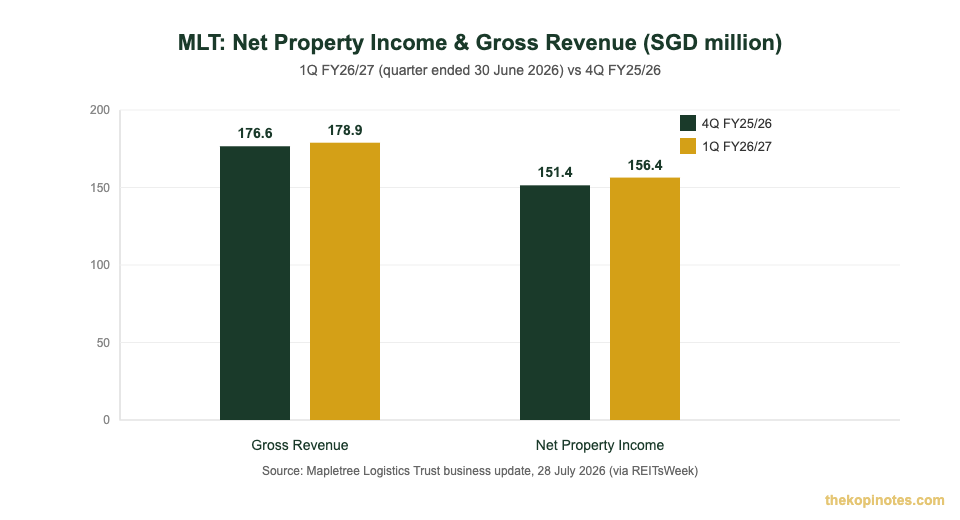
Gross revenue rose 1.3% quarter-on-quarter to SGD 178.9 million. Net property income (NPI) — revenue minus the direct costs of running the properties — climbed a faster 3.3% to SGD 156.4 million. That’s a healthy gap. Property-level margins improved even as top-line growth stayed modest.
But the number unitholders care about most — distribution per unit (DPU) — moved the other way. DPU came in at 1.816 cents, down slightly from 1.819 cents the previous quarter. That’s a small dip, not a collapse. Still, it snaps a run of four consecutive quarters of DPU growth heading into this result.
Why DPU Dipped Even as Income Grew
This might look confusing at first. Revenue is up. NPI is up. So why did the payout per unit go down?
A few things can cause this gap between operating performance and DPU. The most common are unit base dilution (more units on issue, from equity raising or as payment for acquisitions), higher finance costs from new debt taken on for acquisitions, or income retained for working capital.
MLT funded part of its recent India expansion through fresh capital. A full quarter of finance costs and unit issuance tied to that acquisition likely absorbed some of the NPI growth before it reached unitholders. The business update didn’t break out the exact bridge between NPI and distributable income in the same detail you’d get at half-year results. That level of granularity usually comes with the semi-annual report.
The practical takeaway: a 0.2% quarter-on-quarter dip is small. It’s the kind of number that swings with acquisition timing and forex translation, not a sign of operational trouble. What would be more concerning is if this becomes a multi-quarter trend.
What’s Driving the Numbers: India, Singapore and Hong Kong vs China
Two forces are pulling in opposite directions inside MLT’s portfolio right now.
On the positive side, this was the first full quarter where MLT booked a complete three months of income from its recent India acquisition. India logistics demand has been climbing steadily as manufacturers diversify supply chains away from China — the so-called “China plus one” trend. Singapore and Hong Kong SAR properties also put in a stronger showing this quarter, likely reflecting tight logistics supply in both markets.
On the negative side, China remains the segment to watch. Heading into this result, MLT’s China portfolio carried 21.5% vacancy — by far the weakest occupancy across its eight-market footprint spanning Singapore, Australia, China, Hong Kong SAR, India, Japan, Malaysia and South Korea. That’s a lot of empty warehouse space not generating rent.
Why is China so soft? Warehouse oversupply in key logistics hubs, slower domestic consumption, and periodic flare-ups in US-China trade tension have all weighed on tenant demand. If trade tensions escalate again, expect further pressure on China rents in the coming quarters. If they ease, this could be the segment with the most room to recover.
You should watch three drivers together: India’s contribution ramping up, Singapore and Hong Kong staying resilient, and whether China vacancy starts trending down. Two out of three moving in the right direction is a reasonable base case for now.
Occupancy, Gearing and Balance Sheet Health
MLT’s 1Q FY26/27 update used a lighter business-update format. It confirmed the headline financials above but didn’t restate fresh occupancy and gearing figures with the same level of detail as a half-year report.
Here’s the most recent confirmed baseline, as at 31 March 2026 (4Q FY25/26): portfolio occupancy stood at 96.9%, and aggregate leverage (gearing) was 40.6%. The portfolio spanned 175 properties across eight markets.
A 40.6% gearing ratio sits comfortably under MAS’s 50% regulatory leverage cap for S-REITs, giving MLT headroom for further acquisitions or to absorb a market downturn without breaching the limit. That said, it’s higher than some more conservative peers, so refinancing costs as older debt rolls over are worth monitoring, especially with global interest rates still elevated.
We’ll update this section once MLT’s next full report (2Q FY26/27, expected around late October 2026) confirms whether occupancy and gearing have moved from these levels.
MLT Share Price and Yield: Is SGD 1.20 Cheap or Fair?
MLT units traded around SGD 1.20 to SGD 1.21 as at 29 July 2026, the day after results. That’s a modest pullback on the day, consistent with a market digesting a DPU that came in slightly below the prior quarter.
Here’s the yield math. Annualise the 1Q FY26/27 DPU of 1.816 cents (multiply by four) and you get roughly 7.264 cents a year. At a SGD 1.20 unit price, that works out to a forward yield of about 6.05%. At SGD 1.30, the same distribution only yields about 5.59%.
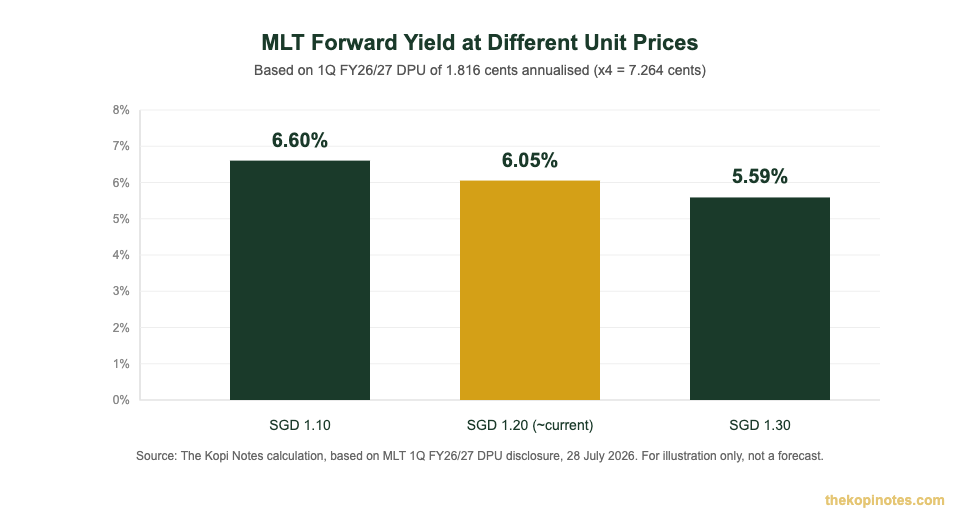
A near-6% yield is respectable for a logistics S-REIT with an investment-grade sponsor in Mapletree, a diversified eight-market footprint, and gearing well within MAS limits. It’s not the highest yield in the S-REIT space — some smaller-cap or higher-risk trusts pay more — but MLT’s yield comes with a track record of relatively stable distributions and a strong sponsor pipeline.
If you’re deciding whether SGD 1.20 is “cheap,” compare it against MLT’s own history and against where analysts see fair value. Our Mapletree Logistics Trust price target 2026 analysis breaks down analyst consensus targets and DPU forecasts in more detail.
How MLT Compares to Other Recently-Reported S-REITs
MLT isn’t the only S-REIT that has reported results this season. Here’s how its DPU trend compares with a few other trusts we’ve recently covered.
| REIT | Latest Period | DPU | Change |
|---|---|---|---|
| Mapletree Logistics Trust | 1Q FY26/27 | 1.816 cents | -0.2% QoQ |
| Mapletree Industrial Trust | 1Q FY26/27 | 3.11 cents | -4.9% YoY |
| Keppel DC REIT | 1H 2026 | 5.714 cents | +11.3% YoY |
| Suntec REIT | 1H 2026 | 3.936 cents | +24.8% YoY |
Source: Company business updates via REITsWeek and The Kopi Notes reporting, as at 28-29 July 2026.
Note that these REITs report on different cycles. Some release quarterly business updates; others report only semi-annually. So this table shows the direction of travel — DPU up or down versus the prior comparable period — not a like-for-like cents comparison. MLT’s small dip puts it in the more cautious camp this quarter, alongside Mapletree Industrial Trust’s steeper 1Q FY26/27 DPU decline, while Keppel DC REIT’s 1H2026 results and Suntec REIT posted stronger growth over their respective half-year periods.
Should You Buy Mapletree Logistics Trust After This Result?
Here’s how to think about it, in plain terms.
MLT could be worth adding if: you want exposure to a large, diversified logistics REIT with an investment-grade, Temasek-linked sponsor, you’re comfortable holding through China’s recovery timeline, and you want a roughly 6% yield backed by a multi-year track record of mostly-growing distributions.
You might wait if: you want to see China vacancy actually improve before adding more capital, you’re worried about further DPU dips if finance costs stay elevated, or you already have heavy logistics and industrial REIT exposure through other trusts.
For a deeper dive into MLT’s business model, portfolio and history, see our complete guide to Mapletree Logistics Trust. If you’re looking to start or add to a brokerage position to buy S-REITs like MLT, our Syfe referral code and sign-up bonus page has the current promotion details.
Whatever you decide, this was a steady, not spectacular, quarter. Income lines grew. DPU dipped by a hair. The real test comes at 2Q FY26/27 results, expected around late October 2026 — that’s when we’ll know whether China vacancy is actually turning a corner.
Frequently Asked Questions
What did Mapletree Logistics Trust report for 1Q FY26/27?
For the quarter ended 30 June 2026, Mapletree Logistics Trust (SGX: M44U) reported gross revenue of SGD 178.9 million (+1.3% QoQ), net property income of SGD 156.4 million (+3.3% QoQ), and DPU of 1.816 cents, down 0.2% from the prior quarter’s 1.819 cents.
Why did MLT's DPU fall even though income rose?
Rising net property income doesn’t always flow straight through to a higher DPU. Higher finance costs and unit issuance tied to MLT’s recent India acquisition likely absorbed part of the NPI growth this quarter. It’s a small 0.2% dip, not a sign of an operational problem.
Is Mapletree Logistics Trust's dividend safe?
MLT’s gearing of 40.6% (as at 31 March 2026) sits comfortably under MAS’s 50% regulatory cap for S-REITs, and it has an investment-grade, Temasek-linked sponsor in Mapletree. That gives it more balance sheet headroom than many smaller S-REITs, though China vacancy remains a watch item for future distributions.
What is MLT's current dividend yield?
Annualising the 1Q FY26/27 DPU of 1.816 cents gives roughly 7.264 cents a year. At a unit price of around SGD 1.20 (as at 29 July 2026), that works out to a forward yield of approximately 6.05%.
Why is China dragging on MLT's results?
MLT’s China portfolio carried 21.5% vacancy heading into this result, the weakest occupancy across its eight markets. Warehouse oversupply, softer domestic consumption, and periodic US-China trade tension have all weighed on tenant demand there.
When are Mapletree Logistics Trust's next results?
MLT’s 2Q FY26/27 results, covering the half-year period, are expected around late October 2026. That report will include the fuller notes-to-accounts detail, plus updated occupancy and gearing figures.
Track Every S-REIT Results Season
See how MLT stacks up against other blue-chip S-REITs, and plan your retirement income around a diversified portfolio.
This article was researched with the help of AI. While we strive to keep all information accurate and up to date, there may be errors. If you notice any discrepancies, please contact us.