S-REITs Near 5-Year Lows in 2026: Should You Buy the Dip?
A data-driven guide for Singapore investors on S-REIT valuations, P/NAV discounts, and whether now is the time to invest.
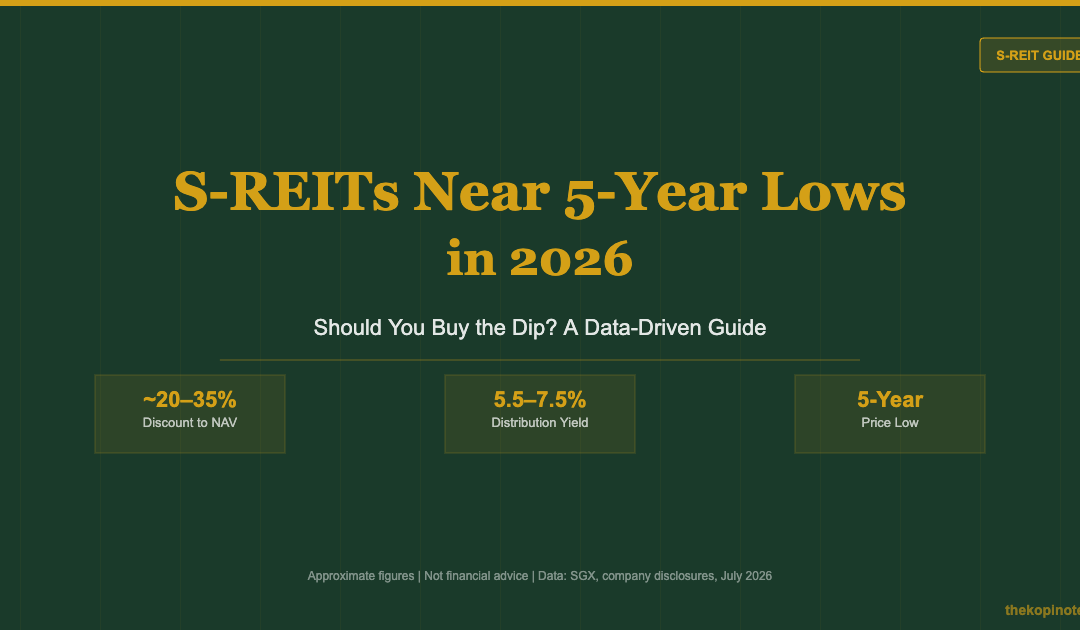
Singapore REITs (S-REITs) have been trading near five-year lows in 2026, with many blue-chip names sitting at 20-35% discounts to their net asset value (NAV). Elevated interest rates have kept borrowing costs high, compressing distributions and investor sentiment. Yet distribution yields now average 5.5-7.5% – levels not seen since 2020 – making this one of the most discussed entry points in recent S-REIT history.
Not financial advice. All figures are approximate and for educational reference only. Data as at July 2026 unless noted. Speak with a licensed financial adviser before making investment decisions.
- Most major S-REITs are trading 15-40% below their net asset value (NAV) in 2026
- Distribution yields have risen to 5.5-7.5%, well above the ~5% historical average
- A recovery depends on interest rate cuts and improving macro conditions – patience required
Why Are S-REITs Near 5-Year Lows?
S-REITs are real estate companies listed on the Singapore Exchange (SGX). They borrow money to buy properties, then pay out most of their income as distributions. That makes them very sensitive to interest rates.
Here is what drove prices down to multi-year lows:
1. Interest rates stayed high longer than expected. The US Federal Reserve and MAS kept rates elevated well into 2025-2026 to fight inflation. Most S-REITs carry 30-45% gearing (debt). Higher borrowing costs eat directly into the distributions you receive.
2. Competing yields became more attractive. Singapore T-bills offering 3-4% meant investors could earn a safe return without equity risk. That pulled money away from REITs. When risk-free yields rise, REIT premiums fall.
3. Some DPU compression occurred. Distribution Per Unit (DPU) – the cash each REIT pays per unit – has been under pressure. Reasons include weaker office demand, slower logistics growth post-pandemic, and property revaluations in China and Australia.
4. Risk-off investor sentiment. Global macro uncertainty – from US trade policy shifts to China’s slower property recovery – weighed on all property stocks. Even fundamentally sound S-REITs got swept down in the tide.
The result: the iEdge S-REIT Leaders Index is approximately 25-30% below its 2022 peak as at mid-2026. For long-term investors, this creates an entry point not seen since the COVID-19 market crash.
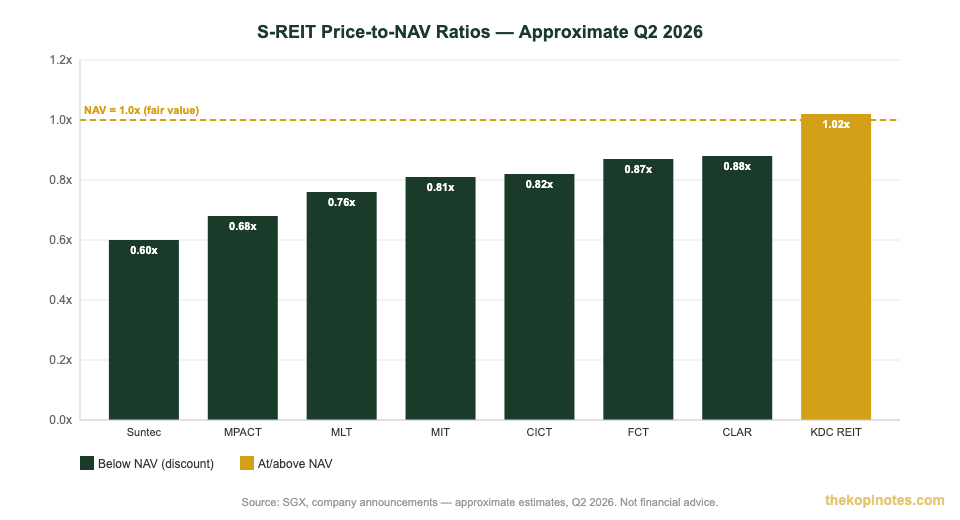
Source: SGX, company announcements – approximate P/NAV estimates, Q2 2026. Not financial advice.
P/NAV and Yield Metrics: 2026 Snapshot
Two numbers matter most when analysing S-REIT valuations:
- Price-to-NAV (P/NAV) – compares the REIT’s market price to the book value of its properties. Below 1.0x means you are buying at a discount to what the properties are worth on paper.
- Distribution Yield – the annual DPU divided by the current market price. Higher yield = better income, but may also signal higher risk or DPU concerns.
Here is a snapshot of eight major S-REITs as at approximately Q2 2026. All figures are estimates for educational reference only.
| REIT | Sector | Est. P/NAV | Est. Yield |
|---|---|---|---|
| CapitaLand Ascendas REIT (CLAR) | Industrial | ~0.88x | ~5.8% |
| CapitaLand Integrated Commercial Trust (CICT) | Office / Retail | ~0.82x | ~5.5% |
| Mapletree Industrial Trust (MIT) | Industrial / Data Centre | ~0.81x | ~6.0% |
| Mapletree Logistics Trust (MLT) | Logistics | ~0.76x | ~6.5% |
| Frasers Centrepoint Trust (FCT) | Suburban Retail | ~0.87x | ~5.7% |
| Mapletree Pan Asia Commercial Trust (MPACT) | Pan-Asia Commercial | ~0.68x | ~6.8% |
| Suntec REIT | Office / Retail / Convention | ~0.60x | ~7.0% |
| Keppel DC REIT (KDC) | Data Centre | ~1.02x | ~4.8% |
Source: SGX, company announcements – approximate estimates, Q2 2026. Always verify with latest SGX filings. Not financial advice.
Notice that data centre-focused REITs like Keppel DC REIT trade at or above NAV – investors see long-term AI-driven demand growth justifying the premium. Traditional commercial and logistics REITs sit far below book value.
Which S-REITs Are Trading at the Biggest Discounts?
The deepest discounts are in REITs with overseas exposure and office-heavy portfolios. Here is a breakdown of the five most discounted names and why they are there:
| REIT | Est. Discount to NAV | Key Reason | Risk Level |
|---|---|---|---|
| Suntec REIT | ~40% | Office weakness, higher gearing, Australia exposure | Higher |
| MPACT | ~32% | Pan-Asia FX headwinds (JPY, CNY, AUD), slower rents | Higher |
| Mapletree Logistics Trust (MLT) | ~24% | Logistics normalisation post-pandemic, China exposure | Medium |
| Mapletree Industrial Trust (MIT) | ~19% | Rate sensitivity; solid industrial + data centre mix | Medium |
| CapitaLand Integrated Commercial Trust (CICT) | ~18% | Strong SG retail, partial office headwind | Medium-Low |
Source: SGX, company announcements – approximate estimates, Q2 2026. Not financial advice.
A deeper discount does not always mean a better buy. It often reflects higher risk. Suntec REIT looks cheap at 40% below NAV, but its gearing and office exposure make a DPU cut more likely if conditions worsen. For a curated view of the better risk-adjusted picks, see TKN’s guide to the best S-REITs in Singapore for 2026.
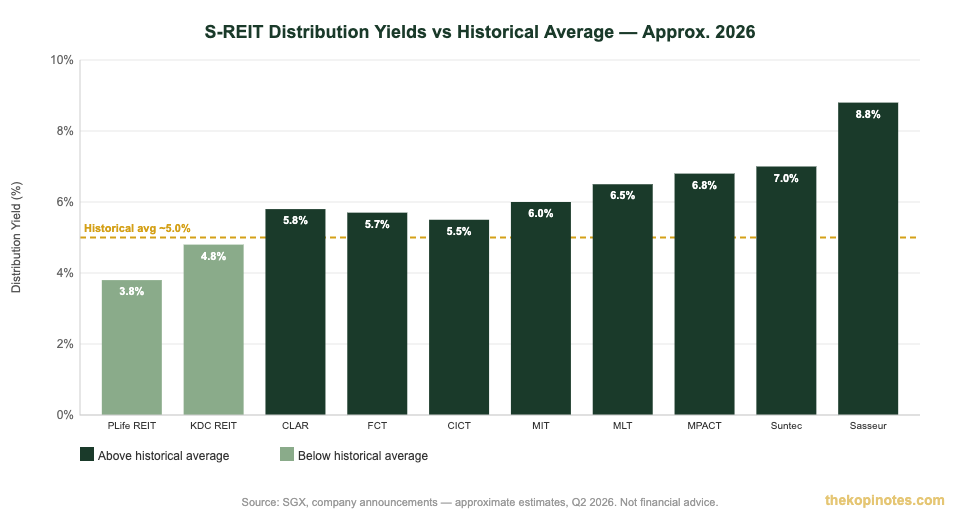
Source: SGX, company announcements – approximate yield estimates, Q2 2026. Not financial advice.
Is This a Buying Opportunity for Singapore Investors?
It depends on three factors: your income needs, your time horizon, and your view on interest rates.
For income investors: Yields at 5.5-7.5% are genuinely attractive compared to alternatives. Even at a conservative 6%, S$100,000 invested across a diversified basket of S-REITs generates approximately S$6,000 per year in distributions – far above bank deposit rates or CPF OA returns.
For capital appreciation: S-REIT prices typically recover when rates fall. As borrowing costs drop, distributions improve and P/NAV re-rates toward 1.0x. The 2020 COVID crash saw similar discounts – and most S-REITs recovered 40-60% over the following two years once rate expectations shifted.
However, timing rate cuts is difficult. If rates stay “higher for longer” into 2027, prices could remain depressed. Dollar-cost averaging – investing a fixed amount monthly rather than a lump sum – reduces the risk of a poorly timed entry.
To model how S-REIT income fits your retirement plan, use the Singapore retirement calculator on TKN. For a broader view of passive income strategies, see TKN’s guide to building passive income in Singapore.
How to Buy S-REITs in Singapore
You can buy individual S-REITs through a regular brokerage or invest in a REIT ETF for diversification. Here are three routes:
Option 1 – Individual REITs via brokerage. Buy specific S-REITs through regulated platforms such as FSMOne, IBKR, or moomoo. You control exactly which REITs you hold, but you need to research each one. The FSMOne referral code gives you a commission reduction on your first trades.
Option 2 – REIT ETFs. The Lion-Phillip S-REIT ETF and NikkoAM-StraitsTrading Asia ex Japan REIT ETF give instant diversification across 20-30 S-REITs in a single trade. Lower effort, lower concentration risk. TKN’s Singapore REIT ETF guide compares both in detail.
Option 3 – Robo-advisors. Platforms like Syfe build and rebalance REIT portfolios automatically. Use the Syfe referral code and sign-up bonus to start with a three-month fee waiver. The Endowus Income portfolio is another option for CPF-eligible REIT exposure – use the Endowus referral code (2V343) for your first transaction fee waived.
Whichever route you choose, dollar-cost averaging (DCA) is recommended during periods of macro uncertainty like 2026.
Key Risks to Consider Before Buying
Discounts to NAV do not guarantee a rebound. Be aware of these risks before committing capital:
- Rates staying higher for longer – If the US Fed and MAS keep rates elevated, REIT valuations may stay depressed through 2026-2027. No rate cut = no re-rating catalyst.
- DPU cuts – If a REIT’s tenants vacate, rents soften, or debt-refinancing costs spike, distributions get cut. This hits both your income and the unit price simultaneously.
- High gearing – REITs with gearing above 45% face refinancing pressure. Always check the gearing ratio in each REIT’s quarterly results before buying.
- Currency risk – MLT, MPACT, and other pan-Asian REITs earn income in JPY, CNY, AUD, and HKD. A stronger SGD erodes those distributions when converted back to Singapore dollars.
- Geopolitical risks – REITs with China, Japan, or Australia exposure can be affected by local policy changes, trade tensions, and currency moves that Singapore cannot control.
Always read the latest quarterly results and prospectus before investing. Past performance is not indicative of future returns.
Frequently Asked Questions
What does S-REIT near 5-year low mean for investors?
It means that S-REIT unit prices are at levels not seen since around 2020-2021. Many S-REITs are now 20-40% below their net asset value (NAV) and 25-30% below their 2022 peak. This is mainly due to elevated interest rates reducing REIT profitability and making alternative investments like T-bills more attractive to investors.
Should I buy S-REITs now in 2026?
It depends on your goals. For income investors, yields of 5.5-7.5% are attractive compared to T-bills (3-4%). For capital appreciation, recovery depends on interest rate cuts, which may happen in late 2026 or into 2027. Dollar-cost averaging (DCA) is a lower-risk approach than lump-sum investing during uncertainty. This is not financial advice – consult a licensed financial adviser before investing.
What is P/NAV and why does it matter for REIT investing?
P/NAV stands for Price-to-Net Asset Value. It compares the REIT’s current market price to the total value of its properties minus its debt, divided by the number of units outstanding. A P/NAV below 1.0x means you are buying the REIT at a discount to what its properties are worth on paper. Historically, S-REITs trading well below 1.0x have offered attractive long-term entry points – but a low P/NAV can also reflect genuine risks in the underlying portfolio, so always look at both metrics together.
Which S-REITs are the most undervalued right now?
As at approximately Q2 2026, Suntec REIT (~40% discount) and MPACT (~32% discount) have the deepest discounts to NAV. However, deeper discounts come with higher risk – weaker fundamentals, higher gearing, or greater macro sensitivity. Blue-chip REITs like CLAR and CICT at 12-20% discounts may offer better risk-adjusted entry points. All figures are approximate; always check the latest SGX filings and quarterly results for up-to-date data.
Are S-REIT distributions taxable in Singapore?
For individual Singapore resident investors, S-REIT distributions are generally exempt from tax at the investor level under the REIT tax transparency regime – the REIT has already been taxed at the fund level. However, distributions from REITs with overseas properties may have foreign withholding tax deducted at source before you receive them. If you hold S-REITs through a corporate entity, different tax rules may apply. Always confirm your specific tax situation with a licensed tax professional.
How much of my portfolio should I put in S-REITs?
A common guideline for Singapore investors is 10-30% of a portfolio in S-REITs, depending on your income needs and risk tolerance. Income-focused retirees might hold more; younger investors building a growth portfolio might hold less. S-REITs should complement – not replace – other asset classes like equities, bonds, and cash. Use TKN’s Singapore retirement planning calculator to model how different REIT allocations affect your income in retirement.
This article was researched with the help of AI. While we strive to keep all information accurate and up to date, there may be errors. If you notice any discrepancies, please contact us.