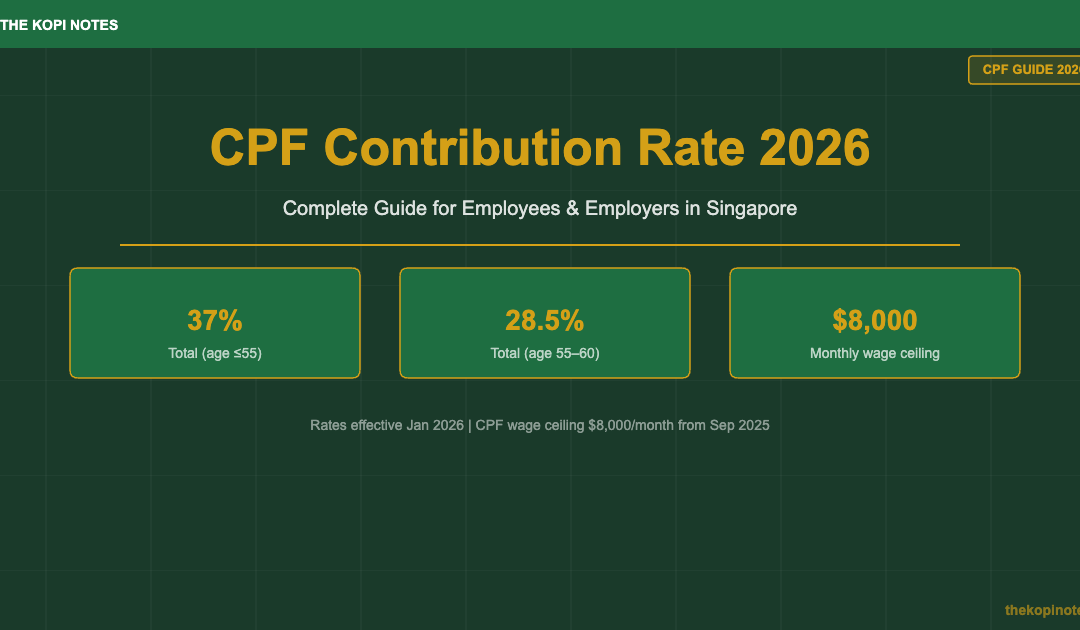
CPF Contribution Rate 2026: Complete Guide for Employees & Employers
Age-by-age rates, OA/SA/MA allocation, 2026 changes and worked examples
The CPF contribution rate in 2026 ranges from 37% (total) for employees aged 55 and below to 10% for those above 70. Employees aged 55 and below contribute 20% of their monthly wages while employers contribute 17%, totalling 37%. Rates are lower for older workers aged 55–70, following phased increases implemented to strengthen retirement adequacy. From 1 Sep 2025, the ordinary wage ceiling increased to $8,000/month — the highest ever.
Not financial advice. All figures are for educational reference only. Data as at July 2026 unless noted.
- If you are 55 or below: you contribute 20%, your employer contributes 17% = 37% total on ordinary wages up to $8,000/month
- If you are 55–60: total rate is 28.5% (employee 15% + employer 13.5%) — increased from 28% in 2025
- CPF Annual Limit remains $37,740; Basic Healthcare Sum (BHS) for 2026 is $79,000
Table of Contents
CPF Contribution Rates 2026: Full Table by Age Group
These rates apply to Singapore citizens and Permanent Residents (PR) from 3rd year onwards. Rates are based on ordinary wages up to the ordinary wage ceiling of $8,000/month (effective 1 Sep 2025).
| Age of Employee | Employee Rate | Employer Rate | Total Rate |
|---|---|---|---|
| 55 and below | 20% | 17% | 37% |
| Above 55 to 60 | 15% | 13.5% | 28.5% ↑ |
| Above 60 to 65 | 11.5% | 10.5% | 22% |
| Above 65 to 70 | 7.5% | 7.5% | 15% |
| Above 70 | 5% | 5% | 10% |
Source: CPF Board — Contribution Rates from 1 January 2026. ↑ indicates increase from 2025 rate. Applies to Singapore citizens and PRs from 3rd year. Monthly ordinary wage ceiling: $8,000.
The ↑ arrow next to the 55–60 rate highlights the increase from 28% (in 2025) to 28.5% in 2026. This is part of a multi-year phased increase to strengthen retirement savings for older Singaporean workers — a policy commitment by the Singapore government from the 2022 Budget.
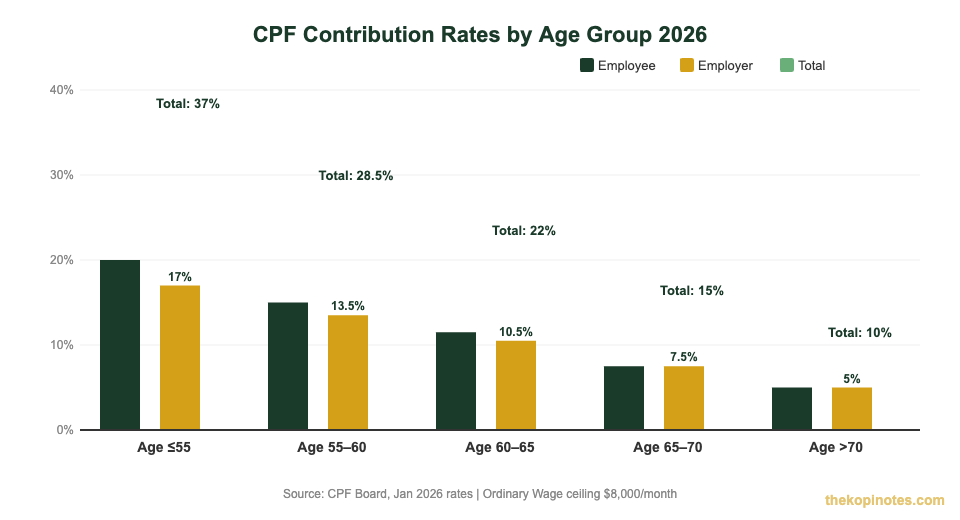
Source: CPF Board, January 2026 rates. Employee (dark green) + Employer (gold) = Total rate per age group.
CPF Allocation: How Much Goes to OA, SA and MediSave?
Your CPF contributions are not pooled into one account. They are split across three separate accounts — each with a different purpose and interest rate:
| Account | Purpose | Interest Rate |
|---|---|---|
| Ordinary Account (OA) | Housing, approved investments, education, insurance | 2.5% p.a. |
| Special Account (SA) | Retirement savings (locked until age 55) | 4.0% p.a. |
| MediSave Account (MA) | Healthcare, hospitalisation, approved insurance premiums | 4.0% p.a. |
Source: CPF Board, 2026. Extra 1% interest on first $60,000 of combined CPF balances (capped at $20,000 from OA). Extra 2% on first $30,000 for members aged 55+.
The allocation ratio shifts as you age. For employees aged 55 and below, roughly 62% of contributions go to OA, 16% to SA, and 22% to MA. As you get older, a larger proportion goes to MediSave — reflecting higher expected healthcare needs — and less goes to SA (which closes at 55).
| Age Group | OA (%) | SA (%) | MA (%) | Total (%) |
|---|---|---|---|---|
| 35 and below | 23 | 6 | 8 | 37 |
| 35 to 45 | 21 | 7 | 9 | 37 |
| 45 to 50 | 19 | 8 | 10 | 37 |
| 50 to 55 | 15 | 11.5 | 10.5 | 37 |
| 55 to 60 | 11.5 | 3.5 | 13.5 | 28.5 |
| 60 to 65 | 3.5 | 2.5 | 16 | 22 |
| 65 to 70 | 1 | 1 | 13 | 15 |
| Above 70 | 1 | 1 | 8 | 10 |
Source: CPF Board allocation table, 2026. Figures are percentages of ordinary wages. SA contributions shift to Retirement Account (RA) after age 55.
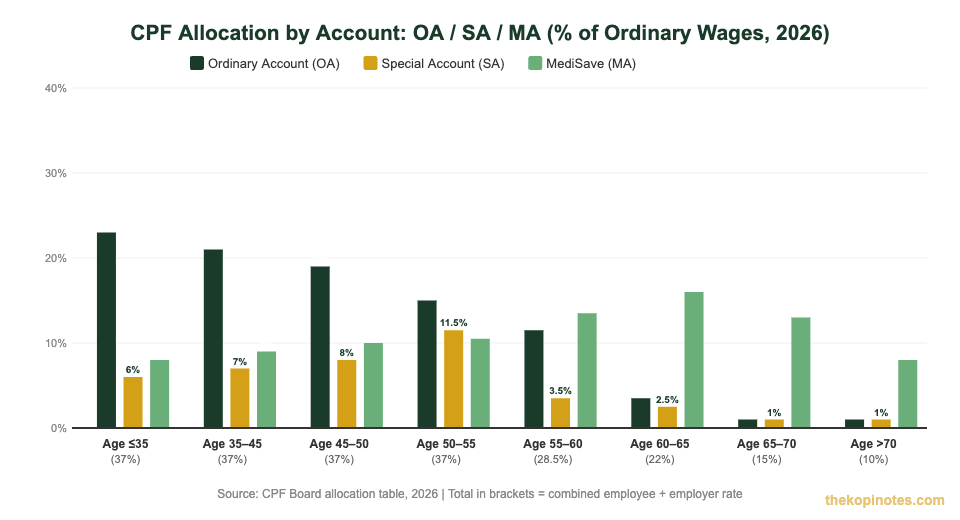
Source: CPF Board 2026. OA (dark green) earns 2.5% p.a.; SA (gold) earns 4% p.a.; MA (light green) earns 4% p.a.
The most important takeaway: MediSave grows significantly above age 60. For workers aged 65–70, the vast majority of CPF contributions (13 out of 15%) go straight to MediSave — ensuring healthcare costs are covered in later life. OA contributions drop sharply because housing loans are typically paid off by retirement age.
Key CPF Changes in 2026
Two major CPF changes took effect in late 2025 and 2026 that directly affect your take-home pay and retirement savings.
1. Ordinary Wage Ceiling Raised to $8,000 (from 1 Sep 2025)
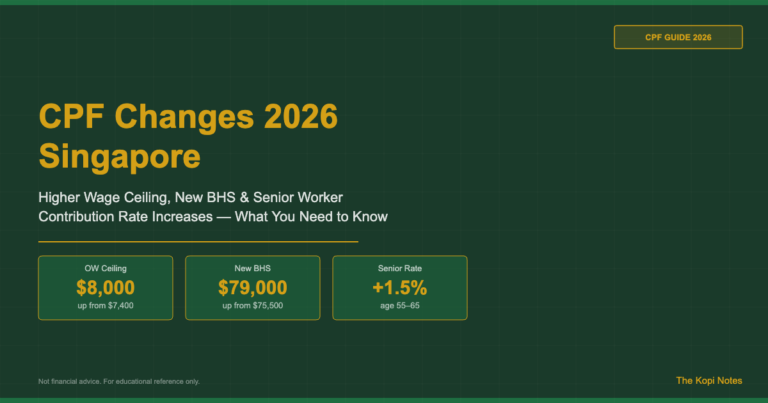
The ordinary wage (OW) ceiling — the maximum monthly wages on which CPF contributions are calculated — increased from $6,800 to $8,000 on 1 September 2025. This is the highest the OW ceiling has ever been.
What this means for you: if you earn more than $8,000/month in ordinary wages, CPF contributions are calculated only on the first $8,000. If you earn between $6,800 and $8,000, your take-home pay decreases slightly (more of your wages are now subject to CPF) but your CPF balance builds faster. Employers similarly contribute more for employees in this salary band.
| Monthly Salary | Old Ceiling ($6,800) | New Ceiling ($8,000) | Change to Employee Take-Home |
|---|---|---|---|
| $6,000 | $6,000 (no cap) | $6,000 (no cap) | No change |
| $7,000 | $6,800 (capped) | $7,000 (no cap) | −$40/month (more to CPF) |
| $8,000 | $6,800 (capped) | $8,000 (no cap) | −$240/month (more to CPF) |
| $10,000+ | $6,800 (capped) | $8,000 (capped) | −$240/month (more to CPF) |
Illustration based on employee CPF rate of 20% (age ≤55). Source: CPF Board; MOM 2024 Budget announcement.
2. Senior Worker CPF Rate Increase (55–60 Age Band)
From 1 January 2026, the CPF contribution rate for the 55–60 age band increased by 0.5 percentage points — from 28% total to 28.5% total. The increase is borne entirely by the employer (+0.5%, from 13% to 13.5%). Employee rates remain at 15%.
This is part of the government’s gradual roadmap to align senior worker CPF rates with younger workers. The goal: a total rate of 37% for all age groups below 60 by 2030.
3. Basic Healthcare Sum (BHS) 2026
The Basic Healthcare Sum (BHS) — the maximum you need in your MediSave Account — increased to $79,000 in 2026 (up from $75,500 in 2025). Once your MediSave balance hits this amount, excess contributions are redirected to your SA (if under 55) or RA (if 55 and above).
This matters for voluntary CPF top-ups: if your MA is already at $79,000, voluntary contributions no longer go into MA first.
Worked Examples: How Much Goes to CPF in 2026?
Here are three practical examples based on different salary levels and ages. All calculations use ordinary wages only (bonuses use additional wage ceiling rules).
Example 1: Age 32, Monthly Salary $5,000
You are 32, earning $5,000/month. The ordinary wage ceiling is $8,000, so the full $5,000 is subject to CPF.
- Your contribution (20%): $1,000/month
- Employer contribution (17%): $850/month
- Total CPF each month: $1,850
- Take-home pay: $4,000 (before income tax)
The $1,850 total is split: approximately OA $1,151 (23% × $5,000), SA $300 (6% × $5,000), MA $400 (8% × $5,000).
Example 2: Age 45, Monthly Salary $8,000
You are 45, earning exactly $8,000/month — right at the ordinary wage ceiling.
- Your contribution (20%): $1,600/month
- Employer contribution (17%): $1,360/month
- Total CPF each month: $2,960
- Take-home pay: $6,400 (before income tax)
Split: OA $1,680 (21% × $8,000), SA $560 (7% × $8,000), MA $720 (9% × $8,000).
Example 3: Age 57, Monthly Salary $6,500
You are 57, earning $6,500/month. Age bracket: 55–60, total rate 28.5%.
- Your contribution (15%): $975/month
- Employer contribution (13.5%): $877.50/month
- Total CPF each month: $1,852.50
- Take-home pay: $5,525 (before income tax)
Split (55–60 allocation): OA $747.50 (11.5% × $6,500), SA $227.50 (3.5% × $6,500), MA $877.50 (13.5% × $6,500).
The CPF Annual Limit caps the total ordinary and additional wages subject to CPF at $37,740/year. If your total CPF contributions (employee + employer) exceed this — which they will if you earn more than $8,000/month — the excess is not contributed. Use our Compound Interest Calculator to see how your CPF balance grows over time at 2.5%–4%.
CPF for Part-Time Workers and the Self-Employed
Part-Time Employees
Part-time employees have the same CPF contribution rates as full-time employees. If you work 20 hours a week at $15/hour, your monthly wages are approximately $1,300. CPF applies as long as you earn more than $500/month — the lower wage threshold for mandatory CPF contributions.
Below $500/month: no CPF contributions are required. Between $500 and $750/month: graduated CPF rates apply (lower than the full rates). Above $750/month: full contribution rates apply.
Self-Employed (Mandatory MediSave Only)
If you are self-employed, CPF contributions to OA and SA are voluntary. However, MediSave contributions are mandatory if your net trade income exceeds $6,000/year.
The mandatory MediSave contribution rate for self-employed persons is 8–10.5% of net trade income, depending on age and income level — subject to the MediSave contribution ceiling. This ensures self-employed Singaporeans have healthcare coverage even without employer CPF contributions.
Making voluntary CPF contributions is a smart strategy for the self-employed: you get the same guaranteed interest rates (2.5% OA, 4% SA) and the contributions reduce your taxable income under the CPF Cash Top-Up Relief. Learn more about CPF investment strategy for self-employed persons.
CPF Contribution Rates for Permanent Residents (PR)
New PRs enjoy a graduated lower CPF contribution rate for the first two years, to ease their transition. From the 3rd year of PR status, full CPF rates apply (same as Singapore citizens).
| PR Year | Employee Rate (≤55) | Employer Rate (≤55) | Total |
|---|---|---|---|
| 1st Year PR | 5% | 4% | 9% |
| 2nd Year PR | 15% | 9% | 24% |
| 3rd Year onwards | 20% | 17% | 37% (full rate) |
Source: CPF Board, 2026. Rates shown for age ≤55 only. PR 1st year = 1 Jan of the calendar year of obtaining PR or date of obtaining PR, whichever is later.
Both employer and employee can jointly agree to contribute at full Singapore citizen rates even in Year 1 or Year 2, if they wish. This is a useful option for new PRs who want to build their CPF balances faster from day one.
How to Maximise Your CPF Returns in 2026
Your mandatory CPF contributions are fixed by law. But there are several legal strategies to grow your CPF balance faster — beyond just receiving your monthly payroll contributions.
1. Voluntary Top-Up to SA (Retirement Sum Top-Up Scheme)
You can top up your own SA (and your family members’ SA or RA) with cash under the Retirement Sum Top-Up Scheme (RSTU). The SA earns 4% guaranteed — beating most bank fixed deposits and short-term endowment plans in 2026. You also get dollar-for-dollar income tax relief, up to $8,000/year for self top-ups and $8,000/year for top-ups to family members.
Caveat: SA cash top-ups are irreversible. Only top up if you have a fully-funded emergency fund and stable cash flow. The money stays in CPF until age 55.
2. Invest CPF OA via CPFIS
The CPF Investment Scheme (CPFIS) lets you invest your OA savings (above $20,000) and SA savings (above $40,000) in approved products — unit trusts, ETFs, endowment plans, shares listed on SGX, and more. However, this only makes sense if you expect your investment to beat the OA’s guaranteed 2.5% p.a. Many financial advisors in Singapore recommend keeping OA money in CPF for the risk-free 2.5% rather than taking investment risk for marginal upside. Use platforms like Endowus (code 2V343) which can access CPFIS-approved funds with institutional-level cost savings.
3. Transfer OA to SA (Under Age 55)
You can transfer funds from your OA (2.5% interest) to your SA (4% interest) — a one-way, irreversible transfer. This is worth considering if you do not need your OA for housing purchases or renovations. The 1.5% interest rate difference compounds significantly over 10–20 years. For example, $50,000 transferred to SA grows to $110,319 over 20 years at 4%, versus $81,931 at 2.5% — a difference of $28,388.
4. Maximise SRS for Tax-Deferred Investing
The Supplementary Retirement Scheme (SRS) is separate from CPF but complements it perfectly. Contributing up to $15,300/year to SRS reduces your taxable income dollar-for-dollar. Invest your SRS funds via Syfe (code SRPRFFFCD) or FSMOne into low-cost ETFs for long-term market-linked returns. Use our Singapore Retirement Calculator to model how CPF + SRS together get you to your retirement goal.
Grow Your CPF and Retirement Savings
Complement your CPF with these Singapore-approved platforms:
Frequently Asked Questions
What is the CPF contribution rate for 2026?
Has the CPF contribution rate changed in 2026?
What is the CPF ordinary wage ceiling in 2026?
How much CPF does my employer have to pay?
What is the CPF Annual Limit in 2026?
Do I need to pay CPF on bonuses and AWS?
Can I voluntarily top up my CPF beyond mandatory contributions?
What is the CPF contribution rate for PR (Permanent Residents)?
How do I calculate my CPF contribution?
This article was researched with the help of AI. While we strive to keep all information accurate and up to date, there may be errors. If you notice any discrepancies, please contact us.