Condo Downpayment Singapore 2026: How Much Cash and CPF a S$1.5M to S$2M Condo Really Needs
Buyers are putting in more of their own money, even as loans hit S$1 million. Here is the full upfront bill, line by line, with October 2026 rates.
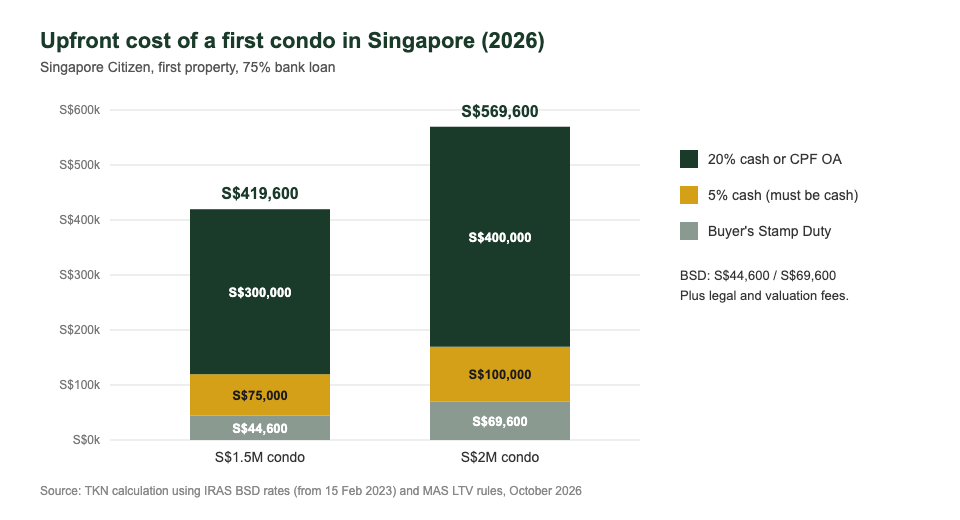
For a first condo in Singapore, the minimum downpayment is 25% of the price: at least 5% in cash and the other 20% in cash or CPF Ordinary Account savings. Add Buyer’s Stamp Duty and a S$1.5 million condo needs about S$420,000 upfront, while a S$2 million unit needs about S$570,000. If your income cannot pass the TDSR test at 4%, you will need even more.
Not financial advice. All figures are for educational reference only. Data as at October 2026 unless noted. Assumes Singapore Citizen buyers with no existing housing loan.
Table of Contents
Contents (click to expand)
- Why condo buyers are putting in more cash and CPF
- What the OCBC data shows (2021 to 2026)
- Condo downpayment rules in Singapore
- The full upfront bill: S$1.5M vs S$2M condo
- How much income you need: the TDSR test at 4%
- The age 65 rule most buyers miss
- Using CPF for a condo: limits and trade-offs
- What to check before you commit
- Frequently asked questions
Why condo buyers are putting in more cash and CPF
Home loans in Singapore have never been bigger. Yet buyers are also paying more of the price out of their own pockets. That is the main finding from OCBC’s mortgage data, reported by The Straits Times on 18 October 2026.
The reason is simple. Condo prices have risen faster than the loans buyers can get. Banks only lend what your income can support under the Total Debt Servicing Ratio (TDSR) test. When prices run ahead of incomes, the gap has to come from cash and CPF.
OCBC financed more than a third of private home deals in 2025, so its numbers give a good picture of the market. The median borrower was about 38 years old.
Other banks see the same pattern. UOB said its average private home loan grew about 8% a year from 2023 to the first half of 2026, to over S$1 million. DBS said loan-to-value ratios on private homes were lower than a year earlier, and that late payments remain extremely low.
What the OCBC data shows (2021 to 2026)
Between 2021 and the first half of 2026, new launch prices rose 49%. The median new-launch mortgage rose only 35%. Buyers covered the difference themselves.
| Segment (2021 to H1 2026) | Price growth | Median mortgage growth | Gap filled by buyers |
|---|---|---|---|
| New launch condos | +49% | +35% | 14 points |
| Private resale | +36% | +32% | 4 points |
| HDB resale | +32% | +32% | None |
Source: OCBC mortgage data, reported by The Straits Times (18 October 2026)
Big loans are now the norm for new launches. About 8 in 10 new-launch borrowers took loans of S$1 million or more in H1 2026, double the share in 2021.
At the same time, fewer buyers are borrowing the maximum. Only 52% of new-launch borrowers took the full 75% loan, down from 67%. Some chose to borrow less. Many simply could not borrow more, because their income did not pass the TDSR test.
| Indicator | 2021 | H1 2026 |
|---|---|---|
| New-launch borrowers with loans of S$1M or more | About 4 in 10 | About 8 in 10 |
| New-launch borrowers at the maximum 75% LTV | 67% | 52% |
| Resale borrowers at the maximum 75% LTV | 66% | 61% |
Source: OCBC mortgage data, reported by The Straits Times (18 October 2026)
Higher rates played a part too. A 3-year fixed rate was about 1.15% in late 2021. By November 2022 it had jumped to 4.25% to 4.5%. Rates have since fallen back, but the TDSR test still assumes at least 4%, so cheaper loans have not made bigger loans possible.
Condo downpayment rules in Singapore
For a first housing loan from a bank, MAS caps the loan-to-value ratio (LTV) at 75%. You pay the other 25% yourself. At least 5% of the price must be in cash. The other 20% can be cash, CPF Ordinary Account (OA) savings, or both.
The 75% cap only applies if the loan tenure is 30 years or less and your age plus the tenure does not go past 65. Break either condition and the cap drops to 55%, with at least 10% in cash.
| Loan tenure and age | Max bank loan (LTV) | Minimum cash | Cash or CPF |
|---|---|---|---|
| Tenure 30 years or less, and age + tenure 65 or less | 75% | 5% | 20% |
| Tenure over 30 years, or age + tenure over 65 | 55% | 10% | 35% |
Source: MAS loan-to-value rules for a first housing loan from a bank, as at October 2026
Unlike HDB flats, private property has no Mortgage Servicing Ratio (MSR) limit. The binding limit is TDSR: all your monthly debt repayments, including car loans and the new mortgage, cannot go above 55% of your gross monthly income.
The key detail is the rate banks must use for that test. Since 30 September 2022, it is the higher of 4% a year or the actual rate after any lock-in period (MAS and MND joint release). That 4% floor is still in force in 2026, even though actual package rates are well below 2%.
The full upfront bill: S$1.5M vs S$2M condo
Here is what a Singapore Citizen couple buying their first condo would pay before collecting the keys. It assumes they borrow the full 75%.
| Item (Singapore Citizen, first property) | S$1.5M condo | S$2M condo | Paid with |
|---|---|---|---|
| Buyer’s Stamp Duty | S$44,600 | S$69,600 | Cash or CPF OA |
| Minimum cash downpayment (5%) | S$75,000 | S$100,000 | Cash only |
| Rest of downpayment (20%) | S$300,000 | S$400,000 | Cash or CPF OA |
| Total upfront (before legal fees) | S$419,600 | S$569,600 | |
| Bank loan (75%) | S$1,125,000 | S$1,500,000 | Monthly instalments |
| ABSD on a second property (citizen) | +S$300,000 (20%) | +S$400,000 (20%) | Cash or CPF OA |
Source: TKN calculation using IRAS BSD rates from 15 Feb 2023 and ABSD rates from 27 Apr 2023; MAS LTV rules. October 2026
Stamp duty is the part people forget. Buyer’s Stamp Duty is charged in tiers, from 1% on the first S$180,000 up to 5% on the portion between S$1.5 million and S$3 million. On a S$2 million condo, that adds up to S$69,600, payable within 14 days of signing.
Legal fees and valuation fees add a few thousand dollars more. For a new launch, you also pay progressive payments during construction, so the loan is drawn down in stages.
If you still own an HDB flat or another property when you buy, Additional Buyer’s Stamp Duty (ABSD) of 20% applies for a citizen’s second property. That is S$400,000 extra on a S$2 million condo. Couples upgrading from HDB usually sell first, or use the ABSD remission for married couples who sell their first home within six months.
How much income you need: the TDSR test at 4%
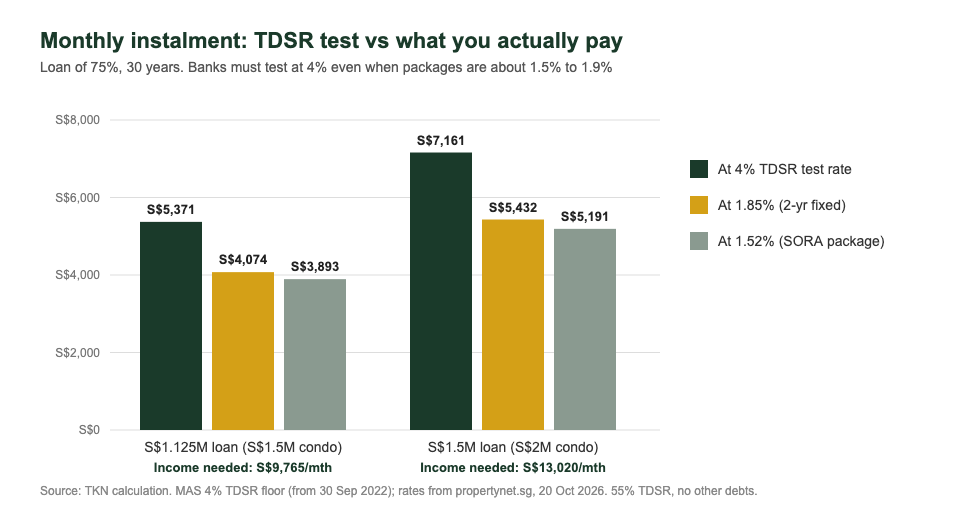
Most buyers find that income, not savings, is the real limit. The bank works out your instalment at 4%, then checks it is no more than 55% of your gross monthly income.
| Loan and rate | S$1.5M condo (S$1.125M loan) | S$2M condo (S$1.5M loan) |
|---|---|---|
| Instalment at the 4% TDSR test rate, 30 years | S$5,371 a month | S$7,161 a month |
| Household income needed to pass 55% TDSR | S$9,765 a month | S$13,020 a month |
| Instalment at 4%, 27 years (age 38 buyer) | S$5,684 a month | S$7,578 a month |
| Household income needed (27 years) | S$10,334 a month | S$13,778 a month |
| Actual instalment at about 1.52% (SORA package), 30 years | S$3,893 a month | S$5,191 a month |
| Actual instalment at 1.85% (2-year fixed), 30 years | S$4,074 a month | S$5,432 a month |
Source: TKN calculation. TDSR floor of 4% from MAS (30 Sep 2022). Package rates from propertynet.sg, 20 October 2026. Assumes no other debts
Look at the gap between the test and real life. On a S$1.5 million loan, the bank tests you at S$7,161 a month. At a 1.52% SORA package, you would actually pay about S$5,191.
That buffer is deliberate. It protects you if rates jump again, as they did in 2022. But it also means a couple earning S$11,000 a month cannot borrow 75% on a S$2 million condo, even though the real instalment would be well within their means.
When the loan is capped by income, the upfront bill grows. The table below shows how much cash and CPF a household needs at different income levels.
| Household income (monthly) | Max loan at 4%, 27 yrs | S$1.5M condo: LTV / cash + CPF needed | S$2M condo: LTV / cash + CPF needed |
|---|---|---|---|
| S$8,000 | S$871,000 | 58% / S$629,000 | 44% / S$1,129,000 |
| S$10,000 | S$1,089,000 | 73% / S$411,000 | 54% / S$911,000 |
| S$12,000 | S$1,306,000 | 75% / S$375,000 | 65% / S$694,000 |
| S$14,000 | S$1,524,000 | 75% / S$375,000 | 75% / S$500,000 |
| S$16,000 | S$1,742,000 | 75% / S$375,000 | 75% / S$500,000 |
Source: TKN calculation, 55% TDSR at 4% over 27 years, no other debts. Excludes stamp duty. October 2026
A household earning S$10,000 a month can borrow about S$1.09 million. For a S$2 million condo, that means finding S$911,000 in cash and CPF, plus S$69,600 in stamp duty. This is exactly the squeeze OCBC’s data shows.
The age 65 rule most buyers miss
OCBC’s median borrower is 38. For the full 75% loan, age plus tenure must stay at 65 or below. So a 38-year-old can only take a 27-year loan at 75%, not 30 years.
For joint buyers, banks use the income-weighted average age. A shorter tenure means a higher instalment, which makes the TDSR test harder to pass. At 4%, the 27-year instalment on a S$1.5 million loan is about S$7,578, or S$417 more than the 30-year figure.
Stretching to 35 years drops the LTV to 55%. On a S$2 million condo, that cuts the loan to S$1.1 million and pushes the upfront amount to S$900,000 plus stamp duty. For most buyers in their late 30s or 40s, the shorter tenure is the better choice.
Using CPF for a condo: limits and trade-offs
You can use CPF OA savings for the 20% non-cash part of the downpayment, for stamp duty and for monthly instalments. But there are limits.
The Valuation Limit (VL) is the lower of the price or the bank’s valuation. Once your CPF use reaches the VL, you can keep going up to the Withdrawal Limit (120% of the VL) only if you set aside the current Basic Retirement Sum (S$110,200 for members turning 55 in 2026). Any amount above the valuation must be paid in cash (EdgeProp guide to CPF for private property).
For full CPF use, the remaining lease must also cover the youngest buyer to age 95. Most new 99-year leasehold condos clear this easily. Older leasehold resale units may not.
The bigger trade-off is your retirement. Every dollar of CPF used, plus the 2.5% interest it would have earned, must go back into your CPF account when you sell. Using more CPF now means a smaller cash payout later.
Before draining your OA, check what you will need at 55 with our guide to how much you need to retire in Singapore and the Singapore retirement calculator. If you plan to invest your OA instead, read our CPF investment strategy first.
What to check before you commit
First, get an In-Principle Approval (IPA) from a bank before you pay the option fee. It tells you the real loan amount after the TDSR test, so you know how much cash and CPF you need.
Second, keep a cash buffer. Joy Tan of real estate firm Edmund Tie noted that auction listings rose to 292 in H1 2026, the most since H1 2021, with 216 of them mortgagee sales. A few months of instalments in cash can stop a job loss from becoming a forced sale.
Third, protect the loan. A S$1 million mortgage is a large debt for a family to carry if something happens to one income. Compare MRTA vs term life insurance, and consider critical illness cover for mortgage holders.
Fourth, do not over-stretch on price. Private home prices rose just 1.4% in H1 2026, after 10.6% in 2021. Slower growth means you cannot count on capital gains to bail out a tight budget.
Not financial advice. Rules and rates change. Check the latest figures with your bank, IRAS and the CPF Board before you buy.
Frequently Asked Questions
How much downpayment do I need for a condo in Singapore?
For a first housing loan from a bank, you need at least 25% of the price: 5% in cash and 20% in cash or CPF OA. If your loan tenure is over 30 years or your age plus tenure is over 65, the downpayment rises to 45%, with 10% in cash.
Can I use CPF for a condo downpayment?
Yes. You can use CPF OA savings for the 20% non-cash portion, stamp duty and monthly instalments. The first 5% must be cash, and any amount paid above the valuation must also be cash.
How much cash do I need for a S$2 million condo?
At minimum, S$100,000 in cash (5%), plus S$400,000 in cash or CPF and S$69,600 in Buyer’s Stamp Duty, for about S$570,000 upfront. If your income cannot support a S$1.5 million loan, you need more.
What income do I need to buy a S$1.5 million condo?
To borrow the full 75% (S$1.125 million) over 30 years, a household needs about S$9,765 a month in gross income with no other debts, because banks test the loan at a 4% interest rate under TDSR.
Why is the TDSR test rate 4% when mortgage rates are below 2%?
MAS requires banks to use the higher of 4% a year or the actual rate after the lock-in period when working out TDSR. This floor, in place since 30 September 2022, builds in a buffer in case rates rise.
Does the 75% loan limit apply to everyone?
No. It only applies to a first housing loan with a tenure of 30 years or less, where age plus tenure does not go past 65. Otherwise the limit drops to 55%, and lower still if you have other housing loans.
This article was researched with the help of AI. While we strive to keep all information accurate and up to date, there may be errors. If you notice any discrepancies, please contact us.