MediSave Limit 2026: Your Maternity Hospital Bill — What MediShield Life Pays and How Your ISP Covers the Rest
Exact MediSave withdrawal limits, step-by-step bill breakdown, and why your Integrated Shield Plan matters most when you’re having a baby.
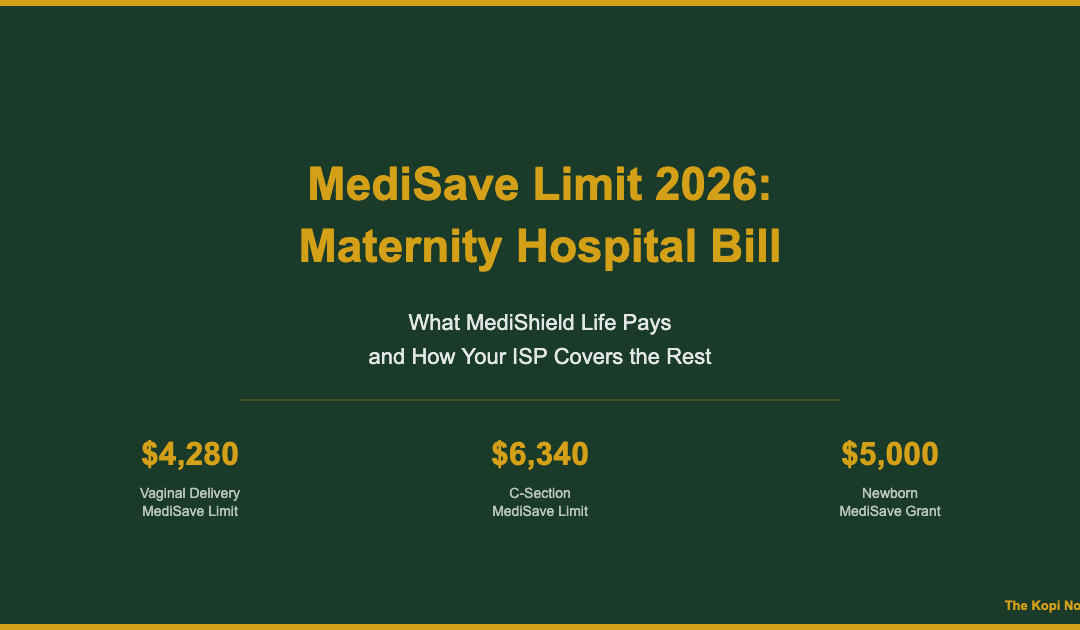
For 2026, MediSave covers up to $4,280 for a vaginal delivery and up to $6,340 for a C-section — but only against very specific charge types. MediShield Life then covers part of the remaining bill after a deductible. Your Integrated Shield Plan (ISP) eliminates that deductible and co-insurance gap, and may upgrade your ward entitlement to a private room — turning a potential five-figure out-of-pocket cost into a manageable amount.
Not financial advice. All figures are for educational reference only. MediSave withdrawal limits sourced from HealthHub (MOH), last reviewed July 2025. Verify current figures at HealthHub before any admission. Data verified as at October 2026.
For MediSave limits across all life stages, see our MediSave limit 2026 life stage guide.
Table of Contents
The True Cost of Having a Baby in Singapore
Having a baby in Singapore is one of the biggest healthcare costs most families will face in their 20s or 30s. The total bill — from first antenatal consultation to hospital discharge — typically runs between $3,000 and $20,000 depending on which hospital you choose, whether you deliver vaginally or by C-section, and which ward class you’re in. In a Class B1 ward at a restructured hospital, a straightforward vaginal delivery with a 2-day stay can cost around $2,000–$6,000. In a private hospital or Class A ward, the same delivery can easily reach $8,000–$15,000. This is exactly why understanding how MediSave, MediShield Life, and your Integrated Shield Plan (ISP) work together for maternity matters — ideally before you fall pregnant, not after.
| Delivery Type | Ward Class | Hospital Type | Est. Total Bill |
|---|---|---|---|
| Vaginal | B2/C | Restructured (subsidised) | $1,500–$3,500 |
| Vaginal | B1/A | Restructured (unsubsidised) | $4,000–$8,000 |
| Vaginal | Private | Private hospital | $8,000–$15,000 |
| C-section | B2/C | Restructured (subsidised) | $2,500–$5,000 |
| C-section | B1/A | Restructured (unsubsidised) | $7,000–$12,000 |
| C-section | Private | Private hospital | $12,000–$25,000+ |
Source: MOH bill sizes reference data 2024–2025. Actual bills vary.
What MediSave Covers — Exact 2026 Limits
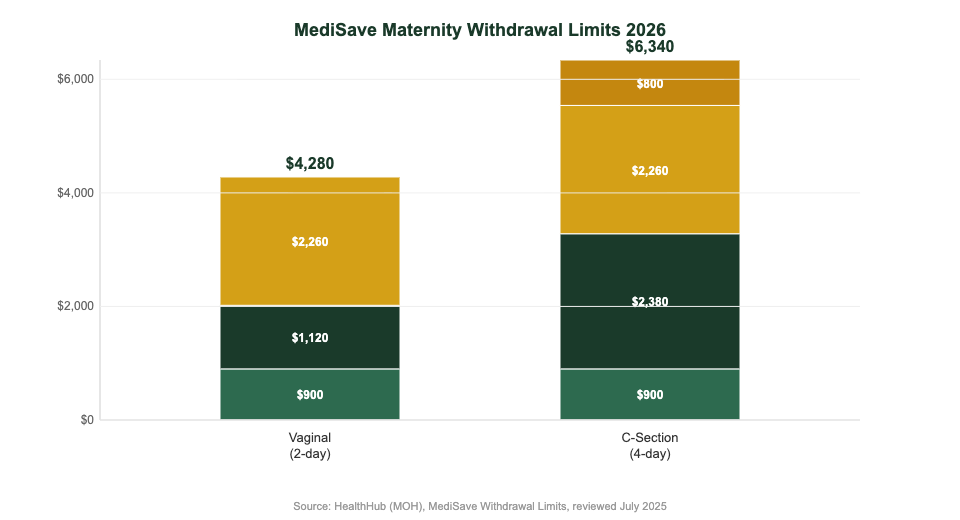
MediSave is a mandatory healthcare savings account within your CPF that you draw from to pay specific healthcare expenses. For maternity, MediSave applies to pre-delivery outpatient charges and inpatient hospitalisation, subject to the following limits set by CPF Board and MOH (verified from HealthHub, July 2025 review). You can withdraw up to $900 per delivery for pre-delivery outpatient expenses (antenatal checkups, ultrasound scans, blood tests). For the actual hospitalisation and delivery procedure, the limits depend on delivery type:
| Charge Type | Vaginal Delivery | Caesarean Delivery |
|---|---|---|
| Pre-delivery expenses | $900 | $900 |
| Surgical (procedure) limit | $1,120 | $2,380 |
| Ward charges (days 1–2) | $1,130/day | $1,130/day |
| Ward charges (from day 3) | $400/day | $400/day |
| Max MediSave (standard stay) | $4,280 (2-day) | $6,340 (4-day) |
Source: HealthHub (MOH), MediSave Withdrawal Limits for Delivery, reviewed July 2025.
The $4,280 vaginal limit: $900 + $1,120 + ($1,130 × 2) = $4,280. The $6,340 C-section limit: $900 + $2,380 + ($1,130 × 2) + ($400 × 2) = $6,340.
What MediShield Life Pays After Your MediSave
Once MediSave has been applied to eligible charges, MediShield Life — Singapore’s compulsory national health insurance — takes over the remaining hospitalisation bill. MediShield Life applies a deductible (the portion you pay before coverage activates) and co-insurance (10% of claimable amounts above the deductible). For a maternity admission that is your first hospitalisation in the calendar year, you typically pay the full deductible before MediShield Life contributes anything:
| Parameter | Class B2/C | Class B1 and above |
|---|---|---|
| Annual Deductible | $1,500 | $2,000–$3,500 |
| Co-insurance | 10% | 10% |
| Coverage basis | Subsidised B2/C rate | Up to B2/C limits |
Source: CPF Board, MediShield Life Scheme parameters, 2026. Deductible applies once per year, not per admission.
Critically, MediShield Life pays at subsidised B2/C ward rates. If you choose a B1/A ward or a private hospital, the ward class differential is your responsibility — unless your ISP covers it.
How Your ISP Fills the Gap
An Integrated Shield Plan — offered by AIA, NTUC Income, Great Eastern, Prudential, and Singlife — works on top of MediShield Life to cover the gaps left by the national scheme. For maternity admissions, a good ISP with a rider delivers three critical protections: (1) Deductible waiver — Your ISP rider absorbs the MediShield Life annual deductible ($1,500–$3,500), eliminating the largest single out-of-pocket cost. (2) Co-insurance waiver — The 10% co-insurance is absorbed by the ISP rider, up to the plan’s co-payment cap. (3) Ward class upgrade — Depending on your ISP tier, you are entitled to a higher ward class without a ward class differential bill.
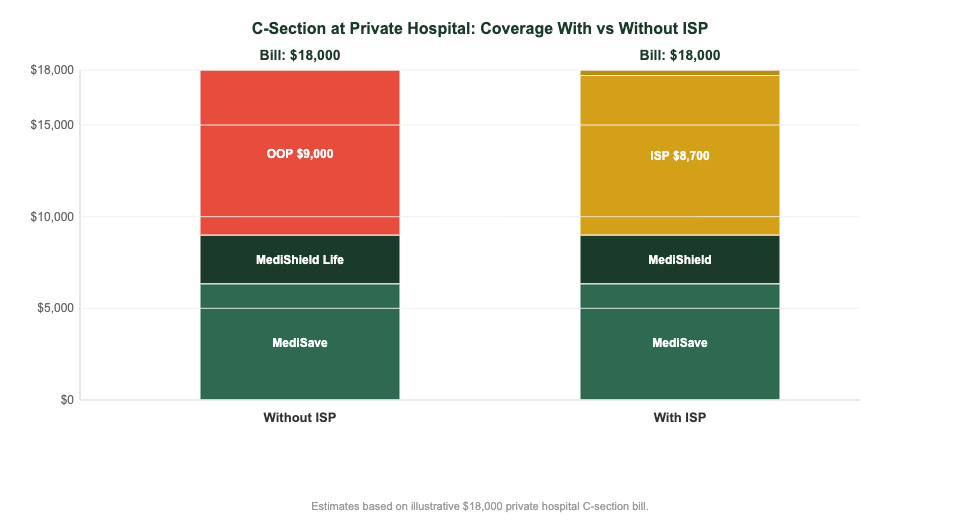
Consider a mother choosing a private hospital for her C-section with a total bill of $18,000. Her MediSave covers up to $6,340. Her ISP (Private Hospital plan with rider) absorbs the deductible, co-insurance, and ward class differential — leaving her with a few hundred dollars out of pocket at most, compared to potentially $9,000+ without an ISP.
For a wider view of how healthcare costs interact with your long-term financial plan, our Singapore retirement planning calculator helps you model ISP premiums in your savings trajectory. You can also explore how CPF investment strategy interacts with healthcare savings goals.
MediSave Grant for Newborns — The $5,000 Head Start
Since April 2025, every Singaporean baby receives a MediSave Grant for Newborns (MGN) of $5,000, credited directly into the child’s CPF MediSave account upon birth registration. This replaced the earlier $4,000 grant as part of the enhanced Baby Bonus package. The $5,000 MGN can be used to pay for the child’s MediShield Life premiums, fund an ISP for the child from birth, and cover future hospitalisation and outpatient expenses. The smartest financial move is to use the MGN to fund the child’s ISP from Day 1: premiums at age zero are the lowest they will ever be, and early coverage avoids waiting period issues for childhood conditions. A typical entry-level ISP for a newborn costs $300–$600/year, meaning the $5,000 MGN can fund roughly 8–15 years of premiums depending on the plan tier.
Key ISP Maternity Claim Tips
Check the maternity waiting period. Most ISPs impose a waiting period of 10–12 months from policy start date before maternity claims are eligible. If you’re newly insured or recently switched plans, verify this with your insurer immediately.
Get pre-authorisation early. Most ISPs require pre-admission approval for planned hospital admissions, including planned C-sections. Contact your ISP insurer at least 2–4 weeks before your expected delivery date. Failing to pre-authorise can result in claim reductions.
Choose a panel hospital. ISPs have panel hospital lists. Delivering at a panel hospital enables direct billing — the hospital bills the insurer, and you pay only the remaining co-payment (if any). Non-panel hospitals may require upfront payment and reimbursement later.
Know what is excluded. Most ISPs cover inpatient delivery and hospitalisation charges. However, some items may require separate riders or are excluded: elective procedures, certain fertility treatments, and professional fees from specialists not on the ISP’s panel. Always read your policy certificate — not just the marketing brochure — before admission.
Sequence claims correctly. The right order is: MediSave first (for eligible charges up to the limits above), then MediShield Life, then ISP for the remaining balance. Your hospital’s billing department handles this in the correct sequence if you present your NRIC, MediSave account details, and ISP policy details at admission.
Frequently Asked Questions
What is the MediSave limit for maternity in 2026?
In 2026, the MediSave withdrawal limit for a standard vaginal delivery is up to $4,280 (for a 2-day stay): $900 for pre-delivery expenses, $1,120 for the delivery procedure, and $1,130/day for two days in the ward. For a Caesarean section with a 4-day stay, the limit rises to $6,340: $900 pre-delivery, $2,380 for the surgical procedure, $1,130/day for the first two days, and $400/day for days three and four. Source: HealthHub (MOH), reviewed July 2025.
Does MediShield Life cover maternity hospitalisation?
Yes. MediShield Life covers maternity hospitalisation, including normal deliveries and C-sections, as standard inpatient coverage. However, it applies an annual deductible of $1,500 (Class B2/C) or $2,000–$3,500 (Class B1 and above) before paying anything, and a 10% co-insurance on claimable amounts above the deductible. Coverage is also calculated at subsidised B2/C ward rates — higher ward class bills are not fully covered by MediShield Life alone. An ISP with a rider addresses all three gaps.
How does an Integrated Shield Plan help with a maternity bill?
An ISP provides three key benefits for maternity admissions: (1) it waives the MediShield Life deductible ($1,500–$3,500), eliminating the largest single out-of-pocket cost; (2) with an ISP rider, it absorbs the 10% co-insurance; and (3) depending on your plan tier, it covers higher ward classes without a ward class differential charge. For an $18,000 private hospital C-section, an ISP could reduce your out-of-pocket cost from ~$9,000 to a few hundred dollars.
Is there a waiting period for maternity claims under an ISP?
Yes, most ISPs impose a waiting period of 10–12 months from policy inception before maternity claims are eligible. This means if you purchase an ISP while already pregnant, maternity coverage may not apply. If you have held your ISP for more than 12 months before the delivery date, the waiting period is not an issue. Always verify the specific waiting period in your policy certificate rather than relying on marketing materials.
What is the MediSave Grant for Newborns in 2026?
The MediSave Grant for Newborns (MGN) is $5,000, credited directly into every Singaporean baby’s CPF MediSave account upon birth registration (increased from $4,000, applicable to births from April 2025). It can be used for MediShield Life premiums, ISP premiums, and future healthcare expenses. Funding the child’s ISP from birth with the MGN locks in the lowest possible premium rate and ensures no coverage gap during childhood.
Can I use my spouse's MediSave for my maternity hospitalisation?
Yes. Under MediSave rules, you can draw from your immediate family members’ MediSave accounts — spouse, parents, and children — to pay for your eligible healthcare expenses, including maternity hospitalisation. The same withdrawal limits apply regardless of whose account you draw from; using a spouse’s account does not increase the limit. If your own MediSave balance is insufficient, your spouse’s account can cover the shortfall up to the applicable limits.
Plan Your Maternity Coverage Before You Need It
The best time to review your ISP coverage is before you start trying for a baby — not after a positive test. Check your plan tier, confirm the maternity waiting period has elapsed, and verify that your preferred hospital is on your insurer’s panel.
For a broader view of MediSave across all life stages, see our MediSave limit 2026 life stage guide.
Get Free Insurance Advice
Speak with a licensed insurance advisor. No obligation, no cost.
By submitting this form, you agree to our Privacy Policy.
This article was researched with the help of AI. While we strive to keep all information accurate and up to date, there may be errors. If you notice any discrepancies, please contact us.