MediSave Limit 2026: Self-Employed vs Salaried — Why Your ISP Strategy Is Different
How the $79,000 BHS, AWL caps, and April 2026 rider changes affect you differently depending on how you earn
In Singapore, both salaried employees and self-employed persons must fund their Integrated Shield Plan (ISP) premiums primarily from MediSave. But the 2026 Basic Healthcare Sum (BHS) of $79,000 and the age-based Additional Withdrawal Limit (AWL) interact very differently with how each group earns and saves. Self-employed persons face a structural MediSave gap that salaried workers rarely encounter — one that the April 2026 rider co-payment changes have made sharper.
Not financial advice. All figures are for educational reference only. Data verified as at 10 October 2026.
In This Article
- The 2026 MediSave Landscape — BHS, AWL & April Rule Changes
- How Salaried Workers Fund Their ISP Through MediSave
- The Self-Employed MediSave Gap
- April 2026 Rider Changes: Different Impact for Each Group
- Strategies: Optimising MediSave & ISP for Both Groups
- At a Glance: Key Differences Table
- Frequently Asked Questions
The 2026 MediSave Landscape — BHS, AWL & April Rule Changes
Three numbers define how much MediSave can do for your ISP in 2026:
1. Basic Healthcare Sum (BHS): $79,000
The BHS is the maximum balance that can accumulate in your MediSave Account (MA). Contributions that push your MA above the BHS are redirected — to your Special Account (SA) if you are below 55, or to your Retirement Account (RA) and then Ordinary Account (OA) if you are 55 and above. Your MediSave balance does not stop growing; it just overflows once it crosses $79,000. You can still use MediSave for ISP premiums regardless of whether your balance exceeds the BHS. For context, cohort BHS values are fixed for life when you turn 65: those who turned 65 in 2025 have a cohort BHS of $75,500, and those who turned 65 in 2024 have $71,500.
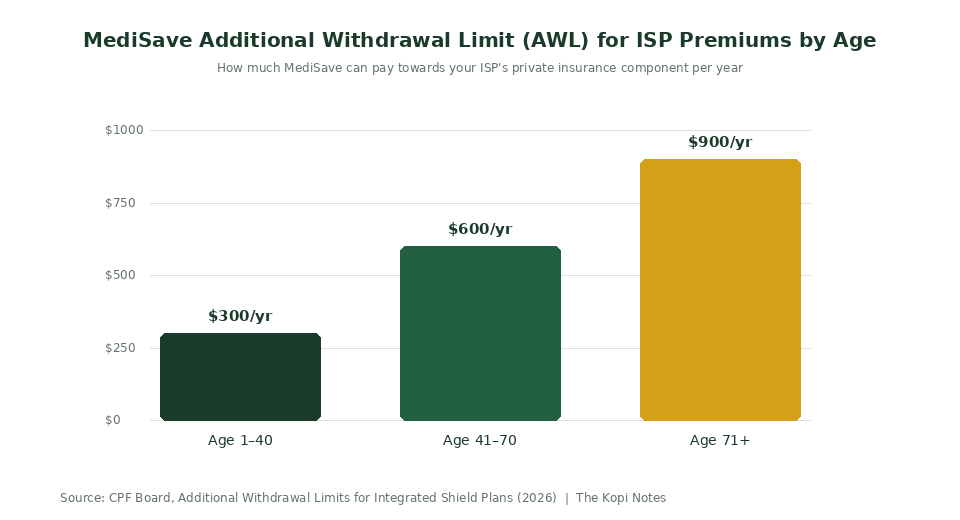
2. Additional Withdrawal Limit (AWL): $300 – $900/year by age
The AWL caps how much MediSave you can use each year towards the private insurance component of your ISP — the amount above MediShield Life premiums. The limits are:
| Age Group | Annual AWL | What It Covers |
|---|---|---|
| Age 1 – 40 | $300/year | Private insurance component of ISP only |
| Age 41 – 70 | $600/year | Private insurance component of ISP only |
| Age 71 and above | $900/year | Private insurance component of ISP only |
Source: CPF Board, Additional Withdrawal Limits for Integrated Shield Plans, 2026.
MediShield Life premiums are paid from MediSave in full on top of the AWL. Rider premiums cannot be paid from MediSave — they must be covered in cash. However, under the April 2026 framework, the deductible and the 5% co-payment can be paid from MediSave (subject to applicable withdrawal limits).
3. April 2026 ISP Rider Changes
From 1 April 2026, all new ISP riders must include a minimum 5% co-payment, with the annual co-payment cap raised from $3,000 to $6,000. Minimum IP deductibles are set by MOH at $1,500 to $3,500 per policy year depending on ward class, and riders may not cover these deductibles. In return, new compliant riders are expected to carry premiums approximately 30% lower on average than the pre-April 2026 maximum-coverage riders. Crucially, the deductible and co-payment amounts can be paid using MediSave.
How Salaried Workers Fund Their ISP Through MediSave
For salaried employees, MediSave grows automatically every month. Both the employee and employer contribute to CPF — and a defined portion flows into the MediSave Account:
- Below age 35: approximately 8% of wages into MediSave (employee + employer combined portion)
- Age 35–44: approximately 9%
- Age 45–49: approximately 10%
- Age 50–54: approximately 10.5%
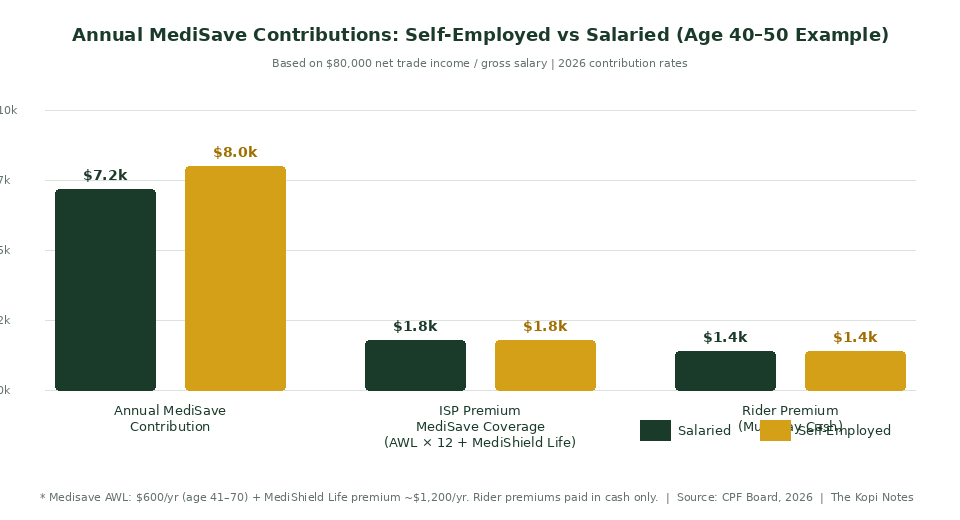
For a salaried worker earning $80,000 a year at age 40–50, this translates to roughly $7,200–$8,000 flowing into MediSave annually. This happens without any active step on the employee’s part — payroll processes it every month.
Against those contributions, the annual ISP premium outflow from MediSave looks like this:
- MediShield Life premiums (fully payable from MediSave): typically $300–$600/year for a 35-year-old, rising to $900–$1,800/year by the mid-50s
- ISP private component (AWL cap applies): up to $600/year for age 41–70
- Rider premiums: cash only
The result: for most salaried workers in their 30s and 40s, ISP premium outflows from MediSave are comfortably below annual inflows. They are building their MediSave balance while paying for their ISP coverage at the same time. The main risk for this group is not running short — it is failing to review their plan as premiums climb steeply past age 50. Our article on how ISP premiums rise with age covers that trajectory in detail.
The Self-Employed MediSave Gap
Self-employed persons (SEPs) face a fundamentally different situation. There is no employer contributing to CPF on their behalf. The only mandatory CPF obligation for SEPs is their MediSave contribution — and it is based on their annual net trade income (NTI), assessed after IRAS tax filing.
The contribution rates by age are broadly similar to those for salaried workers:
| Age | Approx. MediSave Rate on NTI | Est. Annual Contribution ($80k NTI) |
|---|---|---|
| Below 35 | ~8% | ~$6,400 |
| 35 – 44 | ~9% | ~$7,200 |
| 45 – 49 | ~10% | ~$8,000 |
| 50 and above | ~10.5% | ~$8,400 |
Source: CPF Board, MediSave contribution rates for self-employed persons (2026). Rates are approximate top-band rates for NTI above the lower threshold; reduced rates apply at lower income levels.
The problem is not the rate — it is the timing and reliability:
- Payment is annual, not monthly. SEP MediSave contributions are typically assessed and paid once a year (after IRAS assessment), not deducted monthly from payroll. During the year, MediSave does not grow unless you top it up voluntarily.
- Income can be uneven. A freelancer earning $80k in one year but $40k the next will contribute significantly less to MediSave in the lean year — but their ISP premiums do not drop accordingly.
- If MediSave balance is insufficient, ISP premiums shift to cash. ISP insurers will attempt to deduct premiums from MediSave. If the balance is too low to cover even the MediShield Life portion, you will receive a cash demand. Failure to pay can lapse coverage.
- SEPs have no employer OA or SA contributions as a buffer. A salaried worker has a growing OA and SA alongside their MA, creating a broader CPF safety net. An SEP who contributes only to MediSave has no such cushion.
The net result: self-employed persons need to actively manage their MediSave balance in a way salaried workers typically do not. To understand what “how to top up MediSave” means in practice, see our step-by-step MediSave top-up guide.
April 2026 Rider Changes: Different Cash Flow Impact for Each Group
The April 2026 ISP rider changes affect both groups, but the real-world impact on cash flow differs significantly.
For salaried workers: The 5% co-payment with a $6,000 annual cap is manageable for most middle-income earners in stable employment. If a hospitalisation triggers the $6,000 co-pay ceiling, that is a defined, predictable worst case. Many salaried workers also have employer medical benefits, hospitalisation leave, and access to employer-funded insurance that can buffer the out-of-pocket cost. The co-payment and deductible can themselves be funded from MediSave where limits allow.
For self-employed persons: The same $6,000 annual co-pay cap hits harder for three reasons:
- No sick pay or MC. An SEP hospitalised for two weeks does not just face a $6,000 co-pay — they also lose two weeks of billable income. The total financial hit is substantially larger.
- No employer medical coverage to overlap. Many companies offer group hospitalisation plans that partially cover gaps. SEPs have no such fallback.
- Cash flow is already lumpy. A self-employed person whose income dips in the month of hospitalisation faces a double squeeze: lower income and a healthcare bill.
Those who dropped their rider entirely — avoiding the premium cost — now face the full deductible ($1,500–$3,500 depending on ward class) plus co-insurance on top of that. Our detailed breakdown of what the ISP rider actually costs in 2026 shows exactly how the out-of-pocket calculations compare with and without a rider.
The one silver lining: deductible and co-payment amounts can be paid from MediSave (subject to withdrawal limits). So if your MediSave balance is healthy, you can tap it to fund your co-pay rather than paying from cash savings — a genuine advantage for SEPs who have been diligent about top-ups.
Strategies: Optimising MediSave & ISP for Both Groups
For Salaried Workers
- Review your ISP plan as premiums accelerate past 50. The AWL stays at $600/year for age 41–70 but MediShield Life premiums roughly double from the mid-40s to the late 50s. Consider whether your current ISP tier remains cost-effective.
- Voluntary MediSave top-up to reach the BHS. If your MediSave is below $79,000 and you want to maximise the healthcare safety net, cash top-ups are allowed. Note: voluntary cash top-ups to your own MediSave do not qualify for tax relief — but contributions to a family member’s MediSave can qualify for up to $8,000 tax relief.
- Keep your ISP rider if income is stable. The 5% co-pay cap at $6,000 is a manageable worst case for most households, and the premium reduction under the new rules makes keeping coverage more affordable than before.
For Self-Employed Persons
- Make quarterly voluntary MediSave contributions. Do not wait until year-end to pay your mandatory contribution. By March each year, top up based on your estimated NTI so that your MediSave balance covers ISP premium deductions throughout the year. Treat it like a quarterly payroll deduction.
- Maintain a MediSave buffer of $3,000–$5,000 above your expected annual premium outflows. This absorbs ISP premium deductions, any MediShield Life increases, and unexpected outpatient MediSave use without leaving your account short.
- Use your MediSave for co-payments and deductibles. The April 2026 framework allows MediSave to be used for the deductible and co-payment amounts (subject to withdrawal limits). This means a healthy MediSave balance directly reduces how much you pay in cash at a hospital.
- Consider the rider carefully. For SEPs with volatile income, the $6,000 annual co-pay cap provided by a rider acts as a financial ceiling on healthcare costs — offering predictability that is arguably more valuable than it is for a salaried worker. Compare the new compliant rider premiums (averaging ~30% lower than pre-April 2026 products) against the risk you are willing to absorb.
- Claim CPF Relief on your mandatory MediSave contributions. Your mandatory SEP MediSave contributions qualify for CPF Relief at tax filing — this partially offsets the “double cost” of contributing to MediSave without OA/SA growth.
For a step-by-step walkthrough of making voluntary MediSave contributions and the most efficient top-up methods, see our how to top up MediSave guide. For the broader picture of how MediSave and the BHS interact with your ISP premium projections over time, our MediSave Limit 2026 full guide is a useful companion to this article.
At a Glance: Salaried vs Self-Employed MediSave & ISP
| Factor | Salaried | Self-Employed |
|---|---|---|
| MediSave contributions | Automatic monthly (employer + employee) | Manual; assessed annually by CPF Board |
| Annual contribution (~$80k income, age 45) | ~$7,200–$8,000 | ~$8,000 (MediSave only; no OA/SA) |
| ISP base premium (MediShield Life) | MediSave ✓ | MediSave ✓ |
| ISP private component (AWL, age 41–70) | Up to $600/yr from MediSave ✓ | Up to $600/yr from MediSave ✓ |
| Rider premium | Cash only ✗ | Cash only ✗ |
| April 2026 co-pay (5%, capped $6,000/yr) | Manageable with stable income; can use MediSave | More disruptive with variable income; MediSave buffer critical |
| Income during hospitalisation | Sick leave / MC pay available | None — income stops |
| Key risk | Failing to review plan as premiums rise with age | Underfunding MediSave → ISP premium gaps |
Source: CPF Board (MediSave AWL, BHS 2026), MOH (April 2026 ISP rider rules). Data as at 10 October 2026.
If you are unsure which ISP tier is right for your age and income profile, our ISP premium-by-age guide maps out the cost trajectory across insurers. For a full comparison of all five ISP providers, see our complete ISP guide for Singapore.
Frequently Asked Questions
Can self-employed persons use MediSave to pay ISP premiums?
What is the MediSave AWL and how does it apply to ISP premiums?
What happens if a self-employed person's MediSave is too low to pay ISP premiums?
Do the April 2026 ISP rider changes affect self-employed persons differently?
Can I voluntarily top up MediSave above the BHS to cover higher ISP premiums?
Should a self-employed person keep or drop their ISP rider in 2026?
Bottom Line
The MediSave BHS, AWL limits, and April 2026 rider co-payment rules are the same for everyone. But whether you are salaried or self-employed shapes how easily you hit those limits and how much the new co-payment rules sting. Salaried workers can largely set and forget their ISP strategy until their 50s; self-employed persons need to treat MediSave top-ups as a quarterly financial discipline, and weigh the rider decision more carefully given the absence of any employer healthcare buffer. Getting this right means your ISP continues to do its job without a surprise cash call in the middle of a hospitalisation.
Not financial advice. Verify current figures at cpf.gov.sg and moh.gov.sg before making decisions.
Get Free Insurance Advice
Speak with a licensed insurance advisor. No obligation, no cost.
By submitting this form, you agree to our Privacy Policy.
This article was researched with the help of AI. While we strive to keep all information accurate and up to date, there may be errors. If you notice any discrepancies, please contact us.