MediSave Limit 2026: How Much Can You Claim for Hernia Surgery in Singapore?
Real bill data from MOH, MediShield Life claim limits effective June 2026, and what your Integrated Shield Plan pays — so you know your out-of-pocket cost before you sign any consent form.
Hernia surgery costs between $1,394 at a subsidised public hospital and $17,000+ at a private hospital in Singapore. MediShield Life’s surgical claim limit for hernia repairs (TOSP Table 3) ranges from $1,390 to $1,920 under the June 2026 schedule — a fraction of any private hospital bill. Your Integrated Shield Plan covers the remaining gap, subject to your ward class, deductible, and the new 5% minimum co-payment that applies to ISP riders from April 2026.
Not financial or medical advice. All figures are for educational reference only. Bill amounts are from MOH Hospital Bill Size Reference (Jan–Dec 2023 admissions, before insurance payouts). MediShield Life claim limits effective 1 June 2026 as published by MOH.
Table of Contents
Types of Hernia Surgery in Singapore
A hernia occurs when an internal organ or fatty tissue pushes through a weak spot in a surrounding muscle or connective tissue wall. Most hernias do not heal on their own and require surgical repair. The two most commonly performed hernia procedures in Singapore — and the ones most relevant to MediSave and ISP claims — are:
- Inguinal or femoral hernia repair (Procedure Code SF819A) — the most common type, occurring in the groin area. These repairs are classified under TOSP Table 3 and are frequently performed as day surgery (you go home the same day), though an overnight inpatient stay is also possible for bilateral or complex cases.
- Epigastric, umbilical, or incisional hernia repair (Procedure Code SF814A) — hernias occurring near the navel or at the site of a previous surgical scar. These are also under TOSP Table 3 and are more commonly performed as inpatient procedures.
Both can be performed as open surgery or laparoscopically (keyhole surgery). Laparoscopic repairs typically take longer in the operating theatre and use specialised equipment, which is why private hospital bills for keyhole hernia surgery can run higher than the MOH typical figures. The TOSP classification — and therefore your MediShield Life surgical claim limit — does not change based on the surgical technique used. It is determined by the type and complexity of the hernia.
Emergency hernia repairs (for incarcerated or strangulated hernias) may carry a higher complexity classification, which affects the claim limit. Consult your surgeon on the TOSP code to be used before admission if you want to estimate your coverage precisely.
How Much Does Hernia Surgery Cost in Singapore?
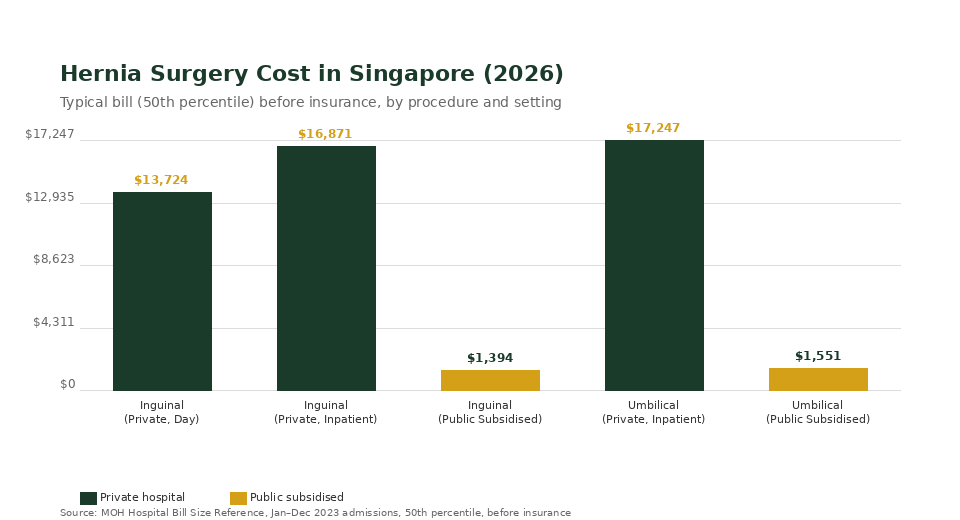
The cost range for hernia surgery in Singapore is wide — from around $1,400 at a subsidised public hospital to over $17,000 at a private hospital. The figures below are from the MOH Hospital Bill Size Reference, which shows real bills paid by patients for the same procedure across different settings. These are “before insurance” amounts.
| Procedure | Hospital | Surgery Type | Typical Bill (50th percentile) |
|---|---|---|---|
| Inguinal hernia (SF819A) | Private hospital | Day surgery | ~$13,724 |
| Inguinal hernia (SF819A) | Private hospital | Inpatient | ~$16,871 |
| Inguinal hernia (SF819A) | Public hospital (subsidised) | Day surgery | ~$1,394 |
| Inguinal hernia (SF819A) | Public hospital (subsidised) | Inpatient | ~$1,643 |
| Umbilical/epigastric hernia (SF814A) | Private hospital | Inpatient | ~$17,247 |
| Umbilical/epigastric hernia (SF814A) | Public hospital (subsidised) | Day surgery | ~$1,551 |
Source: MOH Hospital Bill Size Reference, Jan–Dec 2023 admissions, 50th percentile (typical bill), before insurance payouts. Private hospital bills include surgeon and anaesthetist fees. Actual bills vary by surgeon, complexity, implants, and length of stay. Range: inguinal hernia private day surgery spans $12,036–$17,143 at the 25th–75th percentile.
At a private hospital, the surgeon fee alone for an inguinal hernia repair ranges from $3,924 to $6,540 (including GST). The anaesthetist adds a further $1,199 to $1,744. These professional fees are on top of the facility bill shown in the table above, so for more complex laparoscopic cases, the total bill at a private hospital can comfortably exceed $20,000.
What MediShield Life Pays for Hernia Surgery
MediShield Life is the base compulsory insurance layer every Singapore citizen and permanent resident has. It is not means-tested and applies whether you are admitted to a public or private hospital. However, its claim limits are set at public ward B2 rates — meaning large private hospital bills are only partially offset.
As at 1 June 2026 (following the latest MOH revision), hernia surgery falls under TOSP Table 3, with the following surgical claim limits:
| Complexity Tier (TOSP Table 3) | MediShield Life Surgical Claim Limit |
|---|---|
| Tier A — less complex procedures | $1,390 |
| Tier B — standard complexity | $1,740 |
| Tier C — more complex procedures | $1,920 |
Source: MOH MediShield Life Benefits, effective 1 June 2026. The specific tier assigned to your hernia procedure depends on complexity as coded by your surgeon. Consult your hospital’s billing team for the TOSP code and applicable claim limit before admission.
Beyond the surgical claim, MediShield Life also covers part of the inpatient ward charges. For a standard ward stay, it pays up to $830 per day, with an additional $800 per day for the first two inpatient days. Day surgery procedures have no daily ward charge component — only the surgical claim applies.
MediShield Life pays after your annual deductible is met. The deductible is $1,500 per year for Class B2/C ward stays and $3,000 per year for Class A, B1, and private hospital admissions (verify current figures at MOH’s MediShield Life page). After the deductible, MediShield Life covers 90% of remaining eligible charges (you pay 10% co-insurance). This co-insurance component is typically covered by your Integrated Shield Plan rider.
How MediSave Works for Hernia Surgery
MediSave is your healthcare savings account under the CPF system. It accumulates at the CPF contribution rate throughout your working years — 8% to 10.5% of your monthly wages depending on your age — and can be used to pay approved medical expenses, including hospitalisation, surgery, and health insurance premiums.
For hernia surgery, MediSave serves two important functions:
- Paying the deductible and co-insurance. The portion of your bill not covered by MediShield Life and your ISP (the annual deductible, co-insurance, and any ISP co-payment) can be paid from your MediSave account rather than cash. This is the core “MediSave limit” question most people have — not whether MediSave covers hernia surgery (it does), but how much of the out-of-pocket cost it can absorb.
- Paying ISP premiums. Your ISP annual premium is deducted directly from your MediSave account, so your monthly take-home pay is unaffected. For most working Singaporeans, ISP premiums are fully payable from MediSave until their mid-50s, after which the premium may exceed the annual MediSave contribution and require a small top-up in cash.
There are also specific MediSave surgical withdrawal limits per procedure based on TOSP table — these cap how much can be drawn from MediSave for the surgery itself per admission. For Table 3 hernia procedures, check the latest schedule at CPF Board’s official site for the exact current limit. The MediSave withdrawal limit applies per admission in addition to any daily inpatient allowance, and together they typically cover the deductible for a public hospital stay in full.
At a private hospital, the deductible ($3,000) and 5% minimum ISP co-payment may require a larger MediSave drawdown. If your MediSave balance is below the Basic Healthcare Sum (BHS — the minimum balance CPF requires you to maintain before making non-healthcare withdrawals), you can still use MediSave freely for approved healthcare expenses. The BHS in 2026 is set by CPF annually — check cpf.gov.sg for the exact current year’s BHS figure.
Planning your MediSave alongside other CPF accounts is an important part of long-term financial health. Our CPF investment strategy guide covers how to balance MediSave, OA, and SA contributions over your working years.
What Your ISP (Integrated Shield Plan) Covers
An Integrated Shield Plan tops up MediShield Life by covering the deductible, co-insurance, and charges above what MediShield Life pays — up to your plan’s ward class and annual benefit limit. ISPs in Singapore are sold by seven approved insurers: AIA, Allianz, Great Eastern, Income (NTUC), Prudential, Raffles Health Insurance, and Singlife.
How much your ISP pays for hernia surgery depends on three things:
- Ward class selected. A private hospital plan covers far more of a $13,724 bill than a Class B1 plan would — the B1 plan’s limits are pegged to restructured hospital rates. If you are admitted to a ward class higher than your plan covers, you pay the difference out of pocket.
- Rider type. Riders attached to your ISP can eliminate the deductible and co-insurance gaps. However, since April 2026, all new ISP riders must include a minimum co-payment: at least 5% of the claimable bill amount. For private hospital plans, this co-payment is capped at $3,000 per year; for restructured hospital plans, the annual cap is $1,000. This change was introduced to prevent full “free hospitalisation” and encourage cost-conscious use of healthcare resources. If you purchased a comprehensive rider before April 2026, your legacy rider terms may still apply — check your policy documents.
- Panel vs non-panel hospital. Staying at a panel hospital designated by your insurer often entitles you to cashless billing (a Letter of Guarantee covers the bill upfront) and sometimes higher benefit limits. Non-panel private hospitals may still be covered, but expect to pay first and claim reimbursement.
For hernia surgery specifically, the annual ISP benefit limit matters most when complications arise. A routine laparoscopic inguinal hernia repair at a private hospital typically falls well within a standard $200,000–$500,000 annual limit. For incarcerated or bilateral hernias requiring longer inpatient stays, however, the total bill can grow quickly — having a plan with a higher annual limit gives peace of mind.
If you have never purchased an ISP, the cheapest time to do so is when you are young and healthy. Pre-existing conditions can be excluded or loaded at higher premiums once a diagnosis has been made. If you are diagnosed with a hernia and have not yet obtained an ISP, you may still be able to get coverage — but the hernia itself may be excluded until it has been treated. Consult an independent financial adviser for your specific situation.
For more on how Letter of Guarantee (LOG) requests work at private hospitals — including what to tell the billing department before admission — see our guide on MediSave limits and Letter of Guarantee at a private hospital.
Worked Example: What You’ll Actually Pay
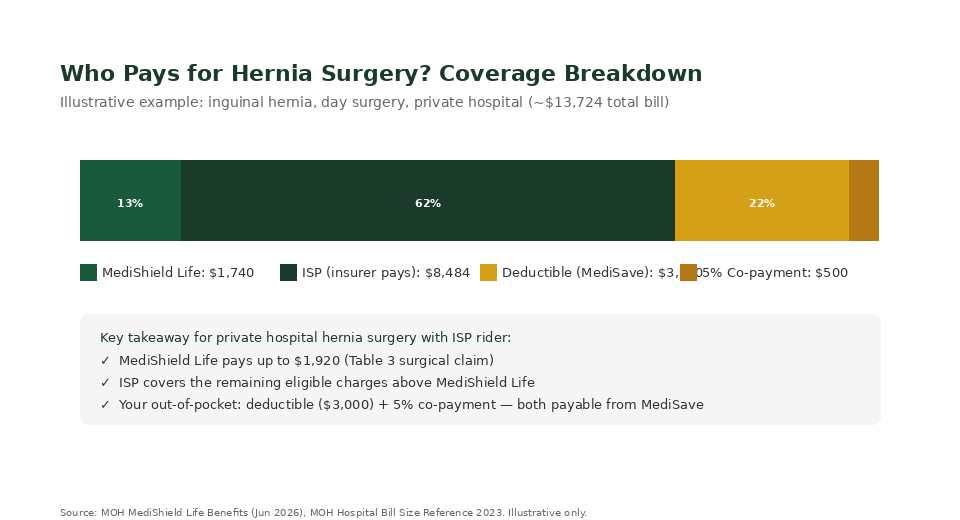
Let’s work through a concrete scenario. A 45-year-old Singapore citizen requires an inguinal hernia repair (SF819A) as a day surgery at a private hospital. He holds a private hospital ISP with a 5% co-payment rider purchased after April 2026.
| Cost Component | Amount (SGD) | Paid By |
|---|---|---|
| Total private hospital bill | $13,724 | — |
| Annual deductible (private/A/B1) | $3,000 | Patient (from MediSave) |
| MediShield Life surgical claim (Table 3) | $1,390–$1,920 | MediShield Life (national insurer) |
| ISP covers remaining eligible charges | up to ISP limit | Your ISP insurer |
| Minimum 5% co-payment on claimable amount (new April 2026 rule) | 5% of eligible charges (capped at $3,000/year) | Patient (MediSave or cash) |
| Estimated total out-of-pocket | $3,500–$4,500 | Patient (MediSave + cash) |
Illustrative example only. Actual out-of-pocket depends on your specific ISP, insurer’s benefit schedule, surgeon’s billing, and whether this is your first claim in the policy year (deductible resets annually). Consult your insurer for a Letter of Guarantee estimate before admission.
At a subsidised public hospital, the picture is very different. The same procedure costs approximately $1,394, which falls within the $1,500 Class B2/C ward deductible — meaning MediShield Life may not pay anything on a first claim of the year. MediSave covers the full bill comfortably, your ISP need not trigger at all, and your out-of-pocket cash cost can be zero.
This gap illustrates why the choice between public and private matters so much for planned, non-emergency procedures like hernia repair. Emergency cases are different — if you are admitted urgently, you go where the ambulance takes you, and your ISP coverage applies regardless.
For a parallel worked example with another common abdominal surgery, see our article on MediSave limit 2026 for gallbladder removal surgery.
Private vs Public Hospital: Which Should You Choose?
For planned hernia surgery, the financial case for a public restructured hospital is compelling if cost minimisation is your priority. The government subsidy brings the total bill to around $1,400–$1,600 for a day surgery, which MediSave typically covers in full with no cash outlay required. Clinical outcomes for routine hernia repairs are comparable across public and private settings — many specialist surgeons operate at both.
The case for a private hospital rests on surgeon choice, timing, and comfort. At a private hospital you can usually choose your preferred specialist surgeon and schedule your procedure within days rather than weeks. If you have an ISP covering private hospital stays with a rider that caps your annual co-payment at $3,000, the total out-of-pocket cost after insurance is often lower than many people expect — and payable from MediSave.
Consider these practical factors:
- Urgency. If the hernia is symptomatic but not an emergency, a 2–4 week wait at a public hospital is often acceptable. An incarcerated hernia (trapped, potentially cutting off blood supply) is a surgical emergency and you go immediately regardless of cost.
- Surgeon preference. Some surgeons operate exclusively at private hospitals. If you have been referred to a specific surgeon who only operates at a private centre, your effective choice is made for you.
- Your ISP coverage. If you hold a private hospital plan with rider, the marginal cost between public and private may be as little as the annual co-payment cap difference. If you hold only a B1-class plan, a private hospital stay means significant out-of-pocket charges for the ward class difference.
- Comfort and convenience. Private hospitals typically offer single rooms, shorter waiting times, and more flexible visiting hours — factors that matter more if you have a longer inpatient recovery.
Use the government’s ISP comparison tool at MOH’s website to see the annual premiums and benefit limits for plans from all seven approved insurers side by side. For a holistic view of how healthcare costs fit into your long-term financial picture, our Singapore retirement calculator can help you stress-test your MediSave balance against future healthcare needs.
Frequently Asked Questions
What is the MediSave limit 2026 for hernia surgery in Singapore?
MediSave can be used to pay for hernia surgery in Singapore, covering the deductible, co-insurance, and any out-of-pocket co-payment not covered by MediShield Life and your ISP. The specific per-admission MediSave surgical withdrawal limit for hernia procedures (TOSP Table 3) is set by CPF Board — check the latest schedule at cpf.gov.sg for the 2026 figure. In practice, MediSave typically covers the full deductible for a public hospital hernia repair and a substantial portion of the out-of-pocket costs at a private hospital.
How much does MediShield Life pay for hernia surgery?
Under the revised MediShield Life benefits effective 1 June 2026, the surgical claim limit for hernia surgery (TOSP Table 3) ranges from $1,390 (simpler procedures) to $1,920 (more complex procedures). This applies per surgical episode, subject to the annual deductible ($1,500 for B2/C ward, $3,000 for A/B1/private) and 10% co-insurance. For a typical inguinal hernia at a private hospital costing $13,724, MediShield Life’s surgical claim covers only a small fraction — your ISP handles the rest.
Is hernia surgery covered by an Integrated Shield Plan (ISP) in Singapore?
Yes. Hernia surgery is a standard covered procedure under all ISPs in Singapore, subject to your plan’s ward class, annual benefit limit, and any pre-existing condition exclusions. The plan pays above MediShield Life, covering the deductible, co-insurance, and additional charges (surgeon fees, ward upgrades) up to your policy limit. From April 2026, new ISP riders require a minimum 5% co-payment on claimable amounts, capped at $3,000/year for private hospital plans and $1,000/year for restructured hospital plans.
Which TOSP table does hernia surgery fall under?
Both common hernia repairs in Singapore fall under TOSP Table 3. Inguinal and femoral hernia repairs (SF819A) and epigastric, umbilical, or incisional hernia repairs (SF814A) are all classified under Table 3, with the specific complexity tier (A, B, or C) assigned based on the difficulty of your individual procedure. The tier determines your MediShield Life surgical claim limit: $1,390, $1,740, or $1,920 respectively under the June 2026 schedule.
Can I use MediSave if I choose a private hospital for hernia surgery?
Yes. MediSave can be used at both public restructured hospitals and private hospitals for approved surgical procedures including hernia repair. At a private hospital, the annual deductible of $3,000 (Class A/B1/private) can be paid from MediSave, as can the 5% minimum co-payment required under new ISP riders. The per-admission MediSave surgical withdrawal limit for Table 3 procedures applies at both settings — check cpf.gov.sg for the current limit.
What is the new 5% ISP co-payment rule and does it affect hernia surgery?
From April 2026, all new Integrated Shield Plan riders sold in Singapore must include a minimum 5% co-payment on claimable amounts. For hernia surgery at a private hospital with a bill of $13,724, the 5% co-payment on the insurer-covered portion could add up to $500–$700 in out-of-pocket costs, capped at $3,000 per policy year for private hospital plans. This applies in addition to the annual deductible. If you purchased a comprehensive rider before April 2026, check your policy — older riders may be grandfathered with different co-payment terms.
How long is recovery after hernia surgery in Singapore?
Recovery from laparoscopic hernia surgery is typically 1–2 weeks for light activity and 4–6 weeks before returning to heavy lifting. Open hernia repair may require a slightly longer recovery of 3–6 weeks. Day surgery patients go home the same day but are advised to rest for 1–3 days before resuming desk work. Your surgeon will advise on specific restrictions based on your procedure and health status. This information is for general reference only — always follow your surgeon’s post-operative instructions.
Check Your ISP Coverage Before Any Surgery
Singapore’s healthcare system is well-designed, but only if you have the right ISP in place before you need it. Review your plan now — not after a diagnosis.
Get Free Insurance Advice
Speak with a licensed insurance advisor. No obligation, no cost.
By submitting this form, you agree to our Privacy Policy.
This article was researched with the help of AI. While we strive to keep all information accurate and up to date, there may be errors. If you notice any discrepancies, please contact us.