TribeCar + MariBank + FSMOne: The Bonus-Window Rotation Strategy (Singapore 2026)
Skip car ownership. Ride MariBank’s 30-day bonus rate. Rotate into FSMOne SRS investing at 0% sales charge before the bonus decays.
What Is the Bonus-Window Rotation Strategy?
Step 1: Free Up Cash With TribeCar
Step 2: MariBank's 30-Day Bonus Window Explained
What Happens When the Bonus Expires
Step 3: FSMOne SRS at 0% Sales Charge
The Rotation Playbook, Step by Step
Worked Example: The Full S$15,300 SRS Cap
How This Differs From the Other 7 TribeCar Combos
Risks and Limitations
FAQ
If you skip car ownership in Singapore, TribeCar’s pay-per-use model frees up hundreds of dollars a month. Park that cash in MariBank during its 30-day new-user bonus window (up to 2.88% p.a.), then rotate it into FSMOne’s SRS account, which charges a permanent 0% sales charge, once the bonus rate decays back to the 0.88% p.a. base.
Not financial advice. All figures are for educational reference only. Data as at September 2026 unless noted.
- Skip a car with TribeCar, park the savings in MariBank to catch its 30-day new-user bonus rate (up to 2.88% p.a.)
- The bonus decays to a 0.88% p.a. base rate after day 30 — that’s your cue to move, not a reason to leave the cash sitting there
- Rotate into FSMOne’s SRS account, which has a permanent 0% sales charge, so none of your SRS contribution is eaten by upfront fees
What Is the Bonus-Window Rotation Strategy?
Most savings-and-invest guides treat a digital bank’s interest rate as fixed. It isn’t. MariBank’s headline rate is really two rates: a short, rich promotional rate for new users, and a much lower rate everyone reverts to afterwards.
The bonus-window rotation strategy treats that decay as a scheduled event, not a surprise. You use TribeCar to avoid car-ownership costs in the first place, park the freed-up cash in MariBank to catch the 30-day bonus, then move the money into FSMOne’s SRS account — which has no sales charge — right as the bonus expires. That way your cash always sits in the highest-value place available to it.
Step 1: Free Up Cash With TribeCar
Owning a car in Singapore means a Certificate of Entitlement, insurance, parking, and depreciation — costs that add up fast even before you turn the key. TribeCar’s referral code and pay-per-use car-sharing plans let you drive only when you need to, without carrying those fixed costs every month.
Use code zZDeg when you sign up. Whatever you’d have spent on a car — often several hundred dollars a month once you count insurance and parking — becomes cash you can actually put to work instead of watching it depreciate in a carpark.
Step 2: MariBank’s 30-Day Bonus Window, Explained
MariBank’s Mari Savings Account pays a base rate of 0.88% p.a., with no minimum deposit, no salary crediting, and no minimum spending required. That part is stable and unremarkable.
What makes MariBank worth timing around is the new-user bonus. For the first 30 days after you open an account, new users earn an additional 1.60% p.a. on top of the base rate — a total of 2.48% p.a. Eligible new users and ShopeeVIP members can stack further bonus interest, pushing the total as high as 2.88% p.a. during that window. Interest is credited daily, based on your balance the day before.
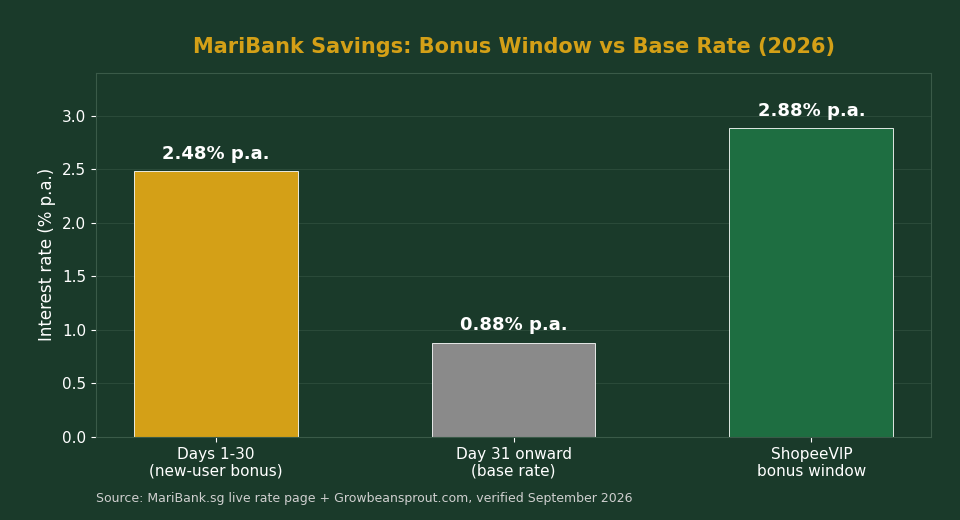
| Period | Rate (p.a.) | Interest on S$5,000 (30 days) |
|---|---|---|
| Days 1-30 (new-user bonus) | 2.48% | ~S$10.20 |
| ShopeeVIP-eligible bonus window | up to 2.88% | ~S$11.84 |
| Day 31 onward (base rate) | 0.88% | ~S$3.62 |
Source: MariBank.sg live rate page, cross-checked against Growbeansprout.com, verified September 2026. Illustrative interest assumes a flat S$5,000 balance for 30 days; actual interest compounds daily on the prior day’s balance.
What Happens When the Bonus Expires
Here’s the part most people miss. On day 31, your MariBank rate quietly drops from up to 2.88% p.a. to 0.88% p.a. Nothing tells you to move your money — it just sits there earning a lot less than it did a month ago.
That’s the exact moment this strategy asks you to act. Instead of leaving your car-ownership savings parked at the base rate indefinitely, you already have the next 30 days planned: open (or top up) your MariBank account using referral code 2DCT80WQ to capture the bonus window, then treat day 30 as a hard deadline to rotate the balance into SRS investing through FSMOne — not a date to shrug past.
Step 3: FSMOne SRS at 0% Sales Charge
Supplementary Retirement Scheme (SRS) — a voluntary account that lets you set aside money for retirement and get a dollar-for-dollar tax relief on what you contribute, up to the annual cap. Most people open one, contribute, then leave the cash sitting in cash-equivalents earning close to nothing. That defeats the point.
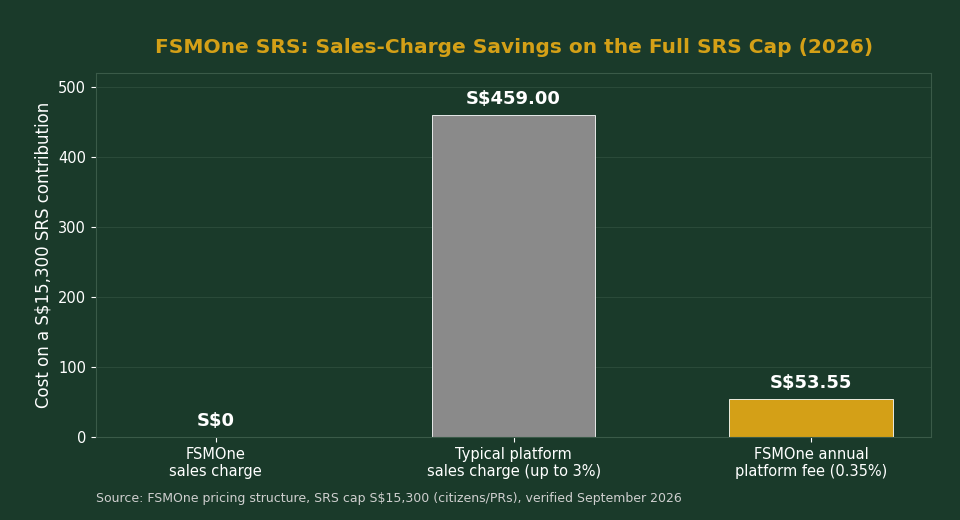
FSMOne’s SRS account lets you invest that money at a permanent 0% sales charge — a fee some other platforms still charge upfront, sometimes as high as 3%, before your money is even invested. Sign up with referral code P0544985.
SRS funds bought through FSMOne aren’t entirely free, though. You still pay the standard tiered platform fee: 0.05% per quarter (0.2% per year) on fixed income funds, or 0.0875% per quarter (0.35% per year) on most other unit trusts, for portfolios up to S$300,000. Stock trades on SGX are a flat S$8.80 per trade, with no percentage brokerage. All fees are exclusive of Singapore’s 9% GST, which applies to Singapore tax residents.
| Fee type | FSMOne SRS rate |
|---|---|
| Sales charge on unit trusts | 0% (permanent) |
| Platform fee — fixed income funds | 0.05%/quarter (0.2%/year) |
| Platform fee — other unit trusts | 0.0875%/quarter (0.35%/year), up to S$300k |
| SGX stock trade | Flat S$8.80/trade |
Source: FSM Global pricing structure, secure.fundsupermart.com, verified September 2026. Fees exclude 9% GST chargeable to Singapore tax residents.
The Rotation Playbook, Step by Step
Here’s how the three platforms slot together in practice. Each step has a clear trigger, so you’re never guessing when to move.
| Step | Action | Trigger to move on |
|---|---|---|
| 1 | Book cars via TribeCar instead of owning one; bank the monthly savings | Once you have a spare S$500-S$1,000+ built up |
| 2 | Open a MariBank account (code 2DCT80WQ) and park the savings there | Day 30 of the bonus window approaching |
| 3 | Open an SRS account and link it to FSMOne (code P0544985) | Do this in parallel with Step 2, not after — SRS accounts take a few days to open |
| 4 | Contribute the MariBank balance into SRS, then invest at 0% sales charge | Bonus rate has decayed to 0.88% p.a. |
| 5 | Repeat: TribeCar savings build the next batch, MariBank catches a fresh bonus if you qualify again, FSMOne absorbs the rotation | Ongoing, monthly or quarterly |
Note that MariBank’s richest bonus tiers are generally new-user offers, so this exact 30-day cycle may not repeat indefinitely on one account. Treat the first rotation as the main event, then default to the 0.88% p.a. base rate as your holding pen for the next batch of TribeCar savings while you build toward your next SRS contribution.
Worked Example: The Full S$15,300 SRS Cap
Say you’re a Singapore citizen or PR maximising your SRS contribution for the year — the annual cap is S$15,300. Here’s how the numbers play out if you route that full amount through this strategy.
| Item | Amount |
|---|---|
| Annual SRS cap (citizens/PRs) | S$15,300 |
| MariBank bonus-window interest on S$15,300 for 30 days (2.48% p.a.) | ~S$31.24 |
| Sales charge if bought via a platform charging up to 3% | S$459.00 |
| Sales charge via FSMOne (permanent 0%) | S$0 |
| FSMOne annual platform fee (0.35% on S$15,300) | ~S$53.55/year |
| Combined first-year benefit vs a 3%-sales-charge platform | ~S$436.69 (S$31.24 bonus interest + S$459 sales charge avoided − S$53.55 platform fee) |
Source: MariBank.sg, FSM Global pricing structure, IRAS-cited SRS cap figures, verified September 2026. Figures are illustrative; actual sales charges vary by platform and fund, and this is not a projection of investment returns.
That S$436.69 isn’t investment growth — markets can go up or down and nobody can promise you a return. It’s the fee and bonus-interest gap between doing this deliberately versus dumping the same S$15,300 into a platform that charges an upfront sales charge and parking your TribeCar savings in an account with no bonus tier at all.
How This Differs From the Other 7 TribeCar Combos
This is the eighth 3-way TribeCar referral combo published on The Kopi Notes. Each one uses a genuinely different mechanic — here’s how the bonus-window rotation compares to what came before.
| Combo | Core mechanic |
|---|---|
| TribeCar + Trust Bank + Endowus | Sequential pipeline (buffer, then invest) |
| TribeCar + GXS + Syfe | Buffer-then-invest timing |
| TribeCar + FSMOne + IBKR | Tax-cap sequencing (fill SRS first) |
| TribeCar + MariBank + Endowus | 3-tier liquidity-horizon ladder |
| TribeCar + MariBank + Syfe | SDIC insurance-cap barbell |
| TribeCar + Trust Bank + FSMOne | Rate literacy (headline vs achievable rate) |
| TribeCar + GXS + Endowus | Named goal-buckets + fee-structure routing |
| TribeCar + MariBank + FSMOne (this article) | Bonus-window rotation — timing a decaying promotional rate |
Where the MariBank + Endowus ladder (above) is about matching money to a fixed time horizon, and the MariBank + Syfe barbell is about staying under an insurance cap, this combo is about something none of the others cover: a promotional rate that actively decays on a countdown, and using that countdown as the trigger to rotate money onward instead of letting it idle at the base rate.
Risks and Limitations
This strategy is a savings and fee-timing tactic, not investment advice. A few things to weigh before you follow it:
- Bonus tiers are promotional and can change. MariBank sets its own new-user bonus terms and can revise or withdraw them at any time. Always check the live rate on MariBank’s site before you plan around it.
- SRS money is locked until the statutory retirement age (with withdrawal penalties for early access, apart from specific exceptions), so only contribute what you’re genuinely comfortable not touching for years.
- Investing involves risk. A 0% sales charge doesn’t mean a guaranteed return — the funds you buy through FSMOne can still fall in value. Diversify and match your fund choices to your own risk tolerance.
- SDIC coverage on MariBank deposits is capped at S$100,000 per depositor per Scheme member bank — this strategy typically involves far smaller balances, but it’s worth knowing the ceiling exists.
- TribeCar savings are only real savings if you’d otherwise have bought a car. If you were never going to own one, there’s no “saved” money to rotate in the first place.
TKN may earn a referral fee if you sign up through the links in this article. That doesn’t change our numbers — every rate and fee above is sourced directly from the platforms and cross-checked against independent trackers.
Start the Rotation Today
Three sign-ups, one deliberate sequence — skip the car, catch the bonus, invest fee-free.
Frequently Asked Questions
How long does MariBank's new-user bonus interest last?
Does FSMOne really charge 0% sales charge on SRS investments?
What's the SRS contribution cap for 2026?
Do I need to sign up for TribeCar to use this strategy?
Can I keep repeating the MariBank bonus window on the same account?
Is my MariBank balance protected if the bank runs into trouble?
Is this combo different from the existing MariBank + Endowus or MariBank + Syfe articles?
Related reading: MariBank Review 2026 · Singapore Retirement Calculator
Disclaimer: This article is for educational purposes only and does not constitute financial advice. Interest rates, fees, and promotional terms are subject to change by the respective platforms — always verify current terms directly with MariBank, FSMOne, and TribeCar before acting. The Kopi Notes may earn a referral commission from links in this article at no extra cost to you.
This article was researched with the help of AI. While we strive to keep all information accurate and up to date, there may be errors. If you notice any discrepancies, please contact us.