Best Investments in Singapore (2026): Complete Guide for Every Budget
Updated September 2026 · 8-min read
The best investment in Singapore depends on your timeline, risk tolerance, and whether you’re using CPF, SRS, or cash. For risk-free returns, CPF SA gives 4% per year and Singapore Savings Bonds now yield up to 2.25% over 10 years. For long-term growth, global ETFs like CSPX have returned 10–12% annually over five years. This guide covers every major option with verified 2026 rates so you can build the right portfolio.
Not financial advice. All figures are for educational reference only. Data verified as at September 2026 unless noted.
- CPF SA/RA earns 4% risk-free — maximise it before investing elsewhere
- SSB and T-bills offer 1.52–1.6% with government backing and full liquidity
- Robo advisors (Syfe, Endowus) and global ETFs (CSPX, VWRA) are the best growth options for most investors
- Use our Singapore retirement calculator to model which mix fits your goals
📋 Table of Contents
- Why You Need an Investment Strategy in Singapore
- Best Investment Options: Returns at a Glance
- CPF — Singapore’s Built-In Investment Foundation
- Singapore Savings Bonds (SSB)
- T-Bills — Short-Term Risk-Free Returns
- Fixed Deposits
- Robo Advisors — Syfe, Endowus & StashAway
- ETFs — Global Diversification at Low Cost
- S-REITs — Dividend Income from Singapore Property
- Stocks — For the Active Investor
- Which Investment is Right for You?
- Frequently Asked Questions
Why You Need an Investment Strategy in Singapore
Singapore has one of the highest costs of living in Asia. If your savings are sitting in a regular bank account earning 0.05% interest, inflation is quietly eating them away. The CPF interest floor of 2.5% (OA) and 4% (SA) already beats most savings accounts — but they’re not enough on their own for retirement.
For perspective: if you save $1,000 a month from age 30 to 65 (35 years) and earn a consistent 6% per year, you’d accumulate about $1.4 million. At 2% (basic savings account), you’d have just $590,000. That gap is your investment strategy.
The good news? Singapore investors have access to excellent, low-cost options — from government-backed bonds to globally-diversified ETFs. The challenge is knowing which to use, and when.
Best Investment Options in Singapore: Returns at a Glance
Here’s how every major investment option stacks up on risk and expected return for a Singapore investor in 2026:
Source: CPF Board, MAS, iShares. CPF & govt rates confirmed Sep 2026. Robo/REIT/ETF returns are estimated historical averages, not guaranteed.
Source: CPF Board, MAS, SGX. All returns are estimates or historical figures — not a guarantee of future performance. As at September 2026.
CPF — Singapore’s Built-In Investment Foundation
Your Central Provident Fund (CPF) is the starting point for any Singapore investment strategy. It’s automatic, guaranteed by the government, and earns more than most savings accounts before you even do anything.
Current CPF interest rates (floor rates, confirmed through 31 December 2026):
| Account | Floor Rate | Notes |
|---|---|---|
| Ordinary Account (OA) | 2.5% | First S$20,000 earns an extra 1% (3.5% effective) |
| Special Account (SA) | 4% | Earmarked for retirement |
| MediSave Account (MA) | 4% | Healthcare expenses |
| Retirement Account (RA) | 4% | Created at age 55 from OA + SA |
Source: CPF Board. Floor rates confirmed through 31 December 2026.
If you’re below 55, the first S$60,000 of combined CPF balances earns an extra 1% interest (capped at S$20,000 from OA). That means your SA is effectively earning 5% on the first S$40,000. That’s hard to beat risk-free.
Should you invest your CPF OA via the CPF Investment Scheme (CPFIS)? Only if you can beat the 3.5–4% CPF earns effortlessly. Many investors find that sticking to CPF and investing their cash surplus in ETFs is the smarter split. Read our full CPF investment strategy guide for a detailed walkthrough.
Singapore Savings Bonds (SSB) — Safe, Flexible, and Government-Backed
Singapore Savings Bonds are issued by the Singapore government every month. You get a step-up interest rate — it starts low in year one but climbs each year you hold the bond, rewarding long-term savers.
September 2026 SSB rates (SBSEP26):
- Year 1: 1.52% p.a.
- 10-year average: 2.25% p.a. (if held the full 10 years)
The big advantage? You can redeem your SSB anytime. If you apply to redeem in any month, you get your full principal back plus accrued interest — no penalties. That’s something fixed deposits don’t offer.
Each person can hold up to S$200,000 in SSBs at any one time. Minimum purchase is S$500.
SSB is ideal for your emergency fund tier 2 — money you want to earn more than a savings account, but still need access to within 1–2 months. For a detailed breakdown, see our Singapore Savings Bonds 2026 guide.
T-Bills — Short-Term Risk-Free Returns
Treasury bills (T-bills) are short-term government securities with maturities of 6 months or 1 year. They’re sold at a discount and pay face value at maturity — the difference is your return.
Latest results (August 20, 2026 auction):
- 6-month T-bill cut-off yield: 1.60% p.a.
- 1-year T-bill cut-off yield: 1.46% p.a.
You apply for T-bills via your bank’s internet banking (DBS, OCBC, UOB) or through CPF OA. Minimum S$1,000. Results are typically announced within a week of the auction date.
T-bills are best for cash you won’t need for exactly 6 months — like parking a bonus while deciding where to invest it. They’re not as flexible as SSBs (you can’t redeem early) but the returns are similar. Full details in our Singapore T-bills 2026 guide.
Fixed Deposits — Simple but Declining Yields
Fixed deposits (FDs) are the most familiar investment for older Singaporeans. You lock in money with a bank for a fixed period — typically 3 to 12 months — and earn a stated interest rate.
In 2026, FD rates have softened significantly as the global rate cycle turns. Most local banks now offer 1.5% to 2.5% for 6 to 12 months. That’s below CPF OA’s effective rate and broadly on par with T-bills and SSBs.
The main downside: you can’t usually redeem early without a penalty. If you break an FD, you lose the interest. For that reason, SSBs are generally a better choice for most retail investors — same government-level safety, better flexibility.
Robo Advisors — Syfe, Endowus & StashAway
Robo advisors are platforms that automatically build and rebalance a diversified portfolio of ETFs on your behalf. They’re the best option for Singaporeans who want growth but don’t have time to pick individual stocks or ETFs.
Key robo advisors for Singapore investors:
| Platform | Annual Fee | CPF/SRS? | Min. Investment |
|---|---|---|---|
| Syfe | 0.25% – 0.65% | SRS only | S$1 |
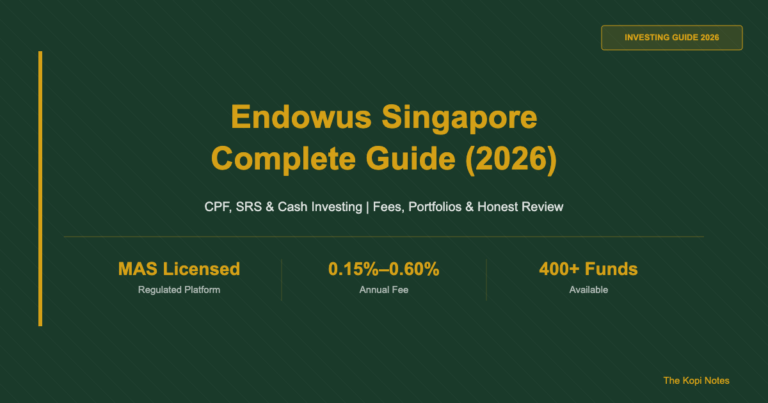
| Endowus | 0.25% – 0.60% | CPF + SRS + Cash | S$1,000 |
| StashAway | 0.2% – 0.8% | SRS only | S$1 |
Source: Official pricing pages, September 2026. Fees are management fees only — underlying fund TERs apply separately.
If you want to invest your CPF OA or SRS savings in a diversified portfolio, Endowus was the first robo to accept all three funding sources (AutoWealth has since joined for CPF OA). Use referral code 2V343 for fee rebates on your first investment.
For cash investing, Syfe is popular for its Core portfolios and REIT+ offering. Use referral code SRPRFFFCD for a fee waiver on your first few months.
Robos are great for beginners. They automate rebalancing, handle dividends, and reduce the emotional decision-making that trips up most retail investors.
ETFs — Global Diversification at Ultra-Low Cost
Exchange-Traded Funds (ETFs) are baskets of shares that track an index. Instead of picking individual stocks, you own a slice of hundreds or thousands of companies in a single trade.
For Singapore investors, the most popular approach is buying UCITS ETFs on the London Stock Exchange (LSE). This avoids US estate tax on assets over US$60,000 — a serious risk if you buy US-listed ETFs like SPY or QQQ.
Top LSE-listed ETFs for Singapore investors:
- CSPX (iShares Core S&P 500 UCITS ETF) — TER 0.07%, tracks the S&P 500
- VWRA (Vanguard FTSE All-World UCITS ETF) — TER 0.22%, global diversification across 3,500+ stocks
- EIMI (iShares Core EM IMI UCITS ETF) — TER 0.18%, emerging markets exposure
You buy these through a broker with LSE access. IBKR (Interactive Brokers) is the go-to choice — low commissions (~USD 1.70/trade), USD/GBP conversion at near-spot rate, and access to the full LSE. Use referral code jianxiong368 when signing up.
ETFs suit investors with a 5–10+ year horizon who can stomach short-term volatility. CSPX, for example, fell ~20% in 2022 but has compounded at around 10–12% annualised over 5 years. That’s the trade-off: higher volatility, higher long-run returns.
S-REITs — Quarterly Dividends from Singapore Properties
Singapore Real Estate Investment Trusts (S-REITs) own commercial properties — malls, office towers, industrial parks, data centres — and pay out at least 90% of taxable income as dividends. That makes them one of the best passive income Singapore vehicles available on SGX.
Most S-REITs pay quarterly dividends. Distribution yields currently range from 5% to 7% for blue-chip names like CapitaLand Integrated Commercial Trust (CICT) and Mapletree Pan Asia Commercial Trust (MPACT).
Unlike ETFs, REITs come with sector-specific risks — interest rate sensitivity, occupancy rates, and management quality. They’re best used as an income layer on top of a growth portfolio, not as a replacement for it.
You can buy S-REITs directly on SGX through any local broker, or through a REIT ETF for broader diversification. For a curated list, see our guide to the best S-REITs in Singapore 2026.
Stocks — For the Active Investor
Buying individual stocks — whether Singapore blue chips on SGX or US tech on NYSE — offers the highest potential returns but also the highest risk. Most retail investors underperform a simple S&P 500 ETF over the long run.
That said, Singapore investors have some structural advantages in local stocks. SGX-listed shares have no capital gains tax, and dividends from Singapore companies are generally tax-exempt at the shareholder level.
If you want to dip into individual stocks, limit them to a “satellite” allocation of 10–20% of your portfolio. The core should be low-cost, diversified ETFs. Most people are better off not stock-picking at all.
Which Investment is Right for You? A Practical Framework
There’s no single “best investment in Singapore” — it depends on your stage of life, risk tolerance, and goals. Here’s a simple decision framework:
| Your Situation | Recommended First Step |
|---|---|
| Building emergency fund | High-yield savings account → SSB (after 3–6 months’ expenses set aside) |
| Parking cash short-term | T-bills or Fixed Deposits (6–12 months) |
| Long-term growth (5+ years) | CSPX or VWRA via IBKR, or Endowus/Syfe robo for hands-off |
| Passive income now | S-REITs on SGX or Syfe REIT+ portfolio |
| Investing CPF OA | Only if you can beat 3.5% — consider Endowus or AutoWealth CPF portfolios for global exposure |
| Using SRS for tax savings | Endowus or Syfe for SRS (up to S$15,300/year for citizens/PRs) |
Use our Singapore retirement calculator to model different return scenarios and see how much you need to invest monthly to hit your retirement target.
Not financial advice. Invest based on your personal circumstances and consult a licensed financial adviser for personalised guidance.
Frequently Asked Questions
”What
”What
”Should
”What
”What
”Is
”How
This article was researched with the help of AI. While we strive to keep all information accurate and up to date, there may be errors. If you notice any discrepancies, please contact us.