Mapletree Logistics Trust Share Price: Inside the S$154.5M China Divestment (SGX: M44U)
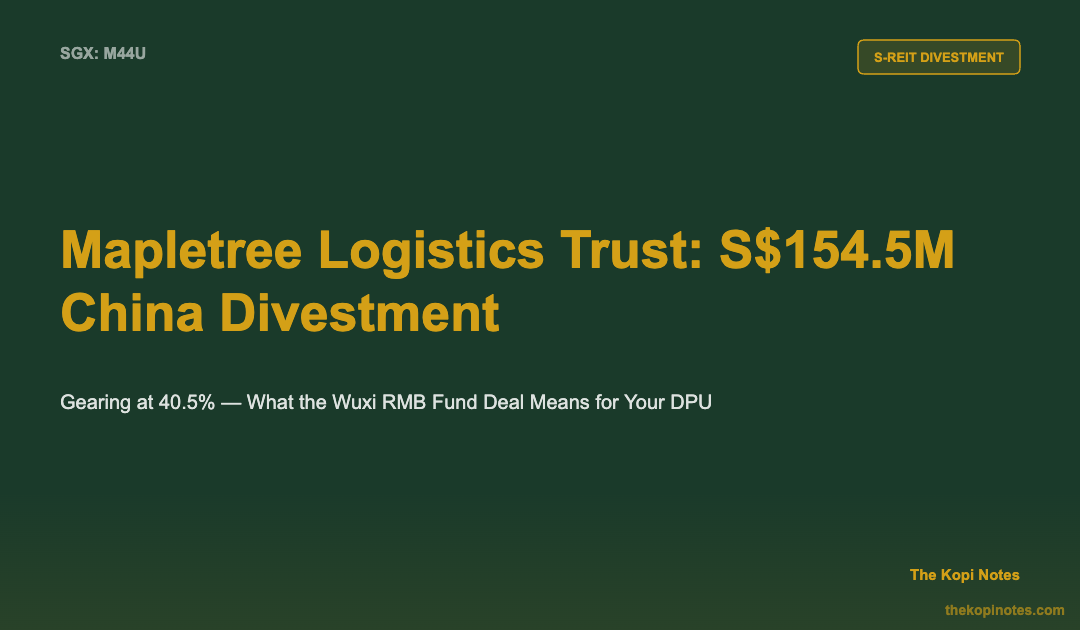
How a sponsor-led RMB fund and a S$154.5 million China-Singapore sale fit into MLT’s 40.5% gearing picture, DPU trend, and 2026 outlook.
Mapletree Logistics Trust’s share price trades around S$1.17, yielding about 6.2% after its 1Q FY26/27 results. The bigger story is a S$154.5 million China-Singapore divestment routed through a new sponsor-led RMB private fund. It’s designed to ease MLT’s 40.5% gearing, the highest among major Singapore logistics REITs, without forcing a dilutive rights issue.
Not financial advice. All figures are for educational reference only. Data as at 17 August 2026 unless otherwise stated.
- MLT is selling two Wuxi warehouses plus a Singapore property for S$154.5 million combined, with the China assets going into a new sponsor-led RMB fund.
- Gearing sits at 40.5% as at 30 June 2026, the highest among peer logistics S-REITs covered here. This divestment buys balance sheet room without new equity.
- At S$1.17, MLT yields about 6.21% on trailing DPU, but the wider S$1 billion divestment programme is only 45% complete.
Table of Contents
Contents — Click to expand
- Mapletree Logistics Trust Share Price: Where It Stands Today
- The S$154.5 Million China-Singapore Divestment, Explained
- Why MLT Needed This Deal: The 40.5% Gearing Question
- MLT vs Its Logistics Peers: Who’s Managing Debt Best?
- What the Divestment Means for Your Dividend Income
- The Risks: Why the Sponsor-Fund Route Isn’t a Free Lunch
- Should You Buy Mapletree Logistics Trust Now?
- Frequently Asked Questions
Mapletree Logistics Trust Share Price: Where It Stands Today
Mapletree Logistics Trust (SGX: M44U) last traded near S$1.17, within its 52-week range of S$1.14 to S$1.37. That works out to a trailing 12-month distribution yield of about 6.21%, based on 12 months of unit distributions totalling roughly 7.3 cents.
The trust released its 1Q FY26/27 results on 28 July 2026, for the quarter ended 30 June 2026. Distribution Per Unit (DPU) came in at 1.816 cents, up 0.2% year-on-year. That doesn’t sound like much, but it’s MLT’s first year-on-year DPU increase since 2024, after several quarters of decline driven by weak China rents.
Gross Revenue for the quarter rose 0.8% to S$178.9 million, while Net Property Income (NPI) grew a faster 2.0% to S$156.4 million, helped by a 6.3% drop in property operating expenses. Portfolio occupancy held at 96.4%, and the trust’s average cost of borrowing eased to about 2.6%.
Analysts covering M44U remain constructive. Fifteen analysts carry an average “Buy” rating with a consensus 12-month price target of S$1.39, implying roughly 19% upside from current levels, according to stockanalysis.com data as at 7 August 2026. You can see the full breakdown of individual house targets in MLT’s 2026 price target and analyst verdicts.
| Metric | Value |
|---|---|
| Share Price (17 Aug 2026) | S$1.17 |
| 52-Week Range | S$1.14 – S$1.37 |
| TTM Distribution Yield | 6.21% |
| 1Q FY26/27 DPU | 1.816 cents (+0.2% YoY) |
| Gross Revenue (1Q FY26/27) | S$178.9M (+0.8% YoY) |
| Net Property Income (1Q FY26/27) | S$156.4M (+2.0% YoY) |
| Aggregate Leverage (30 Jun 2026) | 40.5% |
| Interest Coverage Ratio | 2.9x |
| Portfolio Occupancy | 96.4% |
| Analyst Consensus | Buy, S$1.39 target (15 analysts) |
Source: Mapletree Logistics Trust 1Q FY26/27 results (28 Jul 2026); dividends.sg and stockanalysis.com, as at 17 Aug 2026 and 7 Aug 2026 respectively.
The S$154.5 Million China-Singapore Divestment, Explained
On 23 July 2026, MLT’s manager proposed selling three properties for a combined S$154.5 million. Two are Chinese warehouses in Wuxi; the third is a Singapore industrial building.
The larger Wuxi asset, Mapletree Wuxi New District Logistics Park, is a four-block, two-storey ramp-up logistics complex with 122,403 square metres of net lettable area. MLT agreed to sell it for RMB 544 million, slightly above independent valuations of RMB 541 million and RMB 536 million from JLL and Colliers respectively.
The smaller asset, Mapletree Wuxi Logistics Park, comprises three single-storey warehouse blocks totalling 45,084 square metres. Its agreed RMB 180 million price sits 6.5% to 7.1% above valuation, and 55% above the RMB 116 million MLT originally paid its sponsor for the property.
Here’s the part that makes this deal different from a normal divestment. Both Wuxi properties aren’t being sold to a third party. They’re being transferred into a newly created renminbi-denominated private fund led by MLT’s own sponsor, Temasek-owned Mapletree Investments. Combined, the two properties are valued at RMB 724 million, or about S$137.9 million.
Separately, MLT is selling 39 Changi South Avenue 2, an ageing three-storey Singapore warehouse, for S$16.6 million, a 20.3% premium to its S$13.8 million book value, to Hong Kong-listed Indigo Star Holdings.
“The proposed divestment reinforces our commitment to proactive portfolio rejuvenation and reflects our disciplined approach to capital recycling,” said Jean Kam, CEO of MLT’s manager, in the announcement. “Through the RMB fund, we can unlock value from mature assets and enhance our financial flexibility to pursue new value-accretive investment opportunities.”
Because the new RMB fund counts as a Mapletree-affiliated entity, the transaction is classified as an interested-party transaction under Singapore REIT rules. That normally invites more scrutiny. In this case, it falls under the 3% of net asset value threshold, so it doesn’t require a unitholder vote. MLT expects to receive the China sale proceeds within six months, once equity transfers, capital repatriation, and FDI deregistration procedures in China are complete.
Read more on the deal from Mingtiandi’s coverage of the SGX filing, or the underlying announcement on MLT’s investor relations site.
Why MLT Needed This Deal: The 40.5% Gearing Question
Why go through a sponsor-fund structure instead of a straightforward sale? The answer sits on MLT’s balance sheet.
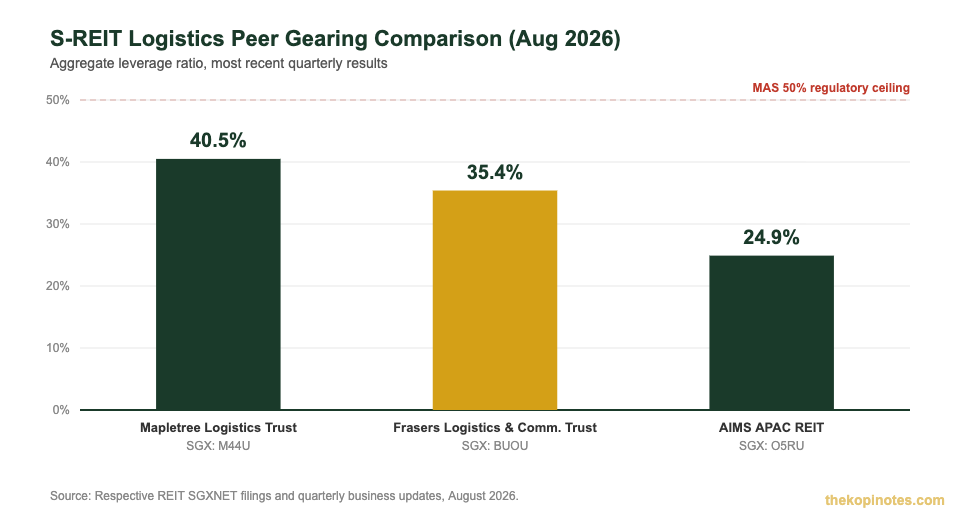
As at 30 June 2026, MLT’s aggregate leverage stood at 40.5%. That’s comfortably under MAS’s 50% regulatory ceiling for S-REITs, and interest coverage remains healthy at 2.9 times. But 40.5% is high relative to MLT’s own logistics and industrial peers, leaving less room to fund a large acquisition with fresh debt alone.
There’s also a portfolio mismatch driving the urgency. Greater China accounts for 41% of MLT’s total asset value, but contributes only 32% of gross revenue and net property income, according to a Mingtiandi report citing MLT’s own disclosures. In plain English, China ties up more balance sheet than it earns in income, relative to the rest of the portfolio.
The good news is that the bleeding has slowed. China rental reversions improved from -11.4% in FY24/25, to -2.0% in 4Q FY25/26, to -1.8% in 1Q FY26/27. Rents are still falling on renewal, just by less each quarter. That’s a recovery in progress, not a China exit.
MLT’s debt profile does offer some protection while it works through this. About 82% of total debt is on fixed rates, and 75% of the next 12 months’ regional income is hedged back into SGD. Only 2% of debt needs refinancing for the rest of FY26/27. That’s part of why MLT also arranged MLT’s S$400 million perpetual bond refinancing earlier this year, locking in funding cost certainty even as it works the divestment side of the balance sheet.
MLT vs Its Logistics Peers: Who’s Managing Debt Best?
MLT isn’t the only Singapore logistics-industrial REIT juggling gearing and growth right now. Here’s how it stacks up against two recent peer moves.
Frasers Logistics & Commercial Trust (FLCT) took the opposite approach in its latest update. It leaned into a S$441.5 million European acquisition, which pushed leverage up to 35.4% but still lifted DPU. You can read the full breakdown in Frasers Logistics & Commercial Trust’s divestment-funded growth story. It’s a useful contrast, because FLCT started from a lower gearing base and had more room to add debt.
AIMS APAC REIT sits at the other extreme. Its gearing fell to 24.9% in its most recent quarterly results, giving it the most acquisition firepower of the three, but also the smallest logistics footprint by far.
MLT’s 40.5% puts it at the tighter end of that spectrum. That’s the practical reason the sponsor-fund route matters. With less headroom to gear up, MLT needs divestments, not just debt, to keep funding new investments without diluting existing unitholders through a rights issue.
| REIT | Latest Gearing | Recent Capital Move |
|---|---|---|
| Mapletree Logistics Trust (M44U) | 40.5% | S$154.5M China-Singapore divestment via sponsor RMB fund |
| Frasers Logistics & Commercial Trust (BUOU) | 35.4% | S$441.5M European acquisition |
| AIMS APAC REIT (O5RU) | 24.9% | Portfolio recycling; leverage fell QoQ |
Source: Respective REIT SGXNET filings and quarterly business updates, as reported by The Kopi Notes, August 2026.
What the Divestment Means for Your Dividend Income
Here’s what this actually means for your wallet, in Singapore dollar terms.
Say you invest S$10,000 in MLT at S$1.17 a unit. That buys you approximately 8,547 units. Annualising the latest 1.816-cent quarterly DPU (1.816 times 4 equals 7.264 cents), your projected yearly income would be about S$620.90, a running yield of 6.21%.
Now, the divestment angle. If MLT applied the full S$154.5 million in proceeds toward debt repayment, at its current 2.6% average cost of borrowing, that would save roughly S$4.0 million a year in interest expense. Spread across MLT’s approximately 5.12 billion units outstanding, that’s about 0.08 cents per unit, a small but real upward lever on distributable income, equivalent to roughly a 1.1% lift on the current annualised DPU.
That calculation is illustrative, not a forecast. Management hasn’t confirmed the proceeds will go entirely to debt paydown. Some could be redeployed into new acquisitions instead, which is consistent with the “recycling” language MLT itself uses. Either way, you’re not getting a windfall from this specific deal. You’re getting a REIT quietly defending its balance sheet so future DPU growth isn’t capped by high leverage.
The Risks: Why the Sponsor-Fund Route Isn’t a Free Lunch
Before you read this as an unambiguous positive, sit with a few risks.
First, the interested-party structure. Selling assets to a fund run by your own sponsor is common in S-REIT land, and the pricing here, at or above independent valuations, looks fair on paper. But it still means less independent price discovery than an open-market sale to an unrelated buyer.
Second, the pace. Before this deal, MLT had completed only S$300 million of its stated S$1 billion divestment target. Adding the S$154.5 million announced in July brings the total to about S$454.5 million, just 45% of the goal. Management has publicly attributed the slow pace to a quiet transaction market and wide bid-ask spreads in China and Hong Kong. If you’re counting on MLT to hit its full target on schedule, temper that expectation.
Third, currency and regulatory friction. Getting cash out of China involves equity transfers, capital repatriation, and FDI deregistration. MLT itself flagged a six-month timeline for this. Renminbi convertibility rules can move, and delays are common in cross-border China property deals.
Should You Buy Mapletree Logistics Trust Now?
So, should you buy Mapletree Logistics Trust now? It depends on what you’re optimising for.
If you want a defensive, sponsor-backed logistics REIT with a 6.2% yield and a first DPU uptick in two years, MLT still screens reasonably well, especially against the 15-analyst “Buy” consensus and S$1.39 price target. The China divestment is a sensible, patient way to fix a real gearing constraint without punishing existing unitholders with a rights issue.
If you want the highest possible logistics-REIT yield today, MLT probably isn’t it. Its sponsor-quality premium means it trades at a tighter yield than smaller, higher-risk industrial names. And if you’re specifically worried about execution risk, the 45%-complete divestment programme is a fair reason for caution.
For most Singapore income investors, MLT works best as one holding inside a diversified S-REIT allocation, not a standalone bet on the China recovery story. If you’re building that broader base, our guide to the best S-REITs in Singapore 2026 is a good next stop, and it pairs naturally with a wider plan for passive income in Singapore.
Further detail on this quarter’s numbers is available in MLT’s 1Q FY26/27 results breakdown.
Frequently Asked Questions
What is Mapletree Logistics Trust's share price today?
As at 17 August 2026, Mapletree Logistics Trust (SGX: M44U) trades near S$1.17, within a 52-week range of S$1.14 to S$1.37. That gives a trailing 12-month distribution yield of about 6.21%, based on the last four quarters of DPU payouts.
Why is Mapletree Logistics Trust selling its Wuxi properties?
MLT is selling two Wuxi warehouses worth a combined RMB 724 million (about S$137.9 million) to trim China’s outsized share of its balance sheet. Greater China holds 41% of MLT’s asset value but generates only 32% of its gross revenue and net property income, so recycling this capital into higher-yielding opportunities improves overall portfolio efficiency.
What is Mapletree Logistics Trust's gearing ratio?
MLT’s aggregate leverage stood at 40.5% as at 30 June 2026, with an interest coverage ratio of 2.9 times. That’s within MAS’s 50% regulatory ceiling for S-REITs, but it’s on the higher side compared with peers like Frasers Logistics & Commercial Trust (35.4%) and AIMS APAC REIT (24.9%).
Is Mapletree Logistics Trust a good dividend stock for Singapore investors?
MLT offers a defensive, sponsor-backed logistics income stream yielding around 6.2%, with its first year-on-year DPU increase since 2024 reported in 1Q FY26/27. Fifteen analysts carry an average Buy rating with a S$1.39 price target. It suits investors who prioritise stability over the highest possible yield, since smaller industrial S-REITs can offer higher headline yields at greater risk.
What is the RMB private fund MLT is using for its China divestment?
It’s a newly created renminbi-denominated private fund led by MLT’s sponsor, Temasek-owned Mapletree Investments. MLT is transferring two Wuxi logistics properties into this fund at prices at or above independent valuations. Because the fund is a sponsor-affiliated entity, the deal is classified as an interested-party transaction, though it falls below the 3% of NAV threshold that would require a unitholder vote.
How does Mapletree Logistics Trust's gearing compare to other Singapore logistics REITs?
As at their most recent quarterly updates, MLT’s gearing of 40.5% is higher than Frasers Logistics & Commercial Trust’s 35.4% and considerably higher than AIMS APAC REIT’s 24.9%. This gives MLT comparatively less headroom to fund large acquisitions with fresh debt, which is why divestment-led capital recycling matters more for MLT right now than for its lower-geared peers.
Ready to Build a Diversified S-REIT Portfolio?
Open a brokerage account and start collecting quarterly distributions. Use our referral links for exclusive sign-up bonuses, and plan your income with our free tools.
This article was researched with the help of AI. While we strive to keep all information accurate and up to date, there may be errors. If you notice any discrepancies, please contact us.