Term Life Insurance for Self-Employed Singapore 2026
The Freelancer’s Complete Protection Guide — Coverage, Plans & Setup
If you’re self-employed or freelancing in Singapore, you have zero employer-provided life insurance — no group term cover, no workplace death benefits, nothing. The Life Insurance Association of Singapore’s 2017 Protection Gap Study found the average Singaporean already underinsured by 2–3× annual income for death cover; for the self-employed, that gap starts at 3× because you begin from zero. Term life insurance closes this gap for as little as $16–$40 per month depending on your age and the insurer you choose.
Not financial advice. All figures are for educational reference only. Data verified as at 9 October 2026 unless noted. Always consult a MAS-licensed adviser before purchasing any insurance product.
📋 In This Guide
Table of Contents
- Why Self-Employed Have a Bigger Protection Gap
- How Much Term Life Coverage Do You Need?
- Best Term Life Insurance Plans for Freelancers (2026)
- Monthly Premium Comparison Chart
- How to Buy Term Life Insurance as Self-Employed
- CPF & MediShield Life: What Changes for the Self-Employed
- Add-Ons Worth Considering
- Frequently Asked Questions
Why Self-Employed Singaporeans Face a Bigger Protection Gap
Employed workers in Singapore often receive a baseline group term life policy from their employers — typically $100,000 to $200,000 in death and total permanent disability (TPD) cover. Freelancers, gig workers, sole proprietors, and business owners get none of this. That means your starting protection balance is $0.
According to the Life Insurance Association of Singapore (LIA), the 2017 Protection Gap Study found the average economically active Singaporean has a protection shortfall of approximately 2× their annual income for death coverage and 3× for critical illness. For someone earning $60,000 a year, that implies a recommended coverage of at least $180,000 for death — and the self-employed need to fund all of this themselves.
The chart below illustrates the protection gap for a self-employed vs employed individual earning $60,000 annually:
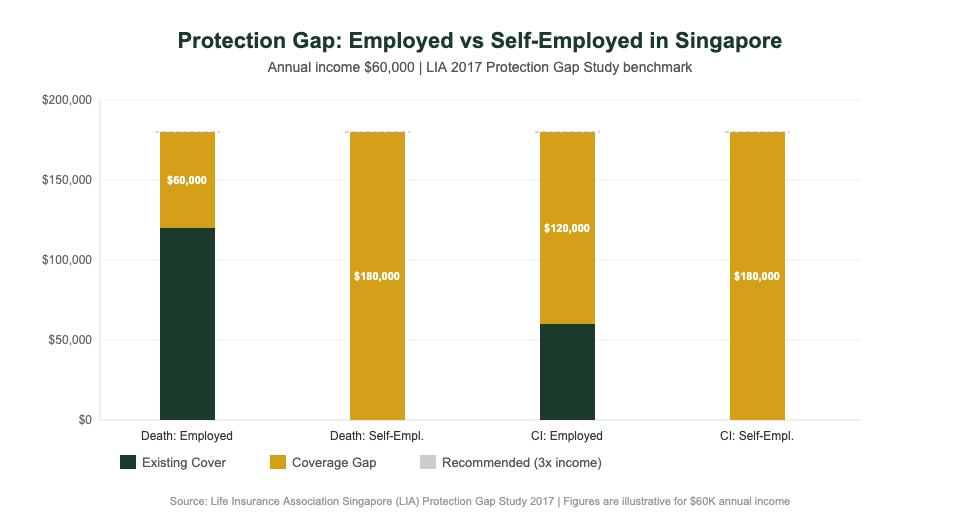
Source: Life Insurance Association of Singapore, Protection Gap Study 2017. Figures are illustrative for a $60,000 annual income.
Three key reasons why the self-employed gap is typically worse:
- No employer group cover baseline — every dollar of coverage must be self-funded
- Irregular income — income disruption from illness or death has a magnified impact when there’s no employer sick pay
- No employer CPF contributions — self-employed persons (SEPs) contribute to MediSave and MediShield Life compulsorily, but there is no employer CPF top-up to ordinary account for retirement or dependents
This is why a comprehensive life insurance comparison always starts with understanding your employment status — it changes the baseline entirely.
How Much Term Life Coverage Do You Need as a Freelancer?
There are two practical methods to size your coverage:
Method 1: LIA Income Multiplier
Use the LIA benchmark as a starting floor: 10× annual income is a commonly cited rule of thumb for working-age adults, though the LIA study references 2–3× as the average gap. For a freelancer with no baseline cover, aim for at least 10× income to replace lost earnings for a decade.
- Annual income: $60,000 → Recommended cover: $600,000 minimum
- Annual income: $100,000 → Recommended cover: $1,000,000
Method 2: DIME Framework
The DIME method is more precise for freelancers with specific obligations:
- D — Debts: Outstanding mortgage, business loans, credit card balances
- I — Income: Number of years your dependents need income support × annual income
- M — Mortgage: Outstanding home loan balance (if not counted in D)
- E — Education: Future education costs for children
A freelancer with a $400K HDB mortgage, two school-age children, and $60K annual income needing 15 years of replacement income would calculate: $400,000 + ($60,000 × 15) + $80,000 education = $1,380,000 in total coverage needed.
| Annual Income | LIA Floor (10×) | DIME Typical Range | Online Medical-Free Limit |
|---|---|---|---|
| $40,000 | $400,000 | $500K–$700K | Up to $1.5M (FWD) |
| $60,000 | $600,000 | $800K–$1.2M | Up to $1.5M (FWD) |
| $100,000 | $1,000,000 | $1.2M–$2M | Medical exam required |
| $150,000 | $1,500,000 | $1.8M–$3M | Medical exam required |
Source: LIA Protection Gap Study 2017; FWD product specifications Oct 2026. DIME ranges are illustrative.
Note: For irregular income (common among freelancers), use your average annual income over the past 3 years for a more stable baseline. Insurers may request tax assessment documents as income proof.
Best Term Life Insurance Plans for Self-Employed in Singapore (2026)
All insurers offering term life in Singapore must be licensed by MAS. The table below compares the key plans most suitable for freelancers — prioritising direct-buy availability (no agent needed), coverage flexibility, and competitive premiums.
| Insurer & Plan | Max Sum Assured | Term Options | Direct Buy? | Key Freelancer Benefit |
|---|---|---|---|---|
| FWD Term Life Plus | $1.5M (online limit) | 5–35 yrs | ✅ 100% online | Lowest premium; no agent required; MAS-licensed since 2013 |
| Singlife Term Life | $2M | 5–40 yrs | ✅ Online portal | Bundled with Singlife account; flexible premium payment frequency |
| Great Eastern GREAT Term 2 | Flexible | To age 65/70/85 | Via agent or online | Established SG insurer; strong rider options for CI add-on |
| AIA Secure Flexi Term | Flexible | 5–40 yrs | Via agent | Convertible to whole life/endowment before age 70; largest SG agent network |
| Manulife ManuProtect Term | Flexible | To age 70/85 | Via agent | Waiver of premium rider if TPD; useful for freelancers with no sick pay |
Source: Insurer product pages and MAS CompareFIRST platform, October 2026. Premiums depend on individual health, age, and underwriting.
For the self-employed who want to avoid agent commissions, FWD Term Life Plus and Singlife Term Life offer fully digital purchase with no adviser required. Compare premiums on MAS CompareFIRST before committing.
If you also lack critical illness coverage (another common freelancer gap), see our guide on critical illness insurance for self-employed Singapore — it pairs well with a term life plan.
Monthly Premium Comparison: How Much Will It Cost?
The chart below shows indicative monthly premiums for a 30-year-old male non-smoker seeking $500,000 sum assured on a 20-year term. Freelancers in Singapore typically fall into standard occupational class 1 or 2, which qualifies for standard rates.
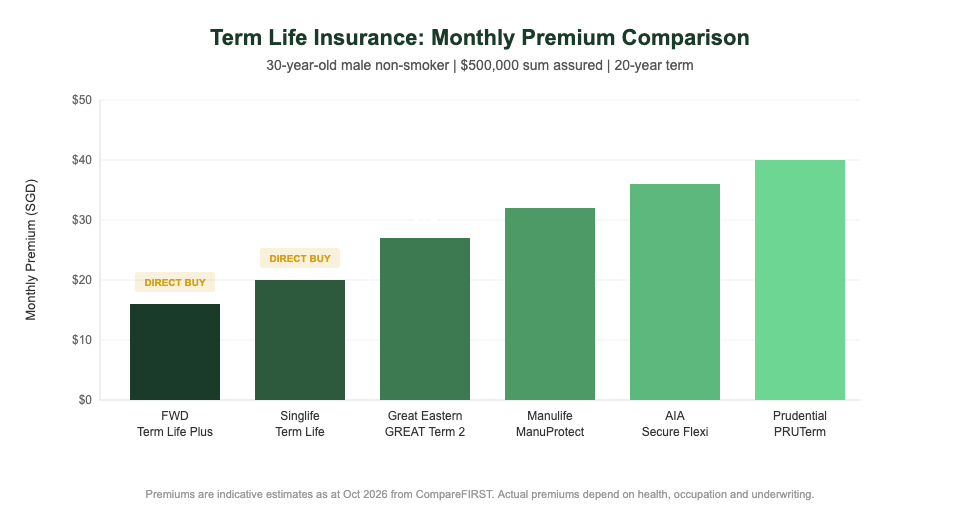
Source: MAS CompareFIRST and insurer indicative quotes, October 2026. Premiums for 30yo male non-smoker, $500K SA, 20-year term. Actual premiums depend on health, occupation, and underwriting decision.
Key takeaways for the self-employed:
- Direct-buy plans save 20–50% on premiums by cutting out agent commissions — FWD at ~$16/month vs AIA at ~$36/month for the same coverage
- Buy young: premiums increase significantly with age — buying at 30 vs 40 can be 2–3× cheaper for the same cover amount
- Non-smoker rates apply if you haven’t smoked in the past 12 months — always declare accurately on your application
- High-risk occupations (construction, offshore work, extreme sports) may face loading or exclusions — check your occupation class with the insurer
Women and younger freelancers often find even lower rates — see our guide on term life insurance for women in Singapore for female-specific premium data.
How to Buy Term Life Insurance as a Self-Employed Person
The process for self-employed applicants is similar to employed applicants, with one additional consideration: income proof. Here’s the step-by-step process:
- Calculate your coverage need using the DIME method or the 10× income rule above
- Compare on CompareFIRST (comparefirst.sg — MAS-endorsed) or obtain quotes directly from FWD/Singlife online portals
- Prepare your documents:
- NRIC (Singapore Citizen/PR) or FIN (EP/SP holders)
- Latest 2–3 years of IRAS Notice of Assessment (NOA) as income proof
- Business registration documents (if a sole proprietor)
- Health declaration (medical history, smoking status)
- Submit application: Online for FWD/Singlife; via agent for AIA/Great Eastern/Prudential. High sum assured (above $1.5M) typically requires a medical examination.
- Wait for underwriting: Most standard applications are processed within 3–7 business days. Occupation loading or medical exclusions may be applied.
- Set up GIRO payment to avoid lapses — a lapsed policy leaves you uninsured. Consider an annual payment to save 5–8% vs monthly.
A key point: if you have irregularly high earnings in one year, use a 3-year average for coverage sizing to avoid over-insuring. Conversely, as your freelance income grows, review and top up coverage accordingly — you can buy a new policy or increase cover at each life milestone.
CPF & MediShield Life: What Changes for the Self-Employed
Understanding CPF obligations helps you plan how to fund your insurance premiums:
- Compulsory MediSave contributions: All self-employed persons earning above $6,000 per year must contribute to MediSave via IRAS. The Medisave Contribution Rate for SEPs ranges from 8% to 10.5% of net trade income, depending on age. These contributions are managed by CPF Board and cannot be used to pay term life premiums directly.
- MediShield Life premiums: Deducted automatically from your MediSave account — this covers hospitalisation only, not death or TPD. You cannot use MediSave to pay term life premiums.
- No employer CPF top-up: Unlike an employed worker who receives employer CPF contributions to Ordinary Account (OA), the self-employed have no such windfall. Your OA balance stays at zero unless you make voluntary contributions.
- CPFIS workaround: If you make voluntary contributions to your OA, you could invest up to 35% of investable savings in Ordinary Account via CPFIS. But this has no link to term life insurance premiums.
Bottom line: term life premiums must be paid from cash, not CPF. Budget $200–$500 per year for $500K–$1M of coverage for a non-smoker under 35. This is one of the most cost-effective ways to close the protection gap as a freelancer.
For a complete overview of investment options specific to the self-employed, see our investing guide for freelancers in Singapore.
Riders Worth Adding as a Self-Employed Person
Riders extend your base term life plan. For freelancers who lack employer benefits, two riders are especially valuable:
- Disability Income (DI) rider or standalone DI plan: Replaces 60–75% of your income if you’re unable to work due to illness or injury. Especially critical when you have no employer sick pay. See our disability income insurance guide for self-employed for detailed plan comparisons.
- Critical Illness (CI) rider: Pays a lump sum on diagnosis of major illnesses (cancer, heart attack, stroke). The waiting period before a CI payout means your regular income stops — a CI payout lets you cover expenses during recovery without draining savings.
- Waiver of Premium on TPD: If you become totally and permanently disabled, future premiums are waived. This prevents your cover from lapsing at the exact moment you need it most.
- Payor Benefit rider (if covering a spouse/child): waives premiums if the policyholder (you, the freelancer) becomes disabled — protects coverage for dependents.
For a full breakdown of which riders actually deliver value vs which are often oversold, read our term life insurance riders guide.
Quick Comparison: Build Your Own Coverage Stack
| Coverage Type | What It Covers | Priority for Freelancers | Est. Monthly Cost |
|---|---|---|---|
| Term Life (base) | Death + TPD lump sum | 🔴 Critical | $16–$40 |
| Disability Income | Monthly income if can’t work | 🔴 Critical | $50–$120 |
| Critical Illness | Lump sum on major illness | 🟡 High | $80–$200 |
| MediShield Life + IP | Hospitalisation costs | 🟡 High (compulsory) | Varies (CPF MediSave) |
Estimates for a 30-year-old non-smoker. Actual premiums vary by insurer and health status. October 2026.
Build Your Emergency Fund First
Before purchasing any insurance, ensure you have 6–12 months of living expenses in a high-yield savings account. A solid emergency fund prevents you from lapsing your insurance policy during a slow income month. Consider parking your emergency fund in a digital savings account for the best interest rates — many offer 3–4% p.a. with no lock-in.
Frequently Asked Questions
Can a freelancer or self-employed person buy term life insurance in Singapore?
How much term life insurance does a freelancer in Singapore need?
Can I use CPF to pay for term life insurance premiums?
What income documents do insurers require from self-employed applicants?
Is term life or whole life insurance better for a freelancer?
What happens to my term life policy if I switch back to employment?
Get Free Insurance Advice
Speak with a licensed insurance advisor. No obligation, no cost.
By submitting this form, you agree to our Privacy Policy.
This article was researched with the help of AI. While we strive to keep all information accurate and up to date, there may be errors. If you notice any discrepancies, please contact us.