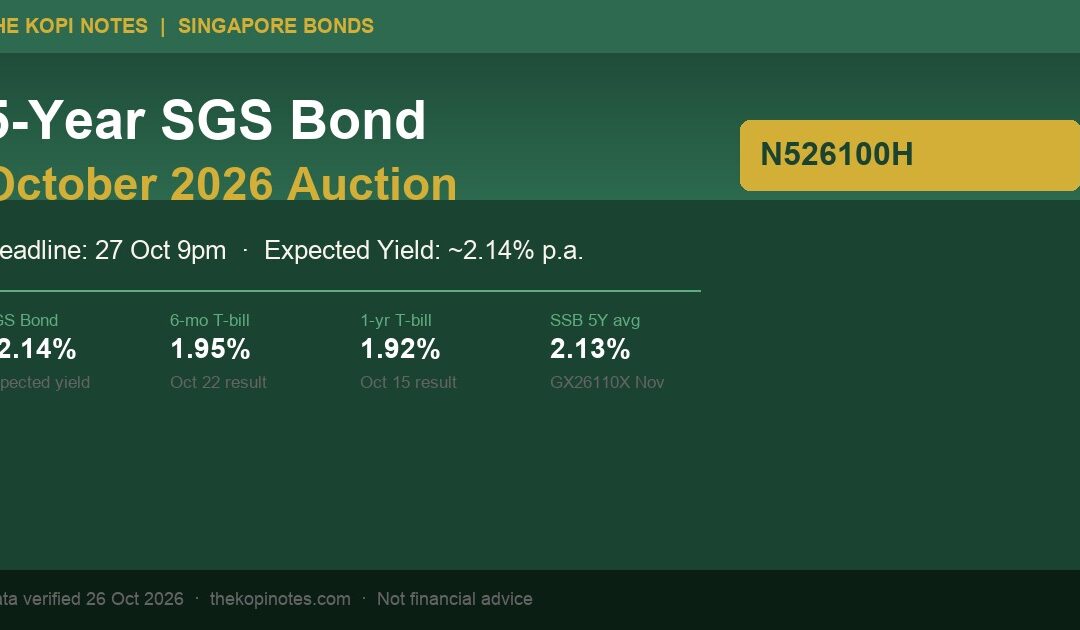
Singapore’s 5-year SGS bond N526100H goes to auction on 28 October 2026 — and applications close at 9pm tomorrow (Tuesday, 27 October). With rising global bond yields pushing the 5-year benchmark to 2.14% p.a., this bond now offers a higher headline yield than 6-month T-bills (1.95%), 1-year T-bills (1.92%), and comparable fixed deposits. Here is everything Singapore retail investors need to know before the deadline.
This is an editorial analysis. Not financial advice. Data verified as at 26 October 2026.
What Is the N526100H SGS Bond?
The N526100H is a newly issued 5-year Singapore Government Securities (SGS) Market Development Bond. Unlike the 6-month and 1-year T-bills that Singapore retail investors typically trade, this is a medium-term bond that pays a fixed coupon every six months over a 5-year holding period.
SGS bonds are issued by the Singapore government and backed by the full faith and credit of the Republic of Singapore. They are among the safest fixed-income instruments available to retail investors here, sitting alongside CPF accounts, Singapore Savings Bonds (SSBs), and T-bills in the spectrum of low-risk cash management tools.
The key difference between the N526100H SGS bond and the more familiar T-bills and SSBs:
- Versus T-bills: T-bills are zero-coupon instruments with 6-month or 1-year tenors. The SGS bond pays regular coupons every 6 months over 5 years, providing income along the way.
- Versus SSBs: The Singapore Savings Bond can be redeemed in any given month with no penalty — the SGS bond cannot. If you need to exit early, you must sell on the secondary market, and you may receive more or less than you paid.
- Versus fixed deposits: The SGS bond is a tradeable security; bank FDs are not. This introduces price risk but also potential for capital gains if yields fall after you buy.
Key Bond Details at a Glance
| Detail | N526100H |
|---|---|
| Issue Code | N526100H |
| ISIN | SGXF62237023 |
| Auction Date | 28 October 2026 |
| Application Deadline | 27 October 2026, 9:00pm |
| Issue Date | 2 November 2026 |
| Maturity Date | 2 November 2031 |
| Tenor | 5 years |
| MAS Intended Tender | S$300 million |
| Total Outstanding (incl. reopenings) | S$3.2 billion |
| Coupon Frequency | Semi-annual (1 May & 1 November) |
| Expected Cut-Off Yield | ~2.10%–2.18% p.a. (benchmark: 2.14% on 22 Oct) |
| Previous Comparable Auction (NX21100N, 26 Jun 2026) | 1.75% p.a. |
| Min Application Amount | S$1,000 |
| Application Channels | DBS/POSB, OCBC, UOB (ATM, internet banking, app); CPF-IS & SRS eligible |
Note: Cut-off yield is determined at auction. The 2.10%–2.18% range is based on the 5-year SGS benchmark yield between 19–23 October 2026. The coupon rate will be set at the time of auction. Verify all details at the MAS website before applying.
Why Singapore Bond Yields Are Rising in 2026
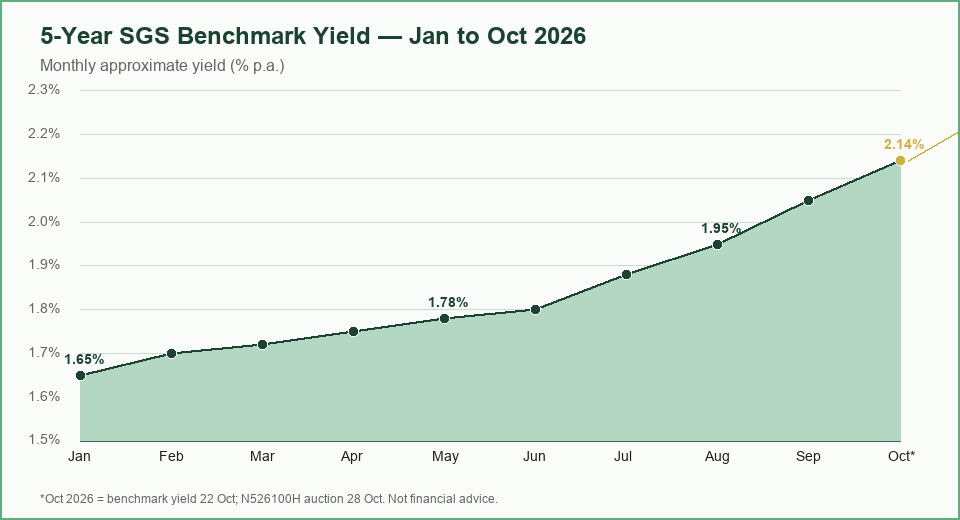
The jump from 1.75% (June 2026) to an expected ~2.14% for this October auction is not a coincidence. It reflects a broad repricing of risk-free rates globally — and Singapore is feeling the pull.
Three macro forces are at work:
1. US Treasury yields above 5%. The US 10-year Treasury yield surpassed 5% in September 2026 — a level not seen since 2023 and one that redefines what “risk-free” pays globally. When US rates rise, investors demand higher yields on comparable instruments elsewhere, including Singapore government bonds.
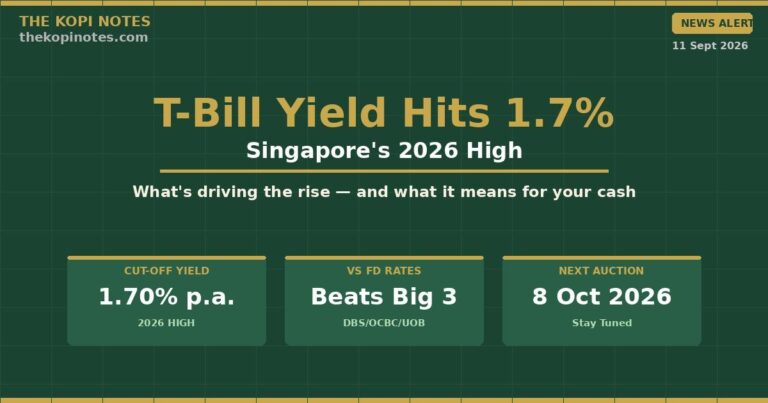
2. Singapore’s yield curve repricing. The 10-year SGS yield was around 1.86% a year ago. By early October 2026, it had climbed above 2.36% and continued rising. The 5-year point of the curve followed. This is why the 6-month T-bill yield hit a 2026 high of 1.95% on October 22 and the 1-year T-bill reached 1.92% on October 15.
3. “Higher for longer” rate expectations. Resilient US economic data, sticky inflation, and heavy US government borrowing have pushed out expectations for rate cuts. For Singapore retail investors, this means the elevated yields on T-bills, SGS bonds, and SSBs may persist for some time — but locking in now offers certainty at a time of uncertainty.
N526100H vs T-Bills, SSBs, Fixed Deposits, and CPF: Full Comparison
Here is how the 5-year SGS bond compares to the other key cash management tools available to Singapore retail investors in October 2026:
| Instrument | Tenor | Yield (p.a.) | Flexibility | Min. Amount |
|---|---|---|---|---|
| 5-Yr SGS Bond N526100H | 5 years | ~2.14%* | Low (secondary market exit only) | S$1,000 |
| 6-Month T-Bill (Oct 22, 2026) | 6 months | 1.95% | Low (held to maturity) | S$1,000 |
| 1-Year T-Bill (Oct 15, 2026) | 1 year | 1.92% | Low (held to maturity) | S$1,000 |
| SSB GX26110X — 5-Year Average | Up to 5 yrs | 2.13% | High (monthly redemption) | S$500 |
| SSB GX26110X — 10-Year Average | 10 years | 2.45% | High (monthly redemption) | S$500 |
| Best 12-Month FD (indicative, Oct 2026) | 12 months | ~2.10%** | Medium (early withdrawal penalty) | S$10,000–S$20,000 |
| Best 6-Month FD (indicative, Oct 2026) | 6 months | ~2.05%** | Medium (early withdrawal penalty) | S$10,000+ |
| CPF Special Account (Q4 2026) | Ongoing | 4.00% | Medium (CPF withdrawal rules) | CPF funds only |
| CPF Ordinary Account (Q4 2026) | Ongoing | 2.50% | High (CPF-OA more accessible) | CPF funds only |
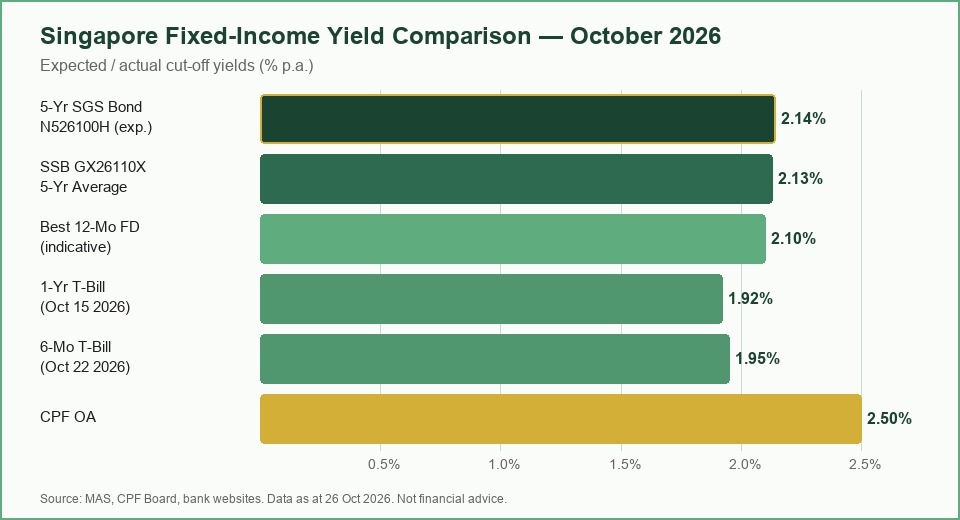
*Expected cut-off yield based on 5-year SGS benchmark yield of 2.14% on 22 October 2026. Actual cut-off set at auction. **FD rates are indicative for October 2026 as reported by financial comparison sites; verify with individual banks before applying. CPF rates confirmed at cpf.gov.sg for Q4 2026. SSB rates confirmed at MAS official document GX26110X-eapps.pdf.
The key takeaway: The 5-year SGS bond offers a higher fixed yield than T-bills for investors willing to commit for five years. It also edges out the SSB’s 5-year average return (2.13%) by a small margin — but with significantly less flexibility. The SSB, which allows penalty-free monthly redemptions, remains the better option for those who want medium-term yield with an exit option.
How to Apply Before the Deadline
The application deadline for N526100H is 27 October 2026 at 9:00pm. Note that some banks close their ATM and internet banking portals 1–2 business days before the auction, so today (Monday, 26 October) is effectively the last safe day to apply via some channels. Check your bank’s specific cut-off time.
Cash applications (using your savings or current account funds):
- DBS/POSB: Via ATM, internet banking (iBanking), or DBS digibank mobile app
- OCBC: Via ATM, internet banking, or OCBC mobile app
- UOB: Via ATM or internet banking (note: UOB does not support mobile app applications for SGS bonds)
SRS (Supplementary Retirement Scheme) applications:
Submit through your SRS operator’s internet banking — DBS/POSB, OCBC, or UOB. This is a particularly useful channel if you have undeployed SRS funds earning the default 0.05% interest rate in cash form.
CPF Investment Scheme (CPFIS) applications:
- CPFIS-OA: Available via your CPFIS agent bank (DBS/POSB and OCBC online; UOB requires an in-person branch visit for SGS bonds)
- CPFIS-SA: Through your CPFIS bond dealer; DBS/POSB and UOB require an in-person branch visit
For non-competitive bids (the recommended approach for most retail investors), you will receive the cut-off yield determined at auction. Non-competitive bids are filled first, up to 40% of the issue — if demand exceeds 40%, allotments are pro-rated, meaning you may receive less than the full amount you applied for.
Applications are processed in S$1,000 denominations. A transaction fee of S$2 typically applies for ATM and internet banking applications.
Risks to Consider Before You Bid
The N526100H SGS bond is a Singapore government obligation — credit risk is virtually zero. However, several other risks matter for retail investors:
1. Market price risk. If interest rates continue rising after the auction, the market value of your bond will fall below par. You would only realise this loss if you sell before maturity. If you hold to November 2031, you receive full face value plus all coupons — regardless of what rates do in between.
2. Liquidity risk. Unlike T-bills or SSBs, SGS bonds do not have a government-backed buyback window. The secondary market for 5-year SGS bonds exists, but it is not as liquid as the T-bill or SSB market. If you need cash urgently, you may not be able to sell at your target price or timing.
3. Opportunity cost. Five years is a long time in Singapore’s investment landscape. If T-bill yields or FD rates rise significantly above 2.14% over the next 12–24 months, you will be locked into a lower rate. Conversely, if yields fall (as many expect when the US Federal Reserve eventually eases), your locked-in rate looks attractive.
4. The SSB alternative is close. The November 2026 SSB (GX26110X) offers a 5-year average return of 2.13% — just 1 basis point below the expected SGS yield — but with full monthly redemption flexibility. The application deadline is the same: 27 October at 9pm. For most retail investors, the SSB is the dominant alternative.
Who Should Consider the 5-Year SGS Bond?
The SGS bond is not for everyone. It suits investors in a specific set of circumstances:
Investors who want certainty and income over five years. If you have a known future liability in 2031 — school fees, a property purchase, or retirement drawdown — locking in a 2.14% yield with semi-annual coupon payments provides reliable, predictable income. The coupons arrive every 1 May and 1 November.
SRS investors with undeployed funds. If your SRS account is sitting in cash at 0.05%, the 5-year SGS bond at ~2.14% is a meaningful improvement. Unlike equities or unit trusts, the SGS bond does not introduce equity market risk, which may suit older investors managing retirement savings.
CPFIS-OA users with excess OA funds. The CPF OA earns 2.5% p.a. — which is higher than the expected SGS yield. In most cases, keeping excess funds in CPF-OA is better than buying the 5-year SGS bond. However, if you are above the CPF Enhanced Retirement Sum and cannot top up further, deploying CPFIS-OA funds into a government bond can be one structured approach.
Bond ladder builders. Some experienced investors construct bond ladders — staggered maturities across 2-year, 5-year, and 10-year government securities — to manage interest rate exposure while maintaining regular income. The N526100H can serve as the 5-year rung if you already hold shorter and longer positions.
The SGS bond is not well-suited for investors who value flexibility above all, or who may need the capital before November 2031. For those investors, the SSB November 2026 offers nearly identical yield (for a 5-year hold) with full redemption flexibility, and a lower minimum of S$500.
Bottom Line for SG Investors
The 5-year SGS bond N526100H is entering the market at the right time. The 5-year SGS benchmark yield of 2.14% represents an 18-month high and reflects a broad repricing of Singapore government rates as global yields normalise at higher levels.
For investors who want government-backed certainty at a reasonable yield and can commit for 5 years, the N526100H offers a marginally better headline yield than both T-bills and the November SSB’s 5-year average. The semi-annual coupon payments also provide a regular income stream that T-bills and SSBs do not match in the same way.
However, if flexibility matters to you at all — and for most Singapore retail investors it should — the November 2026 SSB at 2.13% (5-year) or 2.45% (10-year) with monthly redemption rights is the superior choice. The deadline is the same, the credit quality is identical, and the loss of 1 basis point in yield is an extremely small price to pay for the ability to exit at any time.
Action items for today (Monday, 26 October):
- Decide between the SGS Bond N526100H and SSB GX26110X before tomorrow’s 9pm deadline
- Check your bank’s specific cut-off time (some close ATM/ibanking for bonds a day early)
- Apply via DBS/POSB, OCBC, or UOB (ATM, ibanking, or app where applicable)
- For SRS holders: apply through your SRS operator’s internet banking today
- For CPFIS-SA applicants at DBS or UOB: note the in-person branch visit requirement
Frequently Asked Questions
What is the difference between a 5-year SGS bond and a T-bill?
T-bills are short-term, zero-coupon instruments with 6-month or 1-year tenors. You buy them at a discount to face value and receive S$1,000 at maturity — the difference is your return. SGS bonds like N526100H pay a fixed coupon rate every 6 months over 5 years and return face value at maturity. SGS bonds suit investors seeking medium-term income; T-bills suit those who need liquidity within a year.
How is the cut-off yield for N526100H determined?
MAS runs a competitive auction. Institutional and retail investors submit bids at their desired yield. MAS accepts bids from lowest to highest yield until S$300 million is filled. The highest yield at which the auction clears becomes the cut-off yield. All non-competitive retail bids receive the cut-off yield. Based on the 5-year SGS benchmark of 2.14% on 22 October, the cut-off yield for N526100H is expected to be in the 2.10%–2.18% range — but actual results depend on market conditions on auction day.
Is the 5-year SGS bond better than the November 2026 SSB?
In terms of headline yield for a 5-year hold, they are virtually identical: ~2.14% for the SGS bond vs 2.13% average for the SSB GX26110X. The key difference is flexibility. The SSB allows penalty-free redemption in any month. The SGS bond does not — you must sell on the secondary market if you need cash before November 2031, and you may receive less than you paid. For most retail investors, the SSB is the better choice. The SGS bond suits investors who are certain they can hold for 5 years.
Can I use CPF or SRS funds to buy the 5-year SGS bond?
Yes. The N526100H is eligible under the CPF Investment Scheme for both OA and SA funds. However, note that CPF-OA already earns 2.5% p.a. (confirmed for Q4 2026), which is higher than the expected ~2.14% SGS yield. Using CPFIS-OA for the SGS bond would therefore earn you less than leaving the money in CPF-OA. SRS funds, however, earn just 0.05% when held as cash in the SRS account — so purchasing the SGS bond with SRS funds is a much more meaningful yield improvement. Check the CPF investment strategy guide for more on optimising your CPF funds.
What happens if I miss the October 27 application deadline?
You cannot apply after 9pm on 27 October 2026. The next opportunity to buy the N526100H would be on the secondary market after it is issued on 2 November 2026, through your brokerage. The price on the secondary market will reflect prevailing yields at that time and may be above or below face value. If you miss this window, the next SGS bond primary auction or the next SSB (December 2026) may offer comparable opportunities.
Are Singapore government bonds (SGS) taxable?
SGS bonds issued between 28 February 1998 and 31 December 2028 — which includes N526100H — are eligible for Qualifying Debt Security (QDS) tax incentives. For most Singapore individual investors, interest income from SGS bonds is taxable but the QDS status can provide tax benefits for institutional investors. Individuals should consult a tax advisor for their specific situation. Singapore Savings Bonds (SSBs), by contrast, are fully exempt from Singapore income tax, which is one reason many retail investors prefer them.
How does buying a 5-year SGS bond fit into a broader investment portfolio?
The 5-year SGS bond belongs in the “Income” or “Safe” bucket of a Singapore retail investor’s portfolio — alongside SSBs, T-bills, CPF contributions, and fixed deposits. It is not a substitute for equity investments in S-REITs or ETFs. If you are building long-term wealth, tools like CPF top-ups (earning 4% p.a. in SA) and broad market ETFs should come first. SGS bonds are most useful for allocating specific medium-term cash reserves that you know you will not need before 2031. See our guide on best S-REITs in Singapore 2026 for the higher-yield, higher-risk end of the spectrum.
This article was researched with the help of AI. While we strive to keep all information accurate and up to date, there may be errors. If you notice any discrepancies, please contact us.