Singlife Secure Saver VII Review 2026: Is It Worth It?
An honest, independent review — product specs, surrender penalties, Reddit questions answered, and how it compares to SSBs, T-bills, and fixed deposits.
Singlife Secure Saver VII is a 2-year, single-premium endowment plan offering a guaranteed yield of 3.40% per annum — returning 106.92% of your premium at maturity. It is underwritten by Singapore Life Ltd. and accepts both cash and SRS funds. However, your money is fully locked in for two years, and early surrender in Year 1 could mean getting back less than what you put in. Whether it suits you depends entirely on your liquidity needs and what alternatives are available.
Not financial advice. All figures are for educational reference only. Data as at June 2026 unless noted. The Kopi Notes does not sell insurance products. Always read the Product Summary before purchasing.
- Singlife Secure Saver VII offers 3.40% p.a. guaranteed over 2 years — higher than current SSBs (2.11%), T-bills (1.48%), and FDs (1.45%). But the tranche is now closed.
- The catch: your money is locked for 2 years. Early surrender in Year 1 may result in a loss. No partial withdrawals allowed.
- If you need liquidity or think rates might rise, SSBs or T-bills give you more flexibility — even at lower yields.
Table of Contents
Contents — Click to expand
- What Is Singlife Secure Saver VII?
- Key Features at a Glance
- What Reddit Is Asking About Secure Saver VII
- Guaranteed Returns — Worked Examples in SGD
- Surrender Value and Lock-In Period
- Secure Saver VII vs Alternatives
- When It Makes Sense (and When It Doesn’t)
- SRS Integration and Tax Benefits
- How to Apply
- Frequently Asked Questions
What Is Singlife Secure Saver VII?
Singlife Secure Saver VII is a single-premium, non-participating endowment plan issued by Singapore Life Ltd. (Singlife). It belongs to Singlife’s “Secure Saver” series — a line of short-term endowment plans released in tranches, each with slightly different guaranteed yields.
“Non-participating” means there are no bonuses tied to the insurer’s participating fund performance. What you see is what you get — the return is 100% guaranteed, with no upside or downside from investment performance. That’s the appeal for conservative savers.
The plan works simply. You pay a single lump-sum premium upfront. After two years, Singlife pays you back 106.92% of that amount. During the policy term, you also get basic life coverage of 105% of the premium in the event of death.
Singlife is regulated by the Monetary Authority of Singapore (MAS) and the plan is protected under the Policy Owners’ Protection (PPF) Scheme administered by the Singapore Deposit Insurance Corporation (SDIC). However, PPF coverage has limits — up to S$500,000 for guaranteed sum assured and S$100,000 for guaranteed surrender value per life assured per insurer.
Key Features at a Glance
| Feature | Detail |
|---|---|
| Product Name | Singlife Secure Saver VII |
| Type | Single-premium, non-participating endowment |
| Guaranteed Yield | 3.40% p.a. |
| Guaranteed Maturity Benefit | 106.92% of single premium |
| Policy Term | 2 years |
| Minimum Premium | S$20,000 (some distributors require S$50,000) |
| Maximum Premium | S$500,000 per policy (multiple policies possible) |
| Premium Multiples | S$100 |
| Payment Mode | Cash (bank transfer, PayNow) or SRS funds |
| Entry Age (Cash) | 1 to 75 ANB (age next birthday) |
| Entry Age (SRS) | 19 to 75 ANB |
| Death Benefit | 105% of single premium |
| Medical Underwriting | Not required — guaranteed issuance |
| Capital Guarantee | From start of 2nd policy year |
| Tranche Status | Closed (next tranche TBA) |
Source: Singlife Secure Saver VII brochure, InsureDIY factsheet. Data as at June 2026.
What Reddit and Online Communities Are Asking About Secure Saver VII
Singapore’s personal finance communities — on Reddit, HardwareZone, and Seedly — have strong opinions about short-term endowment plans. Here are the most common questions and concerns we found, answered honestly.
“Is Singlife Secure Saver VII worth it, or should I just stick with T-bills?”
This is the most common question. The answer depends on what “worth it” means to you.
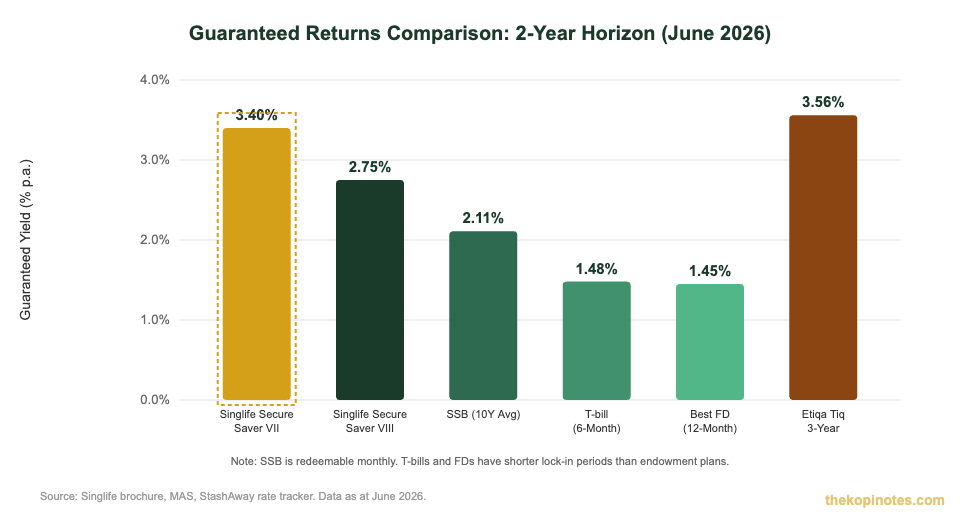
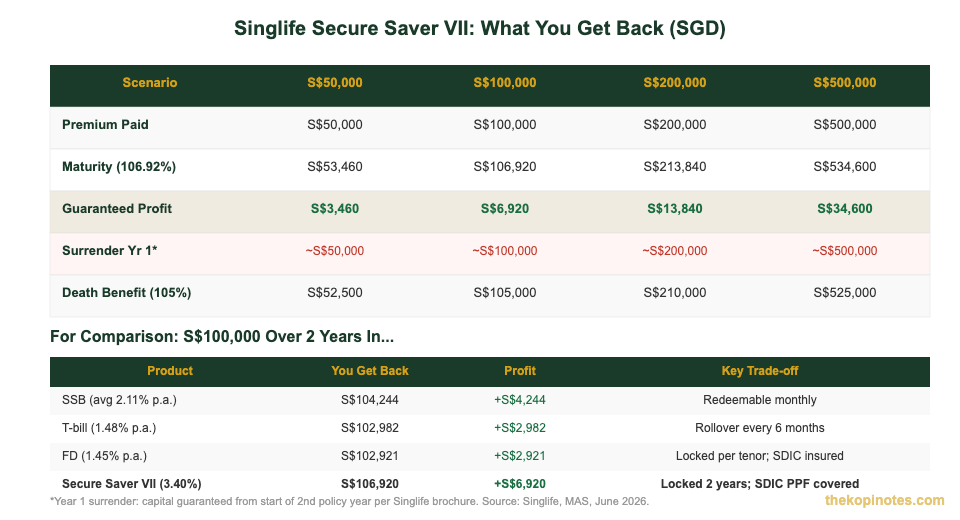
On pure yield, Secure Saver VII wins. Its 3.40% p.a. guaranteed rate comfortably beats the latest 6-month T-bill cut-off yield of 1.48% p.a. (June 2026 auction). Over two years on a S$100,000 investment, that’s S$6,920 back from Secure Saver VII versus approximately S$2,982 from rolling T-bills at current rates.
However, T-bills give you something Secure Saver VII does not: flexibility. T-bills mature every 6 months. If interest rates rise, you can reinvest at the higher rate. With Secure Saver VII, you’re locked in at 3.40% regardless of what happens to rates. If you think rates will climb, T-bills may actually serve you better despite the lower current yield.
The other catch is liquidity. You can let a T-bill mature in 6 months and get your money back. With Secure Saver VII, surrendering in Year 1 could mean getting back less than your premium. That’s a real cost if an emergency comes up.
“What happens if I surrender early? Will I lose money?”
Potentially, yes — especially in Year 1. Singlife states that early termination “usually involves high costs and the surrender value, if any, that is payable to you may be zero or less than the total premiums paid.”
The good news: from the start of the 2nd policy year, your capital is fully guaranteed. So if you surrender any time after the first anniversary, you should get back at least 100% of your premium. But you will forfeit the guaranteed yield that would have accrued at maturity.
Bottom line: don’t put money into this plan unless you’re confident you won’t need it for two full years.
“Is Singlife financially stable? Can they actually pay out?”
This comes up a lot, especially from people unfamiliar with Singlife. Singapore Life Ltd. is licensed and regulated by MAS. It’s backed by Sumitomo Life Insurance Company (Japan) after the completion of the merger with Aviva Singapore in 2023.
The plan is also protected under the PPF Scheme administered by SDIC. However, note that PPF protection has limits — it covers up to S$500,000 for guaranteed sum assured and S$100,000 for guaranteed surrender value per life assured per insurer. It is not the same as SDIC deposit insurance for bank accounts, which covers up to S$100,000.
For most retail investors putting in S$50,000–S$200,000, the PPF coverage is adequate. For very large sums, you should understand the limits.
“Why is the tranche always sold out so fast?”
Singlife releases Secure Saver plans in limited tranches — essentially capped funding rounds. Once the tranche limit is hit, applications close. HardwareZone forum users have described it as “buying train tickets on peak holiday” — agents reportedly race to submit applications at midnight when a tranche opens, prioritising larger premiums first.
The tranche system creates urgency. That can be frustrating, but it’s also how Singlife manages their investment portfolio on the back end — they match the premiums received to specific fixed-income assets, so they can’t accept unlimited applications.
If you missed Secure Saver VII, the next tranche (likely Secure Saver IX or X) will offer a different rate reflecting the prevailing interest rate environment. Don’t rush into an alternative product just because you missed this one.
“Should I use my SRS funds for this?”
Using SRS funds for Secure Saver VII can make sense — but only if you understand the full picture. Contributions to your SRS account are tax-deductible up to S$15,300 per year (for Singapore citizens and PRs). When you withdraw after retirement age, only 50% of the withdrawal is taxable.
However, SRS withdrawals before retirement age are penalised with a 5% penalty plus full taxation. So if you use SRS funds, make sure you won’t need those funds until retirement. The 2-year Secure Saver VII policy term is fine, but the SRS lock-in extends much further.
Also note: when you use SRS, the policyholder must be the life assured (no third-party policies allowed).
“3.40% sounds great, but isn’t it just because interest rates are high right now?”
Yes — and this is an important point many buyers miss. Singlife’s guaranteed yield on Secure Saver directly reflects the prevailing interest rate environment when each tranche is launched. Earlier tranches offered higher rates: Secure Saver V had 3.80% p.a. when rates were peaking. Secure Saver VIII dropped to 2.75% p.a. as rates fell, and Secure Saver IX is at 2.70% p.a.
The 3.40% on Secure Saver VII was competitive when it launched (mid-2024). But if you’re reading this in 2026, the current tranche — whatever is available — will reflect today’s lower rate environment. Don’t compare today’s alternatives against a rate that is no longer available.
“Is this better than just putting money in a high-yield savings account?”
High-yield savings accounts in Singapore currently offer around 2.5%–4% on small balances (typically the first S$75,000–S$100,000), but these rates require you to meet multiple conditions — salary crediting, card spending, bill payments, and insurance purchases. The effective rate on larger sums drops significantly.
Secure Saver VII’s 3.40% applies on the full amount, no conditions attached (beyond holding to maturity). For a straightforward S$50,000–S$200,000 parked for two years, Secure Saver VII likely beats most savings accounts on effective yield.
But savings accounts give you full liquidity. You can withdraw at any time. That trade-off matters — don’t lock up your emergency fund in an endowment plan.
Guaranteed Returns — Worked Examples in SGD
Let’s cut through the percentages and show what you actually get back in dollars. Singlife Secure Saver VII pays a Guaranteed Maturity Benefit of 106.92% of your single premium. Here’s what that looks like at different premium sizes.
| Single Premium | Maturity Payout (106.92%) | Guaranteed Profit | Effective Yield p.a. |
|---|---|---|---|
| S$20,000 | S$21,384 | +S$1,384 | 3.40% |
| S$50,000 | S$53,460 | +S$3,460 | 3.40% |
| S$100,000 | S$106,920 | +S$6,920 | 3.40% |
| S$200,000 | S$213,840 | +S$13,840 | 3.40% |
| S$500,000 | S$534,600 | +S$34,600 | 3.40% |
Source: Singlife Secure Saver VII brochure. Maturity benefit = 106.92% of single premium, less any monies owed to Singlife.
A few things to keep in mind. This is a flat guaranteed return — no compounding magic. The 3.40% p.a. yield translates to a total 2-year return of 6.92%. That’s it. No bonuses, no upside participation.
Compare this to what the Singapore Savings Bonds pay: the June 2026 SSB offers an average 10-year return of 2.11% p.a. Over 2 years, a S$100,000 SSB allocation would return roughly S$104,244 — about S$2,676 less than Secure Saver VII. But you can redeem your SSB any month with no penalty.
Surrender Value and Lock-In Period
This is the part that trips people up. Endowment plans are not savings accounts. You cannot withdraw part of your money. You either hold to maturity or surrender the entire policy.
| Timing | What You Get Back | Key Risk |
|---|---|---|
| Year 1 (before 1st anniversary) | Surrender value may be less than premium paid | Potential capital loss |
| Start of Year 2 (after 1st anniversary) | Capital fully guaranteed (at least 100%) | You forfeit the guaranteed yield |
| Maturity (end of Year 2) | 106.92% of premium | None — full guaranteed payout |
Source: Singlife Secure Saver VII brochure and Singlife Secure Saver VIII product page (same surrender structure). June 2026.
The Year 1 surrender risk is real. Singlife does not publish the exact surrender value formula in the brochure — you’d need to request the Product Summary for that. But the general principle is clear: surrender before the first anniversary and you could lose money.
This is the single biggest trade-off versus T-bills and SSBs. With T-bills, your money comes back every 6 months. With SSBs, you can redeem any month. With Secure Saver VII, it’s locked for 2 years — with a penalty clause in Year 1.
Secure Saver VII vs Alternatives — Honest Comparison
Here’s how Singlife Secure Saver VII stacks up against other places you could park your cash. We’re comparing apples to oranges in some cases — endowment plans, government bonds, and bank deposits work very differently. The table below highlights the trade-offs.
| Product | Guaranteed Return | Lock-In | Min. Amount | Liquidity | Best For |
|---|---|---|---|---|---|
| Singlife Secure Saver VII | 3.40% p.a. | 2 years | S$20,000 | Low — penalty in Year 1 | Locking in higher rate |
| SSB (Jun 2026) | 2.11% (10Y avg) | None | S$500 | High — redeem monthly | Flexibility + safety |
| T-bill (6-Month) | 1.48% p.a. | 6 months | S$1,000 | Medium — every 6 months | Short-term parking |
| Best FD (12-Month) | ~1.45% p.a. | 12 months | S$500–S$20,000 | Medium — per tenor | SDIC-insured deposit |
| Etiqa Tiq 3-Year | 3.56% p.a. | 3 years | S$5,000 | Low — 3-year lock | Higher yield, longer lock |
| NTUC Gro Capital Ease | 3.38% p.a. | 2 years | S$10,000 | Low — similar structure | Alternative 2-yr plan |
Source: Singlife, MAS (SSB/T-bill), Syfe (FD rates), Etiqa, NTUC Income product pages. Data as at June 2026. Rates change with each tranche/auction.
A few honest observations from this comparison:
Secure Saver VII’s 3.40% was excellent when it launched. But it’s now closed. The latest Secure Saver IX offers just 2.70% — barely above SSB rates, with much less liquidity. The value proposition weakens significantly with each new tranche as rates decline.
If you value flexibility above all else, SSBs remain the best option for risk-free savings in Singapore. The yield is lower, but you can exit any month without penalty. For short-term needs (under 6 months), T-bills are the obvious choice.
Endowment plans like Secure Saver VII make the most sense when you have a specific 2-year cash allocation that you won’t need — perhaps earmarked for a housing down payment, a child’s education fund, or SRS deployment for tax savings.
When Secure Saver VII Makes Sense (and When It Doesn’t)
It may suit you if:
- You have a lump sum (S$20,000+) that you won’t need for 2 full years
- You want a guaranteed return with zero market risk — no chance of capital loss at maturity
- You want to deploy SRS funds into a short-term product for tax-efficient savings
- You prefer the simplicity of a set-and-forget product over rolling T-bills every 6 months
- You’re comfortable with an insurance company (not a bank) holding your money, with PPF rather than SDIC deposit insurance
It probably doesn’t suit you if:
- You might need the money within the next 2 years — the Year 1 surrender penalty is a real risk
- You believe interest rates will rise and want to reinvest at higher yields (T-bills give you this flexibility)
- You’re looking for higher returns and are willing to accept some risk — ETFs like CSPX or Singapore REIT ETFs may give better long-term returns, though with no guarantees
- You’re investing more than S$500,000 — PPF coverage limits mean you may not be fully protected
- You want partial withdrawals — this is all-or-nothing
The biggest risk with Secure Saver VII isn’t financial — it’s opportunity cost. By locking in 3.40% for 2 years, you give up the ability to redeploy that capital if something better comes along. For some people, that peace of mind is worth it. For others, the flexibility of T-bills or SSBs is more valuable than the extra yield.
SRS Integration and Tax Benefits
One of Singlife Secure Saver VII’s genuine advantages is that it accepts Supplementary Retirement Scheme (SRS) funds. Not all short-term endowment plans do — this makes it one of a smaller pool of options for SRS deployment.
Here’s why this matters. If you contribute to your SRS account, you get dollar-for-dollar tax relief up to S$15,300 per year (for Singapore citizens and PRs). That contribution then sits in your SRS account earning minimal interest — typically under 0.5% p.a. from the SRS operator bank.
By deploying those SRS funds into Secure Saver VII at 3.40% p.a., you’re earning a significantly better return on money that’s already locked away for retirement anyway. The 2-year policy term is manageable within the broader SRS timeline, and you get your SRS funds back (with the guaranteed yield) after maturity.
Key SRS rules to remember: the policyholder must be the life assured (no third-party policies). And withdrawing SRS funds before the statutory retirement age triggers a 5% penalty plus full income tax on the withdrawn amount. So only use SRS funds you’re committed to keeping locked until retirement.
How to Apply
Singlife Secure Saver VII’s tranche is currently closed. However, Singlife periodically launches new tranches in the Secure Saver series. Here’s how the application process typically works:
- Through a Singlife Financial Adviser Representative (FAR): The most common channel. FARs get early access to tranche openings and can submit applications on your behalf.
- Through InsureDIY or other brokers: Some insurance brokers like InsureDIY offer direct online applications for Secure Saver tranches.
- Through FSMOne: FSMOne (Fundsupermart) has historically distributed Singlife Secure Saver policies.
To register interest for the next tranche, you can visit the Singlife Secure Saver Series page and submit your details. Singlife will contact you when a new tranche opens.
No medical check-up is needed — it’s guaranteed issuance. Payment is via bank transfer, PayNow, or SRS. Credit card payments are not accepted.
For larger premiums (S$250,000 and above), Singlife requires an Enhanced Customer Due Diligence Questionnaire with evidence of source of wealth.
Disclaimer: This article is for educational purposes only and does not constitute financial advice. The Kopi Notes does not sell or distribute insurance products and is not affiliated with Singlife. Past tranche rates are not indicative of future tranche rates. Always read the Product Summary before purchasing any insurance or savings product. Consider consulting a licensed financial adviser for advice tailored to your personal circumstances.
Frequently Asked Questions
What is the guaranteed return on Singlife Secure Saver VII?
Singlife Secure Saver VII offers a guaranteed yield of 3.40% per annum over a 2-year policy term. At maturity, you receive 106.92% of your single premium. For example, a S$100,000 premium returns S$106,920 after two years. This return is fully guaranteed — there are no non-guaranteed bonuses or market-dependent components.
Can I withdraw my money early from Singlife Secure Saver VII?
You can surrender the policy early, but it comes at a cost. If you surrender during Year 1, the surrender value may be less than your original premium — meaning you could lose money. From the start of Year 2, your capital is fully guaranteed, but you forfeit the guaranteed yield. There is no option for partial withdrawals — it is all or nothing. This is a key disadvantage compared to Singapore Savings Bonds, which allow penalty-free monthly redemptions.
Is Singlife Secure Saver VII still available for purchase?
No — the Secure Saver VII tranche is now closed. Singlife has since launched Secure Saver VIII (2.75% p.a.) and Secure Saver IX (2.70% p.a.). Each new tranche has its own rate reflecting the prevailing interest rate environment. You can register interest for the next tranche on the Singlife website.
Can I use SRS funds to buy Singlife Secure Saver VII?
Yes. Singlife Secure Saver VII accepts Supplementary Retirement Scheme (SRS) funds as premium payment. The policyholder must be the life assured when using SRS. This is one of the plan’s genuine advantages — it allows you to earn a guaranteed yield on SRS funds that would otherwise sit earning near-zero interest in your SRS operator account. SRS contributions also qualify for income tax relief up to S$15,300 per year.
How does Singlife Secure Saver VII compare to Singapore Savings Bonds?
Secure Saver VII offers a higher guaranteed yield (3.40% vs SSB’s ~2.11% 10-year average as at June 2026). However, SSBs offer far superior liquidity — you can redeem any month without penalty, while Secure Saver VII locks your money for 2 years. SSBs also have a much lower minimum investment of S$500 versus S$20,000 for Secure Saver VII. SSBs are backed directly by the Singapore government, while Secure Saver VII is covered by the PPF Scheme with different protection limits. Neither is objectively “better” — it depends on whether you prioritise yield or flexibility.
Is Singlife Secure Saver VII protected if Singlife goes bankrupt?
Singlife Secure Saver VII is protected under the Policy Owners’ Protection (PPF) Scheme administered by the Singapore Deposit Insurance Corporation (SDIC). Coverage is up to S$500,000 for guaranteed sum assured and S$100,000 for guaranteed surrender value per life assured per insurer. This is different from SDIC bank deposit insurance. Singlife is regulated by MAS and is backed by Sumitomo Life Insurance Company of Japan.
What is the minimum investment for Singlife Secure Saver VII?
The minimum single premium is S$20,000, in multiples of S$100. Some distributors like InsureDIY required a minimum of S$50,000 for their channel. The maximum premium is S$500,000 per policy, though multiple policies are possible. For premiums of S$250,000 and above, Singlife requires an Enhanced Customer Due Diligence Questionnaire with source of wealth documentation.
Is Singlife Secure Saver VII better than a fixed deposit?
On yield alone, yes — Secure Saver VII’s 3.40% p.a. significantly beats the best 12-month fixed deposit rates in Singapore, which stand at around 1.45% p.a. as at June 2026. However, fixed deposits are covered by SDIC deposit insurance (up to S$100,000 per bank), while Secure Saver VII falls under the PPF Scheme with different limits. Fixed deposits also offer more tenor flexibility. If your priority is yield and you can lock up the funds for 2 years, Secure Saver VII was the better option. If you need SDIC protection or flexible tenors, FDs may be more suitable.
Planning Your Savings Strategy?
Whether you choose endowment plans, SSBs, T-bills, or a mix — the best strategy depends on your goals and timeline. Use our tools to plan ahead.
Get Free Insurance Advice
Speak with a licensed insurance advisor. No obligation, no cost.
By submitting this form, you agree to our Privacy Policy.
This article was researched with the help of AI. While we strive to keep all information accurate and up to date, there may be errors. If you notice any discrepancies, please contact us.