Published 11 October 2026 | News | The Kopi Notes
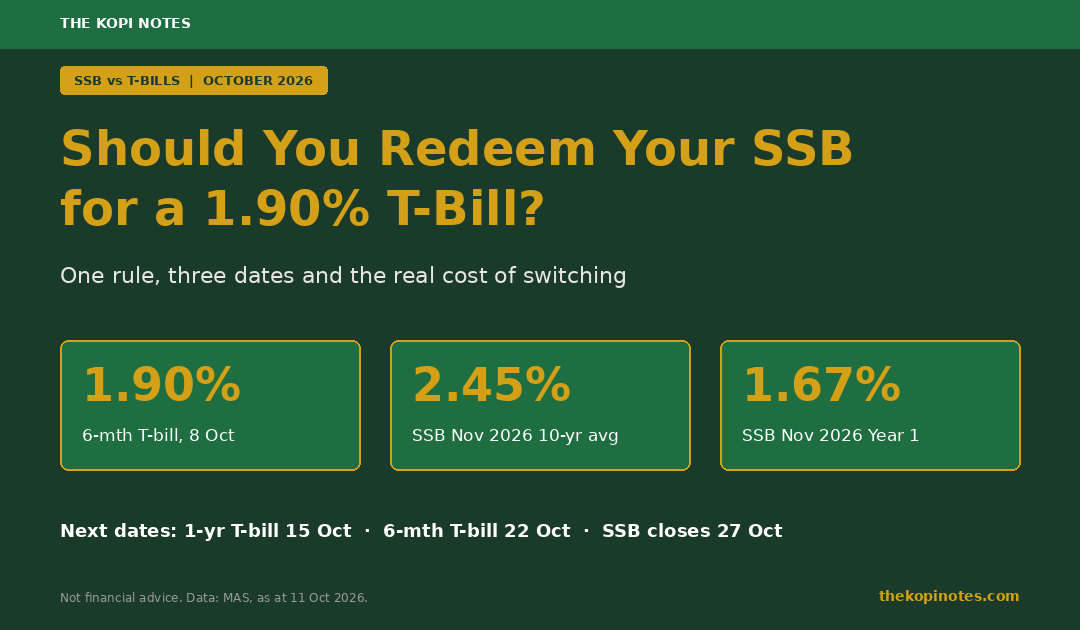
The 6-month T-bill closed at 1.90% on 8 October. The SSB you bought last year may be paying you 1.4%. That gap is why searches for SSB redemption and T-bills have spiked this month, and why many savers are asking the same thing: should I redeem my SSB and move the money into T-bills?
For most people the answer turns on one number, the rate your SSB pays this year. This guide shows you how to find it, when switching makes sense, what SSB redemption actually costs, and the three dates in October that decide your timing.
This is an editorial analysis, not financial advice. Rates are from MAS issue data and auction results as at 11 October 2026.
- SSBs issued from Aug 2022 to Jul 2025 started at 2.00% or more. Step-ups mean they still pay at least that. Keep them.
- SSBs issued from Aug 2025 onwards started at 1.33% to 1.82%. Switching to a 1.90% T-bill can earn a little more, but only for money you need within a year or two.
- Switching S$50,000 from a 1.50% SSB to a 1.90% T-bill nets about S$50 over six months after fees and idle days.
- Key dates: 1-year T-bill auction 15 Oct, 6-month T-bill 22 Oct, SSB redemption and SSB November applications both close 27 Oct, 9pm.
Latest T-bill and SSB rates (October 2026)
The 8 October auction (BS26120W) cleared at 1.90%, a touch below 24 September’s 1.92%. Demand rose. S$17.8 billion was bid for S$8.3 billion of bills, a bid-to-cover of 2.14x against 1.88x last time. Non-competitive bids alone came to S$2.0 billion.
On the SSB side, the November 2026 tranche (GX26110X) pays 1.67% in Year 1 and averages 2.45% if held for ten years. That is the third monthly rise in a row and the best 10-year average since July 2025.
| Instrument | Rate | Lock-in | Can use |
|---|---|---|---|
| 6-month T-bill (8 Oct 2026) | 1.90% | 6 months | Cash, SRS, CPF OA |
| 1-year T-bill (last: 23 Jul 2026) | 1.68% | 12 months | Cash, SRS, CPF OA |
| SSB November 2026, Year 1 | 1.67% | None | Cash, SRS |
| SSB November 2026, 10-year average | 2.45% | None | Cash, SRS |
Sources: MAS auction results for BS26120W (8 Oct 2026) and BY26102T (23 Jul 2026); MAS SSB issue details for GX26110X. SSBs cannot be bought with CPF money.
For the full auction breakdown, see our 8 October T-bill and SSB November comparison.
The one rule: compare this year’s SSB coupon, not the 10-year average
Every SSB has a fixed step-up schedule set on the day it was issued. The rate never falls from one year to the next. So the coupon you earn today is at least the Year 1 rate you started with, and often higher.
That gives a clean test. If your SSB’s current-year coupon is above the T-bill yield you could get, keep it. You are already earning more, with no lock-in, and the step-ups keep coming.
If the current coupon is below the T-bill yield, switching can earn more for six months. Whether it is worth doing depends on the size of the gap, the amount, and how long you would have held the SSB anyway.
You can see each holding’s coupon schedule in the SSB section of your DBS/POSB, OCBC or UOB app, or by entering the issue code into the MAS SSB calculator. Our SSB interest calculator shows what each holding period earns.
Keep or switch, by SSB issue date
Because the coupon never steps down, the Year 1 rate tells you the floor for every SSB you own. Here is how the past four years sort against a 1.90% T-bill.
| SSB issued | Year 1 rate range | 10-yr average range | Against a 1.90% T-bill |
|---|---|---|---|
| Before Aug 2022 | 0.45% to 1.69% (2022) | 1.64% to 2.71% (2022) | Check. Many are now in later, higher-coupon years. |
| Aug 2022 to Jul 2025 | 2.00% to 3.30% | 2.49% to 3.47% | Keep. Every coupon is above 1.90%. |
| Aug 2025 to Jul 2026 | 1.33% to 1.82% | 1.83% to 2.29% | Borderline. Check this year’s coupon. |
| Aug 2026 to Oct 2026 | 1.46% to 1.65% | 2.06% to 2.32% | Below the T-bill now. Keep if you will hold 5+ years. |
Ranges from MAS SSB issue data, Aug 2022 to Oct 2026. “Before Aug 2022” ranges cover Jan to Jul 2022 issues only; 2015 to 2021 issues vary widely.
The middle row is the one that matters. Anyone who bought SSBs between August 2022 and July 2025 locked in some of the best government rates of the past decade. December 2022’s tranche averages 3.47%. Redeeming it for a 1.90% T-bill gives up roughly 1.5% a year for no gain in safety.
The bottom two rows are where switching can make sense. A tranche from late 2025 paying around 1.4% this year earns noticeably less than a 1.90% T-bill. If that money is earmarked for a renovation or a car in 2027, the T-bill does the job better.
If the money is long-term, the case weakens. Those same tranches step up to 2.5% or more in their later years, and you cannot buy that schedule back once you sell.
What SSB redemption really costs
MAS charges no penalty for redeeming. You get your full principal back plus interest accrued to the end of the month. The costs are smaller and easy to miss.
Fees
Banks charge S$2 per redemption request. Buying a T-bill with cash at DBS, OCBC or UOB costs another S$2. On S$10,000 that is 0.04% in total. On S$500 it is 0.8%, which wipes out the benefit.
Idle days
Redemption money lands on the second business day of the following month. T-bill auctions run on fixed dates, so the cash usually sits in a savings account for one to three weeks before a T-bill issues. That gap earns close to nothing.
Lost step-ups
This is the big one. An SSB is a ten-year option on a rising rate schedule. Selling it ends that schedule. A new SSB can be bought later, but only at whatever rate MAS sets that month, and within the S$200,000 per-person cap.
A worked example
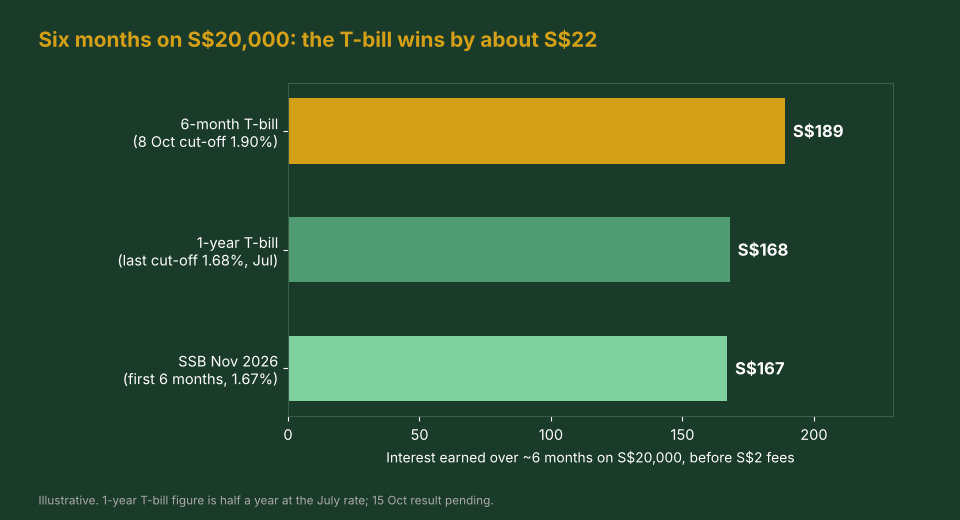
Say you hold S$50,000 in a late-2025 SSB paying 1.50% this year. You redeem by 27 October and buy the 19 November 6-month T-bill at about 1.90%.
| Extra yield, 0.40% for about six months | +S$100 |
| Redemption fee + T-bill application fee | −S$4 |
| About three weeks idle (3 to 24 Nov) at 1.50% forgone | −S$43 |
| Net gain over six months | about S$53 |
Fifty dollars is real money, but it comes with a catch. In April 2027 you will need to roll the T-bill at whatever yield the market offers then, and the SSB’s step-ups are gone. If T-bill yields drift back to 1.6%, the switch has cost you.
The idle-days line is also why timing matters. If you can get the cash into the 4 November auction instead, the net gain rises to roughly S$80.
How to redeem SSB, step by step
- Find the issue code. Log in to your bank app and open the SSB holdings page. Each tranche has its own code, such as GX25110X. Redemptions are per issue.
- Choose the amount. You can redeem part of a holding, in multiples of S$500.
- Submit the request through DBS/POSB, OCBC or UOB internet banking or ATM. For SSBs bought with SRS money, go through your SRS operator instead.
- Meet the cut-off. Requests must reach MAS by the fourth-last business day of the month, 9pm. In October 2026 that is Tuesday 27 October.
- Wait for the payout. Principal and accrued interest are credited by the second business day of the next month, here Tuesday 3 November. SRS-funded redemptions go back to your SRS account.
Our SSB Singapore guide covers applications, allotment and the S$200,000 cap in more detail.
October 2026 timing: the dates that matter
| Date | Event | What it means for you |
|---|---|---|
| Thu 15 Oct | 1-year T-bill auction (BY26103X) | Only four a year. July cleared at 1.68%. |
| Thu 22 Oct | 6-month T-bill auction (BS26121N) | Needs cash you already have. SSB redemption money is too late for this one. |
| Tue 27 Oct, 9pm | SSB redemption cut-off and SSB November 2026 applications close | Last day to redeem for a November payout, and last day to apply for the 2.45% tranche. |
| Tue 3 Nov | SSB redemption proceeds credited | Bank T-bill applications for 4 Nov usually close the evening before, so this is tight. |
| Wed 4 Nov / Thu 19 Nov | Next 6-month T-bill auctions | 19 November is the safe target for redeemed SSB money. |
Auction dates from the MAS issuance calendar. Bank application cut-offs vary; check yours before relying on the 4 Nov auction.
If you have spare cash now, a cleaner sequence is to bid in the 22 October auction with that cash, then redeem the SSB at month-end to refill your buffer. Our T-bill bidding strategy guide explains competitive versus non-competitive bids. Competitive bids at exactly 1.90% were only about 52% filled on 8 October, so bidding at the cut-off does not guarantee a full allotment.
The other switch: old SSB into SSB November 2026
A less obvious move is to swap a weak SSB for a stronger one. Tranches from late 2025 and early 2026 average 1.83% to 2.25% over ten years. SSB November 2026 averages 2.45% and starts at 1.67%, above most of them in Year 1 as well.
For long-term money that you keep in SSBs anyway, redeeming a December 2025 tranche (Year 1 1.35%, average 1.85%) and buying November 2026 can lift the yield in most years of the schedule. Compare the two step-up tables year by year before you do it, because the gap is not the same every year.
Two risks apply. November’s S$400 million issue may be oversubscribed and scaled back, leaving you with cash and no bond. A pending redemption may also not free up room under the S$200,000 cap in time. The safer order is to apply for the new tranche with spare cash first, then redeem the old one once your allotment is confirmed.
See our SSB November 2026 breakdown for the full step-up schedule.
SSB interest rate history, 2022 to 2026
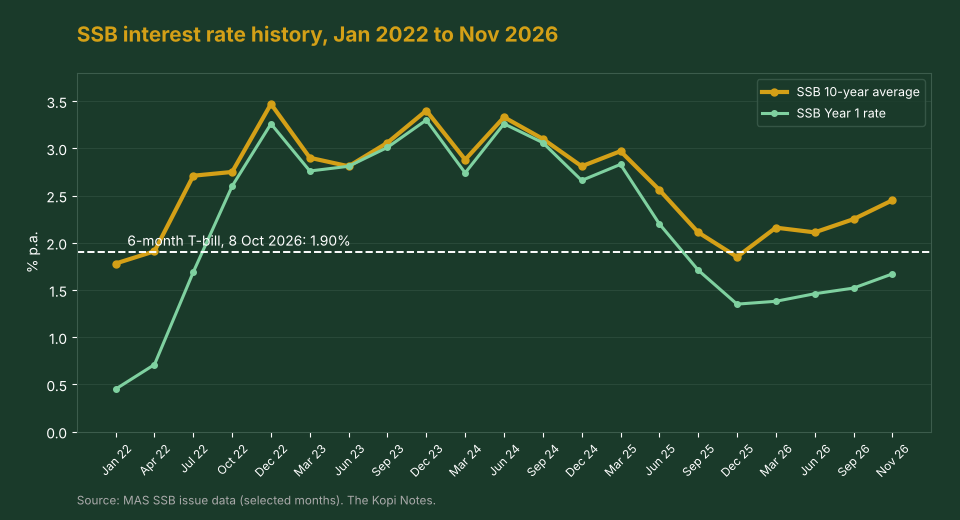
The chart below shows why the issue date matters so much. SSB rates rose from under 2% in early 2022 to a 3.47% peak in December 2022, held near 3% through mid-2024, then fell to a 1.83% low in November 2025. They have risen three months running since August 2026.
| SSB issue (2026) | Year 1 rate | 10-year average |
|---|---|---|
| Jan 2026 | 1.33% | 1.99% |
| Feb 2026 | 1.35% | 2.25% |
| Mar 2026 | 1.38% | 2.16% |
| Apr 2026 | 1.36% | 1.99% |
| May 2026 | 1.40% | 2.14% |
| Jun 2026 | 1.46% | 2.11% |
| Jul 2026 | 1.46% | 2.11% |
| Aug 2026 | 1.46% | 2.06% |
| Sep 2026 | 1.52% | 2.25% |
| Oct 2026 | 1.65% | 2.32% |
| Nov 2026 | 1.67% | 2.45% |
Source: MAS SSB issue data. Year 1 rates have stayed below the 6-month T-bill all year, while 10-year averages have stayed above it.
That last line is the whole SSB versus T-bill choice in one sentence. T-bills pay more for the next six months. SSBs pay more if you hold for several years, and let you leave any month.
The December 2026 SSB rates will be published in early November, based on SGS yields through October. If you are deciding whether to wait, our T-bill ladder strategy for Q4 2026 shows how to keep cash working while you do.
Bottom line
If your SSB was issued between August 2022 and July 2025, leave it alone. It already pays more than any T-bill on offer.
If it was issued after mid-2025 and the money is needed within a year or two, a 1.90% T-bill earns slightly more. Do the switch only on amounts large enough for S$4 in fees not to matter, and aim the cash at the 19 November auction.
For money you plan to keep in safe assets for five years or more, the step-ups are worth more than six months of extra yield. Check your current coupon before 27 October and decide on that number alone.
Data sources: MAS T-bill auction results (BS26120W, 8 October 2026; BY26102T, 23 July 2026), MAS issuance calendar, MAS Singapore Savings Bonds issue data (GX26110X and earlier tranches). Worked examples are illustrative and use simple interest. This article is for general information only and is not financial advice. Check rates and cut-offs with MAS and your bank before acting.
FAQ: SSB redemption and T-bills
Is there a penalty for redeeming SSB early?
When is the SSB redemption deadline in October 2026?
Is SSB or T-bill better right now?
Should I redeem my 2023 SSB to buy T-bills?
Can I use redeemed SSB money for the 22 October T-bill?
Can I buy SSBs or T-bills with CPF?
How do I check my SSB interest rate history?
This article was researched with the help of AI. While we strive to keep all information accurate and up to date, there may be errors. If you notice any discrepancies, please contact us.