IWDA Share Price Guide 2026: Live Data, Historical Trend & What Drives It
A Singapore investor’s guide to the iShares Core MSCI World UCITS ETF — what moves its price, how the three exchange listings differ, and how to buy it tax-efficiently.
IWDA (iShares Core MSCI World UCITS ETF) is an Ireland-domiciled fund tracking the MSCI World Index, listed on Euronext Amsterdam, the London Stock Exchange, and Xetra. Its price moves with roughly 1,300 global large- and mid-cap stocks across 23 developed markets, about 71% of which is US equities. Singapore investors buy the LSE or Amsterdam line through brokers like IBKR, Saxo, or moomoo because it carries a 15% US dividend withholding tax and no US estate tax exposure — versus 30% and estate tax risk for US-listed equivalents.
Not financial advice. All figures are for educational reference only. Data verified as at 11 October 2026 unless otherwise dated.
What Is IWDA?
IWDA is the ticker Singapore investors most commonly use for the iShares Core MSCI World UCITS ETF (ISIN IE00B4L5Y983), a passive fund that tracks the MSCI World Index — around 1,300 large- and mid-cap companies across 23 developed markets, including the US, Japan, the UK, and continental Europe. The fund is domiciled in Ireland, structured as accumulating (dividends are reinvested automatically rather than paid out in cash), and has been running since September 2009, making it one of the longest-track-record global equity UCITS ETFs available to Singapore investors.
Technically, “IWDA” is the Euronext Amsterdam listing’s ticker. The same fund trades as SWDA on the London Stock Exchange and EUNL on Deutsche Börse Xetra — Singapore brokers and investors typically refer to all three loosely as “IWDA” since they represent one underlying fund with one NAV. We cover this distinction in more detail in the guide to buying IWDA on the London Stock Exchange.
IWDA Key Facts at a Glance
| Metric | Detail |
|---|---|
| Full Name | iShares Core MSCI World UCITS ETF |
| ISIN | IE00B4L5Y983 |
| Tickers | IWDA (Amsterdam, EUR) · SWDA (LSE, GBP/USD line) · EUNL (Xetra, EUR) |
| Index Tracked | MSCI World Index (~1,300 holdings, 23 developed markets) |
| Domicile | Ireland |
| Structure | Accumulating (dividends reinvested) |
| TER (Expense Ratio) | 0.20% p.a. |
| Fund Size (AUM) | ~€123 billion (as at Q3 2026) |
| Launch Date | 25 September 2009 |
| Base Currency | USD (share classes quoted in EUR, GBP, USD) |
Source: iShares Core MSCI World UCITS ETF fund factsheet; AUM cross-checked against third-party fund trackers, as at Q3 2026.
What Drives the IWDA Share Price
Because IWDA is a passive index fund, its share price (NAV) simply tracks the weighted average performance of its underlying holdings, converted into whatever currency the listing quotes. There is no active manager making calls — the fund’s price moves almost one-for-one with the MSCI World Index itself, minus the small daily drag of the 0.20% TER.
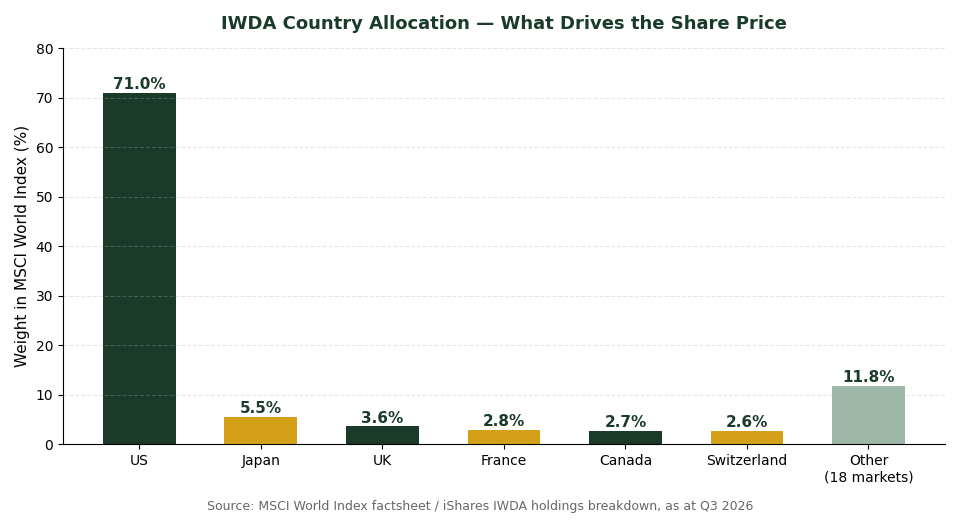
The single biggest driver is the US weighting. At roughly 71% US equities, IWDA’s price is heavily correlated with the S&P 500 and broader US market sentiment — Fed rate decisions, US tech earnings, and USD strength all move the fund more than any other single factor. The remaining ~29% is spread across Japan, the UK, France, Canada, Switzerland, and 18 other developed markets, which provides some diversification but doesn’t meaningfully dilute the US influence.
| Region | Approx. Weight | Why It Matters for the Price |
|---|---|---|
| United States | ~71% | Dominant driver; tracks S&P 500 sentiment, Fed policy, mega-cap tech earnings |
| Japan | ~5.5% | Sensitive to JPY moves and Bank of Japan policy shifts |
| United Kingdom | ~3.6% | Relevant mainly for the GBP-quoted LSE line’s local price |
| Other 20 markets | ~19.9% | France, Canada, Switzerland and others — modest diversification cushion |
Source: MSCI World Index factsheet / iShares IWDA holdings breakdown, as at Q3 2026.
IWDA Across Three Exchanges: Amsterdam, LSE & Xetra
A common source of confusion: IWDA is one fund with one NAV, but it trades under three different tickers on three exchanges, each quoted in a different currency. The underlying holdings and performance are identical — only the listing currency and ticker differ. For a Singapore investor, this mostly affects FX conversion costs and which exchange your broker routes the order to by default.
| Exchange | Ticker | Currency | Notes for SG Investors |
|---|---|---|---|
| Euronext Amsterdam | IWDA | EUR | Most liquid line; closed at approximately €131 on 7 October 2026 |
| London Stock Exchange | SWDA | GBP / USD line | Preferred by most SG brokers (IBKR, Saxo) for UK/SG trading hours overlap |
| Deutsche Börse Xetra | EUNL | EUR | Less commonly used by SG investors; similar liquidity profile to Amsterdam |
Source: Exchange listing pages and third-party quote aggregators; Amsterdam close price dated 7 October 2026. Live prices move continuously during market hours — always check your broker’s real-time quote before trading.
Because exact live quotes change every second markets are open, treat any single price figure in this article as a historical reference point, not a trading signal. For a real-time quote, check your broker’s platform or a live data terminal directly before placing an order.
Historical Price Trend
IWDA’s price history mirrors the MSCI World Index closely since inception in 2009, with the fund compounding through the post-2009 bull run, the 2020 pandemic crash and recovery, the 2022 rate-hike drawdown, and the subsequent 2023–2025 recovery led by US mega-cap tech. Because the fund is accumulating, all of this return shows up in price appreciation alone — there’s no separate dividend history to track, which is part of why many Singapore investors find it simpler to monitor than a distributing ETF.
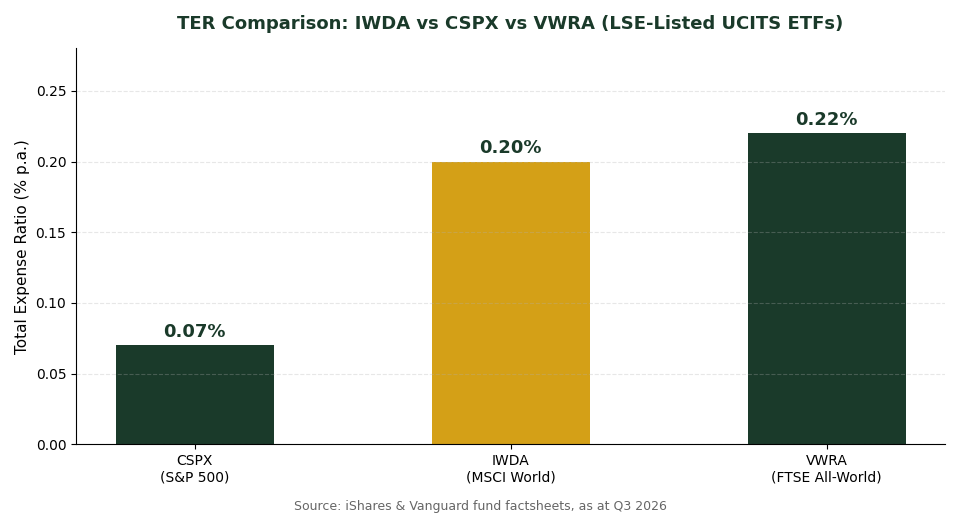
For a Singapore investor holding SGD 50,000 in IWDA, a typical long-run MSCI World annualised return in the high-single-digits (before fees) translates to roughly SGD 100 per year in TER drag at the current 0.20% expense ratio — modest compared to many actively managed funds, though higher than the 0.07% TER on a pure S&P 500 tracker like CSPX.
How to Buy IWDA in Singapore (Step-by-Step)
Singapore investors cannot buy IWDA directly on SGX — it’s accessed via a broker with access to Euronext Amsterdam or the LSE. Here’s how across the main platforms:
Interactive Brokers (IBKR): Fund your account in USD, GBP or EUR, search “IWDA” or “SWDA” in the order ticket, select the London (LSE) or Amsterdam exchange, and place a limit order. IBKR tends to offer the tightest commissions and FX spreads for larger portfolios, making it the most cost-effective option once you’re investing more than a few thousand dollars per trade.
Saxo Markets: Similar process — fund your account, search the ticker, choose your exchange, and place the order through Saxo’s platform. Saxo’s custody fee structure differs from IBKR’s, so compare total holding costs if you’re a long-term buy-and-hold investor.
moomoo Singapore: Offers access to LSE-listed ETFs including SWDA; useful if you already hold a moomoo Singapore account for other instruments and want to consolidate your portfolio on one platform.
Syfe Brokerage: The simplest route for beginners who want core-and-satellite exposure without managing multiple broker logins — read more via the Syfe referral code and sign-up bonus page.
Whichever broker you use, remember that CPF Ordinary Account funds cannot be used to buy LSE- or Amsterdam-listed ETFs like IWDA — only SRS funds (via an eligible broker) or cash can be used. See our guide on CPF investment strategy for how CPF-eligible alternatives compare.
Who Should Buy IWDA?
IWDA is a good fit if you want one-ticket global developed-market exposure without having to separately manage a US fund and an ex-US fund, you’re comfortable with the ~71% US concentration that comes with global market-cap weighting, and you prefer an accumulating structure that avoids manual dividend reinvestment.
Consider alternatives if you specifically want emerging markets exposure too (IWDA excludes them — VWRA vs IWDA covers this gap), you want a pure US large-cap tracker with the lowest possible TER, or you’re building a passive income portfolio and prefer a distributing fund — in which case our passive income Singapore guide and the Singapore retirement calculator can help you model distributing vs accumulating outcomes for your retirement timeline.
Disclaimer: This article does not constitute financial advice. IWDA, like all equity ETFs, carries market risk — its price can fall as well as rise, and past performance of the MSCI World Index is not indicative of future returns. Currency risk also applies since the fund’s underlying assets are priced in multiple currencies against the SGD. Consult a licensed financial adviser before making investment decisions.
Frequently Asked Questions
What is the IWDA share price today?
IWDA’s price changes continuously during market hours across its three listings — Amsterdam (EUR), London (GBP/USD line), and Xetra (EUR). Rather than quoting a single “live” figure that goes stale within minutes, check your broker’s real-time quote before trading. As a historical reference point, the Amsterdam line closed at approximately €131 on 7 October 2026.
Is IWDA the same as SWDA or EUNL?
Yes. IWDA, SWDA, and EUNL are the same underlying fund — the iShares Core MSCI World UCITS ETF — listed on three different exchanges (Amsterdam, London, and Xetra respectively) in three different currencies. The holdings, NAV, and performance are identical; only the quoted currency and ticker differ.
Can I buy IWDA using my CPF or SRS funds?
IWDA cannot be bought with CPF Ordinary Account funds, as it is not on the CPFIS-included investment list. It can be bought with SRS (Supplementary Retirement Scheme) funds through brokers that support SRS-funded overseas ETF purchases, such as Interactive Brokers via a linked SRS arrangement — check with your specific broker for current SRS support.
Which broker is best for buying IWDA in Singapore?
Interactive Brokers (IBKR) is generally the most cost-effective for larger, less frequent trades due to its tight commissions and FX spreads. Syfe Brokerage is simpler for beginners who want fewer platform decisions. moomoo Singapore is a reasonable middle ground if you already use it for other holdings. Compare total cost of ownership — commission, FX spread, and custody fees — rather than commission alone.
Why does IWDA have a higher TER than CSPX?
IWDA tracks the MSCI World Index (23 countries, ~1,300 holdings) at a 0.20% TER, while CSPX tracks only the US S&P 500 (500 holdings) at a lower 0.07% TER. Broader, more diversified indices generally carry marginally higher running costs due to the complexity of tracking more markets and currencies, though both are considered very low-cost by global ETF standards.
Is IWDA safe? What are the risks?
IWDA is a passively managed, highly diversified equity ETF, which reduces single-stock risk, but it still carries full equity market risk — its price can decline significantly during market downturns, as it did in 2020 and 2022. It also carries concentration risk given its ~71% US weighting, and currency risk from holding USD- and EUR-denominated assets against the SGD. It is not a capital-guaranteed or low-volatility product.
Ready to Start Investing in Global ETFs?
Open a brokerage account and buy your first global ETF today. Use our referral links for exclusive sign-up bonuses.
This article was researched with the help of AI. While we strive to keep all information accurate and up to date, there may be errors. If you notice any discrepancies, please contact us.