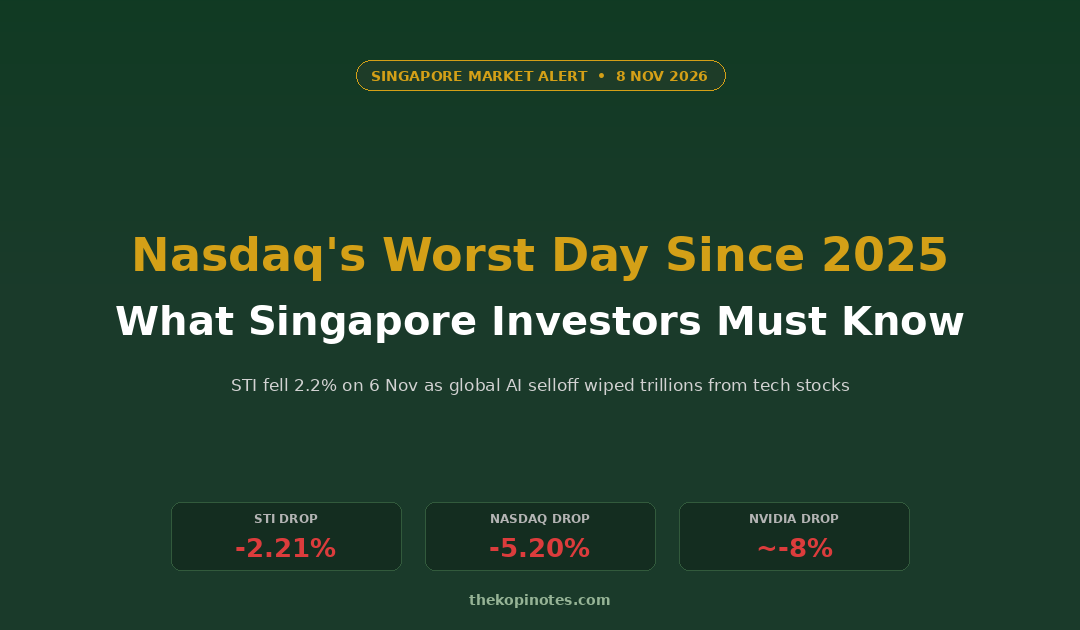
Singapore’s Straits Times Index plunged 2.2% — shedding 117 points to close at 5,179.17 on 6 November 2026 — as a catastrophic selloff in US technology and semiconductor stocks swept through global markets. The trigger: US midterm election results that threaten to slow America’s AI data centre buildout, sending shockwaves from Wall Street to Raffles Place. Here’s what every Singapore retail investor needs to understand.
This is an editorial analysis. Not financial advice. Data verified as at 8 November 2026.
What Triggered the Global AI Tech Rout
Americans voted in the US midterm elections on Tuesday 3 November 2026. Democrats retook both the Senate and the House of Representatives, and in Texas, Gina Hinojosa, who campaigned for a pause on new data centres, won the governor’s race. Within two days, AI-related stocks were sharply repriced.
On Thursday 5 November, the Nasdaq Composite fell 5.52% to close at about 24,315, while the S&P 500 fell 4.36% and the Dow 3.44%, in a single session — its steepest single-day decline since the Liberation Day tariff shock of April 2025 and among the worst in the post-COVID era. The Philadelphia Semiconductor Sector Index, which tracks the 30 largest chipmakers, was on track for its biggest one-day loss since March 2020. Nvidia fell roughly 8% in midday trading, dragging the broader tech complex with it.
The fear was clear: if US data centre expansion faces new regulatory headwinds, the entire AI infrastructure buildout narrative — which has powered a multi-year bull market in chips, cloud, and related stocks — could stall. Meta’s president Dina Powell McCormick put it plainly, noting that building US data centres is “going to be harder,” and that every major hyperscaler is now exploring overseas alternatives.
Tech analyst Dan Ives warned that AI capex growth would likely peak the following year rather than in 2028–2029 as previously expected. He estimated that between 10% and 20% of the 800 to 1,000 US AI-focused data centres in the pipeline could face delays or cancellations.
The Nvidia H200 China Overhang
Compounding investor anxiety was a separate but related story: approximately 600,000 Nvidia H200 chips are sitting in Hong Kong warehouses, unable to enter mainland China because Beijing has withheld mass customs clearance approvals. Officials have only allowed smaller batches of approximately 10,000 chips at a time.
This represents a significant revenue overhang for Nvidia and reinforces concerns that China’s push for semiconductor self-reliance is tightening the market for US-made AI chips. For Singapore — a major node in the global semiconductor supply chain — this geopolitical friction adds an extra layer of uncertainty to an already volatile situation.
Singapore Market Impact: STI Falls 2.2%
Singapore’s equity market bore the brunt of the regional contagion on 6 November 2026. The STI fell 2.2%, closing at 5,179.17 — a loss of 117.08 points. The intraday range stretched from 5,138.75 to 5,199.82, suggesting significant selling pressure throughout the session.
The pullback was broad-based but milder than regional peers. Here’s how the rout played out across Asian markets:
| Index | Change (6 Nov 2026) | Level |
|---|---|---|
| Straits Times Index (Singapore) | -2.21% | 5,179.17 |
| Nikkei 225 (Japan) | -5.96% | 57,434.77 |
| Hang Seng Index (Hong Kong) | -1.27% | 24,481.86 |
| FTSE 100 (UK) | -1.63% | 10,607.34 |
| FTSE Bursa Malaysia | -1.18% | 1,616.58 |
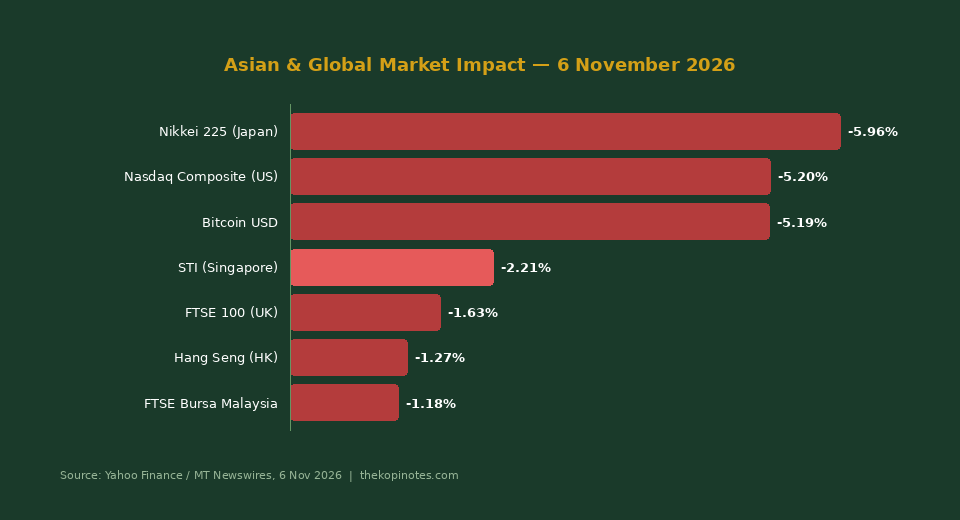
Singapore’s relatively contained decline compared to Japan’s 5.96% plunge reflects the STI’s lower concentration in AI-linked technology names. Japan’s Nikkei is heavily weighted towards semiconductors and technology exporters, making it far more exposed to the selloff’s epicentre.
What It Means for Singapore Data Centre REITs
Singapore’s data centre REITs — particularly Keppel DC REIT (SGX: AJBU) and Mapletree Industrial Trust (SGX: ME8U) — have been among the STI’s standout performers this year, buoyed by the narrative of insatiable AI-driven demand for colocation and hyperscaler capacity.
The November selloff complicates that story. If US hyperscalers face regulatory and political pressure to slow their AI data centre buildout, the pipeline of new leasing demand from Amazon Web Services, Microsoft Azure, and Google Cloud — which underpins the rent growth outlook for Singapore’s data centre operators — could soften. The concern is not about existing contracted revenue (which is locked in) but about the trajectory of future expansions.
That said, Singapore-based data centres retain structural advantages: political neutrality, proximity to Southeast Asian markets, and green energy access. Any shift by hyperscalers to build outside the US could actually benefit Singapore. The long-term demand thesis remains intact; what has changed is the pace and certainty of that demand growth.
Investors should monitor Q3 2026 DPU (Distribution Per Unit) guidance from major data centre REITs in the coming weeks. As we outlined in our Singapore Data Centre REIT guide, the key metrics to watch are occupancy rates, weighted average lease expiry (WALE), and gearing levels.
Singapore Bank Stocks: Dividend Yields Still Attractive
DBS (SGX: D05), OCBC (SGX: O39), and UOB (SGX: U11) have already been navigating a challenging rate environment after the US Federal Reserve raised its policy rate to a target range of 3.75%–4.00% in September 2026. Rising bond yields have compressed the relative attractiveness of bank dividends while also pressuring loan growth.
As we covered in our October 2026 bank selloff analysis, Singapore’s big three banks had already pulled back from their September record highs. The November tech rout adds another near-term headwind through general risk-off sentiment.
However, the fundamentals remain relatively solid. Based on FY26 analyst estimates (as of October 2026), dividend yields are as follows:
| Bank | FY26 Est. Dividend Yield | FY27 Est. Dividend Yield | Price-to-Book (Oct 2026) |
|---|---|---|---|
| DBS (D05.SI) | 4.5% | 5.0% | 2.87x |
| UOB (U11.SI) | 4.4% | 4.6% | 1.20x |
| OCBC (O39.SI) | 3.7% | 3.4% | 1.94x |
Source: FactSet, as of 8 October 2026. Dividend yields are forward estimates and subject to change.
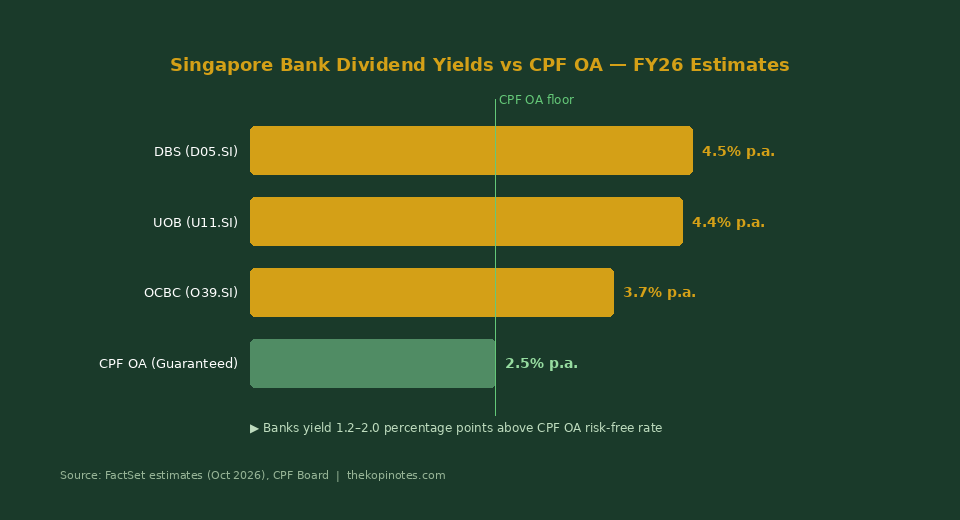
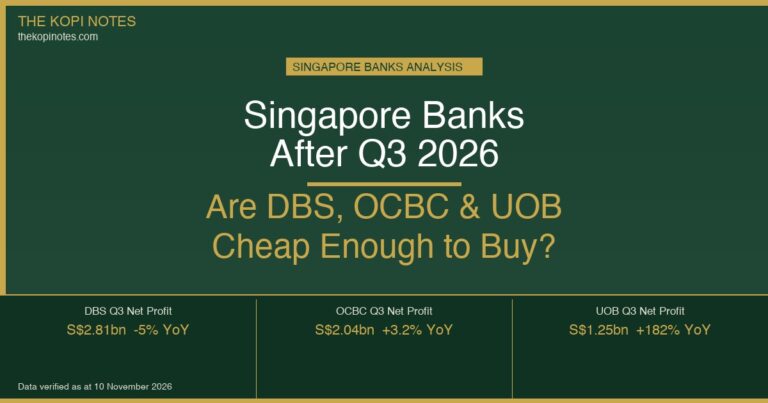
For long-term dividend investors, the ongoing pullback may present an accumulation opportunity — but watch for Q3 2026 earnings (due in November) which will provide fresh guidance on net interest margins, fee income, and credit quality. The tech rout itself does not directly impair bank earnings, but a prolonged risk-off environment could weigh on sentiment.
ETF Investors: What Happens to CSPX, VWRA, and IWDA?
If you hold broad global equity ETFs, your portfolio has taken a hit. The iShares Core S&P 500 UCITS ETF (CSPX), Vanguard FTSE All-World UCITS ETF (VWRA), and iShares Core MSCI World UCITS ETF (IWDA) all have heavy weightings in US technology stocks.
CSPX, in particular, allocates approximately 32%–35% of its portfolio to the Information Technology sector (including semiconductor and AI-linked names). A 5% decline in the Nasdaq typically translates to a 1.5%–2.5% drawdown in a full S&P 500 index fund like CSPX, depending on broader market conditions.
The important perspective: drawdowns are a feature, not a bug, of equity investing. As our CSPX historical returns guide shows, the index has recovered from every major selloff in its history — including the COVID crash of 2020, the 2022 rate shock, and the Liberation Day disruption of April 2025. For investors with a 10–20 year horizon, single-day moves of 2–5% are noise.
What should you do? If you are on a regular monthly investment plan (DCA), do nothing — your scheduled purchase will simply buy more units at a lower price. If you are sitting on a cash lump sum, this may be a reasonable entry point, though no one can call the bottom. As we explained in our Fed rate hike ETF guide, volatility is the price of long-term returns.
For global ETF holders who want broader diversification beyond the US tech complex, the XWR vs IWDA comparison is worth revisiting — both offer MSCI World exposure with different exchange and cost profiles.
CPF Investors: Your SA and RA Are Shielded
If you have invested your CPF Ordinary Account (OA) funds via CPFIS (CPF Investment Scheme) into equity-linked instruments, your portfolio may have experienced a temporary paper loss. However, it is important to remember that CPF monies left uninvested in OA continue to earn a guaranteed 2.5% per annum — a risk-free return that no equity market can guarantee in a downturn.
Your Special Account (SA), MediSave Account (MA), and Retirement Account (RA) savings are entirely unaffected — they earn a guaranteed 4% per annum floor, which the government extended through 31 December 2027. See our full breakdown of the CPF 4% floor extension for details.
For CPF investors considering whether to continue investing via CPFIS, the current environment is a reminder of the trade-off: the equity premium over your 2.5% OA floor requires you to tolerate periods of significant volatility like this week’s selloff. If you cannot stomach a 5–10% paper loss on your CPF-invested portion, it may be worth reconsidering your allocation.
Bottom Line for SG Investors
The November 2026 AI tech rout is a significant event — but not a catastrophe. Here is what matters for Singapore retail investors:
Stay calm and check your time horizon. The STI’s 2.2% decline and broader portfolio losses are painful in the short term, but do not change the long-term investment thesis for well-diversified portfolios. If you are 20–30 years from retirement, this week is a rounding error.
Monitor your data centre REIT exposure. Keppel DC REIT and Mapletree Industrial Trust face increased uncertainty around the pace of AI demand growth. The existing DPU stream remains secure, but forward growth projections should be revisited. Watch Q3 2026 results closely.
Singapore banks remain dividend anchors. With forward yields of 4%–5% at current prices, Singapore’s three big banks offer income investors a reasonable floor — particularly relative to CPF OA’s 2.5%. The key risk is a sharper-than-expected economic slowdown that impairs credit quality.
Keep DCA-ing your ETFs. Volatility is uncomfortable, but it creates the entry points that generate long-term outperformance. CSPX, VWRA, and IWDA remain structurally sound instruments for long-term wealth building. This week’s sell-off, like those before it, will likely be forgotten within 12–18 months.
Your CPF is your safety net. Whatever happens in equity markets, your SA/MA/RA savings compounding at 4% are untouched. Use that security as a mental anchor when market headlines trigger anxiety.
Frequently Asked Questions
Why did Singapore stocks fall on 6 November 2026?
Singapore’s STI fell 2.2% (117 points) on 6 November 2026 as a global selloff in technology and semiconductor stocks spread to Asian markets. The trigger was the US midterm election result — Democrats retook Congress and voters approved measures to restrict AI data centre construction — which prompted investors to reprice AI-related growth stocks sharply lower.
How much did the Nasdaq fall in this selloff?
The Nasdaq Composite fell 5.52% on 5 November 2026, closing at about 24,315. This was its biggest single-day decline since the Liberation Day tariff shock in April 2025. The Philadelphia Semiconductor Index posted its worst one-day loss since March 2020.
Should I sell my CSPX, VWRA, or IWDA now?
If you are a long-term investor with a 10+ year horizon, selling during a panic selloff typically destroys wealth rather than preserving it. Historical data shows that investors who stayed the course through major drawdowns consistently outperformed those who sold and tried to time re-entry. Continue your DCA plan and avoid making decisions based on short-term market fear.
Are Singapore data centre REITs safe after this selloff?
Existing contracted revenue for Singapore data centre REITs is secure — their current DPUs are not directly threatened by the US regulatory changes. However, the forward growth narrative (driven by AI hyperscaler demand) faces increased uncertainty. Monitor Q3 2026 results and management guidance. Long-term structural demand for Singapore data centres remains positive, particularly if hyperscalers shift buildout away from the US.
Are DBS, OCBC, and UOB dividends at risk?
There is no direct link between the AI tech selloff and Singapore bank dividend safety. DBS, OCBC, and UOB dividends are funded by core banking operations — net interest margins, fee income, and capital management — not technology stocks. The main risk to bank dividends is a broader economic slowdown that increases loan defaults, not the current tech-driven market volatility.
Is my CPF affected by this selloff?
Your CPF Ordinary Account (OA), Special Account (SA), MediSave Account (MA), and Retirement Account (RA) savings that are not invested via CPFIS are completely unaffected. They continue to earn guaranteed interest rates (OA: 2.5% p.a.; SA/MA/RA: 4% p.a. floor, extended to 31 December 2027). Only CPF monies you have specifically invested in equities, unit trusts, or ETFs via CPFIS may show temporary paper losses.
What is Nvidia H200 and why does it matter for Singapore?
The Nvidia H200 is one of the world’s most powerful AI training chips. Reports indicate that approximately 600,000 H200 chips are sitting in Hong Kong warehouses because Beijing has withheld mass customs clearance approvals for imports into mainland China. This represents a significant inventory overhang for Nvidia and highlights the growing geopolitical risk in the AI chip supply chain — a chain that runs through Singapore’s semiconductor ecosystem.
This article was researched with the help of AI. While we strive to keep all information accurate and up to date, there may be errors. If you notice any discrepancies, please contact us.