Endowment Plan for Couples Singapore 2026: Joint Policy or Separate Plans?
When couples in Singapore buy an endowment plan together, they face a critical choice: one joint policy or two separate policies. While both cover the same S$500/month premium budget, separate policies provide double the SDIC protection (S$200,000 vs S$100,000), independent nomination rights for each spouse, and full policy control if either partner passes away. This guide breaks down every difference so you can choose the right structure for your household.
Not financial advice. All figures are for educational reference only. Data as at November 2026 unless noted. Consult a licensed financial adviser before purchasing any insurance product.
What Is a Joint Endowment Plan?
A joint endowment plan is a participating (par) life insurance policy with two named lives: typically a husband and wife, or any two individuals with an insurable interest in each other. Both lives are covered under a single policy contract, with one primary policyholder who holds all legal rights to the policy.
Under Singapore’s Insurance Act, a joint life endowment plan typically pays out when the policy matures at the end of the agreed term, the first life assured dies during the policy term (first-to-die basis), or both lives are covered until the second death (last-to-die basis), depending on the product structure.
Most joint endowment plans sold in Singapore today use the first-to-die structure — meaning the policy pays out in full upon the first death, and cover ends. This contrasts with separate policies, where each spouse’s policy continues independently if the other passes away.
Key terms: The policyholder (owner of the contract) may differ from the life assured (the person whose life is covered). In a joint policy, there is typically one policyholder even if both lives are assured. This distinction matters for SDIC protection, CPF usage, and nomination.
Joint vs Separate Endowment Plans: 7 Key Differences
At the same total premium budget, here is how the two structures compare across every dimension that matters for Singapore couples:
| Factor | Joint Policy | Separate Policies |
|---|---|---|
| SDIC Protection | S$100,000 max (1 policyholder) | S$200,000 max (2 policyholders) |
| CPF OA Eligibility | One CPF account only | Both spouses can use own CPF OA |
| Premium Waiver on Death | Policy pays out & ends on first death | Each policy continues independently |
| Nomination Rights | One policyholder nominates only | Each spouse nominates independently |
| Divorce Risk | Complex — belongs to one party | Clean — each owns their policy |
| Premium Flexibility | Single combined premium | Each can adjust independently |
| Admin Simplicity | One policy to manage | Two policies to track |
Source: MAS Insurance Act (Cap. 142), SDIC Life Insurance Protection Scheme, CPF Board CPFIS guidelines, November 2026.
SDIC Protection: Why Separate Policies Win on Coverage
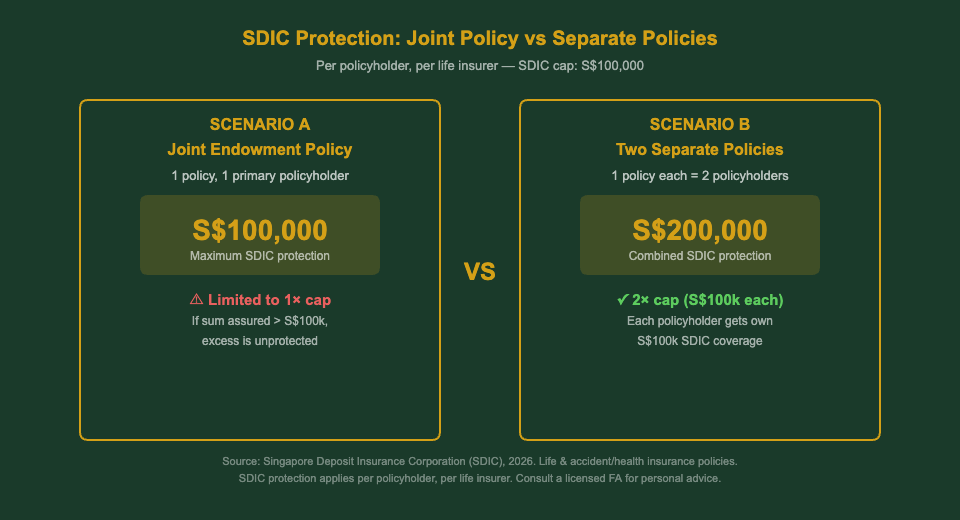
The Singapore Deposit Insurance Corporation (SDIC) protects policyholders if a licensed life insurer fails. For life insurance and endowment policies, SDIC covers up to S$100,000 of the surrender value per policyholder, per life insurer.
Joint policy: The primary policyholder is one person. SDIC protection is capped at S$100,000 for the entire policy. If the maturity or surrender value exceeds S$100,000, the excess sits outside SDIC protection.
Separate policies: Each spouse is a policyholder in their own right. Each gets their own S$100,000 SDIC protection, giving a combined household coverage of S$200,000.
For couples saving S$500/month over 20–25 years, projected maturity values often exceed S$150,000–S$200,000. That means a joint policy may leave a significant amount unprotected, while two separate policies keep both spouses fully within the SDIC cap.
CPF Considerations for Couples
Many Singapore couples ask whether they can use CPF OA savings for their endowment plan. Under CPFIS-OA rules, the policyholder must be the CPF member using their own account. This means a joint policy can only draw premiums from one spouse’s CPF OA — the named policyholder. With two separate policies, each spouse uses their own CPF OA independently, potentially doubling the CPF savings deployed toward savings and protection.
CPF OA currently earns 2.5% per annum. For CPFIS-approved endowment plans, only under the upper LIA illustration rate scenario (4.25% p.a.) do most par plans exceed this threshold by a meaningful margin.
Couples interested in growing CPF savings more aggressively can explore Endowus (referral code 2V343) for CPFIS-eligible unit trust portfolios alongside their CPF investment platform.
Projected Returns: What to Expect from Your Endowment Plan
All participating (par) endowment plans in Singapore use LIA illustration rates. As at 2026, the standard rates are: lower rate 3.00% p.a. and upper rate 4.25% p.a. (both gross, non-guaranteed bonuses).
| Policy Term | Total Premiums Paid | Lower Rate (3.00%) | Upper Rate (4.25%) |
|---|---|---|---|
| 10 years | S$60,000 | S$65,450 | S$67,800 |
| 15 years | S$90,000 | S$100,250 | S$106,400 |
| 20 years | S$120,000 | S$139,800 | S$152,200 |
| 25 years | S$150,000 | S$184,600 | S$207,400 |
Source: LIA Singapore par fund illustration rates, 2026. Projections are illustrative; actual returns are not guaranteed.
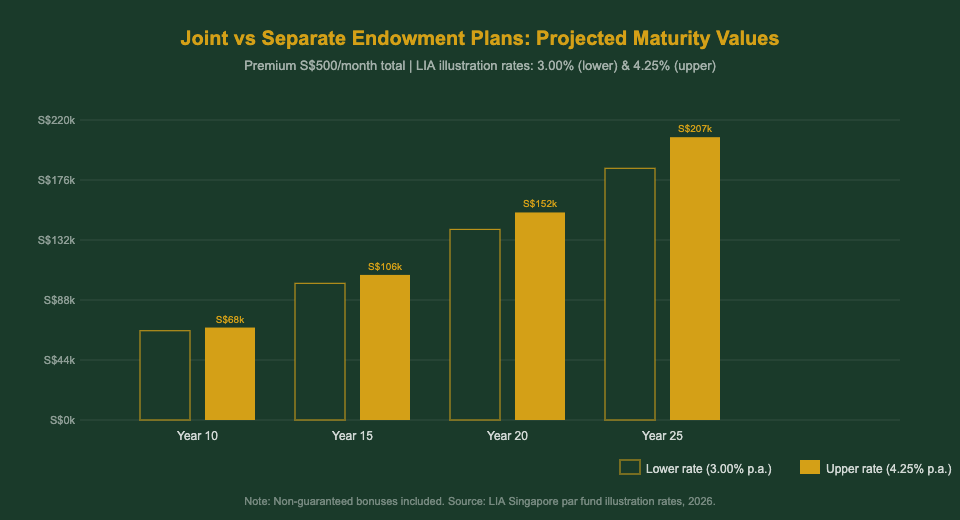
At the 15-year mark, the upper-rate maturity value exceeds S$100,000. Under a joint policy, amounts above S$100,000 sit outside SDIC protection. Under two separate policies, each spouse’s policy (S$250/month) stays well within the S$100,000 SDIC cap throughout the entire term.
Couples who want additional passive income alongside an endowment plan may consider Singapore’s passive income options in 2026, including S-REITs and Singapore Savings Bonds.
Nomination & Estate Planning for Couples
Under Singapore’s Insurance Act, policyholders can nominate under Section 49L (revocable trust nomination) or Section 73 (irrevocable trust nomination).
- S.49L nomination: Revocable. The policyholder can change nominees anytime. Proceeds may form part of the estate if the nomination lapses.
- S.73 trust nomination: Irrevocable in most cases. Proceeds bypass the estate entirely and go directly to named beneficiaries. Useful when protecting proceeds from creditors.
Joint policy nomination challenge: Only the primary policyholder can nominate. If both spouses want independent control over where their share goes — especially important if each has children from a previous relationship — a joint policy creates complications.
Separate policies solve this cleanly: Each spouse nominates independently. Husband nominates wife; wife nominates husband. Or each nominates their children directly. This provides estate certainty that a joint policy cannot.
Use our Singapore retirement planning calculator to see how endowment plan proceeds fit into your overall retirement income picture alongside CPF LIFE and other savings.
When to Choose Joint vs Separate: Decision Guide
| Your Situation | Better Choice |
|---|---|
| Total savings goal under S$80,000 at maturity and you want simplicity | Joint policy |
| Total savings goal over S$100,000 at maturity | Separate policies |
| Both spouses have CPF OA savings to deploy under CPFIS | Separate policies |
| Blended family / different beneficiary needs per spouse | Separate policies |
| One spouse is uninsurable or significantly older | Joint policy (may avoid loading on healthy spouse’s separate policy) |
| You want the survivor to inherit the full policy value and continue saving | Separate policies |
Source: MAS Financial Advisory Industry Review guidelines; LIA product disclosure standards, 2026.
The Kopi Notes Verdict
For most Singapore couples saving S$500/month or more, two separate endowment policies outperform a single joint policy across nearly every dimension: double SDIC protection, independent CPF OA usage, clean estate nomination, and policy continuity if one spouse passes away early.
The only compelling argument for a joint policy is administrative simplicity — and for lower savings goals under S$80,000 at maturity. If your household savings target is S$100,000 or more over 15–25 years, the SDIC gap alone makes separate policies the smarter financial choice.
Compare your options with our retirement planning calculator, and consider pairing your endowment plan with Singapore T-bills in 2026 for the liquid portion of your savings.
Frequently Asked Questions
Can unmarried couples buy a joint endowment plan in Singapore?
If we buy separate endowment plans, do both need to be with the same insurer?
Can we use SRS to pay endowment plan premiums?
What happens to a joint endowment plan during a divorce?
Is the LIA 4.25% upper rate guaranteed?
How do we compare endowment plans across different insurers?
Get Free Insurance Advice
Speak with a licensed insurance advisor. No obligation, no cost.
By submitting this form, you agree to our Privacy Policy.
This article was researched with the help of AI. While we strive to keep all information accurate and up to date, there may be errors. If you notice any discrepancies, please contact us.