Keppel DC REIT (AJBU) 2026 Complete Guide: Share Price, DPU & Investment Verdict
Singapore's leading data centre REIT — everything Singapore investors need to know
Keppel DC REIT (SGX: AJBU) is Singapore’s first and largest pure-play data centre REIT, owning 23 data centres across 9 countries in Asia-Pacific and Europe. Listed on the SGX in December 2014 at S$0.93, it has delivered a total return exceeding 190% by 2026 — with a 2026 dividend yield of approximately 4.7%, ultra-low gearing of ~31%, and a growing distribution backed by hyperscaler demand. Here is the complete 2026 guide for Singapore investors.
Not financial advice. All figures are for educational reference only. Data as at November 2026 unless noted.
What Is Keppel DC REIT?
Keppel DC REIT is Singapore’s first listed data centre REIT, managed by Keppel DC REIT Management Pte. Ltd., a wholly-owned subsidiary of Keppel Corporation. It was listed on the SGX Mainboard on 12 December 2014 at an IPO price of S$0.93 per unit.
As of 2026, Keppel DC REIT’s portfolio comprises 23 data centre assets spread across Singapore, Australia, Germany, the Netherlands, Italy, Ireland, the UK, Malaysia, and Japan. Its portfolio is predominantly freehold or long-leasehold, providing strong NAV stability.
The REIT sits at the intersection of two of the most powerful structural tailwinds of the 2020s: the accelerating shift to cloud computing and the explosion of artificial intelligence workloads. Major tenants include hyperscalers such as Microsoft, Amazon Web Services (AWS), Alibaba Cloud, and NTT, alongside colocation clients and enterprise customers.
Key Facts at a Glance
| Attribute | Details |
|---|---|
| SGX Ticker | AJBU |
| REIT Type | Data Centre (Pure-Play) |
| IPO Date | 12 December 2014 |
| IPO Price | S$0.93 |
| No. of Assets | 23 data centres (9 countries) |
| Market Cap | ~S$3.8 billion |
| Gearing Ratio | ~31.4% (MAS cap: 50%) |
| Distribution Frequency | Semi-annual (1H and 2H) |
| Sponsor | Keppel Corporation |
Source: Keppel DC REIT company filings and SGX announcements, November 2026.
For Singapore investors seeking exposure to the global digital infrastructure boom through a tax-efficient REIT structure, KDC offers a compelling combination of growth potential and income. See our broader list of the best S-REITs in Singapore 2026 for a full comparison across all sectors.
KDC Share Price Analysis 2026
Keppel DC REIT’s share price has experienced a remarkable journey since its 2014 IPO. From an IPO price of S$0.93, the unit price climbed to an all-time high of approximately S$3.60 in mid-2021 before retracing alongside the global interest rate hike cycle. By late 2026, the share price has stabilised in the S$2.00–S$2.20 range as rate cut expectations have returned to the fore.
KDC Share Price Performance: Key Milestones
| Period | Share Price (Approx.) | Key Driver |
|---|---|---|
| Dec 2014 (IPO) | S$0.93 | Listing — first data centre REIT on SGX |
| 2021 Peak | ~S$3.60 | COVID-era digital boom; near-zero rates |
| 2022–2023 | S$1.70–S$2.20 | Rate hike cycle pressure on REIT valuations |
| 2024–2025 | S$1.80–S$2.20 | Preferential offering dilution; Tokyo acquisition |
| Nov 2026 (est.) | ~S$2.05–S$2.15 | Rate cut cycle; 9M 2026 DPU surges 11.7% |
Source: SGX historical data, TKN analysis. Past performance does not guarantee future results.
At approximately S$2.10, KDC trades at a slight discount to its estimated net asset value (NAV) of ~S$2.17–S$2.22 per unit, implying a P/NAV ratio of ~0.95x. For yield-focused Singapore investors, the entry point matters: at S$2.10 per unit, the trailing yield is approximately 4.5–4.7%, which remains competitive versus the Singapore CPF Ordinary Account rate of 2.5% and the prevailing 6-month T-Bill yield of approximately 2.0%.
For a deeper dive on historical returns, see our dedicated Keppel DC REIT share price analysis, which covers the full return journey from IPO to present.
Keppel DC REIT DPU & Dividend History
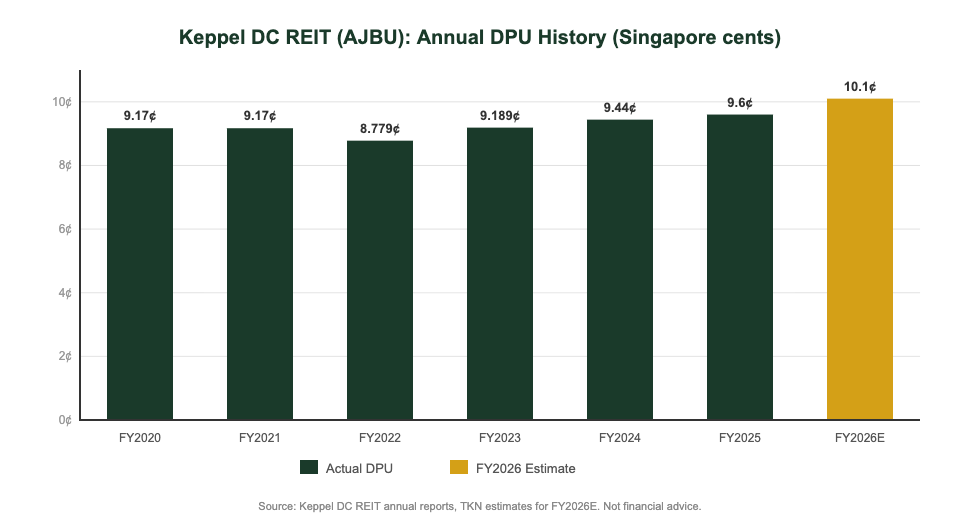
Keppel DC REIT has maintained a broadly stable to growing distribution per unit (DPU) since its 2014 IPO, with the exception of FY2022 which saw a temporary dip following its large-scale rights issue to fund Singapore portfolio acquisitions. By FY2026, DPU momentum has recovered strongly, with the 9-month 2026 DPU surging 11.7% year-on-year driven by its Japan acquisition performing ahead of expectations.
Annual DPU Summary (Singapore Cents Per Unit)
| Financial Year | DPU (Singapore cents) | YoY Change | Key Event |
|---|---|---|---|
| FY2020 | 9.17¢ | +4.0% | COVID digital acceleration |
| FY2021 | 9.17¢ | 0.0% | Portfolio growth; stable income |
| FY2022 | 8.78¢ | -4.3% | Rights issue dilution (Jul 2022) |
| FY2023 | 9.19¢ | +4.7% | Singapore assets fully income-accretive |
| FY2024 | 9.44¢ | +2.7% | Portfolio optimisation; European growth |
| FY2025 | ~9.60¢ | ~+1.7% | Japan entry; preferential offering |
| FY2026E | ~10.1¢ | ~+5.2% | 9M 2026 DPU +11.7% YoY; Tokyo ramp-up |
Source: Keppel DC REIT annual reports and SGX announcements. FY2025–FY2026E are TKN estimates. Not financial advice.
KDC distributes semi-annually: typically in March (for the 2H distribution) and September (for the 1H distribution). For investors planning their income calendar, this means cash flow twice per year. For a detailed 12-month forward DPU projection, read our Keppel DC REIT DPU Forecast FY2027 article.
KDC Rights Issue & Preferential Offering: What Happened?
Keppel DC REIT has undertaken two significant equity fundraising exercises since IPO, both of which have caused short-term dilution but funded income-accretive acquisitions.
July 2022 Rights Issue
In July 2022, KDC launched a renounceable rights issue to raise approximately S$1.1 billion. The rights were issued at S$1.68 per unit on a 1-for-2 basis. The proceeds funded the acquisition of a data centre development at Genting Lane, Singapore, as well as a data centre in Amsterdam, Netherlands. While the rights issue temporarily diluted DPU in FY2022, the acquired assets became fully income-accretive by FY2023, with DPU recovering strongly.
Key takeaway for investors: If you held KDC units before the rights issue and subscribed in full, your effective cost basis would have been reduced, partially offsetting the dilution. If you did not subscribe, your economic interest in KDC was reduced proportionally.
2024–2025 Preferential Offering
To fund the acquisition of a data centre in Tokyo, Japan — a key strategic move given the surging AI infrastructure demand in the region — KDC conducted a preferential offering at approximately S$1.90–S$2.00 per unit. The Tokyo asset has since proved transformative, contributing to the 11.7% DPU surge reported in KDC’s 9M 2026 results.
What is the difference between a rights issue and a preferential offering? A rights issue is offered to all unitholders in proportion to their existing holdings, and rights can be traded on the exchange. A preferential offering is similar but is typically non-renounceable, meaning it cannot be sold — unitholders must either subscribe or let their entitlement lapse.
Future Capital Recycling Watch
With its sponsor Keppel Corporation owning a global pipeline of data centre assets, there is a right of first refusal (ROFR) for KDC to acquire these properties. Singapore investors should watch for future acquisition announcements and assess whether the acquisition price and gearing impact are value-accretive before deciding whether to subscribe to any future equity fundraising.
KDC Portfolio: 23 Data Centres Across 9 Countries
Keppel DC REIT’s geographic diversification is a key differentiator from pure Singapore-listed S-REITs. Its 23 data centres span two of the world’s most critical digital infrastructure hubs: Asia-Pacific and Europe.
| Geography | No. of Assets | % of Portfolio Value (est.) | Key Assets |
|---|---|---|---|
| Singapore | 6 | ~44% | KDC SGP 7, Genting Lane DC |
| Australia | 4 | ~16% | Sydney, Melbourne assets |
| Europe | 10 | ~32% | Netherlands, Germany, Ireland, Italy, UK |
| Japan | 2 | ~5% | Tokyo (Shin-Kiba DC) — high growth |
| Malaysia | 1 | ~3% | Cyberjaya DC |
Source: TKN estimates from KDC annual report and SGX disclosures, 2026. Portfolio composition subject to change.
Singapore remains the backbone of KDC’s income, contributing the largest share of distributable income due to favourable lease structures and high occupancy (consistently 97–99%). The European portfolio introduces FX risk (primarily EUR) but provides exposure to some of the world’s highest-tier data centres with Tier III and Tier IV certifications.
The Japan acquisition (Tokyo) is the newest growth engine: Japan’s AI and cloud infrastructure investment has surged since 2024 as hyperscalers rush to build out capacity ahead of local data sovereignty regulations. KDC’s Tokyo data centre secured strong pre-commitment from anchor tenants before even completing construction, underscoring the depth of demand.
For Singapore investors building a passive income portfolio in Singapore, KDC’s combination of geographic diversification and long weighted average lease expiry (WALE) provides reliable, recurring distributions.
Financial Health: Gearing, ICR & Balance Sheet
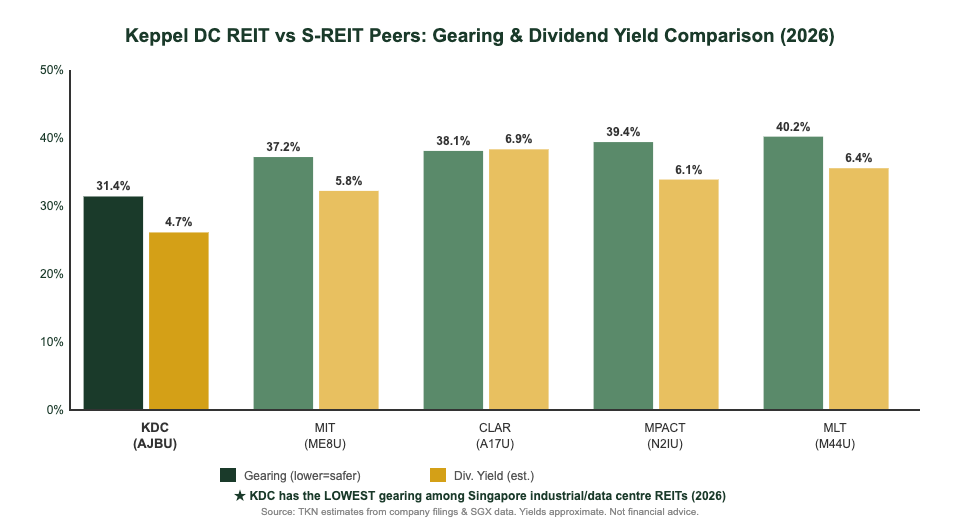
One of Keppel DC REIT’s most compelling attributes for risk-aware investors is its conservative balance sheet. With a gearing ratio of approximately 31.4%, KDC operates significantly below Singapore MAS’s regulatory cap of 50%, giving it substantial debt headroom of roughly S$1.6–1.8 billion for future acquisitions without requiring additional equity fundraising.
Key Financial Metrics vs S-REIT Peers (2026)
| Metric | KDC (AJBU) | MIT (ME8U) | CLAR (A17U) | MPACT (N2IU) |
|---|---|---|---|---|
| Gearing Ratio | ~31.4% | ~37.2% | ~38.1% | ~39.4% |
| Div. Yield (est.) | ~4.7% | ~5.8% | ~6.9% | ~6.1% |
| P/NAV | ~0.95x | ~1.00x | ~1.20x | ~0.70x |
| WALE (years) | ~7+ years | ~4–5 years | ~4–5 years | ~2–3 years |
| Sector | Data Centre | Industrial | Industrial | Commercial |
Source: TKN estimates from company SGX filings and analyst reports, November 2026. All figures approximate. Not financial advice.
KDC’s significantly lower gearing means it has the most debt headroom to pursue growth without equity dilution. Its long WALE of 7+ years — underpinned by master lease structures with its key Singapore tenants — also provides strong income visibility that is rare among S-REITs. This is a meaningfully different risk profile from commercial or retail REITs with shorter leases and higher refinancing risk.
However, KDC’s lower yield (~4.7%) compared to peers like CLAR (~6.9%) reflects the market pricing in its superior balance sheet quality and growth prospects. Investors should use our Singapore retirement calculator to model how different yield levels compound over their investment horizon.
Investment Verdict: Is Keppel DC REIT Worth Buying in 2026?
Bull Case for KDC
1. AI-driven demand is structural, not cyclical. Every ChatGPT query, every AI image generation, every large language model inference requires compute — and compute requires data centres. KDC sits at the epicentre of this structural shift. As Singapore’s first mover in listed data centre REITs, it has first-mover advantages in lease negotiations with hyperscalers.
2. Tokyo acquisition already paying off. KDC’s FY2026 9-month DPU surged 11.7% year-on-year, driven in large part by its Tokyo data centre achieving higher-than-forecast occupancy. This validates management’s acquisition thesis and demonstrates capital allocation discipline.
3. Lowest gearing in its peer group. At ~31.4%, KDC has S$1.6–1.8 billion in debt headroom before hitting 45% (a typical internal cap). This means KDC can grow through acquisition without necessarily tapping equity markets — protecting existing unitholders from dilution.
4. Rate cut cycle tailwind. As global central banks continue cutting rates in 2025–2026, the discount rate applied to KDC’s future cash flows decreases, supporting NAV recovery and potentially a re-rating of the unit price towards fair value estimates in the S$2.30–S$2.60 range.
Bear Case & Risks
1. Lower yield vs peers. At ~4.7%, KDC’s yield is below the S-REIT average of approximately 6–7%. Income-focused investors may prefer higher-yielding alternatives like CLAR (~6.9%) or MPACT (~6.1%).
2. FX risk. With ~56% of its portfolio value outside Singapore (primarily Europe and Japan), KDC carries meaningful FX exposure. A strengthening Singapore dollar against the EUR or JPY could reduce the SGD value of distributions from overseas assets.
3. Concentration risk in hyperscalers. While having Microsoft, AWS, and Alibaba as tenants sounds stable, losing even one hyperscaler anchor tenant could have an outsized impact on distributable income given the WALE structure of master leases.
4. Capital recycling uncertainty. Future acquisitions from Keppel Corp’s pipeline will require either debt or equity funding. If KDC executes a large acquisition at the wrong price, there is a risk of EPS/DPU dilution.
TKN Verdict
Keppel DC REIT is a high-quality, long-term hold for Singapore investors seeking structural growth exposure through the digital infrastructure theme. At the current price of approximately S$2.05–S$2.15, it trades at a slight discount to NAV with a ~4.7% yield — not the highest income available, but among the most defensible. We rate KDC as suitable for income-and-growth investors with a 5–10 year horizon, particularly those who want their portfolio anchored by the AI infrastructure megatrend.
Investors looking to build a position can do so via brokers such as Syfe Trade or FSMOne. Use our Syfe referral code for new account bonuses, or the FSMOne referral code for fee-free investing in selected instruments. For US-listed ETF investors, IBKR remains the most cost-efficient broker for SGX and international equities.
Frequently Asked Questions About Keppel DC REIT
What is Keppel DC REIT's ticker symbol on the SGX?
Keppel DC REIT trades on the Singapore Exchange (SGX) under the ticker symbol AJBU. It is included in the FTSE ST Real Estate Investment Trusts Index and is a constituent of multiple S-REIT indices. You can find live pricing on the SGX website or through most Singapore brokerage platforms.
How often does Keppel DC REIT pay dividends?
Keppel DC REIT pays distributions semi-annually — once for the first half (1H) of each financial year (typically paid in September) and once for the second half (2H, typically paid in March of the following year). Singapore unitholders receive these distributions without withholding tax deductions, as Singapore REITs distribute at least 90% of distributable income and unitholders benefit from tax transparency.
What was Keppel DC REIT's rights issue about?
In July 2022, KDC launched a renounceable rights issue on a 1-for-2 basis at S$1.68 per unit to raise approximately S$1.1 billion. The proceeds funded the acquisition of a data centre at Genting Lane, Singapore, and an asset in Amsterdam, Netherlands. While the rights issue temporarily reduced DPU in FY2022, both assets became fully income-accretive by FY2023, with DPU recovering above pre-rights levels.
What is Keppel DC REIT's current gearing ratio?
As of the latest available reporting period (mid-2026), Keppel DC REIT’s aggregate leverage (gearing ratio) is approximately 31.4%, which is significantly below Singapore MAS’s regulatory cap of 50%. This gives KDC one of the strongest balance sheets among all S-REITs, with estimated debt headroom of S$1.6–1.8 billion for future acquisitions without requiring equity fundraising.
Is Keppel DC REIT a good investment for income in 2026?
KDC offers an estimated trailing yield of approximately 4.7% at current prices (November 2026), which is below the S-REIT sector average but among the most defensible income streams. Its long WALE of 7+ years, low gearing, and AI infrastructure tailwind make it suitable for investors seeking a blend of income and capital growth. It is not ideal for pure income investors chasing the highest possible yield — for that, see our guide to the best S-REITs in Singapore 2026.
How do I buy Keppel DC REIT in Singapore?
You can buy Keppel DC REIT (AJBU) through any SGX-approved brokerage platform. Popular choices for Singapore retail investors include Syfe Trade, FSMOne, moomoo Singapore, IBKR (Interactive Brokers), and local bank brokerages (DBS Vickers, UOB Kay Hian, OCBC Securities). Look for the ticker AJBU in your broker’s SGX stock search. Minimum lot size is 100 units. Use our Syfe referral code for sign-up bonuses on new accounts.
This article was researched with the help of AI. While we strive to keep all information accurate and up to date, there may be errors. If you notice any discrepancies, please contact us.