Unit Trust vs ETF in Singapore: Endowus Now Lists ETFs (Beta) — How to Choose (2026)
What actually differs between a unit trust and an ETF, what Endowus has added, and five questions to decide which fits you.
A unit trust and an ETF are both pooled funds, but you buy a unit trust from the fund manager at its end-of-day price, while an ETF trades on a stock exchange at a live price. ETFs are usually cheaper, especially index ETFs at 0.03% to 0.35% a year, while unit trusts are easier to buy in small amounts, are more widely available for CPF and SRS, and include actively managed funds. In November 2026, Endowus began showing UCITS ETFs in its app as a beta, so the choice is no longer only about which platform you use.
Not financial advice. All figures are for educational reference only. Endowus ETF details are as shown in the Endowus app on 5 November 2026 during a beta and may change. The Kopi Notes may earn a referral fee if you sign up to some platforms mentioned.
What Endowus Has Added: ETFs in Beta
Endowus built its business on unit trusts: its Flagship portfolios and its Fund Smart menu are made of funds you buy from the manager, with 100% of trailer fees rebated to you. In early November 2026, some users began seeing exchange-traded funds in the Fund Smart equity list, marked as UCITS ETFs held in USD cash.
Endowus has not announced the feature publicly yet, and its pricing page does not list ETF fees. Treat the details below as a snapshot of a beta, not a final product.
| ETF (as listed in the Endowus app) | Focus | Fund fee | 1Y return shown | 3Y return shown |
|---|---|---|---|---|
| VanEck Semiconductor UCITS ETF | US technology | 0.35% | 52.44% | 50.51% |
| Franklin FTSE Taiwan UCITS ETF | Taiwan | 0.19% | 54.38% | 42.52% |
| Xtrackers NASDAQ 100 UCITS ETF | US technology | 0.20% | 9.02% | 23.60% |
| Xtrackers MSCI World Energy UCITS ETF | Developed-market energy | 0.25% | 51.07% | 19.36% |
| Xtrackers S&P 500 Equal Weight UCITS ETF | US large caps, equal weighted | 0.15% | 19.22% | 17.39% |
| Amundi Global Luxury UCITS ETF | Global luxury brands | 0.35% | -5.77% | 4.06% |
| iShares Global Aerospace & Defence UCITS ETF | Global defence | 0.35% | -1.04% | Not shown |
| iShares MSCI World ex USA UCITS ETF | Developed markets outside the US | 0.15% | 14.08% | Not shown |
Source: Endowus app, Fund Smart > Equities, screenshots taken 5 November 2026. All shown as USD cash, accumulating. Past returns do not predict future returns.
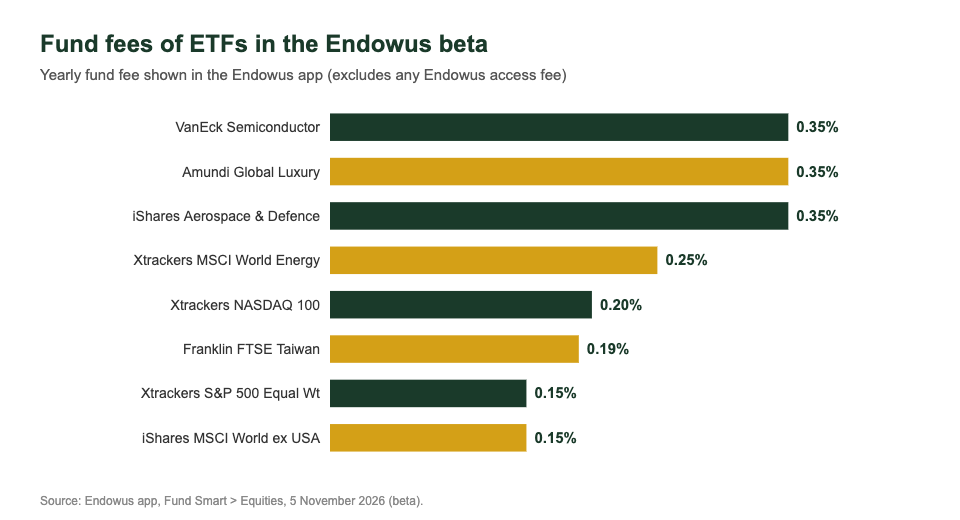
Three things stand out. First, these are all Irish or European-domiciled UCITS ETFs that reinvest dividends, the same structure many Singapore investors already buy on the London Stock Exchange. Second, the list leans towards themes and sectors (semiconductors, Taiwan, energy, luxury, defence) plus two broad options. Third, the funds show as held in USD cash, and the beta screens do not mention SRS or CPF.
What is still unknown is the total cost. Endowus normally charges an access fee on top of the fund fee: for a single Fund Smart fund paid in cash, the lower of 0.30% or your tier rate, according to its pricing page. Whether the same fee applies to ETFs, and how buys are executed, is not shown yet. Check the cost breakdown in the app before you buy, and see our Endowus fees guide for how the access fee works.
Unit Trust vs ETF: The Key Differences
| Unit trust | ETF | |
|---|---|---|
| How you buy | From the fund manager, through a platform or bank | On a stock exchange, through a broker (or now Endowus beta) |
| Price | Net asset value, set once a day after the market closes | Live market price during trading hours, plus a bid-ask spread |
| Typical yearly fee | About 0.1% to 0.5% for index funds; often 1% to 2% for active funds | About 0.03% to 0.35% for most index ETFs; higher for niche themes |
| Sales charge | 0% on platforms like Endowus; banks have historically charged up to a few percent | None, but you pay broker commission and the spread |
| Minimum | Often S$1,000 to start on Endowus, then small top-ups | One unit; some are under S$30 |
| Regular investing | Easy: monthly plans in any dollar amount | Possible on some brokers; otherwise whole units only |
| Active or passive | Both, with many active funds | Mostly passive index trackers |
| CPF Investment Scheme | Many approved unit trusts | Only a handful of SGX-listed ETFs |
| SRS | Widely available on platforms | SGX-listed ETFs through SRS-linked brokers |
Source: The Kopi Notes summary; Endowus pricing page, November 2026; CPF Board and MOM published guidance
The legal wrapper matters less than what is inside it. An index unit trust tracking the S&P 500 and an S&P 500 ETF hold the same companies. The real differences are cost, how you trade, and which accounts can hold them.
Domicile also matters for US shares. Irish-domiciled funds, unit trust or ETF, suffer 15% withholding tax on US dividends; see CSPX withholding tax explained. Check a fund’s domicile on its factsheet before comparing returns.
How Much the Fee Gap Costs Over 20 Years
Fees compound against you. Here is S$50,000 left for 20 years, assuming the same 6% yearly return before fees:
| Set-up | Total yearly cost | Value after 20 years |
|---|---|---|
| Active unit trust via a bank | 1.75% | About S$114,900 |
| Index unit trust on a low-cost platform | 0.85% (fund + access fee) | About S$136,500 |
| Index ETF through a broker | 0.20% | About S$154,400 |
Source: The Kopi Notes calculation: S$50,000 × (1.06 − cost)^20. Illustrative only; excludes trading costs and taxes.
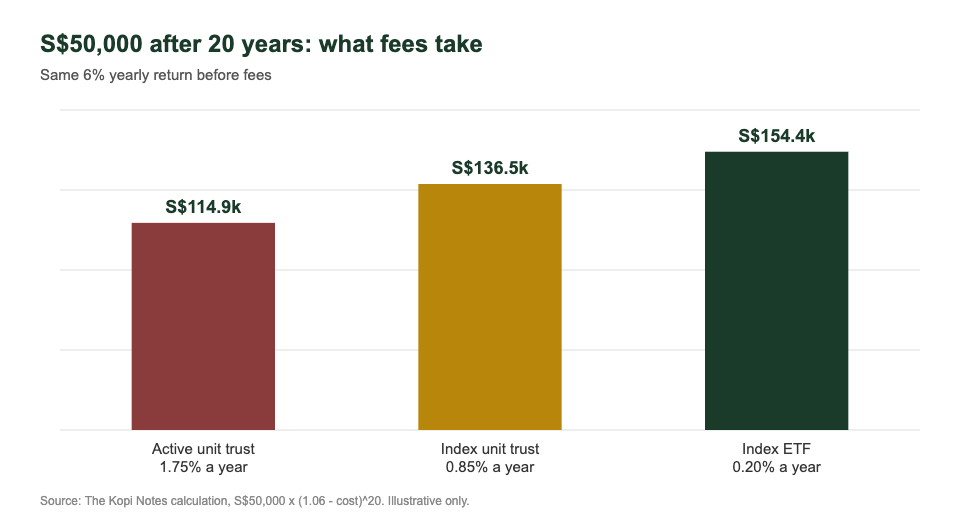
The gap between the first and last row is close to S$40,000, from the same market return. That is why low-cost index funds became the default advice. Between a cheap index unit trust and an ETF, though, the gap is smaller, and convenience can reasonably win.
CPF and SRS: Where Unit Trusts Still Win
If you invest CPF OA money, unit trusts are still the main route. The CPF Investment Scheme includes many unit trusts but only a few SGX-listed ETFs, and London-listed ETFs such as CSPX or VWRA are not allowed. Our CPFIS-approved ETF guide lists what you can buy.
For SRS, both work: unit trusts through platforms like Endowus, and SGX-listed ETFs through SRS-linked brokers. The new SGX-listed S&P 500 ETF, XUS, has widened the ETF options; see XUS vs CSPX vs SPYL and our SRS ETF guide.
Five Questions to Decide
- Which money is it? CPF OA points to unit trusts. SRS gives you both. Cash gives you every option.
- Do you want active management? If you specifically want a manager picking bonds or stocks, that is mostly found in unit trusts. If you want the market return, an index fund or ETF does it more cheaply.
- How do you like to invest? Fixed monthly dollar amounts are easiest with unit trusts. Lump sums and occasional buys suit ETFs.
- What is the total yearly cost? Add the fund fee, any platform or access fee, and trading costs. Compare that single number, not the headline fee.
- Do you want to manage it yourself? A managed portfolio does rebalancing for you. Buying your own ETFs means you decide when to rebalance, which some people find harder than expected.
What Singapore Investors Keep Asking
These are the questions that come up most in search data and in discussions on forums such as r/singaporefi and HardwareZone.
Is a mutual fund the same as a unit trust?
Yes, in practice. “Unit trust” is the term used in Singapore and the UK; “mutual fund” is the American term. Both pool investors’ money into one fund priced once a day.
Unit trust vs ETF: which is better?
Neither is better in itself. For a broad index, an ETF is usually cheaper. For CPF money, small monthly investing or active strategies, a unit trust is often more practical.
Why pay a platform fee when I can buy ETFs on IBKR?
If you are comfortable placing trades, converting currency and rebalancing yourself, a broker is usually cheaper. A platform fee buys automation, fractional amounts and managed portfolios. Whether that is worth 0.3% to 0.6% a year is a personal call.
Should I sell the unit trust my bank sold me?
Check its total yearly fee, any exit charge and whether it has beaten its benchmark after fees. Selling locks in any loss and may trigger charges, so compare costs carefully rather than switching on impulse.
Do ETFs pay dividends?
Some do. Distributing ETFs pay out dividends; accumulating ETFs, like all the ones in the Endowus beta, reinvest them inside the fund.
Ready to compare platforms? See our Endowus beginner guide, the Endowus referral code page, or what a UCITS ETF is. To see what regular investing adds up to, try the Singapore retirement calculator.
Frequently Asked Questions
What is the difference between a unit trust and an ETF?
Both are pooled funds. A unit trust is bought from the fund manager at a once-a-day price; an ETF trades on a stock exchange at a live price. ETFs are usually cheaper; unit trusts are easier to buy in small, regular amounts and are more widely available for CPF and SRS.
Does Endowus offer ETFs?
As of November 2026, some Endowus users see UCITS ETFs in the Fund Smart list as a beta, including Xtrackers, iShares, VanEck, Franklin and Amundi funds in USD cash. Endowus has not published ETF pricing yet.
Are ETFs cheaper than unit trusts?
Usually. Most index ETFs charge 0.03% to 0.35% a year, while active unit trusts often charge 1% to 2%. Low-cost index unit trusts narrow the gap, so compare the total yearly cost including platform fees.
Can I buy ETFs with my CPF?
Only a handful of SGX-listed ETFs are included under the CPF Investment Scheme. London-listed ETFs such as CSPX and VWRA cannot be bought with CPF.
Can I buy the Endowus ETFs with SRS?
The beta screens show the ETFs held in USD cash and do not mention SRS or CPF. Check in the app before assuming SRS is supported.
Is a mutual fund the same as a unit trust?
Yes. Mutual fund is the American term; unit trust is the term used in Singapore.
This article was researched with the help of AI. While we strive to keep all information accurate and up to date, there may be errors. If you notice any discrepancies, please contact us.