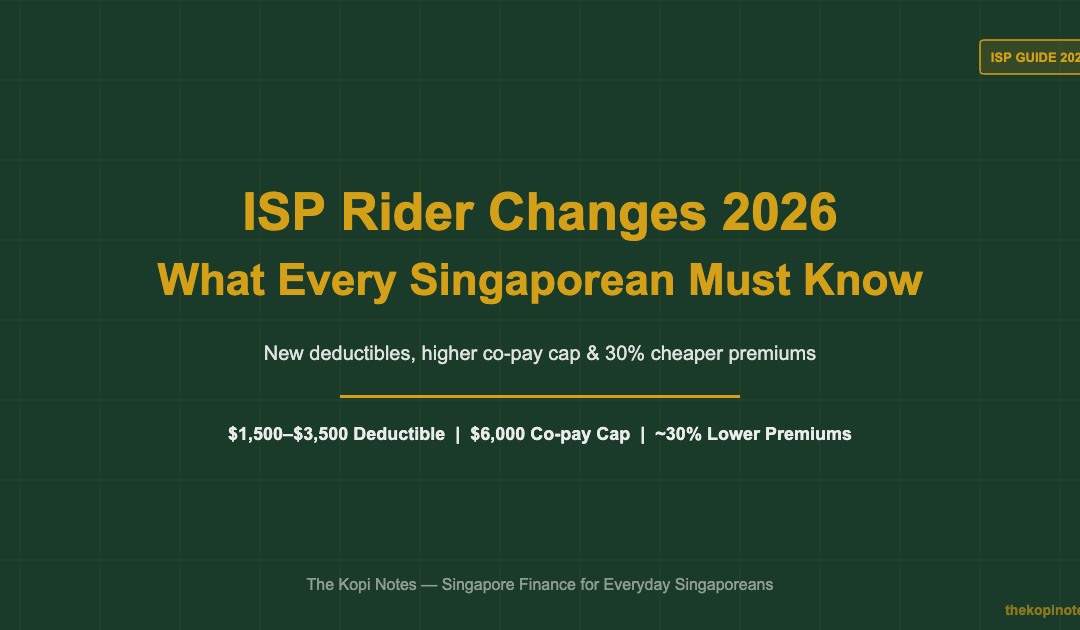
ISP Rider Changes 2026: What Every Singaporean Must Know Before Their Next Renewal
New deductibles, higher co-pay cap, and ~30% cheaper premiums — effective 1 April 2026
From 1 April 2026, integrated shield plan (ISP) riders in Singapore can no longer cover your minimum deductible — which ranges from $1,500 to $3,500 per year depending on your ward class. The co-payment cap also rises from $3,000 to $6,000 per year. The trade-off: new compliant rider premiums are about 30% cheaper on average. Here is what changed, how much more you pay out of pocket, and what to do before your next renewal.
Not financial advice. All figures are for educational reference only. Data verified as at August 2026. Sources: Ministry of Health Press Release, 26 November 2025.
- Your rider no longer covers the minimum IP deductible ($1,500–$3,500 depending on ward class) — you pay this first, every year you make a claim.
- The annual co-payment cap rose from $3,000 to $6,000, but new rider premiums are ~30% cheaper — saving you roughly $200–$600 per year in cash.
- Both the deductible and co-payments can be paid using MediSave. If you bought your rider before 27 November 2025, you must transition to the new compliant rider by your next renewal after 1 April 2028.
- What Changed on 1 April 2026
- The New Deductible Amounts by Ward Class
- The Co-payment Cap: From $3,000 to $6,000
- Real Bill Examples: How Much More Will You Pay?
- Premium Savings With the New Riders
- What Happens to Your Existing Rider?
- Can You Use MediSave to Pay the Deductible?
- Which Insurer’s New Rider Should You Pick?
- Frequently Asked Questions
What Changed on 1 April 2026
On 26 November 2025, the Ministry of Health (MOH) announced sweeping changes to how ISP riders work. The new rules took effect on 1 April 2026. These are the first major structural changes to rider design since 2018.
Before April 2026, many Singaporeans held what is called a “maximum coverage” rider. These riders covered almost everything — including your deductible. So if you were hospitalised, your out-of-pocket costs could be close to zero.
MOH data showed this was driving up costs sharply. Private hospital IP policyholders with riders were 1.4 times more likely to make a claim, with average claim sizes running 1.4 times larger than those without riders. Premiums kept climbing year on year as a result.
The new rules make two key structural changes:
- Riders can no longer cover the minimum IP deductible. You pay this first, before your insurance and rider pay anything. The deductible ranges from $1,500 to $3,500 per year depending on your ward class.
- The co-payment cap rises from $3,000 to $6,000 per year. Your rider still caps your annual co-insurance — but the ceiling is now twice as high.
The upside: the removal of deductible coverage makes new riders much cheaper. New private hospital rider premiums are expected to be about 30% lower than the old maximum-coverage riders.
The New Deductible Amounts by Ward Class
The deductible is the fixed amount you pay each policy year before your ISP pays anything. Under the new rules, your rider cannot cover this amount. You pay it from MediSave or cash.
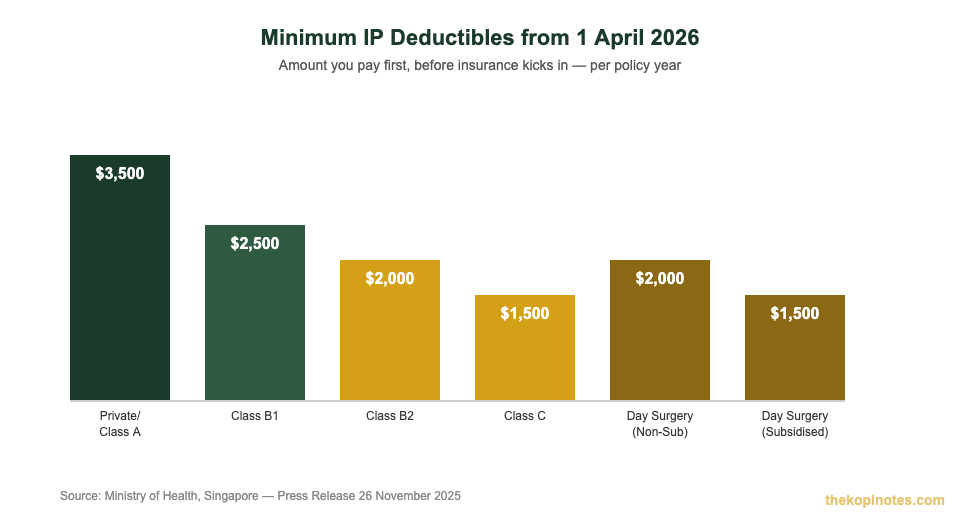
MOH sets the minimum deductible for each ISP. Here are the amounts as at August 2026:
| Ward Class Used | Minimum IP Deductible |
|---|---|
| Private Hospital / Class A | $3,500 |
| Class B1 | $2,500 |
| Class B2 | $2,000 |
| Class C | $1,500 |
| Day Surgery / Short Stay (Non-Subsidised) | $2,000 |
| Day Surgery / Short Stay (Subsidised) | $1,500 |
Source: Ministry of Health Singapore, Press Release 26 November 2025. Minimum deductibles may be updated from time to time.
There is an important nuance: the deductible you pay is the lower of (i) the amount for your IP’s target ward class, and (ii) the ward class you actually use.
For example, if your IP covers Class B1 wards but you choose to stay in a Class A ward, your deductible is still $2,500 (Class B1 rate) — not $3,500. However, if your IP covers Class A wards and you stay in a Class B1 ward, your deductible is $2,500 (Class B1 rate, the lower amount).
The deductible applies once per policy year, not per admission. If you are hospitalised twice in one year, you only pay the deductible once. The second admission does not trigger another deductible.
The Co-payment Cap: From $3,000 to $6,000
After you pay the deductible, your ISP pays most of the remaining bill. But you still owe a co-payment — a 5% share of the remaining bill. This 5% rate has not changed under the new rules.
What changed is the annual cap on your co-payments. This cap was set at $3,000 per year in 2018. From 1 April 2026, it rises to a minimum of $6,000 per year.
The cap means you will never pay more than $6,000 in co-insurance per year — no matter how high your bills get. This is important protection against very large, unexpected medical bills.
Here is how a typical private hospital bill works under the new system:
- You are admitted to a private hospital. Your total bill: $50,000.
- You pay the IP deductible: $3,500 (from MediSave or cash).
- Remaining bill after deductible: $46,500.
- Your 5% co-payment: $2,325.
- Your rider covers the rest: $44,175.
- Total you pay: $3,500 + $2,325 = $5,825 — entirely payable from MediSave, subject to withdrawal limits.
In that example, the $6,000 co-payment cap was not triggered. For very large bills — say $200,000 — the 5% co-payment would hit $6,000 and the cap kicks in, shielding you from further out-of-pocket costs.
For those choosing a best Class A ward shield plan, understanding both the deductible and the co-payment cap is essential to knowing your true out-of-pocket exposure.
Real Bill Examples: How Much More Will You Pay?
MOH published two real-money case studies in their November 2025 press release. Both use actual median private hospital bill sizes from 2024 MOH claims data.
Case 1: Knee Joint Replacement at a Private Hospital — $56,900 Bill
Mr A is 60 years old and switched from his old maximum-coverage rider to the new compliant rider in April 2026. He immediately saved $1,600 in cash per year on premiums. Three years later, he undergoes a knee joint replacement surgery. His bill comes to $56,900.
| Component | Amount |
|---|---|
| Total hospital bill | $56,900 |
| IP deductible paid by Mr A | $3,500 |
| 5% co-payment on remainder | $2,670 |
| Total out-of-pocket (deductible + co-pay) | $6,170 |
| Covered by MediSave | $6,170 |
| Cash out-of-pocket after MediSave | $0 |
Source: MOH Press Release, 26 November 2025. Bill based on median private hospital bill for knee joint replacement (2024 MOH data).
Compared to his old rider, Mr A paid $3,330 more in MediSave. But by switching, he saved $1,600 per year in cash premiums — so after three years, his cumulative premium savings ($4,800) already exceeded the extra MediSave cost ($3,330).
Case 2: ACL Reconstruction at a Private Hospital — $38,700 Bill
Mrs B is 40 years old and previously could not afford a rider. The new cheaper riders made coverage affordable for her. In December 2026, she tears her knee and needs ACL surgery. Bill: $38,700.
| Component | Amount |
|---|---|
| Total hospital bill | $38,700 |
| IP deductible | $3,500 |
| 5% co-payment on remainder | $1,760 |
| Total out-of-pocket | $5,260 |
| Covered by MediSave | $3,900 |
| Cash out-of-pocket | $1,360 |
Source: MOH Press Release, 26 November 2025. Bill based on median private hospital bill for ACL reconstruction (2024 MOH data).
Without a rider, Mrs B would have paid $3,120 in cash. With the new rider, she paid just $1,360 — saving $1,760 on that single hospitalisation. And she paid $500 less per year in rider premiums than peers who had bought the old maximum-coverage rider.
Premium Savings With the New Riders
The biggest reason to switch early: the new rider design removes deductible coverage — and that feature was expensive. Without it, premiums drop significantly.
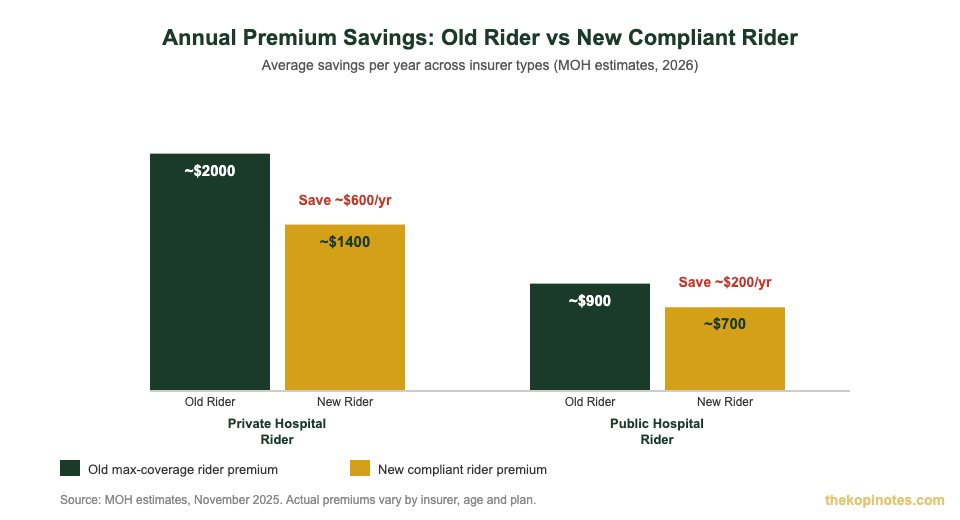
MOH’s estimates as at November 2025:
- Private hospital rider policyholders: save ~$600 per year on average
- Public hospital rider policyholders: save ~$200 per year on average
- Older policyholders save more, since their premiums are higher to begin with
The savings compound over time. As premiums rise with age, the gap between old maximum-coverage riders and the new compliant riders grows wider. Switching sooner means more cumulative savings before you ever make a claim.
To get a realistic view of how these premium savings fit into your long-term financial plan, try the Singapore retirement calculator — it helps you see how annual savings compound over decades.
What Happens to Your Existing Rider?
Your transition timeline depends on when you bought your rider.
Group 1: Bought Before 27 November 2025 (Legacy Policyholders)
You are on a “legacy” rider. You are not forced to switch immediately. However, each insurer must transition you to a compliant rider no later than your next policy renewal after 1 April 2028. This gives you roughly two years to plan and compare options.
You can also switch voluntarily — especially if the annual premium savings are significant at your age. Older policyholders in particular may find that switching immediately is financially better, since their premium savings are higher.
Group 2: Bought Between 27 November 2025 and 31 March 2026
If you bought a non-compliant rider in this window, your insurer was required to inform you at purchase that you would transition to a compliant rider at your next renewal after 1 April 2028. So you are in the same boat as Group 1, but you were formally notified.
Group 3: Bought on or After 1 April 2026
All new riders sold from this date already comply with the new rules. You are on the new compliant structure.
The bottom line: speak to your financial adviser before your next renewal. Compare your current rider premium versus the new compliant rider for your specific plan and age. For many policyholders — especially those over 50 — the premium savings outweigh the higher deductible.
See the complete guide to integrated shield plans in Singapore for a full breakdown of how each ISP tier works and which ward class makes sense for your situation.
Can You Use MediSave to Pay the Deductible?
Yes — and this is one of the most important practical points in the whole ISP rider overhaul.
Both the deductible and co-payments can be paid using your MediSave account, subject to the CPF Board’s prevailing withdrawal limits. This means the higher out-of-pocket costs under the new riders do not necessarily require you to reach into your cash savings.
MOH’s case examples show that for bills in the $38,700–$56,900 range, the combined deductible and co-payment ($5,260–$6,170) can be fully or largely covered by MediSave. In Mr A’s case (60-year-old, knee replacement at $56,900), the entire $6,170 came from MediSave — zero cash needed.
For most working Singaporeans, MediSave balances have been building up for years. For a typical 40-year-old with $50,000+ in their MediSave account, a $5,260 hospitalisation expense is well within reach — without touching their cash savings at all.
Which Insurer’s New Rider Should You Pick?
All seven approved ISP insurers are required to offer compliant riders from 1 April 2026. The seven insurers are: AIA, Great Eastern, NTUC Income, Prudential, Singlife, Raffles Health Insurance, and HSBC Life.
The base ISP (without a rider) provides MediShield Life benefits and is identical in structure across all insurers. The rider is where the differences lie — in terms of panel size, coverage enhancements, and premium pricing.
Under the new design, the key questions when comparing riders are:
- What is the annual rider premium for your age?
- Does the rider cover panel and pre-authorised claims only, or also non-panel claims?
- What is the annual claim limit for the combined base plan + rider?
- Are there any additional benefits (e.g. cancer treatment, post-hospitalisation coverage)?
For detailed, insurer-by-insurer reviews, see these TKN guides:
- AIA’s new VitalHealth Pro rider — AIA’s compliant rider launched in April 2026, with premiums, benefits, and panel details explained.
- Singlife Shield Plan guide — covers Plan 1, Plan 2, and the new rider structure for Singlife.
- Great Eastern Supreme Health guide — GE’s plans and how their new rider compares.
If you are primarily focused on Class A ward coverage and want to compare which insurer gives you the best combination of premium and annual claim limit, the best Class A ward shield plan guide is the right starting point.
Finally, do not make any changes to your shield plan without first speaking to a licensed financial adviser. Every situation is different — your age, MediSave balance, hospitalisation risk, and budget all affect which rider makes most sense for you.
Frequently Asked Questions
From what date do the ISP rider changes take effect?
Do I have to switch my rider immediately?
What is the deductible for private hospital coverage?
Can I use MediSave to pay the deductible and co-payment?
How much cheaper are the new rider premiums?
What is the new co-payment cap?
Why did MOH change the ISP rider rules?
How do I find out what rider I currently hold?
Get Free Insurance Advice
Speak with a licensed insurance advisor. No obligation, no cost.
By submitting this form, you agree to our Privacy Policy.
This article was researched with the help of AI. While we strive to keep all information accurate and up to date, there may be errors. If you notice any discrepancies, please contact us.