Endowment Plan vs Dividend Stocks Singapore 2026
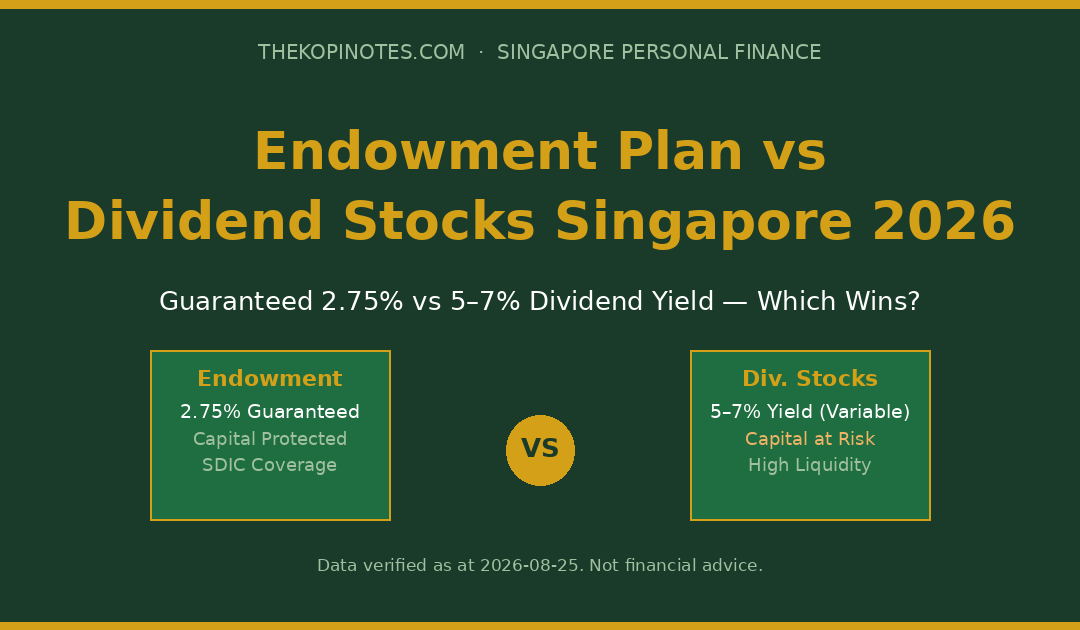
Endowment plans offer 2.75–2.80% p.a. guaranteed. Singapore blue-chip dividend stocks yield 5–7%. One protects your capital; the other can grow it — but comes with real risk. This guide breaks down exactly what you get, what you risk, and who should pick which.
Data verified as at 2026-08-25. Rates and yields are indicative snapshots and change frequently. This is not financial advice.
Table of Contents
What Is an Endowment Plan?
An endowment plan is a life insurance savings product sold by MAS-licensed Singapore insurers — Singlife, NTUC Income, Manulife, Great Eastern, Prudential, AIA, and others. You commit a lump sum (single premium) or regular premiums for a fixed policy term, typically 2 to 5 years, and receive a guaranteed maturity payout when the policy matures.
Short-term single premium endowment plans (the most common type in Singapore today) typically offer:
- Guaranteed returns locked in at policy inception — typically 1.44% to 2.80% p.a. in August 2026 for 2-year plans
- Capital protection — your principal is returned in full at maturity if no claims are made
- Life insurance coverage during the policy term (usually 100–105% of premium)
- Policy Owners’ Protection (PPF) Scheme coverage administered by SDIC — up to S$100,000 per insurer
- SRS eligibility for many plans — useful for deferring income tax
For a full breakdown of current endowment interest rates and how LIA caps work, see our endowment plan interest rates guide.
What Are Dividend Stocks in Singapore?
Dividend stocks are shares in listed companies that pay regular cash distributions to shareholders — typically quarterly, semi-annually, or annually. In Singapore, the most popular dividend stocks fall into three categories:
- Singapore blue-chip banks — DBS, OCBC, UOB. These consistently pay dividends and trade on the SGX. As at August 2026, dividend yields are approximately: DBS 5.3%, OCBC 5.8%, UOB 5.5%.
- Singapore REITs (S-REITs) — trusts that own income-generating properties and must distribute at least 90% of distributable income to unitholders. S-REIT yields in 2026 range from approximately 5% to 8% depending on the REIT. See our high dividend stocks guide and best S-REITs 2026 for ranked lists.
- Other blue chips — Singtel (~3.0%), Keppel, Jardine group companies, and others. Yields vary more widely.
Unlike endowment plans, dividend stocks are listed instruments — you buy and sell them through a brokerage (DBS Vickers, Tiger Brokers, IBKR, Moomoo, Syfe, Endowus, etc.). You can invest in a diversified basket of dividend stocks through platforms like Endowus (referral code: 2V343) or Syfe (referral code: SRPRFFFCD) for lower minimums and automatic rebalancing.
Importantly, Singapore does not impose dividend withholding tax on individual investors receiving dividends from Singapore-listed companies. This is a significant tax advantage versus, for example, US dividend stocks (which face 30% withholding unless reduced by treaty).
Side-by-Side Comparison
| Feature | Endowment Plan | Dividend Stocks (SG) |
|---|---|---|
| Typical Returns (2026) | 1.44% – 2.80% p.a. guaranteed | 5% – 7%+ yield (variable) |
| Capital Protection | ✅ Yes — full capital returned at maturity | ❌ No — share price can fall |
| Returns Guaranteed? | ✅ Guaranteed maturity benefit | ❌ Dividends can be cut or omitted |
| Liquidity | ❌ Locked in (early surrender penalty) | ✅ Listed — sell anytime on SGX |
| Investor Protection | SDIC PPF up to S$100,000/insurer | No capital guarantee; SGX settlement protection |
| SRS Eligible | Many plans — check brochure | ✅ Yes via SRS investment account |
| CPF (OA) Eligible | Some plans (CPFIS-approved) | Yes (CPFIS-approved stocks/ETFs) |
| Dividend/Return Tax | Tax-free in Singapore | Tax-free (no dividend withholding for SG residents) |
| Minimum Investment | S$10,000 – S$20,000 (single premium) | From S$100 (fractional/ETF); S$1 via Syfe/Endowus |
| Time Horizon | Fixed term (typically 2–5 years) | Flexible — can hold indefinitely |
| Life Insurance? | ✅ Yes — included in policy | ❌ No — separate coverage needed |
Returns Comparison 2026
Endowment Plan Rates (August 2026)
Current short-term endowment plan rates in Singapore as at August 2026:
| Plan | Term | Guaranteed Yield | Min. Premium |
|---|---|---|---|
| Singlife Secure Saver VIII | 2 years | 2.75% p.a. | S$20,000 |
| OCBC 2-Year Endowment | 2 years | ~2.80% p.a. | Varies by tranche |
| DBS SavvyEndowment 23 | 2 years | 1.44% p.a. guaranteed; up to 1.60% total | S$5,000 |
Tranche availability changes frequently. Verify current rates before purchasing. See our endowment interest rates guide for updated comparisons.
Dividend Stock Yields (August 2026)
Indicative trailing dividend yields for Singapore’s most popular dividend stocks and S-REITs as at August 2026:
| Stock / REIT | Type | Indicative Yield (2026) |
|---|---|---|
| DBS Group | Bank | ~5.3% |
| OCBC Bank | Bank | ~5.8% |
| UOB | Bank | ~5.5% |
| Mapletree Industrial Trust (MIT) | Industrial S-REIT | ~6.4% |
| Typical S-REIT | Property REIT | 5% – 8% |
Yields are calculated as trailing annual dividend divided by current share price. They fluctuate daily. Past yields do not guarantee future payouts.
The headline gap is significant: even the highest guaranteed endowment yield (2.80% p.a. from OCBC) is roughly half the dividend yield of Singapore bank stocks (~5.5–5.8%) and a fraction of better-paying S-REITs (6–8%). However, this comparison ignores the most critical difference — risk.
Risk and Capital Protection
The most fundamental difference between endowment plans and dividend stocks is what happens to your capital.
Endowment Plans: Capital Protected
Short-term non-participating endowment plans guarantee the return of your full premium at maturity, plus the stated guaranteed yield. There is no scenario in which you receive less than this guaranteed maturity benefit — provided you hold to term and no claims are made. This capital protection is contractual and legally binding under the policy contract.
The only risks to consider are:
- Insurer insolvency — mitigated by SDIC’s PPF Scheme (see below)
- Early surrender — exiting before maturity typically returns below the premium paid in year 1
- Inflation risk — a 2.75% guaranteed return may underperform inflation over the same period
Dividend Stocks: Capital at Risk
When you buy shares in DBS, OCBC, or a Singapore REIT, your capital is fully exposed to market movements. The share price can rise (giving you capital gains on top of dividends) or fall (giving you capital losses that may offset or exceed dividend income).
Consider a simple example: if you invest S$50,000 in a stock yielding 5.5%, you receive S$2,750 in dividends in year one. But if the share price falls 10%, your portfolio is now worth S$45,000 — a net loss of S$2,250 despite receiving dividends.
Dividend cuts are also a real risk. During the COVID-19 period in 2020, several Singapore banks were advised by MAS to cap dividend payouts. REITs temporarily reduced distributions when rental income fell. Past dividend consistency does not guarantee future payouts.
That said, over longer time horizons (5–10+ years), high-quality Singapore dividend stocks have historically delivered total returns (dividends + capital appreciation) well in excess of endowment plan rates. The trade-off is accepting volatility along the way.
SDIC and Investor Protection
Endowment Plans: PPF Scheme via SDIC
Singapore’s Policy Owners’ Protection (PPF) Scheme, administered by the Singapore Deposit Insurance Corporation (SDIC), covers the surrender value or guaranteed maturity benefit of life insurance and endowment policies up to S$100,000 per life assured per insurer. This protection activates if a licensed Singapore insurer is wound up or becomes insolvent.
Key points on PPF coverage:
- Covers guaranteed benefits only — non-guaranteed bonuses are not covered
- S$100,000 limit applies per insured person per insurer — investors with large lump sums should spread across multiple insurers
- Applies only to policies issued by MAS-licensed Singapore insurers
Dividend Stocks: No Capital Guarantee
There is no equivalent capital protection scheme for listed equities in Singapore. SGX settlement rules and CDP (Central Depository) ensure you retain legal ownership of shares in the event of a broker’s insolvency — your shares are held separately at CDP, not on the broker’s balance sheet. However, this protects ownership, not value. If the company itself becomes insolvent, shares can fall to zero.
Singapore’s Investor Protection Framework (administered by MAS) focuses on conduct regulation (fair dealing, disclosure, suitability assessments) rather than capital guarantees. There is no equivalent of a “share price protection scheme.”
Liquidity Comparison
Endowment plans have poor liquidity. Once you commit your premium, your capital is locked in for the full policy term. Surrendering early — particularly in year 1 — typically returns less than the premium paid. The exact surrender value schedule is disclosed in your policy illustration before you sign. Plan administrators may take 2–4 weeks to process surrender requests and transfer funds.
Dividend stocks have excellent liquidity. SGX-listed stocks trade on every business day from 9am to 5pm Singapore time. You can sell your entire position at prevailing market prices within minutes and receive the proceeds in your brokerage account within T+2 business days. This flexibility makes dividend stocks much more suitable for capital you may need access to unexpectedly.
The liquidity trade-off is the core reason many Singapore investors use endowment plans for earmarked capital (e.g., “I won’t touch this for 2 years”) and dividend stocks for the remaining investible portion of their portfolio. Use our retirement planning calculator to help determine how to allocate between liquid and illiquid assets based on your timeline.
Tax Treatment in Singapore
Both endowment plans and Singapore dividend stocks offer highly tax-efficient returns for Singapore residents.
- Endowment plan maturity benefits are received tax-free. Singapore does not tax investment gains or insurance maturity proceeds for individuals.
- Singapore stock dividends are also received tax-free for individual investors. Singapore operates under a one-tier corporate tax system — companies pay tax at the corporate level, and dividends are paid out of after-tax profits with no further withholding tax at the investor level.
- Capital gains from selling shares are also tax-free in Singapore — there is no capital gains tax.
The main tax consideration unique to endowment plans is SRS eligibility. Premiums paid from your Supplementary Retirement Scheme (SRS) account provide a dollar-for-dollar income tax deduction in the year of contribution. If your endowment plan accepts SRS funds, this can meaningfully boost your effective after-tax return — especially for higher-income earners in the 19–24% marginal tax bracket. Many short-term endowment plans from Singlife, Manulife, Great Eastern, and NTUC Income accept SRS funds; confirm with the specific plan brochure before purchasing.
Dividend stocks can also be held via SRS and benefit from the same deduction at the contribution stage, though SRS equity investing requires an SRS-linked brokerage account.
Who Should Choose What?
Choose Endowment Plans If:
- You have a specific lump sum you cannot afford to lose — an emergency fund buffer, a house down payment reserve, or savings ear-marked for a specific goal in 2 years
- You want predictable, guaranteed income and dislike the uncertainty of market fluctuations
- You want to use SRS funds and need a non-equity product that qualifies
- You want bundled life insurance coverage without purchasing a separate term policy
- You are in or near retirement and prioritise capital preservation over growth
Choose Dividend Stocks If:
- You have a longer investment horizon of 5+ years and can tolerate interim price volatility
- You want to build growing passive income over time — quality dividend stocks historically grow their payouts, compounding income year over year
- You need liquidity flexibility — the ability to access funds if an unexpected expense arises
- You want inflation protection — dividend stocks can grow payouts over time, partially offsetting inflation; endowment rates are locked at inception
- You are comfortable with basic equity market risk and have an emergency fund already in place
For many Singapore investors, the right answer is both — using endowment plans for capital you’re certain you won’t need for 2 years, and dividend stocks (via platforms like Syfe Income+ or Endowus Fund Smart) for the long-term portion of your portfolio. For detailed guidance on dividend investing strategy, see our dividend investing Singapore guide.
The Verdict
Endowment plans and dividend stocks solve different problems. Endowment plans guarantee your capital and provide a known, modest return — ideal for short-term goals and risk-averse investors. Dividend stocks deliver substantially higher yields (5–7%+ vs 2–3%) and long-term growth potential, but with capital risk and short-term volatility you must be prepared to absorb.
The critical question isn’t which is “better” — it’s which suits your specific goal. Money you can’t afford to lose belongs in an endowment plan. Money you’re investing for retirement 10+ years away, or for growing passive income, belongs in quality dividend stocks or S-REITs.
If you’re choosing platforms for dividend investing, compare Endowus (code: 2V343) for access to institutional-grade dividend funds or Syfe (code: SRPRFFFCD) for their Income+ portfolio optimised for SG dividend income.
Frequently Asked Questions
Is the dividend from Singapore stocks guaranteed?
No. Dividends from Singapore-listed stocks — including blue-chip banks and S-REITs — are not legally guaranteed. The board of directors declares dividends based on earnings and cash flow in each period. During difficult periods (COVID-19 in 2020 is a clear example), MAS advised Singapore banks to cap dividends, and some REITs reduced distributions due to lower rental income. However, many Singapore companies have long track records of consistent dividend payment. Blue-chip banks like DBS, OCBC, and UOB have paid dividends consistently for decades — but past consistency is not a contractual guarantee.
Which is better for a 2-year time horizon — endowment plan or dividend stocks?
For a strict 2-year horizon where you cannot afford to lose capital, an endowment plan is the better choice. At 2.75–2.80% p.a. guaranteed, it outperforms fixed deposits and provides known outcomes. Dividend stocks could theoretically deliver higher returns in 2 years — but they could also deliver negative total returns if share prices fall during that period. If your 2-year capital is truly ringfenced (e.g., a house down payment due in 24 months), the certainty of an endowment plan is worth accepting a lower yield.
Which is better for retirement income — endowment plan or dividend stocks?
For long-term retirement income building (10+ years away), dividend stocks and S-REITs typically win on total return. High-quality Singapore dividend stocks compound both share price and dividend payouts over time, potentially delivering 7–10%+ annualised total return historically, versus 2–3% p.a. from endowment plans. As you approach retirement, however, a portion of your portfolio may appropriately shift towards capital-protected instruments like endowment plans to preserve the wealth you’ve built. Use our retirement planning calculator to model different scenarios.
Are S-REIT distributions taxed in Singapore?
For individual Singapore tax residents receiving distributions from Singapore REITs listed on SGX, the distributions are generally received tax-free at the investor level. Singapore REITs operate under a tax-transparent framework — distributions pass through to investors without withholding tax at the REIT level for qualifying investors. However, if you invest via certain fund structures or hold REITs in an offshore account, the tax treatment may differ. For direct SGX-listed S-REIT investments, most retail investors receive distributions without Singapore withholding tax. Always verify the specific REIT’s distribution statement and consult a tax professional for your personal situation.
Can I use CPF to invest in endowment plans or dividend stocks?
Yes to both, with conditions. Under the CPF Investment Scheme (CPFIS), you can use your OA (Ordinary Account) savings to invest in CPFIS-approved endowment plans and certain insurance products. You can also use OA funds to invest in CPFIS-approved Singapore stocks and ETFs. However, your OA currently earns a guaranteed 2.5% p.a. (with a floor of 3.5% on the first S$60,000 of combined CPF savings). Given that top endowment plans now offer ~2.75–2.80% guaranteed, the incremental return over leaving funds in OA is slim — while dividend stocks must meaningfully outperform 2.5–3.5% risk-free OA returns to justify the added risk. For most investors, CPF CPFIS investing requires careful consideration.
What is the SDIC PPF limit for endowment plans?
The Policy Owners’ Protection (PPF) Scheme administered by SDIC covers guaranteed benefits of life insurance policies — including endowment plans — up to S$100,000 per life assured per licensed insurer. This limit applies to the guaranteed maturity benefit or surrender value. If you have S$200,000 to deploy in endowment plans, consider splitting between two different insurers (e.g., S$100,000 with Singlife and S$100,000 with NTUC Income) to maximise PPF coverage. Non-guaranteed bonuses (if any) are not covered by the PPF Scheme.
What happens to my endowment plan if the insurer fails?
If a MAS-licensed Singapore insurer becomes insolvent, the PPF Scheme is triggered. SDIC steps in to protect policyholders up to the scheme limits (S$100,000 guaranteed value for life/endowment policies). In practice, MAS closely supervises Singapore insurers and requires them to maintain adequate solvency margins — the failure of a Singapore licensed insurer is an extremely low-probability event. For comparison, no PPF payout has been required in Singapore since the scheme’s inception. Nevertheless, the S$100,000 per insurer cap is worth being aware of for larger lump-sum investors.
How do I start investing in Singapore dividend stocks?
You have several options. For direct SGX stock purchases, open a brokerage account with DBS Vickers, Moomoo, Tiger Brokers, or Interactive Brokers — fund it with cash or SRS funds and buy shares directly. For a managed approach with lower minimums, platforms like Endowus (referral code: 2V343) provide access to institutional-grade dividend-focused funds, while Syfe (referral code: SRPRFFFCD) offers their Income+ portfolio focused on Singapore dividend income. For a full guide to the strategy and mechanics, see our dividend investing Singapore guide.
Can I hold both an endowment plan and dividend stocks?
Yes — and for many Singapore investors, this is the optimal approach. Use endowment plans for capital you’ve ring-fenced for a specific near-term goal (2–3 years) where you need certainty. Use dividend stocks and S-REITs for the long-term, growth-oriented portion of your portfolio where you can accept interim price volatility. This two-bucket approach lets you benefit from both the capital protection of endowment plans and the higher long-term return potential of equities, calibrated to your risk tolerance and time horizon. There are no regulatory restrictions on holding both simultaneously.
Get Free Insurance Advice
Speak with a licensed insurance advisor. No obligation, no cost.
By submitting this form, you agree to our Privacy Policy.
This article was researched with the help of AI. While we strive to keep all information accurate and up to date, there may be errors. If you notice any discrepancies, please contact us.