Dividend Investing Strategy: A 5-Step Framework for Singapore Investors (2026)
A practical guide to choosing income vehicles, minimising tax drag, and building a portfolio that actually pays you.
Dividend investing means building a portfolio of income-paying assets — blue-chip stocks, S-REITs, and dividend ETFs — to generate regular cash payouts. Singapore dividends are tax-free under the one-tier system, but dividends from US-listed stocks lose 30% to US withholding tax before they even reach you. This guide gives you a 5-step framework: pick your vehicles, know your tax drag, diversify properly, decide on reinvestment, and avoid the mistakes that quietly erode returns.
Not financial advice. All figures are for educational reference only. Data verified as at 18 August 2026 unless otherwise noted.
- Local Singapore dividends are 100% tax-free; US-listed stock dividends lose 30% to withholding tax before they land in your account
- Yield alone is a trap — diversify across at least 15-20 holdings or three or more sectors before you chase a headline number
- Decide upfront whether you’re reinvesting for growth or taking cash for income. Switching back and forth without a plan quietly erodes your returns
Table of Contents
Contents — Click to expand
What “Dividend Investing” Actually Means
Dividend investing isn’t just buying whatever stock has the highest yield on a screener. It’s a strategy built around cash flow. You hold assets specifically because they pay you regularly, not because you’re betting the price will double.
In Singapore, three vehicles dominate this strategy: blue-chip stocks such as DBS or Singtel, S-REITs (Singapore real estate investment trusts), and dividend-focused ETFs. Each pays differently, gets taxed differently, and carries different risks.
For a broader walkthrough covering S-REITs, blue chips, and ETFs side by side, see our complete guide to dividend investing in Singapore. This article goes deeper into the decision-making framework — the five steps that separate a durable income portfolio from a collection of high-yield stocks bought without a plan.
The framework below treats dividend investing as a system with five decisions, not one. Skip a step, such as diversification, and you end up with a portfolio that looks diversified on paper but behaves like one concentrated bet when a sector turns.
Step 1: Choose Your Income Vehicles
Start by understanding what each vehicle actually offers you. A blue-chip stock like DBS pays a dividend because the underlying business generates profit. An S-REIT is legally required to distribute at least 90% of its taxable income to unitholders to keep its tax-transparent status. A dividend ETF simply pools many income-paying assets into a single fund.
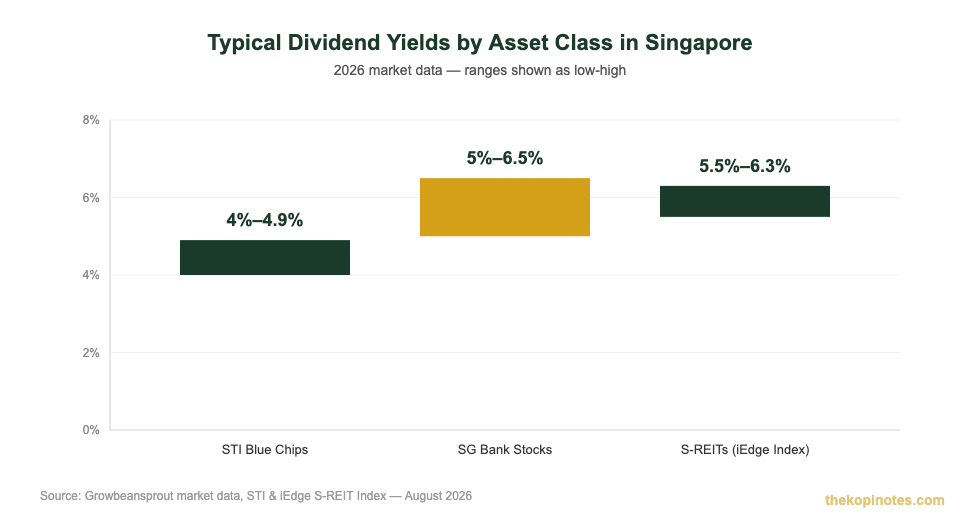
Blue chip stocks in Singapore have delivered an average STI dividend yield of around 4.5% in 2026, with the three local banks — DBS, OCBC, and UOB — running higher, in the 5%–6.5% range. They tend to be the most liquid and easiest to research, since they publish quarterly results and get heavy analyst coverage.
S-REITs, tracked by the iEdge S-REIT Index, have carried an average yield closer to 5.5%–6.3% through 2026. That’s higher than blue chips, but S-REIT distributions move with occupancy rates, interest costs, and gearing levels — not just company profit. For a deeper look at individual names, our guide to dividend stocks in Singapore breaks down sector-by-sector picks.
Dividend ETFs sit in between. They spread your money across dozens or hundreds of payers automatically, which removes single-stock risk. But you also inherit whatever the fund’s rules select — including some weaker payers you might not choose yourself.
| Vehicle | Typical Yield (2026) | What Drives Payouts | Research Effort |
|---|---|---|---|
| Blue-chip stocks (DBS, OCBC, UOB) | 4.5%–6.5% | Company profit & payout policy | Medium — read quarterly results |
| S-REITs | 5.5%–6.3% | Rental income, occupancy, gearing | Medium-high — check DPU trend & gearing |
| Dividend ETFs | Varies by fund | Combined yield of the underlying basket | Low — one fund, one decision |
Source: Growbeansprout market data, STI & iEdge S-REIT Index, August 2026
Step 2: Know Your Real Tax Drag
This is where most beginners lose money without realising it. Singapore taxes dividends very differently depending on where the paying company is listed.
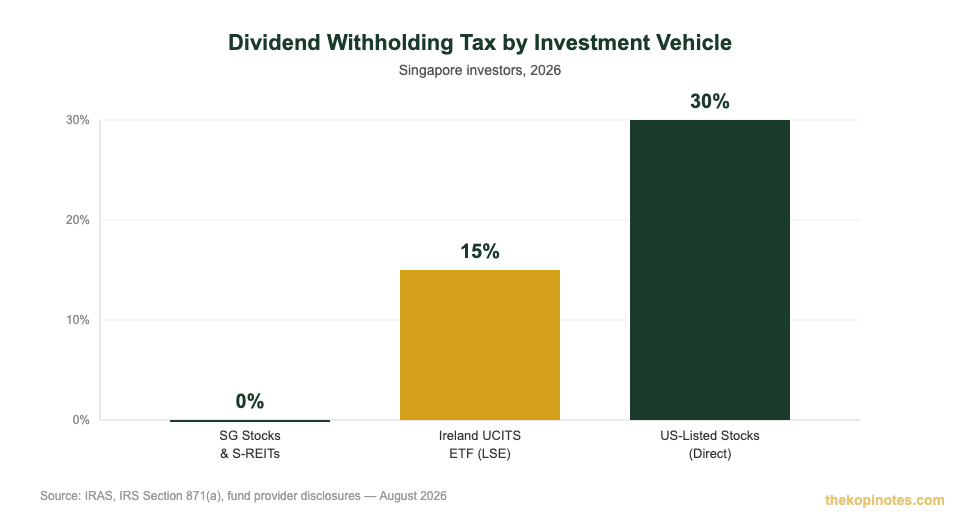
Dividends from a Singapore tax-resident company are exempt from tax in your hands. The company has already paid corporate tax before distributing profit, so IRAS doesn’t tax it again. This applies to blue-chip stocks and S-REITs listed on the SGX.
Dividends from US-listed stocks work very differently. The US withholds 30% tax on dividends paid to non-resident aliens, and Singapore has no tax treaty with America to reduce that rate. If a US stock pays you USD 100 in dividends, USD 30 is deducted before the money reaches your account — permanently.
There’s a middle path. Ireland-domiciled UCITS ETFs — the kind listed on the London Stock Exchange, such as CSPX or VWRA — benefit from Ireland’s tax treaty with the US. That cuts the effective withholding tax on US-source dividends inside the fund to roughly 15%, half of what you’d lose holding the same US stocks directly.
| Dividend Source | Withholding Tax | What It Means for You |
|---|---|---|
| SG-listed stocks & S-REITs | 0% | Full dividend reaches you, no tax filing needed |
| Ireland-domiciled UCITS ETF (LSE) | ~15% | Withheld inside the fund before distribution |
| US-listed stocks (direct) | 30% | USD 30 of every USD 100 dividend withheld at source |
Source: IRAS, IRS Section 871(a) NRA withholding rules, fund provider disclosures — August 2026
This doesn’t mean you should avoid US exposure entirely. It means you should know the cost before you buy. A pure S-REIT and blue-chip portfolio has zero withholding drag. A portfolio built entirely on direct US dividend stocks gives up 30% of every payout before it lands.
Run the numbers on a real portfolio. Say you hold SGD 30,000 in US-listed dividend stocks yielding 4% a year, that is SGD 1,200 in gross dividends. After 30% withholding tax, you actually receive SGD 840 in cash. Hold the same exposure through an Ireland-domiciled UCITS ETF instead, and the 15% effective withholding tax leaves you with SGD 1,020. The difference, SGD 180 a year on a single position, compounds meaningfully over a multi-decade holding period.
Step 3: Diversify Beyond Yield
A high yield alone tells you nothing about safety. Some of the highest-yielding stocks on the SGX carry that yield because the share price has fallen — the dividend hasn’t gone up, the price has gone down.
Before adding any income holding, check three things: how long the company or REIT has paid a stable or growing dividend, whether the payout ratio leaves room for a bad year, and how much debt sits on the balance sheet. A REIT with gearing above 40% has less room to manoeuvre if interest rates rise or a tenant leaves.
Spread your holdings across sectors, not just stock count. Five S-REITs that are all in retail or all in office property behave like one bet, not five. Aim for exposure across at least three different S-REIT sub-sectors — industrial, retail, and data centres, for example — plus banking and telecom on the stock side.
A useful rule of thumb: no single holding should account for more than 10% of your total income portfolio, and no single sector more than 30%. If one dividend gets cut, the rest of your portfolio should barely notice.
Step 4: Reinvest or Take Cash?
Decide this before you buy your first share, not after your first payout. Reinvesting dividends — either automatically through a Dividend Reinvestment Plan or manually by buying more units — compounds your income over time. Taking cash gives you spendable income today but slows portfolio growth.
Here’s a worked example. If you invest SGD 50,000 in a portfolio yielding 5% and reinvest every payout, you’re compounding at that rate on top of any capital growth. Left untouched for 15 years at a steady 5% reinvested yield, that SGD 50,000 grows to roughly SGD 104,000 from dividends alone — before accounting for any share price movement.
If you’re still working and don’t need the income, reinvest. If you’re retired or building toward a specific spending goal, taking cash makes more sense. That’s the entire point of building the portfolio in the first place. For more on structuring income for retirement, see our guide to passive income in Singapore.
The mistake is switching back and forth without a plan. That makes it hard to track your actual return and quietly erodes compounding over time.
Step 5: Where to Hold Your Portfolio
Where you hold your dividend portfolio changes what it costs you. SGX-listed stocks and REITs settle into your CDP (Central Depository) account by default when you trade through most brokers, keeping ownership directly in your name.
Broker choice matters more than most beginners realise. Syfe offers commission-free access to SGX blue chips and REITs, which suits smaller portfolios and first-time dividend investors. Larger portfolios often benefit from CDP-linked direct ownership and a wider product range through a full-service broker.
If you plan to add Ireland-domiciled UCITS ETFs on the LSE for lower-withholding-tax global exposure, check that your broker supports GBP-denominated trades before committing. Model how your dividend income fits your overall retirement number using our Singapore retirement planning calculator — dividend investing works best as part of a broader plan, not a standalone bet.
You can also hold Singapore dividend stocks and REITs inside your SRS (Supplementary Retirement Scheme) account. Contributions qualify for immediate tax relief, and if you withdraw only after your prescribed statutory retirement age, just 50% of the withdrawal is taxable. That makes SRS a useful wrapper for dividend holdings you do not plan to touch until retirement.
Common Mistakes That Wreck Dividend Portfolios
- Chasing yield without checking the payout ratio. A REIT yielding 9% when the sector average is 6% usually means the market expects a dividend cut, not a bargain.
- Ignoring gearing levels. High-debt REITs get squeezed hardest when interest rates rise. Check gearing before you check yield.
- Concentrating in one sector. Owning ten stocks in the same industry isn’t diversification — it’s one large position split into ten tickers.
- Forgetting the withholding tax drag. A US stock advertising a 4% yield effectively pays you closer to 2.8% after the 30% withholding tax. Factor that into every comparison.
- No reinvestment plan. Letting dividend cash sit uninvested in your brokerage account for months at a time is one of the quietest ways to lose long-term compounding.
- Treating dividend investing as separate from your overall plan. Your dividend portfolio should work alongside CPF, SRS, and any other retirement savings — not sit in isolation.
None of these mistakes are complicated to avoid. They just require checking the numbers before you buy, not after the dividend gets cut.
Frequently Asked Questions
What is dividend investing?
Dividend investing means building a portfolio of stocks, REITs, or ETFs specifically to generate regular cash payouts, rather than relying only on share price growth. In Singapore, it’s a common strategy for retirement income because local dividends are tax-free.
Is dividend income taxable in Singapore?
Dividends paid by a Singapore tax-resident company are exempt from tax in your hands under the one-tier corporate tax system. Dividends from foreign-listed stocks, such as US shares, may be subject to withholding tax at source — for the US, that’s 30% since Singapore has no tax treaty with America.
How much withholding tax do I pay on US dividend stocks?
The US withholds 30% on dividends paid to Singapore residents holding US-listed shares directly, since there’s no US-Singapore tax treaty. Ireland-domiciled UCITS ETFs that hold US stocks, such as those listed on the London Stock Exchange, cut this to roughly 15% thanks to Ireland’s tax treaty with the US.
What's a good dividend yield for Singapore stocks?
STI blue-chip stocks have averaged around 4.5% in 2026, with the three local banks running higher at 5%–6.5%. S-REITs, tracked by the iEdge S-REIT Index, have averaged 5.5%–6.3%. A yield well above these ranges is worth investigating before you buy, not celebrating.
Should I reinvest my dividends or take the cash?
Reinvest if you’re still building your portfolio and don’t need the income now — it compounds your returns over time. Take cash if you’re retired or funding a specific goal. Decide this upfront rather than switching between the two without a plan.
How many stocks or REITs should a dividend portfolio hold?
There’s no fixed number, but a useful guideline is at least 15–20 holdings across three or more sectors, with no single position above 10% of your total portfolio. This limits the damage if any one dividend gets cut.
Ready to Start Building Your Dividend Portfolio?
Open a brokerage account and put this 5-step framework to work. Use our referral links for exclusive sign-up bonuses.
This article was researched with the help of AI. While we strive to keep all information accurate and up to date, there may be errors. If you notice any discrepancies, please contact us.