How to Invest in Singapore: Lump Sum vs Dollar Cost Averaging (DCA)
Should you invest all at once or spread it out monthly? The data has a clear answer — but psychology matters just as much.
If you have a lump sum to invest — a year-end bonus, an inheritance, or a CPF top-up refund — should you put it all in at once or spread it out monthly? Research from Vanguard shows that lump sum investing outperforms dollar cost averaging (DCA) in roughly two-thirds of historical scenarios. But DCA wins on psychology — and for most Singapore investors investing monthly salary, it is still the smarter practical default.
Not financial advice. All figures are for educational reference only. Data verified as at 28 August 2026.
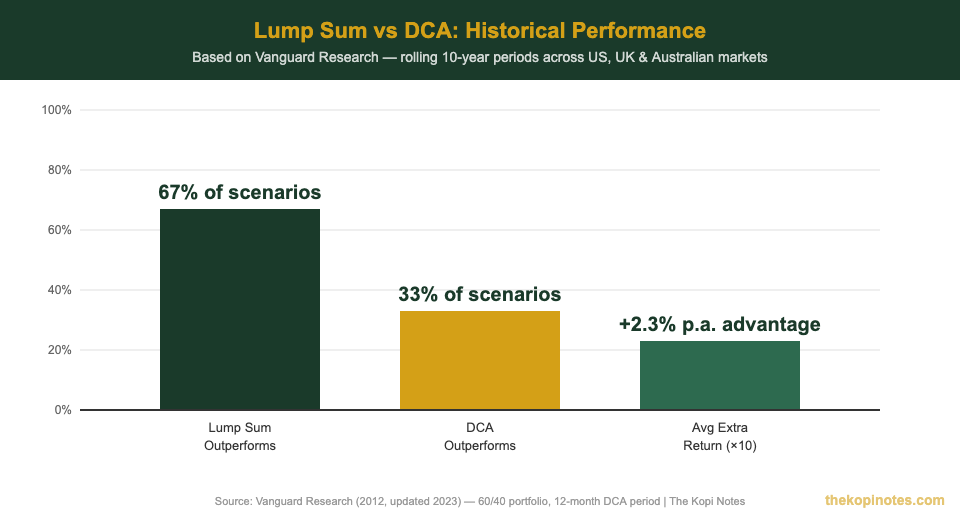
- Lump sum investing outperforms DCA roughly 67% of the time historically (Vanguard research)
- The average advantage is about 2.3% over 12 months for a balanced 60/40 portfolio
- If you invest monthly salary, DCA is your natural default — and that is perfectly fine
- If you have a windfall, consider investing it all at once — or split over 3–6 months max if volatility makes you nervous
What Is Dollar Cost Averaging (DCA)?
Dollar cost averaging means investing a fixed amount at regular intervals — regardless of what the market is doing. Instead of putting S$12,000 in all at once, you invest S$1,000 every month for 12 months.
Here is a simple example with the STI ETF:
| Month | ETF Price (S$) | Units Bought | Amount Invested |
|---|---|---|---|
| January | 3.20 | 156 | S$500 |
| February | 2.90 | 172 | S$500 |
| March | 3.10 | 161 | S$500 |
| April | 3.40 | 147 | S$500 |
Source: Illustrative example. ETF prices are hypothetical for demonstration purposes.
Notice what happened in February. The price dropped to S$2.90, so your S$500 bought 172 units instead of 156. You automatically bought more when the price was cheaper. That is the core benefit of DCA — you buy more units at lower prices and fewer units at higher prices.
Your average cost per unit across four months works out to roughly S$3.14. If you had invested the full S$2,000 in January at S$3.20, your average cost would be higher. DCA smoothed your entry.
This is also why most Singapore investors already practise DCA without realising it. Your monthly salary arrives, you invest a portion, and you repeat next month. That is dollar cost averaging by design.
What Is Lump Sum Investing?
Lump sum investing means deploying all your available capital at once. You receive a S$50,000 year-end bonus and instead of dripping it in monthly, you put the entire amount into the market on a single day.
The logic is straightforward. Markets trend upward over time. If you hold cash waiting to invest, that cash earns less than invested assets. Every day you wait is a day of potential compound growth you leave on the table.
That 73% figure is why lump sum investing has the mathematical edge. If markets are more likely to be higher in the future than today, getting in now beats waiting.
But here is the real catch. Lump sum investing feels terrible when you invest everything just before a crash. Even if you know it will recover eventually, watching S$50,000 drop to S$38,000 in a month is genuinely painful. That emotional cost is real. It can cause investors to panic-sell at exactly the wrong moment — turning a temporary paper loss into a permanent one.
What Does the Research Say?
Vanguard published a landmark study analysing rolling 10-year periods across the US, UK, and Australian stock markets. The findings were clear.
In practical terms: if you invested all your money on day one rather than spreading it over 12 months, you came out ahead about two times out of three. The average outperformance was 2.3% for a balanced 60/40 portfolio over a 12-month DCA period. For an all-equity portfolio, the advantage was 2.4%.
That might not sound dramatic. But on S$100,000, that is S$2,300 in year one alone. Compounded over a lifetime of investing, the gap becomes significant.
Why Does Lump Sum Win Mathematically?
Because cash earns less than equities over long periods. When you DCA, you hold part of your money in a savings account for months waiting to be deployed. That cash is not compounding at the same rate as invested assets.
Markets also have a positive expected drift. If you invest today and hold for 12 months, you have benefited from 12 months of expected positive returns. If you wait 12 months to fully invest, you have given up most of that drift.
When DCA Wins
The 33% of scenarios where DCA beats lump sum? Almost all of them are falling-market environments. If you happened to invest everything just before a major crash, DCA would have protected you — you would have spread your purchases across lower prices as the market fell.
The key insight is this: you do not know in advance whether you are in the 67% or the 33%. That uncertainty is why DCA remains popular — not because it is mathematically superior, but because it caps your regret and keeps you in the market.
The Singapore Context: Why Most of Us Already DCA
Here is something most investing guides miss: if you invest monthly from your salary, you are already doing DCA. You have no choice. You earn S$5,000 this month, invest S$1,500, then repeat next month. That is dollar cost averaging built into your life.
The lump sum vs DCA question really becomes important in these situations:
- Year-end bonus — Do you deploy all S$20,000 now or spread it over a few months?
- Inheritance or windfall — Do you invest S$200,000 at once or ease in?
- Property sale proceeds — Do you put the cash straight into a portfolio or pace it?
- SRS top-up — Do you invest immediately after topping up or wait?
For those scenarios, here is a practical Singapore take on what actually works.
If you already have a globally diversified portfolio and can handle volatility without panic-selling, invest your windfall all at once. The data favours you, and you have demonstrated you can handle drawdowns.
If you are a first-time investor or the amount is large relative to your existing portfolio, consider a 3–6 month DCA plan. The slightly lower expected return is worth the emotional stability. An investor who sleeps at night stays invested through downturns. An investor who panics at a 20% drop and sells has turned a paper loss into a real one.
There is also an important Singapore-specific angle: your CPF contributions are already forced DCA. Every month, a portion of your salary flows into CPF Ordinary Account (2.5% p.a. floor interest), Special Account (4% p.a. floor), and Medisave Account. If you invest your OA savings via CPFIS, read our guide on CPF investment strategy to see how to put that money to work.
For SRS, many Singaporeans top up the full S$15,300 annually (citizens and PRs) for the tax relief, then immediately invest that lump sum into a fund or ETF. That is a natural hybrid — DCA contributions over years, lump sum deployment each time you top up. It is a perfectly sensible approach.
Best Platforms for Dollar Cost Averaging in Singapore (2026)
If you want to automate DCA, you need a Regular Savings Plan (RSP). An RSP is a standing instruction to your brokerage or robo-advisor to invest a fixed amount every month — automatically, without you having to log in and click buy.
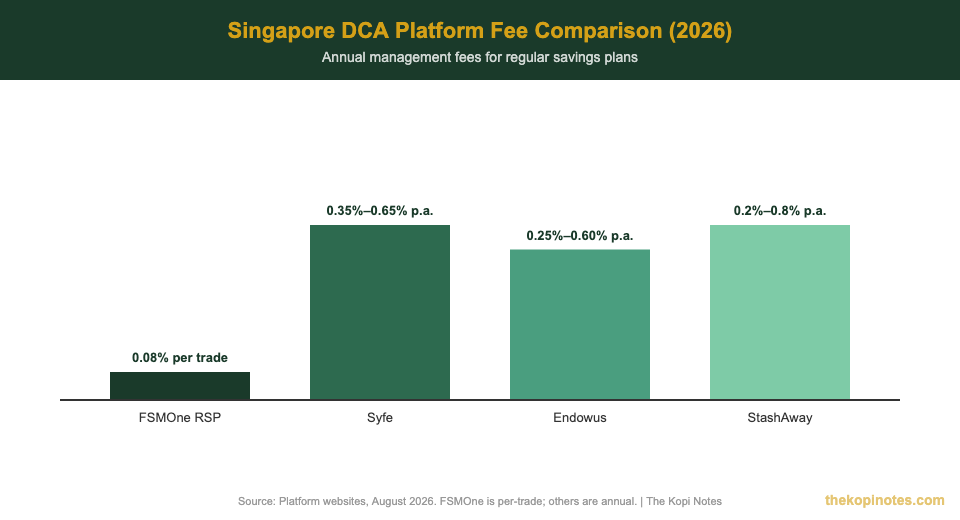
| Platform | Min Monthly | Fee Structure | Best For |
|---|---|---|---|
| FSMOne RSP | S$50 | 0.08% per trade (min S$1) | DIY ETF investors |
| Syfe | S$10 | 0.35%–0.65% p.a. | Hands-off robo portfolios |
| Endowus | S$100 | 0.25%–0.60% p.a. (cash); 0.40% flat (CPF/SRS) | CPF and SRS investing |
| StashAway | S$1 | 0.2%–0.8% p.a. | Beginners, fully automated |
Source: Platform websites, August 2026. Fees shown exclude underlying fund expense ratios (TERs). FSMOne fee is per transaction; Syfe, Endowus, and StashAway fees are annual management fees.
FSMOne RSP — Best for DIY ETF Investors
If you want to DCA into a specific ETF such as CSPX on the London Stock Exchange or the STI ETF on SGX, FSMOne RSP is the cheapest option at 0.08% per transaction with a S$1 minimum. You set it up once and it runs automatically. You can start from just S$50 per month.
The trade-off: you choose your own ETFs and manage your own asset allocation. If you know what you want to hold and are comfortable with that responsibility, FSMOne RSP is hard to beat on cost. Use our FSMOne referral code (P0544985) when signing up.
Syfe — Best for Hands-Off Investing
Syfe builds and rebalances a diversified portfolio for you. You pick a portfolio type — such as Syfe Core Equity100 for global equities or Syfe REIT+ for Singapore REITs — set a monthly auto-invest amount, and Syfe handles everything else. Fees are 0.35%–0.65% p.a. depending on your portfolio size. You can start from just S$10 per month.
If you want the benefits of global diversification without choosing individual ETFs, Syfe is a strong pick. Use our Syfe referral code and sign-up bonus (SRPRFFFCD) to get your first three months fee-free. You can learn more about what to put inside a Syfe portfolio in our guide to passive income in Singapore.
Endowus — Best for CPF and SRS
If you want to invest your CPF OA or SRS balance on a regular basis, Endowus is the platform most Singaporeans use. The CPF and SRS fee is a flat 0.40% p.a. regardless of portfolio size. For cash investing, fees are tiered from 0.25% to 0.60% p.a. based on AUM. Endowus also rebates all trailer commissions — no hidden fees on top of the management fee. Use our Endowus referral code (2V343) to get S$20 Endowus Cash when you open an account.
When to Choose Lump Sum vs DCA: A Simple Framework
Here is a practical decision framework for Singapore investors.
Invest as a lump sum if:
- You already have an established, diversified portfolio and can handle volatility without panicking
- The windfall is small relative to your total existing portfolio (for example, a S$10,000 bonus going into a S$200,000 portfolio)
- You are investing into a broadly diversified global ETF like VWRA — where single-market timing risk is reduced
- You understand that markets trend upward and you want maximum expected return
Spread it over 3–6 months with DCA if:
- You are investing a large first-time amount and market timing risk genuinely keeps you up at night
- The windfall would double or triple your current invested portfolio
- You know yourself well enough to say: if this drops 25% next month, I might panic-sell
Do not DCA for longer than 12 months. The research shows that beyond 12 months, the probability of lump sum outperforming DCA rises above 90%. At some point, spreading out becomes procrastination — not risk management.
For guidance on which accounts to prioritise first — CPF, SRS, or cash — see our invest Singapore account order guide. It covers exactly which bucket to fill first for the best tax and return outcome.
Common DCA Mistakes Singapore Investors Make
1. DCA-ing Into the Wrong Asset
DCA smooths your entry price — but it does not fix a poor investment choice. If you DCA into a single stock that later becomes worthless, spreading your purchases over 12 months does not help you. DCA works best with broadly diversified index ETFs where the long-term trend is upward. Do not use it as a strategy to average down into speculative positions.
2. Stopping When Markets Drop
This defeats the entire point. DCA works precisely because you buy more units when prices are lower. If you pause your S$500 monthly RSP when markets fall 20%, you miss the best buying opportunity of the cycle. The most important rule in DCA is to keep going when it feels uncomfortable. That is when it earns its keep.
3. Spreading a Windfall Over Too Many Years
Some investors hear “DCA” and decide to invest their S$100,000 bonus over five years. That is too long. You are leaving money in a savings account earning 2–3% when it could be in equities compounding at a historically higher rate. If you want to spread risk, 3–6 months is the right window — not five years.
4. Forgetting to Rebalance
DCA builds your portfolio steadily, but it does not automatically maintain your target asset allocation. If you are only auto-investing into one ETF, check once a year whether your allocation has drifted from your target. Use our Singapore retirement calculator to check if you are on track for your retirement goal.
5. Ignoring the Tax-Efficient Approach
The order in which you invest your money — CPF vs SRS vs cash — matters for your after-tax returns. Read our companion guide on how to invest in Singapore tax-efficiently to make sure you are not leaving money on the table through suboptimal account sequencing.
Frequently Asked Questions
Is dollar cost averaging better than lump sum investing in Singapore?
Not by the numbers. Vanguard research shows lump sum investing outperforms DCA in roughly 67% of historical scenarios, with an average advantage of about 2.3% over 12 months for a balanced portfolio. However, DCA is better for your psychology — it eliminates the regret of investing just before a crash. For Singapore investors earning a monthly salary, DCA is the natural default. For windfalls, lump sum is mathematically better, but DCA is emotionally easier and keeps you invested.
How much should I invest monthly using DCA in Singapore?
A common starting point is 10–20% of your monthly take-home pay. If you earn S$5,000 net per month, that is S$500–S$1,000 per month. Before investing aggressively, make sure you have an emergency fund of 3–6 months of expenses in a liquid savings account. Platforms like FSMOne RSP start from S$50 per month and Syfe from S$10 per month, so there is no minimum income requirement to start.
What is the best ETF for DCA in Singapore?
For global diversification, VWRA (Vanguard FTSE All-World UCITS ETF, listed on the London Stock Exchange) and CSPX (iShares Core S&P 500 UCITS ETF, also on LSE) are popular choices among Singapore investors. Both are accumulating ETFs that automatically reinvest dividends — ideal for long-term compounding via DCA. They are also Irish-domiciled, which means no US estate tax exposure for non-US investors. If you prefer Singapore stocks, the STI ETF (ES3 or G3B on SGX) is the go-to option.
Can I do DCA with my CPF OA or SRS money?
Yes. For CPF OA, you can invest via CPFIS-OA into selected unit trusts and ETFs. Endowus makes this easier by allowing recurring investments from your CPF account. For SRS, many Singaporeans contribute the annual cap of S$15,300 (citizens and PRs) for the tax relief, then immediately invest that amount as a lump sum — effectively a DCA of annual lump sum contributions. Both Endowus and FSMOne accept SRS transfers.
What is an RSP and how does it enable DCA in Singapore?
A Regular Savings Plan (RSP) is a standing instruction to your brokerage or robo-advisor to invest a fixed amount every month automatically. It is the mechanism that makes DCA effortless in Singapore. You set it up once and the platform buys your chosen ETF or fund every month without you needing to log in. RSPs are available from FSMOne (0.08% per trade), Syfe, Endowus, and StashAway. They remove the temptation to skip months when markets look scary — which is often the worst time to stop investing.
Should I invest my year-end bonus as a lump sum or spread it out?
The research favours investing it all at once. If your bonus is S$20,000 and your existing portfolio is S$100,000, adding the full S$20,000 immediately means you are exposed to market gains from day one — and markets tend to rise over time. If the amount makes you genuinely nervous (for example, it doubles your portfolio overnight), spreading it over 3–6 months is a reasonable compromise. Avoid spreading over more than 12 months — beyond that point, you are procrastinating rather than managing risk.
The Bottom Line
Lump sum investing has the mathematical edge. DCA has the psychological edge. For most investors, psychology is the more important variable — because an investor who stays the course always outperforms one who sells at the bottom.
For Singapore investors: if you invest from your monthly salary, you are already DCA-ing and that is exactly right. If you receive a windfall, invest it all now — or spread it over 3–6 months if you need the comfort. Either way, the most important step is to start. Time in the market beats timing the market, every time.
Keep reading: which account to fill first — CPF, SRS, or cash | how to invest in Singapore tax-efficiently in 2026
This article was researched with the help of AI. While we strive to keep all information accurate and up to date, there may be errors. If you notice any discrepancies, please contact us.