Endowment Plan vs Term Life + Invest the Rest (BTIR) Singapore 2026: Guaranteed Growth vs DIY Investing
Same $500 a month, two completely different paths — we ran the actual 20-year numbers.
An endowment plan and “term life + invest the rest” (BTIR) both start from the same idea — put aside money every month for the future — but they split that money very differently. An endowment plan bundles a small amount of life cover with a savings component that grows at an illustrated 3.00% to 4.25% p.a. (capped by the Life Insurance Association of Singapore). BTIR buys cheap standalone term life cover, then invests everything left over in a diversified portfolio with no guaranteed return, but historically higher long-run growth.
Not financial advice. All figures are for educational reference only and were verified against LIA Singapore, insurer product pages, and MSCI index data. Data verified as at 2026-08-10.
- Endowment plans illustrate returns capped at 3.00% (Lower) to 4.25% (Upper) p.a. by LIA Singapore — non-guaranteed, bundled with a small life cover component.
- BTIR uses cheap term life insurance (from $16/month for $500k cover) and invests the rest — our worked example shows $500/month over 20 years, and BTIR’s conservative 6% scenario still beats a typical endowment plan’s actual average return by roughly $79,000, before touching the optimistic scenario.
- Endowment plans suit people who value contractual certainty and can’t stomach market volatility; BTIR suits people comfortable with market swings in exchange for meaningfully higher expected long-run growth.
Table of Contents
Contents — Click to expand
What Is “Term Life + Invest the Rest” (BTIR)?
Buy Term, Invest the Rest is exactly what it sounds like: you buy a cheap, standalone term life policy for pure protection, then take whatever budget is left over and invest it yourself — typically in a globally diversified equity ETF portfolio through a broker or robo-advisor.
This is a different comparison from our earlier ILP vs Buy Term Invest the Rest guide. That article compares BTIR against investment-linked policies (ILPs), which bundle life cover with an investment fund inside the same wrapper. This article compares BTIR against endowment plans instead — a different product that bundles a much smaller amount of life cover with a savings component targeting a fixed maturity payout, usually invested in the insurer’s participating (par) fund rather than in funds you choose yourself.
Term life insurance in Singapore is inexpensive precisely because it has no savings component — your premium pays only for the risk of death, terminal illness, and total permanent disability (TPD) during the policy term. Every dollar that isn’t consumed by mortality risk and insurer overhead is a dollar you invest yourself, on your own timeline, in your own choice of instruments.
How Endowment Plans Work
An endowment plan is a participating (par) life insurance policy that combines a small amount of life cover with a savings goal — for example, a lump sum payout at the 20-year mark for a child’s university fees, or a retirement top-up. Your premiums are pooled into the insurer’s par fund alongside other policyholders’ money, invested across a mix of bonds, equities, and property, and the insurer periodically declares bonuses based on the fund’s performance.
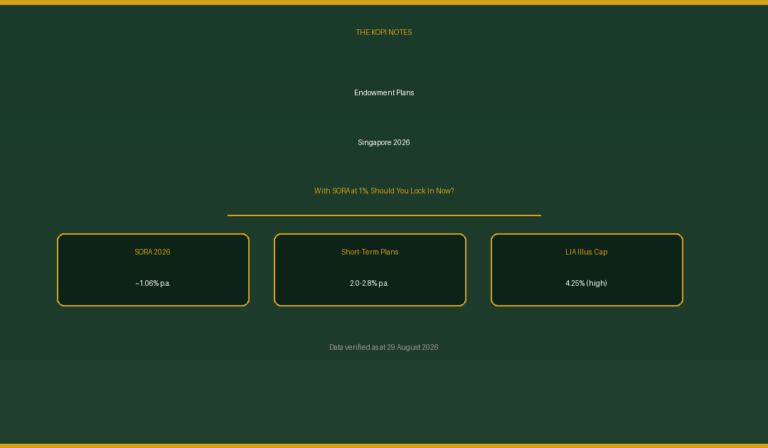
Crucially, most of the projected return is non-guaranteed. The Life Insurance Association of Singapore (LIA) caps how optimistic insurers can be when illustrating potential returns: as at 2026, the cap is 4.25% p.a. for the Upper Illustration Rate and 3.00% p.a. for the Lower Illustration Rate, a gap of at least 1.25 percentage points that insurers must maintain between the two scenarios. These caps have applied since 1 July 2021 and are reviewed annually by LIA — as at August 2026, they remain unchanged.
Source: LIA Singapore, Illustrated Investment Rate of Return for Par Policies, accessed 10 August 2026.
In practice, actual declared bonuses have often landed closer to the Lower Illustration Rate than the Upper one over the past decade of low interest rates and volatile markets — which is why our worked example below uses a more conservative 1.81% effective average annual return, consistent with real-world short-to-medium-term endowment plan illustrations we’ve reviewed on The Kopi Notes.
A 20-Year Worked Example: $500/Month, Endowment vs BTIR
Take a 30-year-old non-smoker with a $500/month total budget to allocate toward “protection plus savings.” Here’s how the two paths compare over 20 years.
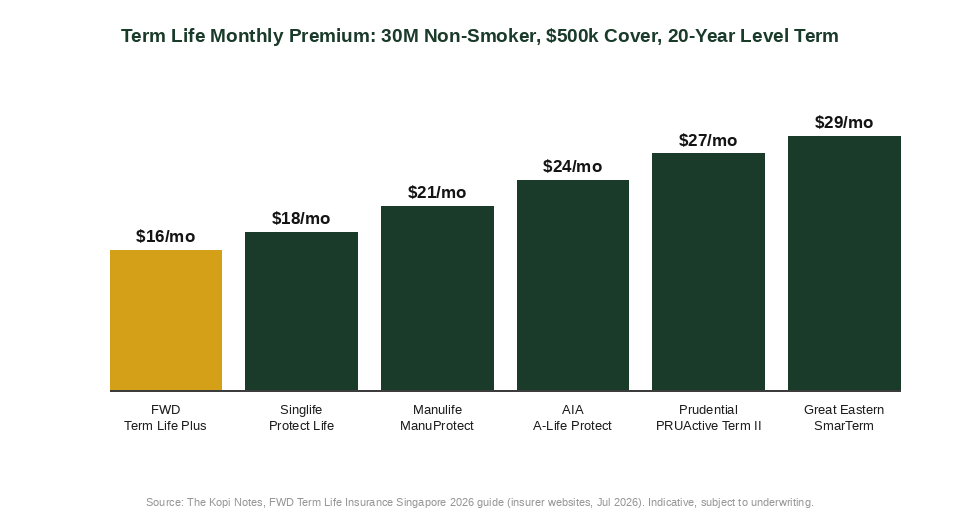
Term life premium used: FWD Term Life Plus, $16/month for $500,000 of death, terminal illness and TPD cover over a 20-year level term — the cheapest of six insurers we compared for this exact profile (30-year-old male non-smoker, $500,000 sum assured, 20-year level term, direct online purchase).
| Path | Monthly Allocation | Assumed Return | Value After 20 Years |
|---|---|---|---|
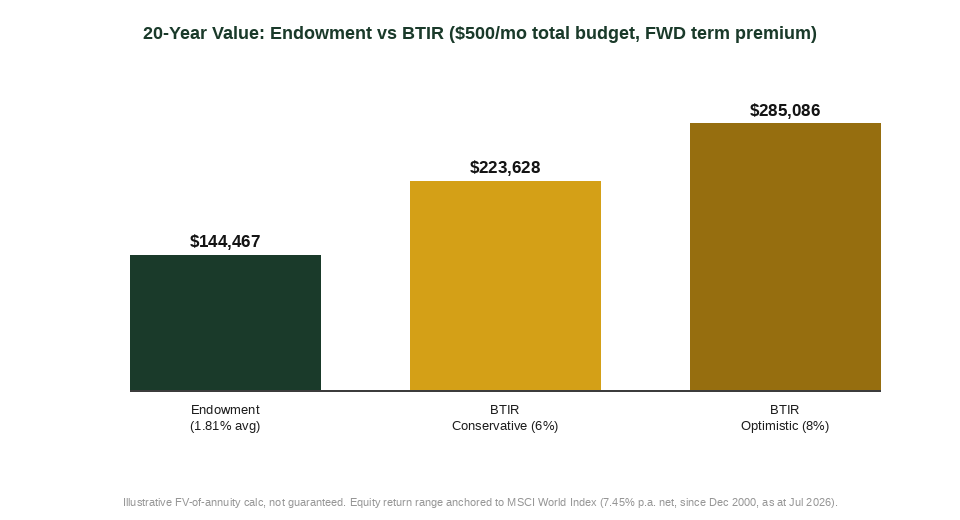
| Endowment Plan | $500/mo (full budget) | 1.81% p.a. (illustrative average) | $144,467 |
| BTIR — Conservative | $484/mo ($500 − $16 term premium) | 6.00% p.a. | $223,628 |
| BTIR — Optimistic | $484/mo ($500 − $16 term premium) | 8.00% p.a. | $285,086 |
Source: Author’s calculation using Python future-value-of-annuity formula (monthly compounding), $500/month for 240 months. Endowment return re-derives the 1.81% effective average figure independently verified in The Kopi Notes’ Aug 2026 Endowment vs ILP comparison. BTIR return assumptions are illustrative long-run equity scenarios, not guaranteed — see methodology note below.
Where the 6% and 8% assumptions come from: the MSCI World Index — a broad benchmark for developed-market global equities — delivered a net annualised return of 7.45% p.a. since 29 December 2000 (roughly 25.6 years), and 12.73% p.a. over the most recent 10 years (an elevated, non-representative recent run), as at 31 July 2026. Our 6% conservative and 8% optimistic scenarios bracket that long-run 7.45% figure, err on the side of caution for the lower bound, and are explicitly illustrative — equities carry real volatility and sequence-of-returns risk that a 20-year annuity formula cannot capture.
Source: MSCI World Index (USD) Factsheet, data as at 31 July 2026. Past performance is not indicative of future results.
Two things are worth sitting with. First, BTIR’s advantage isn’t a rounding error — it’s tens of thousands of dollars over 20 years, even under a conservative assumption below the index’s actual long-run average. Second, that advantage is not risk-free: the endowment’s 1.81% path is contractually smoother (subject to the insurer’s solvency and bonus policy), while BTIR’s 6-8% path depends on staying invested through market downturns, including years where equities lose 15-20% or more. The math favours BTIR; the psychology of holding through a crash is a separate question only you can answer.
Endowment Plan: Pros and Cons
| Pros | Cons |
|---|---|
| Contractual, insurer-managed structure — you don’t need to pick funds or rebalance | Illustrated returns capped at 3.00-4.25% p.a. by LIA, and non-guaranteed even within that range |
| Combines a small life cover component with the savings goal in one policy | Life cover amount is usually far below what a dedicated term plan provides for the same premium |
| Forced savings discipline — early surrender usually means a financial penalty, which deters impulsive withdrawals | Early surrender can return significantly less than total premiums paid, especially in the first several years |
| Useful for savers who know they will not stay disciplined with a separate investment account | Historically underperforms diversified equity portfolios over 15-20+ year horizons |
Term Life + Invest the Rest: Pros and Cons
| Pros | Cons |
|---|---|
| Far more life cover per dollar — $500,000 for $16/month vs a fraction of that from an endowment plan’s tiny built-in cover | No guaranteed return — markets can and do fall 15-20%+ in a single year |
| Historically higher expected long-run return — our worked example shows a ~$79,000-$140,000 gap over 20 years | Requires self-discipline to keep investing consistently, including during downturns |
| Full flexibility — change your investment platform, fund mix, or contribution amount anytime | You bear the responsibility of picking and monitoring your own investments (or a low-cost diversified ETF/robo option) |
| Term insurance premiums are typically level and predictable for the policy term | No forced-savings mechanism — easier to skip contributions in lean months |
Who Should Pick Which Approach
An endowment plan may suit you if: you know you won’t consistently invest on your own, you want a contractually defined (if modest) target payout at a known maturity date, or you’re saving for a near-fixed goal like a wedding or a child’s tertiary education where the certainty premium matters more than maximising growth.
BTIR may suit you if: you’re comfortable opening and maintaining a low-cost brokerage or robo-advisor account, you can emotionally tolerate market drawdowns without panic-selling, and you want meaningfully more life cover per dollar spent alongside meaningfully higher expected long-run growth. If you’re unsure how much life cover you actually need before running this comparison yourself, our Insurance Gap Calculator is a useful starting point, and our Retirement Planning Calculator can help you model the investing leg over a longer horizon.
For a broader look at endowment plans against other alternatives — including how they stack up against ILPs and whole life insurance — see our Endowment Plan vs Whole Life Insurance comparison, or start from our Investment Insurance Singapore Guide for the full picture across ILPs, endowments, and ETFs.
Comparison Summary Table
| Factor | Endowment Plan | Term Life + Invest the Rest |
|---|---|---|
| Life cover per dollar | Low (small bundled sum assured) | High ($500k for ~$16/month) |
| Illustrated / assumed return | 3.00%-4.25% p.a. (LIA cap), non-guaranteed | 6-8% p.a. illustrative, not guaranteed |
| 20-year value ($500/mo example) | $144,467 | $223,628 – $285,086 |
| Volatility | Low | Moderate-to-high |
| Discipline required | Low (structured, penalty for early exit) | High (self-directed, no penalty for stopping) |
Frequently Asked Questions
Is BTIR always better than an endowment plan?
Not always — it depends on your discipline and risk tolerance, not just the math. Our worked example shows BTIR’s conservative 6% scenario outperforming a typical endowment plan by roughly $79,000 over 20 years, but that assumes you actually stay invested through downturns rather than selling in a panic. If you know you would not do that consistently, the endowment plan’s structured, lower-volatility path may suit you better despite the lower expected return.
What return does an endowment plan actually guarantee?
Very little is guaranteed. The Life Insurance Association of Singapore caps the illustrated Upper Rate at 4.25% p.a. and the Lower Rate at 3.00% p.a. for participating policies, but these are illustrative scenarios, not guarantees — your actual return depends on the insurer’s par fund performance and bonus declarations over the policy’s lifetime.
How much does term life insurance cost in Singapore in 2026?
For a 30-year-old non-smoking male seeking $500,000 of cover over a 20-year level term bought directly online, premiums we compared ranged from $16/month (FWD Term Life Plus) to $29/month (Great Eastern SmarTerm), with Singlife, Manulife, AIA and Prudential in between. Your actual premium depends on age, gender, health, and smoking status.
Is the 6-8% investment return assumption realistic?
It is grounded in real historical data, though not guaranteed. The MSCI World Index, a broad developed-market equity benchmark, delivered a 7.45% p.a. net annualised return since December 2000 (as at 31 July 2026). Our 6% conservative and 8% optimistic scenarios bracket that figure. Actual future returns could be lower or higher, and equities carry meaningful year-to-year volatility that a simple annuity formula does not capture.
Does BTIR give me more life insurance coverage than an endowment plan?
Yes, typically by a wide margin. A standalone $500,000 term life policy costs from around $16/month for a healthy 30-year-old, while an endowment plan’s built-in life cover component is usually a small fraction of the total sum insured relative to premiums paid, since most of the premium goes toward the savings/investment component rather than pure protection.
What happens if I stop paying premiums on an endowment plan early?
Surrendering an endowment plan in its early years typically returns significantly less than the total premiums you have paid in, due to upfront distribution costs and the structure of the policy’s cash value schedule. This is different from BTIR, where you can simply pause or reduce your investment contributions without a similar penalty, though your term life premiums are still due to keep the policy in force.
Can I combine both approaches?
Yes. Some Singaporeans use a smaller endowment plan for a specific, near-term guaranteed goal (like a child’s primary school enrolment fund) while running a separate BTIR strategy with term life insurance and a diversified investment portfolio for their broader long-term wealth building. There’s no rule that says you must pick only one.
Where can I compare term life insurance premiums across insurers?
See our Best Term Life Insurance Singapore comparison guide for a full side-by-side across AIA, Manulife, Singlife, Prudential, Great Eastern and more.
Ready to Run the Numbers on Your Own Plan?
Whichever path you choose, start investing the rest through a low-cost platform.
Not financial advice. All figures are educational reference only and were verified against LIA Singapore, insurer product pages, and MSCI index data as at 10 August 2026. The Kopi Notes may earn a referral fee if you sign up through the links below.
Get Free Insurance Advice
Speak with a licensed insurance advisor. No obligation, no cost.
By submitting this form, you agree to our Privacy Policy.
This article was researched with the help of AI. While we strive to keep all information accurate and up to date, there may be errors. If you notice any discrepancies, please contact us.