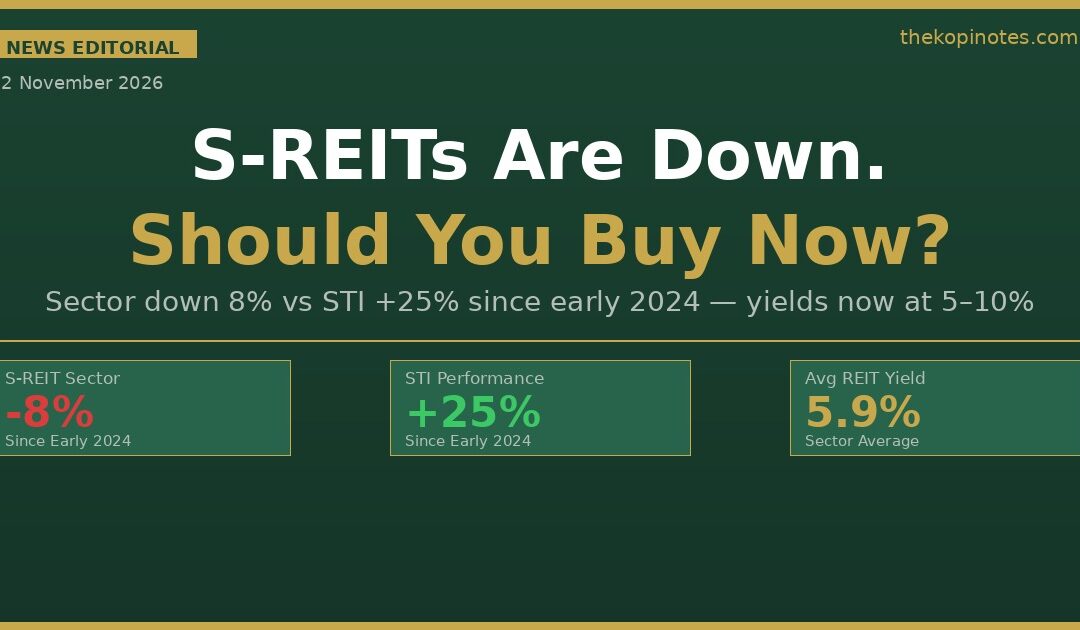
Singapore’s S-REIT sector has quietly become one of the most beaten-down asset classes of 2024–2026, falling 8% even as the Straits Times Index surged 25%. For income-seeking retail investors, this divergence has created a rare window: sector-wide yields averaging 5.9%, valuations near multi-year lows, and growing evidence the Fed rate cycle has peaked. Is November 2026 the buying opportunity patient investors have been waiting for?
This is an editorial analysis. Not financial advice.
The Great Singapore Divide: Banks Up 25%, REITs Down 8%
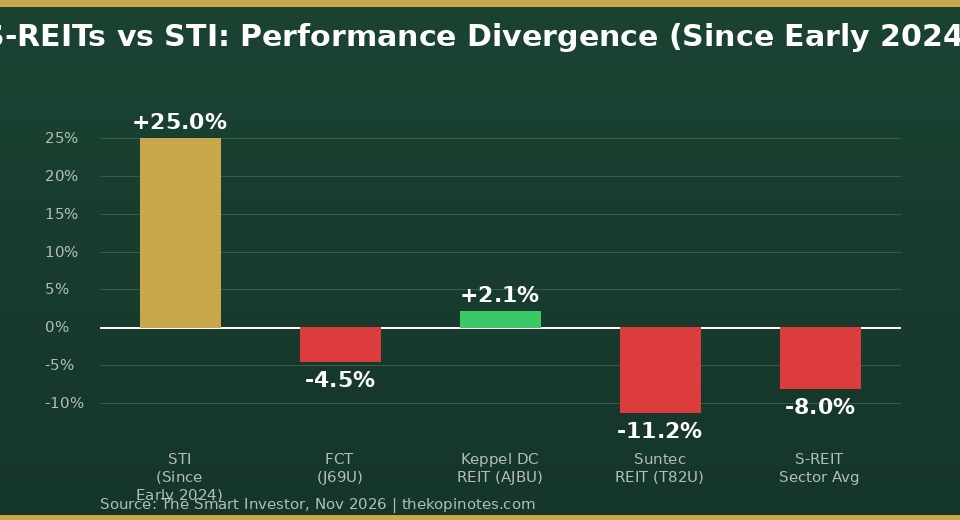
Since early 2024, Singapore’s two biggest investment themes have moved in sharply opposite directions. DBS, OCBC and UOB rode a wave of strong earnings, expanding net interest margins and record dividends to push the Straits Times Index up roughly 25%. S-REITs told a very different story.
The iEdge S-REIT Index has fallen approximately 8% over the same period, dragged down by elevated borrowing costs, cautious property demand across office and retail, and fierce competition from cash instruments. T-bills briefly yielded above 4%, making many retail investors question why they’d take REIT risk for a marginal yield pick-up.
The divergence between Singapore banks and S-REITs is now one of the widest in recent memory — and that is precisely what makes the opportunity interesting. Historically, periods of extreme divergence between financials and REITs have preceded meaningful REIT re-ratings.
See how the numbers stack up — STI vs S-REIT sector and individual REIT returns since early 2024:
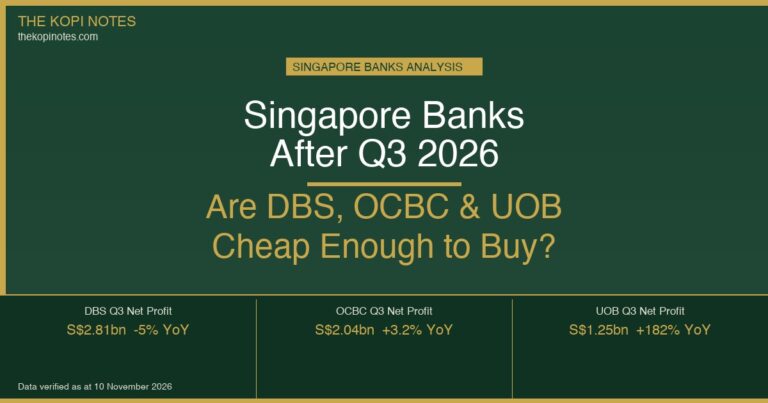
For more on where Singapore banks stand after Q3 earnings, read our analysis: Singapore Banks After Q3 2026: Are DBS, OCBC & UOB Cheap?
Why Are S-REITs Underperforming?
Three structural forces have suppressed S-REIT valuations since early 2024, and understanding them is key to assessing whether the worst is behind us.
Higher borrowing costs squeeze distributions. REITs borrow heavily to fund acquisitions. As interest rates rose, borrowing costs for most S-REITs climbed to 3.5–4.5%, narrowing the gap between rental yields and financing costs — the core of REIT economics. For office-heavy names like Suntec, this compression was particularly severe. Their interest coverage ratio (ICR) fell to 3.2x — still above MAS’s 1.5x minimum, but uncomfortably thin.
T-bills and SSBs provided serious competition. When Singapore 6-month T-bill yields peaked above 4% in late 2025, many retail investors shifted capital out of REITs and into risk-free instruments. Why accept a 5% REIT yield with capital risk when you could earn 3.9% with zero risk? That logic, multiplied across hundreds of thousands of retail portfolios, was a meaningful headwind.
Post-pandemic property patterns remain uneven. Office occupancy in Singapore’s CBD has recovered, but hybrid work means per-employee space demand hasn’t fully bounced back. Retail is healthy at heartland malls like those in FCT’s portfolio, but suburban vs. prime divergence is real. Only data centres — led by Keppel DC REIT’s AI-driven demand — have shown consistent positive momentum.
Related reading: Singapore Home Prices Hit 2-Year High in Q3 2026 — But S-REITs Are Still Struggling
5 S-REITs Every Singapore Investor Should Know Right Now
Not all S-REITs will benefit equally from a rate-cut cycle. Here’s a focused breakdown of five names covering the full spectrum of risk and yield, with November 2026 data:
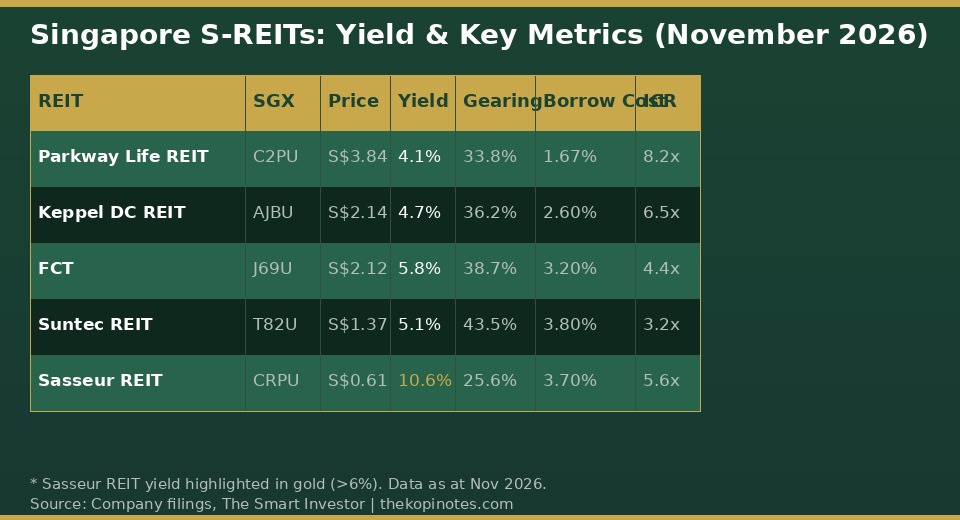
Parkway Life REIT (C2PU) — The Defensive Anchor. At S$3.84 and a 4.1% yield, PLife is the safest name in the sector. Its hospital and nursing home leases in Singapore and Japan are structured with inflation-linked escalations, making distributions remarkably stable. Low gearing of 33.8% and an ICR of 8.2x mean it has the most buffer of any S-REIT in a downturn. The trade-off: limited upside. This is core, not speculative.
Keppel DC REIT (AJBU) — The AI Beneficiary. At S$2.14 and a 4.7% yield, Keppel DC is the growth story in the sector. Its 9M 2026 DPU surged 11.7% as its Tokyo data centres ramped up and Singapore assets saw strong demand from AI workload providers. Singapore’s constrained data centre capacity — there’s effectively a moratorium on new builds — creates a durable competitive moat. Read the full analysis: Keppel DC REIT 9M 2026: DPU Surges 11.7% as Tokyo Bet Pays Off
Frasers Centrepoint Trust (J69U) — The Heartland Retail Play. FCT’s portfolio of suburban malls — Causeway Point, Northpoint City, Waterway Point — caters to everyday Singaporeans, not tourists. FY2026 DPU hit a record 12.35 cents, confirming the resilience of heartland retail. At S$2.12 and a 5.8% yield, it offers an attractive income entry point. Full results: FCT FY2026 Record DPU of 12.35 Cents: What Singapore Investors Need to Know
Suntec REIT (T82U) — The High-Risk, High-Yield Contender. Suntec’s 5.1% yield at S$1.37 is the most precarious in this group. High gearing of 43.5% and an ICR of just 3.2x leave little room for earnings surprise. Its mixed commercial portfolio (office + retail + convention) means it won’t be a clean play on any single theme. Rate cuts would help it disproportionately — but investors must be comfortable with the execution risk.
Sasseur REIT (CRPU) — The Contrarian Bet. At S$0.61 and a 10.6% yield, Sasseur commands the sector’s highest yield — and the highest risk. Its portfolio of outlet malls in China means every piece of Sasseur analysis must start with a China consumption view. Its low gearing (25.6%) is reassuring and its ICR of 5.6x is healthy. If you have conviction on a China retail recovery over 2–3 years, the yield is compelling. If you don’t, it’s a yield trap.
For a broader overview of high-yield S-REITs, see: 6 S-REITs With 6%–9.3% Dividend Yields and Unanimous Buy Ratings: October 2026
Why November 2026 Could Be the Inflection Point
Three macro shifts are converging in a way that meaningfully improves the S-REIT investment case heading into 2027:
The Fed has effectively paused. The Federal Reserve held rates at 3.75–4.0% at its October 2026 meeting — the fourth consecutive hold. Futures markets are pricing 2–3 cuts in 2027. When US rates fall, Singapore borrowing costs follow with a lag. For S-REITs, every 25bps reduction in borrowing cost translates directly to higher distributable income. The rate cycle has not yet turned — but the direction is now clear. Full context: Fed Holds at 3.75–4%: What Singapore Investors Need to Know Now
T-bill competition is fading. Singapore 6-month T-bill yields have retreated from their 4%+ peaks to around 2.5–3.0% as of November 2026. The SSB October 2026 rate was under 3%. As risk-free rates fall, the yield premium offered by quality S-REITs at 5–6% looks increasingly attractive by comparison. The capital rotation trade from cash instruments back into REITs is beginning.
Singapore GDP growth supports rents. Singapore’s economy grew 5.4% year-on-year in Q3 2026 — ahead of consensus estimates. Strong GDP growth supports commercial rental demand across office, retail and industrial segments, which should underpin REIT distributions in coming quarters.
Bottom Line for SG Investors
The S-REIT opportunity in November 2026 is genuine, but it rewards selectivity. The macro tailwinds — Fed pivot, falling T-bill yields, solid Singapore growth — are building. The sector-level 8% decline from early 2024 highs has created entry points not seen in years. Average sector yields of 5.9% are well above the risk-free alternatives available today.
The TKN editorial recommendation framework:
- Conservative income investors: FCT and Parkway Life REIT offer the best combination of yield quality and balance sheet resilience. Build positions gradually.
- Growth-oriented investors: Keppel DC REIT’s AI data centre tailwind is structural, not cyclical. The 4.7% yield understates total return potential if distributions keep growing at double-digit rates.
- Higher-risk/reward seekers: Sasseur REIT’s 10.6% yield compensates for China risk — but size the position to match your conviction and risk tolerance.
- Cautious investors: Wait for Suntec to demonstrate ICR improvement before adding. The gearing is uncomfortable at current interest rates.
Dollar-cost averaging into 2–3 quality S-REITs over the next 3–6 months remains a sound strategy for Singapore retail investors seeking income in a falling-rate environment.
Data verified as at 12 November 2026. Sources: SGX company filings, The Smart Investor, MAS, Bloomberg. All prices as of 11 November 2026.
What is an S-REIT and how does it work?
An S-REIT (Singapore Real Estate Investment Trust) is a listed vehicle on the Singapore Exchange (SGX) that owns income-producing real estate. Under MAS regulations, S-REITs must distribute at least 90% of their taxable income to unitholders each year. This makes them popular among Singapore retail and institutional investors seeking regular income. S-REITs trade like stocks during SGX market hours and can be bought with both cash and CPF-OA funds (for approved REITs).
Why have S-REITs underperformed the STI since early 2024?
Three main factors: (1) Rising interest rates increased REIT borrowing costs from roughly 2.5% to 3.5–4.5%, compressing distribution yields; (2) T-bill and SSB yields peaked above 4%, offering near-risk-free competition to REIT distributions; (3) Post-pandemic property demand recovery has been uneven, with office and some retail segments slower to recover. These factors combined to push the iEdge S-REIT Index down approximately 8% while Singapore banks and the broader STI rose 25%.
Is now a good time to buy S-REITs in November 2026?
The macroeconomic environment is improving for S-REITs: the Fed has paused rate hikes, Singapore T-bill yields have declined from their peaks, and S-REIT valuations are near multi-year lows with yields averaging 5.9%. However, every investor’s situation is different. This is not financial advice. Investors should consider their own risk tolerance, investment horizon, and portfolio composition — and may wish to consult a licensed financial adviser before making decisions.
Which S-REIT has the highest yield right now?
As of November 2026, Sasseur REIT (SGX: CRPU) has the highest distribution yield at approximately 10.6%. This reflects the market’s risk premium for its China outlet mall portfolio. For investors seeking high yield with more Singapore-centric exposure, FCT (SGX: J69U) offers 5.8% with a proven suburban retail track record and record FY2026 DPU.
What is REIT gearing and why does the 50% limit matter?
Gearing is the ratio of total debt to total assets for a REIT. Singapore REITs are regulated by MAS with a maximum gearing limit of 50% (or 55% if the REIT has a credit rating). Higher gearing means more sensitivity to interest rate changes and less financial flexibility. Among the five REITs analysed here, Suntec has the highest gearing at 43.5% — leaving only 6.5 percentage points of regulatory headroom. This is why interest coverage ratio (ICR) matters: Suntec’s ICR of 3.2x is the lowest of the five, indicating less earnings cushion for debt servicing.
Can I use CPF OA to buy S-REITs?
Yes. Singapore investors can use CPF Ordinary Account (OA) funds to invest in CPF-approved S-REITs under the CPF Investment Scheme (CPFIS). The investment limit is up to 35% of investible savings (OA savings above S$20,000). Note that not all S-REITs are CPFIS-approved — check the CPF Board’s latest approved investment list at cpf.gov.sg before investing. Using CPF-OA for REITs means you forgo the guaranteed 2.5% OA interest rate, so the investment needs to clear that hurdle.
What is the iEdge S-REIT Index?
The iEdge S-REIT Index is Singapore’s benchmark index tracking the performance of REITs and property trusts listed on the SGX. It is maintained by SGX in partnership with iEdge and is the standard industry reference for measuring S-REIT sector performance. As of November 2026, it is down approximately 8% from its early 2024 level, compared to the STI’s gain of 25% over the same period — the divergence that forms the basis of this analysis.
This article was researched with the help of AI. While we strive to keep all information accurate and up to date, there may be errors. If you notice any discrepancies, please contact us.