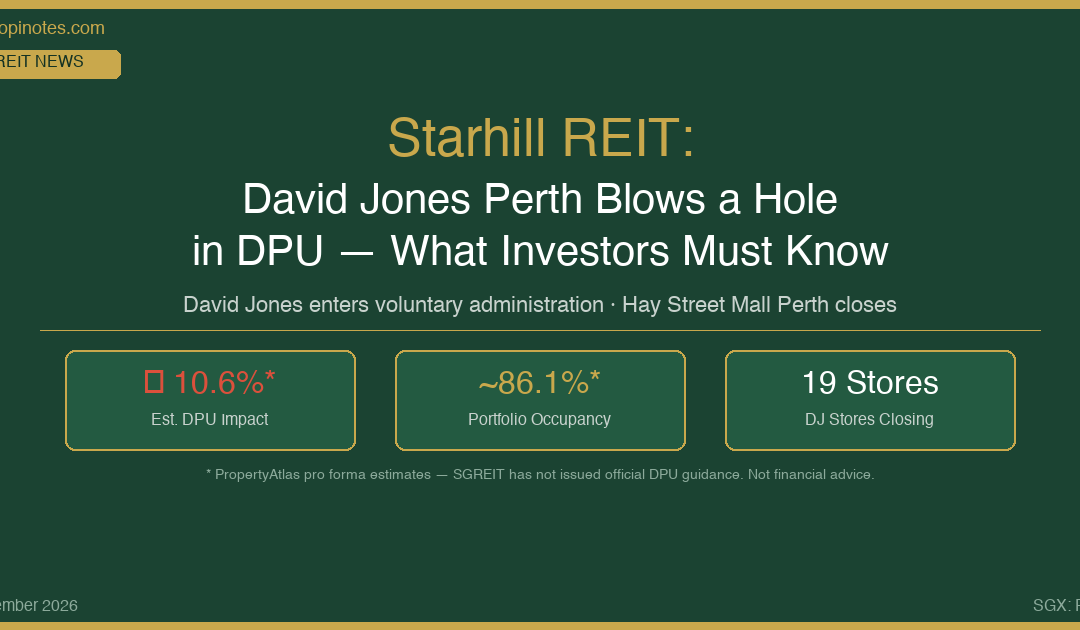
Starhill Global REIT (SGX: P40U) is facing its biggest tenant shock in years. When David Jones entered voluntary administration in early November 2026 and receivers confirmed the closure of its Hay Street Mall Perth store on 11 November, it triggered an estimated DPU cut of up to 10.6% — pushing projected distributions from S$3.68 cents to roughly S$3.29 cents per unit. Here is what Singapore retail investors need to know right now.
Disclaimer: This article is for informational purposes only. It does not constitute financial advice. All DPU impact figures are third-party pro forma estimates and not official guidance from Starhill Global REIT management. Past performance is not indicative of future results. Please consult a licensed financial adviser before making any investment decisions.
What Happened: David Jones Enters Voluntary Administration
On 4–5 November 2026, Australian retailer David Jones appointed Deloitte as voluntary administrator, triggering a formal insolvency process. Just days later, on 11 November, the receivers and managers announced the planned closure of 19 David Jones stores across Australia — including the flagship Hay Street Mall store in Perth, which is a major anchor tenant of Starhill Global REIT’s Myer Centre Perth and Hay Street Mall properties.
This is not a minor operational hiccup. David Jones has been one of SGREIT’s largest single tenants in Australia for years, anchoring its Perth retail precinct. SGREIT issued a Singapore Exchange filing on 11 November 2026 disclosing the closure and noting that the financial impact remains “unquantified” pending further assessment.
What made this event particularly jarring for investors was its speed. From voluntary administration announcement to store closure confirmation was under a week — giving SGREIT’s management little time to prepare a mitigation strategy before it had to report to shareholders.
SGREIT’s Exposure to David Jones: By the Numbers
To understand the financial hit, we need to break down what David Jones means to SGREIT’s portfolio.
| Metric | Value | Context |
|---|---|---|
| David Jones lease revenue (annual) | S$9.0M | ~4.7% of FY25/26 total gross revenue |
| David Jones as % of NPI | ~6.0% | Higher NPI share due to low operating costs |
| David Jones Building (Perth) valuation | S$106.4M | ~3.5% of SGREIT’s total asset value |
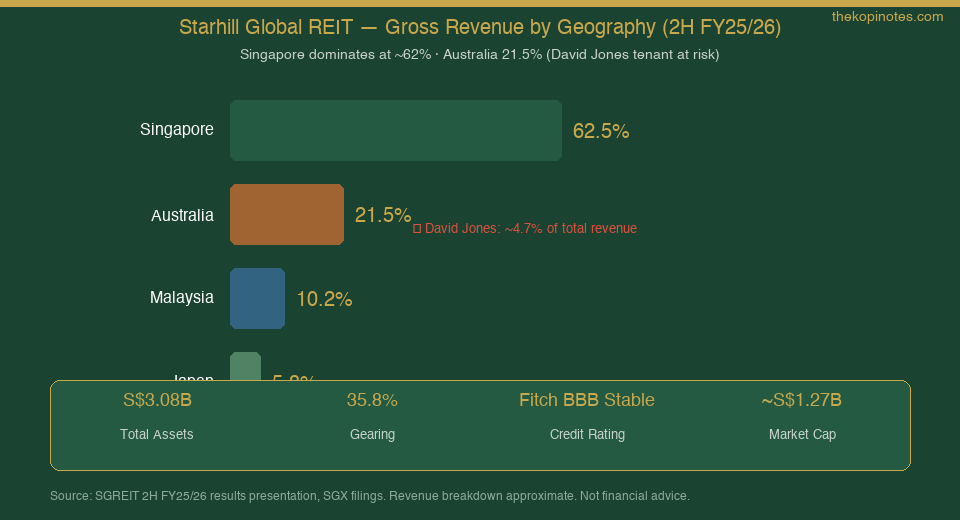
| Australia as % of gross revenue | 21.5% | 2H FY25/26 gross revenue |
| Australia as % of total assets | 12.3% | By book value |
| Portfolio occupancy (Jun 2026) | 97.2% | Official reported figure |
| Pro forma occupancy (DJ space vacant)* | ~86.1% | PropertyAtlas estimate — not official |
*All pro forma estimates are from PropertyAtlas and have not been confirmed by SGREIT management.
It is worth noting that Australia accounts for over one-fifth of SGREIT’s gross revenue despite representing a much smaller share of total assets. This tells you something important about the relative income efficiency of the Perth asset — and why losing David Jones as an anchor tenant would punch above its asset-weight proportionally in terms of DPU impact.
For more context on SGREIT’s overseas exposure, see our Starhill Global REIT Overseas Portfolio guide.
DPU Impact: Estimates vs Official Guidance
This distinction matters enormously for investors: SGREIT has not issued official DPU guidance for FY26/27 following the David Jones closure. The 10.6% DPU reduction figure circulating in the market is a pro forma estimate from PropertyAtlas — it assumes the David Jones space remains entirely vacant with no rental income replacement.
Here is what we know officially from SGREIT’s most recent filings:
- FY25/26 actual DPU: S$3.68 cents per unit (confirmed in annual results)
- SGREIT’s Nov 11 SGX filing described the financial impact as “unquantified”
- Management has yet to issue revised distribution guidance for FY26/27
- Pro forma analysis by PropertyAtlas puts potential DPU at ~S$3.29 cents (-10.6%) if the space stays vacant
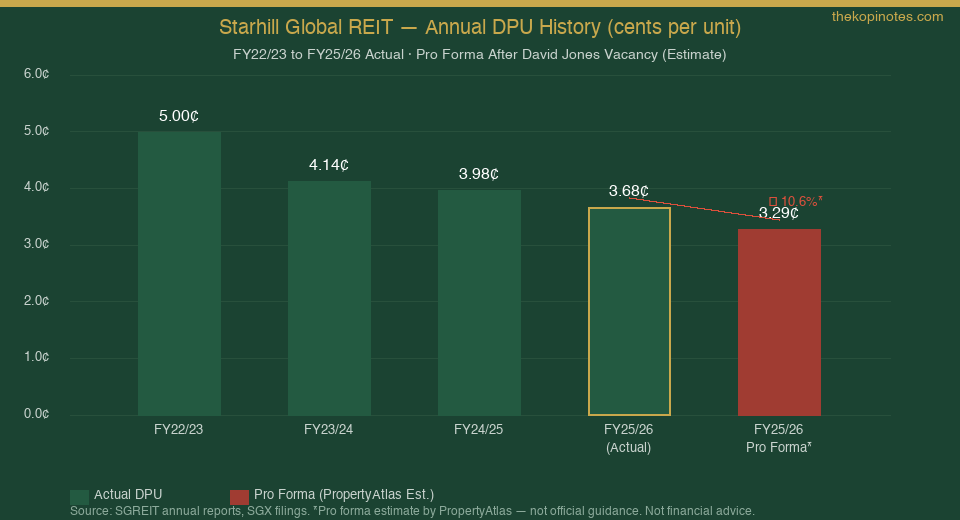
The key caveat here is that SGREIT’s management team has a strong track record of active asset management. The Perth retail precinct is a prime urban location, and finding replacement tenants — even at reduced rents temporarily — is entirely possible. The worst-case scenario of full vacancy is unlikely to persist through FY26/27 entirely.
What Singapore investors should watch for is any investor briefing or SGX filing from SGREIT management in the coming weeks that quantifies the impact and outlines a leasing strategy for the vacated space.
Portfolio Resilience: Singapore Is the Bedrock
It is easy to get caught up in the Australia exposure when reading about this news. But here is a crucial perspective that often gets lost: SGREIT is fundamentally a Singapore-anchored REIT.
Singapore accounts for:
- 70.0% of total asset value
- ~62% of gross revenue (2H FY25/26)
- Key properties: Wisma Atria on Orchard Road, Ngee Ann City stake (held via JV with CapitaLand), and other Orchard Road retail assets
Wisma Atria and Ngee Ann City sit at arguably the most prestigious retail addresses in Singapore. Footfall at Orchard Road remains robust, and both properties have luxury and F&B tenant mixes that have demonstrated strong resilience even in economic slowdowns. SGREIT’s Singapore properties carry an overall committed occupancy above 97%, reflecting the premium positioning of these assets.
The Australia segment, while meaningful, is not the REIT’s core identity. For long-term investors who bought SGREIT for Orchard Road exposure, the David Jones development is a negative but not an existential threat to the investment thesis.
See our related analysis: Singapore REIT Sector Outlook 2026.
Balance Sheet Position: Gearing and Credit Rating
One of the more reassuring aspects of this situation is SGREIT’s financial position heading into it:
- Gearing: 35.8% — well below MAS’s 50% regulatory limit and conservative relative to sector peers
- Fitch credit rating: BBB, Stable outlook — an investment-grade rating that provides access to capital markets for refinancing
- Market capitalisation: ~S$1,265M — a mid-cap REIT with reasonable trading liquidity
- Total assets: ~S$3.08 billion
The low gearing means SGREIT has headroom to absorb a temporary income shock without triggering covenant breaches or requiring an emergency rights issue. This is an important buffer that distinguishes SGREIT from REITs that entered similar situations with leverage closer to the 40–45% range.
That said, any prolonged vacancy in Perth would put further pressure on distributions, and investors should monitor management commentary on whether they plan to inject any retained earnings to smooth DPU or pursue asset recycling in Australia.
For a broader look at this topic, our guide to REIT tenant concentration risk explains how to evaluate these situations systematically.
What Should Singapore Retail Investors Do?
This is the question on most SGREIT unitholders’ minds right now. Here is a framework for thinking through it:
If you currently hold SGREIT: Do not panic-sell based on the pro forma estimates alone. The 10.6% DPU cut is a worst-case modelling scenario. The actual impact will depend on (1) how quickly SGREIT re-leases the Perth space, (2) whether a lease surrender payment is received from David Jones’s administrators, and (3) whether SGREIT’s Singapore income continues to hold. Wait for official management guidance — which should come in the next quarterly or half-year results.
If you are considering buying: SGREIT’s yield was already above 7% based on FY25/26 DPU before the David Jones news. Even if DPU falls 10.6% to ~S$3.29 cents, the yield at current prices remains above 6% — which is competitive for a Singapore-listed retail REIT with Orchard Road exposure. The question is whether you believe the management team can backfill the vacancy within 12–18 months.
If you are undecided: The uncertainty itself is information. Until SGREIT management quantifies the impact and communicates a leasing plan, the risk premium on the stock is justified. It is entirely reasonable to wait for the official update before adding to or initiating a position.
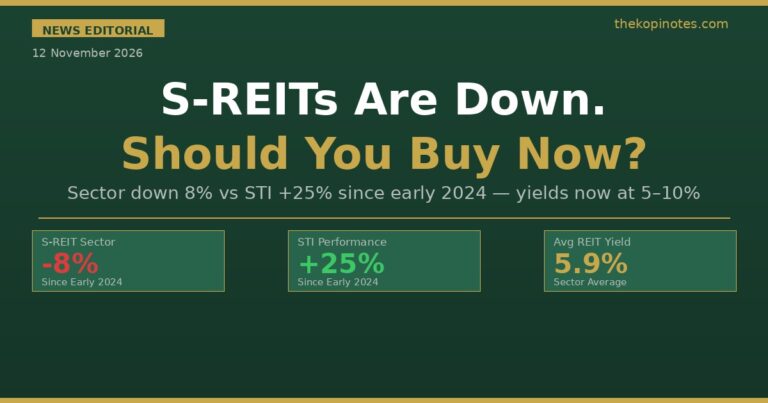
See also: S-REITs Down 8% in 2026 — Is This a Buying Opportunity? and our comprehensive Retail REIT Singapore Guide.
Bottom Line
The David Jones voluntary administration is a material negative event for Starhill Global REIT, but it needs to be contextualised carefully. The 10.6% DPU cut figure is an analyst estimate — not a confirmed number from management. SGREIT retains a strong balance sheet, an investment-grade credit rating, and a Singapore-dominant portfolio that is performing well.
The next key catalyst will be SGREIT’s official communication on the Perth vacancy — whether that comes as an SGX filing, an analyst briefing, or the half-year results. That is what will determine whether the current risk premium priced into the stock is excessive or justified.
For live tracking of SGREIT’s share price and updated analyst targets, visit our Starhill Global REIT Share Price 2026 tracker.
Frequently Asked Questions (FAQ)
Has Starhill REIT confirmed a DPU cut after David Jones?
No. As at the date of this article, SGREIT has not issued official DPU guidance. The 10.6% DPU reduction estimate is a pro forma calculation by PropertyAtlas, assuming the David Jones space remains entirely vacant. SGREIT’s official SGX filing on 11 November 2026 described the financial impact as “unquantified.”
How big is David Jones as a tenant in SGREIT’s portfolio?
David Jones contributes an estimated S$9.0M in annual lease revenue, representing approximately 4.7% of FY25/26 total gross revenue and around 6.0% of net property income. The David Jones Building in Perth is valued at approximately S$106.4M, or about 3.5% of SGREIT’s total asset value.
Will SGREIT’s Singapore properties be affected?
No, the David Jones closure is confined to SGREIT’s Australian portfolio. The Singapore properties — including Wisma Atria and Ngee Ann City on Orchard Road — are unaffected and continue to report strong occupancy above 97%.
What is SGREIT’s current gearing ratio?
As at the last reported date (30 June 2026), SGREIT’s aggregate leverage (gearing) stood at 35.8% — comfortably below MAS’s 50% regulatory cap. The REIT holds a Fitch BBB Stable credit rating.
Should I sell my SGREIT units now?
This is a personal investment decision that depends on your portfolio goals, risk tolerance, and investment horizon. This article is for informational purposes only and does not constitute financial advice. If you are unsure, please consult a MAS-licensed financial adviser.
When will SGREIT give more clarity on the DPU impact?
SGREIT management is expected to provide further guidance in an investor briefing or SGX update within the coming weeks. The next scheduled results release (1H FY26/27) would typically include updated distribution guidance.
This article was researched with the help of AI. While we strive to keep all information accurate and up to date, there may be errors. If you notice any discrepancies, please contact us.