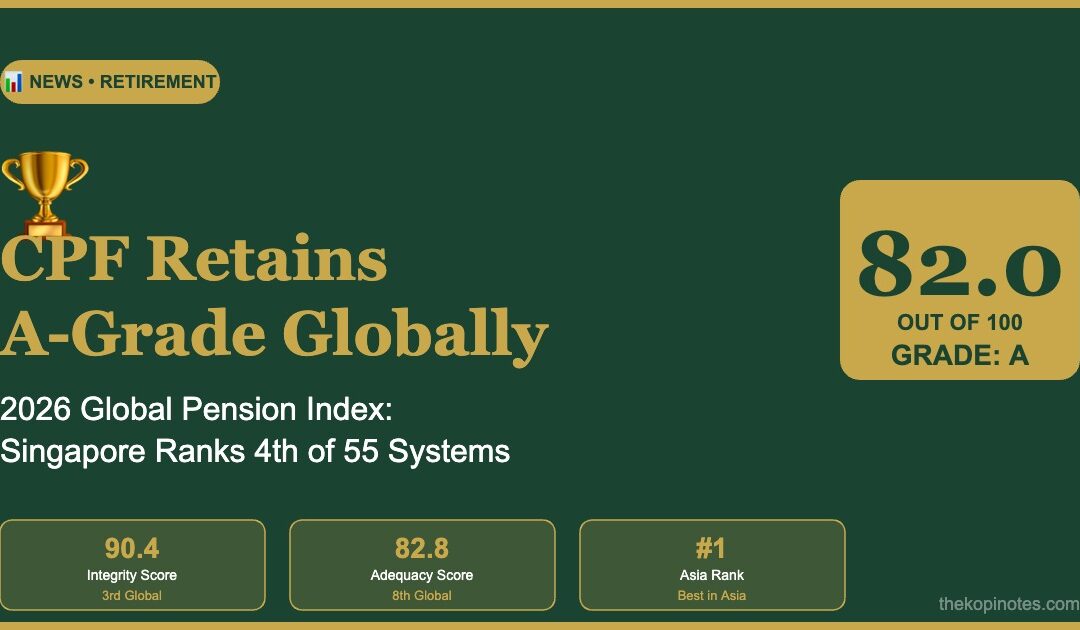
Singapore’s CPF system has once again earned an A-grade in the Marsh CFA Institute Global Pension Index 2026, scoring 82.0 out of 100 — up from 80.8 in 2025 — and ranking 4th out of 55 pension systems worldwide. For Singapore investors, this matters not because it changes your CPF interest rates, but because it validates why CPF-first retirement strategies remain among the most reliable in the world.
This is an editorial analysis. Not financial advice. Data verified as at 14 November 2026.
What Is the Global Pension Index and Why Does It Matter?
The Marsh CFA Institute Global Pension Index (formerly Mercer CFA) is now in its 18th edition and covers 55 retirement systems representing about 66% of the world’s population. It was produced in partnership with Monash Business School and published on 20 October 2026.
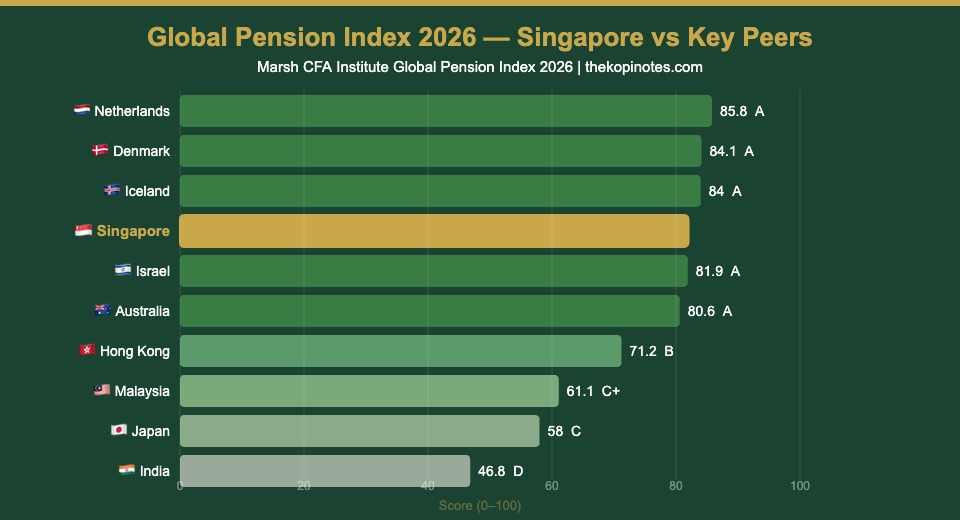
Each system is scored across three pillars — Adequacy (40% weighting), Sustainability (35%), and Integrity (25%) — and assigned an overall grade from A to E. Only six systems in the world earned an A in 2026: Netherlands (85.8), Denmark (84.1), Iceland (84.0), Singapore (82.0), Israel (81.9), and Australia (80.6).
Australia joined the A-grade club for the first time in 2026, while Singapore retained its position for a second consecutive year. The average across all 55 systems rose by 1.1 points, meaning Singapore’s improvement of +1.2 is slightly above the global trend.
Singapore’s 2026 Scores: Where CPF Excels — and Where It Doesn’t
Singapore’s overall score of 82.0 is built on three sub-index scores that tell a more nuanced story:
| Sub-Index | 2026 Score | 2025 Score | Global Rank | Grade |
|---|---|---|---|---|
| Adequacy | 82.8 | 79.4 | 8th / 55 | A |
| Sustainability | 75.3 | 75.5 | 7th / 55 | B+ |
| Integrity | 90.4 | ~89.5 | 3rd / 55 | A |
| Overall | 82.0 | 80.8 | 4th / 55 | A |
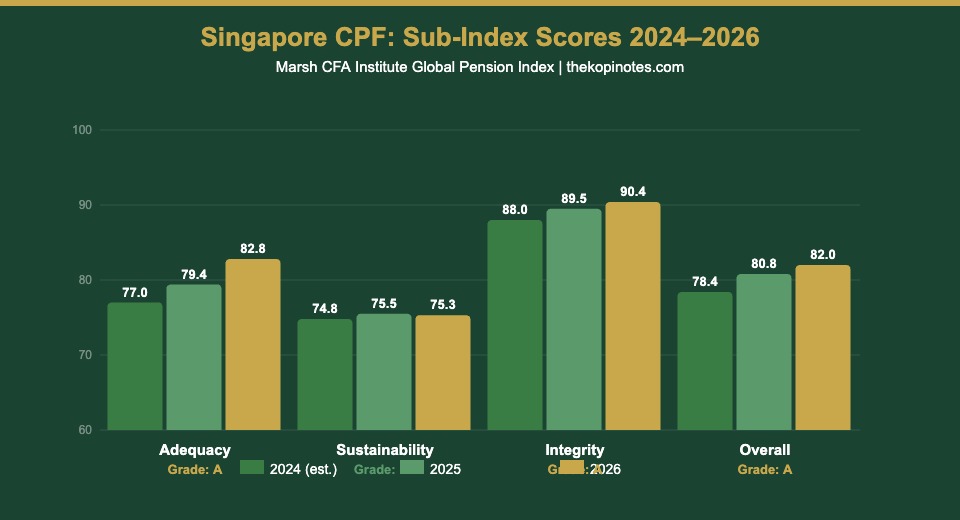
Adequacy (82.8, Grade A, 8th) saw the biggest jump — up 3.4 points from 79.4 in 2025. The report attributes this mainly to a higher minimum pension as a proportion of wages, an OECD-sourced measure. This reflects the CPF’s role in providing baseline retirement income for all Singaporeans and PRs, reinforced by CPF Life’s mandatory annuity structure.
Integrity (90.4, Grade A, 3rd) remains Singapore’s standout score. Only Finland and Norway rank higher globally. This reflects CPF’s strong regulatory governance, member communication standards, and legal protections — all factors that make CPF one of the most trustworthy retirement vehicles in the world.
Sustainability (75.3, Grade B+, 7th) is the one weak spot — it actually dipped slightly from 75.5. This measures whether a pension system can maintain its current benefit levels as the population ages. Singapore, like most developed economies, faces demographic headwinds: an ageing population and a relatively low birth rate. This is not unique to CPF, but it explains why the index authors recommend raising the minimum access age over time.
How Singapore Compares to Asia-Pacific Peers
The gap between Singapore’s CPF and other Asian pension systems is striking. While Singapore leads Asia at 4th globally, the nearest competitor — Hong Kong at 71.2 — sits 10.8 points behind. Meanwhile, Malaysia, China, and Japan all rank in the C+ to C range, reflecting weaker adequacy, lower coverage, or sustainability challenges.
| Country / System | 2026 Score | Grade | Global Rank |
|---|---|---|---|
| 🇸🇬 Singapore (CPF) | 82.0 | A | 4th |
| 🇦🇺 Australia | 80.6 | A | 6th |
| 🇭🇰 Hong Kong SAR | 71.2 | B | 17th |
| 🇲🇾 Malaysia (EPF) | 61.1 | C+ | 35th |
| 🇨🇳 China | 60.6 | C+ | 36th |
| 🇯🇵 Japan | 58.0 | C | 39th |
| 🇻🇳 Vietnam | 54.6 | C | 47th |
| 🇮🇳 India | 46.8 | D | 53rd |
The data underscores why Singapore retail investors are fortunate to have CPF as a cornerstone of retirement planning. Malaysia’s EPF — another mandatory savings fund — scores 61.1 partly because of concerns around lump-sum withdrawals and lower minimum pension levels. Japan’s C-grade reflects a structurally underfunded public pension that requires government debt to sustain.
The 4 Recommended Improvements — What Could Change for CPF Members?
The index authors are clear that their recommendations are not government policy — they’re suggestions for improvement. But understanding them helps investors anticipate potential future changes to CPF rules.
1. Raise the age at which CPF retirement savings can be accessed. Currently, Singapore members can start withdrawing from their Retirement Account (RA) at age 65 under CPF Life. The recommendation suggests pushing this higher. If implemented, it would mean less flexibility but potentially higher monthly payouts for those who wait — similar to delaying CPF Life start age, which already increases payouts.
2. Reduce barriers to tax-approved group corporate retirement plans. Singapore currently has the SRS (Supplementary Retirement Scheme) as a voluntary top-up. The index suggests broadening employer-sponsored plans to cover more workers — especially given that employment-linked savings coverage is currently strong but could be improved for self-employed and gig workers.
3. Open CPF to non-residents. Singapore has a large proportion of the workforce that are Employment Pass (EP) and S-Pass holders who do not currently contribute to CPF. The index notes this as a gap — these workers leave Singapore without retirement savings tied to the local system. This change would have implications for HR costs for employers and could potentially affect long-stay PRs and EP holders.
4. Show income projections on annual CPF statements. Currently, CPF statements show accumulated balances. The recommendation is to show projected monthly payouts at retirement age — a feature that many Singapore investors already calculate manually using the CPF Life payout calculator. This is a transparency improvement that would help members see the long-term picture without needing third-party tools.
What the A-Grade Really Means for Your CPF Strategy
The A-grade is a system-level validation — it confirms that the structural design of CPF is sound. But it does not change your CPF OA rate (2.5%), your SA/MA rate (4%), or your CPF Life payouts. What it does tell investors is:
CPF remains a high-certainty retirement foundation. With the 4% floor on SA, MA, and RA extended through end-2027, and the system ranked 3rd globally for integrity, CPF is as reliable a fixed-income vehicle as any Singapore retail investor has access to. The integrity score of 90.4 means the governance is robust — member funds are protected.
Top up your CPF SA before the access rules potentially change. If the government eventually raises the CPF access age or adjusts withdrawal rules, those already at the Full Retirement Sum (FRS) or Enhanced Retirement Sum (ERS) will be better positioned. 2026 FRS is S$213,000; ERS is S$426,000. Members who have hit the FRS get monthly payouts of approximately S$1,560–S$1,730 from CPF Life Standard Plan at age 65.
Sustainability is the index’s concern, not yours individually. The B+ sustainability score reflects system-wide long-term funding questions as Singapore ages. For individuals, the most actionable insight is to build supplementary assets — whether through S-REITs, ETFs like CSPX or VWRA, or SRS contributions — to complement CPF Life payouts rather than relying solely on them.
Use SRS as a tax-advantaged complement. Given the index’s recommendation to expand supplementary retirement savings, the SRS (Supplementary Retirement Scheme) remains underutilised by most Singapore investors. SRS contributions get a dollar-for-dollar tax relief, and investments inside SRS grow tax-free until withdrawal, where only 50% is taxable.
The Netherlands Is Still #1 — And What Singapore Can Learn
The top-ranked Netherlands (85.8) achieves its score through near-universal occupational pension coverage, mandatory employer contributions, and strong annuity requirements that prevent lump-sum withdrawals. Its adequacy score of 87.7 is higher than Singapore’s 82.8, primarily because Dutch occupational pensions sit on top of the state pension, delivering higher total replacement rates.
Singapore’s route to improving from 4th to 3rd or higher likely runs through the same path: expanding employer-contributed supplementary pensions (complementing CPF), potentially through enhanced SRS matching or mandated employer contributions for all workers including non-residents. The index’s recommendations align with this direction.
Bottom Line for SG Investors
Singapore’s CPF has now held an A-grade for two consecutive years in the world’s most credible pension benchmarking exercise — scoring 82.0 out of 100 and ranking 4th of 55 globally. The adequacy score’s jump to 82.8 reflects that CPF is delivering stronger baseline retirement income relative to wages.
For retail investors, the practical takeaway is straightforward: CPF is not just a tax or mandatory saving — it’s one of the best-designed retirement systems in the world. That means:
- Maxing your CPF SA contributions before 55 to reach ERS or FRS is worth prioritising over lower-yield alternatives.
- The recommended improvement on access age signals potential future tightening — build complementary assets now rather than relying on early CPF withdrawal flexibility.
- Use SRS as a tax-efficient supplement to CPF, particularly if your income is in the 15–22% tax bracket.
- The world-class integrity score (3rd globally) means your CPF funds are safer than most pension systems on Earth — that’s not nothing in a world of underfunded state pensions.
The full Marsh CFA Institute Global Pension Index 2026 report is available at Mercer’s website. For more on optimising your CPF, see TKN’s guide to CPF Retirement Sums (BRS, FRS, ERS) and the MAS October 2026 monetary policy impact on your savings.
Frequently Asked Questions
What is the Marsh CFA Institute Global Pension Index 2026?
It is an annual report (18th edition) that evaluates and ranks 55 retirement income systems worldwide across three pillars: Adequacy (40% weight), Sustainability (35%), and Integrity (25%). Published in October 2026 by Marsh, the CFA Institute, and Monash Business School, it covers about 66% of the global population and assigns grades from A to E.
How did Singapore’s CPF score in the 2026 Global Pension Index?
Singapore scored 82.0 overall (Grade A), ranking 4th out of 55 systems globally — up from 80.8 in 2025. Sub-scores were: Adequacy 82.8 (8th), Sustainability 75.3 (7th), Integrity 90.4 (3rd). Singapore leads all of Asia.
Does the A-grade mean my CPF interest rates will increase?
No. The Global Pension Index grades the structural design of the CPF system, not individual account returns. Your CPF OA rate remains 2.5%, and the SA/MA/RA rate remains at a 4% floor (extended through end-2027). The grade is a third-party validation of system quality, not a policy change.
What improvements does the index recommend for Singapore’s CPF?
Four recommendations were made: (1) raise the minimum age for accessing CPF retirement savings; (2) reduce barriers to tax-approved group corporate retirement plans; (3) open CPF contributions to non-residents; and (4) show projected monthly income on CPF annual statements. These are suggestions, not confirmed policy changes.
How does CPF compare to Malaysia’s EPF?
CPF scored 82.0 (Grade A, 4th globally) versus Malaysia’s EPF at 61.1 (Grade C+, 35th globally). The gap reflects CPF’s stronger mandatory annuity structure through CPF Life, better regulatory governance, and higher minimum support levels relative to wages. EPF allows full lump-sum withdrawals at 55, which the index considers a risk for retirement adequacy.
Should I do anything differently with my CPF given this ranking?
The ranking reinforces CPF-first strategies for Singapore retail investors. Consider maximising Retirement Account top-ups to reach the Full Retirement Sum (S$213,000 in 2026) or Enhanced Retirement Sum (S$426,000) for higher CPF Life payouts. Use the SRS as a tax-efficient supplement. For broader portfolio diversification, complement CPF with S-REITs, global ETFs like CSPX or VWRA, and fixed deposits as appropriate for your risk profile and time horizon.
This article was researched with the help of AI. While we strive to keep all information accurate and up to date, there may be errors. If you notice any discrepancies, please contact us.