MediSave Limit 2026: What Your ISP Covers for Psychiatric Hospitalisation in Singapore
Know your Medisave limits before a psychiatric admission — IMH, restructured hospitals, and private facilities have different rates.
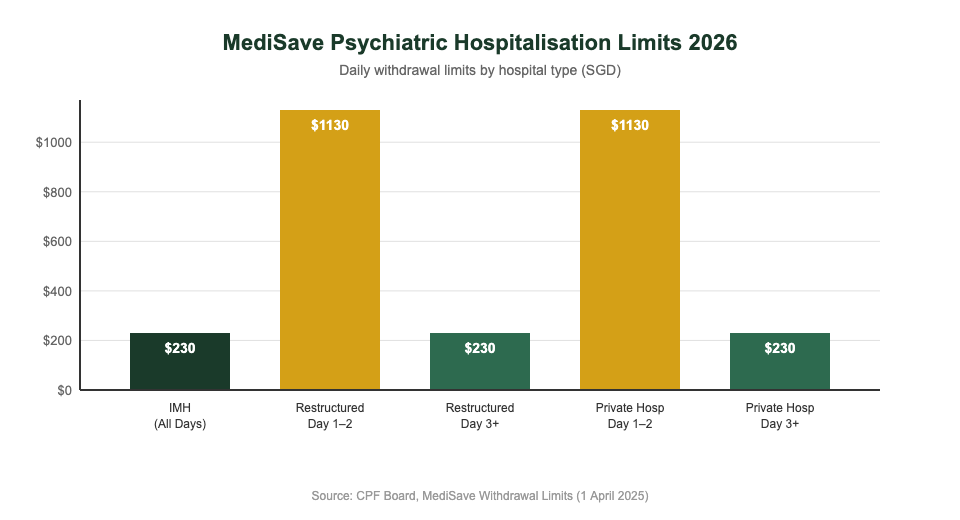
Under Singapore’s 2026 MediSave rules, psychiatric hospitalisation at the Institute of Mental Health (IMH) draws a maximum of $230 per day throughout the stay. At other restructured or private hospitals, the daily limit is $1,130 for the first two days, then $230 from day three onward. MediShield Life’s psychiatric coverage is limited — knowing how your Integrated Shield Plan (ISP) rider fills the gap could save you thousands during an already difficult time.
Not financial advice. All figures are for educational reference only. Data verified as at 25 October 2026 unless otherwise stated.
Table of Contents
Contents — Click to expand
MediSave Withdrawal Limits for Psychiatric Hospitalisation
When you’re admitted to a hospital for a psychiatric condition, MediSave can be used to pay your daily hospital charges — but the withdrawal limits depend on which hospital you’re admitted to. The CPF Board sets different rates for the Institute of Mental Health (IMH) versus restructured hospitals and private facilities.
Here is the key distinction: at IMH, the MediSave withdrawal cap remains at $230 per day for the entire stay. At all other hospitals — whether restructured (such as SGH, NUH, CGH) or private — you can draw $1,130 per day for the first two days, then the rate drops to $230 per day from day three onward.
| Hospital Type | Days 1–2 (Daily Limit) | Day 3 Onwards |
|---|---|---|
| Institute of Mental Health (IMH) | $230/day (flat rate) | $230/day |
| Restructured Hospitals (SGH, NUH, CGH, TTSH, etc.) | $1,130/day | $230/day |
| Private Hospitals | $1,130/day | $230/day |
Source: CPF Board, MediSave Withdrawal Limits (effective 1 April 2025). Daily limits apply to daily hospital charges only and do not include surgical fees.
Why is the IMH rate lower? IMH wards are heavily subsidised by the government, so the actual chargeable fees per day are much lower than at restructured or private hospitals. The $230/day cap aligns with IMH’s subsidised ward fee structure. If you receive treatment at a private psychiatric facility (such as Promises Healthcare or Adam Road Hospital), the $1,130 rate applies for the first two days, as these are not government-run institutions.
If you’re unsure how the 2026 MediSave limit affects your deductible calculations, our MediSave limit 2026 and ISP deductible guide walks through the interaction in detail.
What MediShield Life Covers (and Doesn’t) for Psychiatric Admissions
MediShield Life provides a baseline layer of coverage for psychiatric hospitalisation in Singapore, but it’s important to understand its limitations before your admission.
MediShield Life’s coverage for psychiatric hospitalisation is structured around its standard claim limits and deductible framework. The annual deductible still applies before MediShield Life pays any claim — meaning you pay the first $1,500 to $3,500 of your eligible psychiatric hospital bill (depending on your ward class) before MediShield Life contributes. After the deductible, MediShield Life covers 90% of eligible expenses up to its claim limits, and you pay the remaining 10% as co-insurance.
| Ward Class | MediShield Life Deductible | Patient Co-Insurance | ISP Needed? |
|---|---|---|---|
| Class C / B2 | $1,500/year | 10% of eligible | Optional |
| Class B1 | $2,000/year | 10% of eligible | Recommended |
| Class A | $3,000/year | 10% of eligible | Essential |
| Private Hospital | $3,500/year | 10% of eligible | Essential |
Source: MOH, MediShield Life Claim Limits (2026). Deductible is per policy year, not per admission.
One important detail: the deductible is per policy year, not per admission. If you had a separate hospitalisation earlier in the same policy year — for example, a surgical procedure in March — you may have already partially or fully met your deductible. This means your psychiatric admission later in the year could be covered from the first dollar (above the co-insurance). For a detailed breakdown of how this works, see our MediShield Life claim limits and ward class guide.
It’s worth noting that MediShield Life’s claim limits for psychiatric stays can be lower than for comparable general medical admissions. If you are staying in a subsidised ward and your stay is long (extending beyond 30+ days), you may find that MediShield Life’s psychiatric claim limits are reached before your deductible is covered in full. An ISP adds a crucial additional layer on top.
How Your ISP Extends Psychiatric Coverage
All five approved ISP insurers in Singapore — AIA, Prudential, NTUC Income, Great Eastern, and Singlife — offer plans that include inpatient psychiatric treatment as part of their standard hospitalisation coverage. Your ISP steps in where MediShield Life’s lower claim limits leave off, allowing you to access B1, Class A, or private ward rates with substantially better coverage.
What an ISP adds over MediShield Life for psychiatric admissions:
- Higher daily claim limits aligned with your plan tier (B1, A-class, or private)
- Coverage for attending specialist fees during your inpatient stay
- Pre-admission and post-discharge specialist outpatient follow-up (check your specific policy)
- Access to higher ward classes at restructured or even private hospitals
- Potential “letter of guarantee” facility, so you don’t pay the full bill upfront
With an ISP rider (April 2026 rules): The April 2026 ISP rider changes introduced mandatory minimum co-payments for all new riders — typically 5% of eligible claim expenses, capped at $3,000 per policy year. For a psychiatric admission, this co-payment applies just as it does for any other hospitalisation. The detailed breakdown of what the new rider co-payment means for your out-of-pocket costs is covered in our new ISP rider 2026 co-payment guide.
Legacy rider holders (those who purchased riders before the 2026 changes) may be on different co-payment structures — check your policy documents or contact your insurer.
Without a rider: Your ISP base plan covers eligible expenses above MediShield Life’s limits, but the co-insurance portion (which you must pay) is higher. Without a rider, you bear a larger share of the bill above the deductible. For high-cost admissions at Class A or private wards, this can be significant — the analysis of ISP rider real costs in 2026 shows that rider co-payments for long psychiatric stays remain manageable compared to self-paying without an ISP.
Pre-existing condition considerations: If you had a diagnosed mental health condition before taking out your ISP, your insurer may have excluded psychiatric hospitalisation from your policy, applied a premium loading, or imposed a waiting period. Always review your policy’s Schedule of Benefits and Exclusions, or consult a licensed financial adviser, to understand your specific coverage position.
Ward Classes and Real-World Cost Scenarios
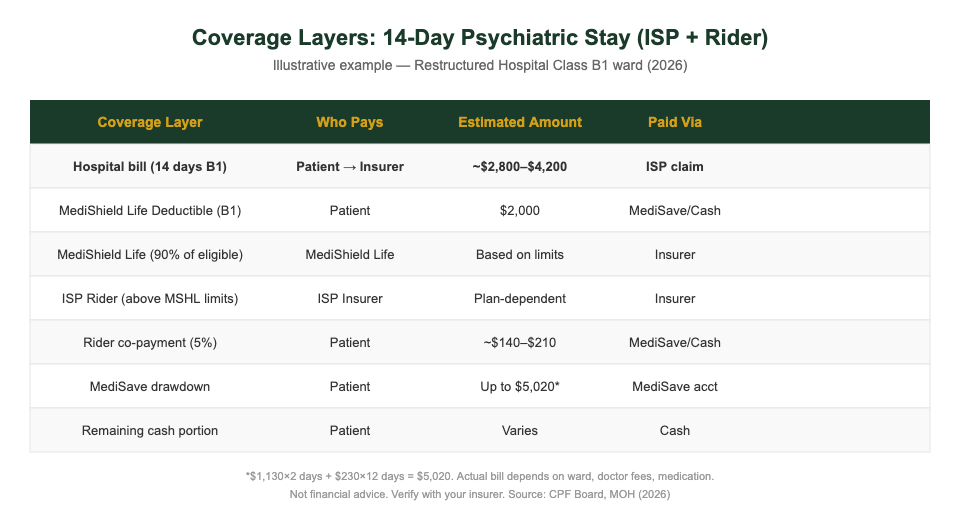
To make the numbers concrete, let’s walk through a sample 14-day psychiatric hospitalisation and see how the coverage layers interact. The following illustration is for a patient admitted to a restructured hospital’s Class B1 psychiatric ward, with an ISP and a post-April 2026 rider.
Sample Scenario: 14-Day Psychiatric Stay (Restructured Hospital, B1 Ward)
| Coverage Component | Who Bears Cost | Amount (Illustrative) | Funded Via |
|---|---|---|---|
| Hospital daily charges (14 days × B1) | — | ~$2,800–$4,200 | Insurer claim |
| MediShield Life deductible (B1) | Patient | $2,000 | MediSave / Cash |
| MediShield Life (90% of eligible after deductible) | MediShield Life | Based on claim limits | CPF / Insurer |
| ISP base coverage (above MediShield Life limits) | ISP Insurer | Plan-dependent | Insurer |
| ISP rider co-payment (5%, capped at $3,000/year) | Patient | ~$140–$210 | MediSave / Cash |
| MediSave available for deductible + co-pay | Patient (MediSave) | Up to $5,020* | MediSave acct |
*$1,130 × 2 days + $230 × 12 days = $5,020. Illustrative estimate only. Actual bill depends on ward, specialist fees, and medication costs. Always consult your insurer for exact figures.
At IMH (Class C ward): The picture is quite different. Daily subsidised ward charges at IMH Class C can be as low as $40–$100/day for Singapore Citizens (after government subsidies). MediSave at $230/day and MediShield Life coverage together are often sufficient to cover the majority of costs for short-to-medium length stays. Most subsidised patients at IMH pay very little out-of-pocket.
At private psychiatric hospitals: Without an ISP with private hospital coverage, costs escalate significantly. Private psychiatric ward daily rates can exceed $800–$1,500/day before specialist fees, with MediSave covering only $1,130 for the first two days and $230 from day three. An ISP with private hospital coverage (typically Plan A or higher) is essential if you prefer private facilities.
Using MediSave Toward Your Psychiatric Bill
After your ISP and MediShield Life have processed their portions of the claim, MediSave can be used to pay your remaining patient liability — specifically the deductible and any co-insurance or rider co-payment amounts.
The withdrawal hierarchy for psychiatric hospital bills works as follows:
- The hospital bills your insurer (your ISP + MediShield Life) directly, where possible via a Letter of Guarantee
- MediShield Life pays its share after the deductible (90% of eligible expenses, up to claim limits)
- Your ISP pays its share above MediShield Life’s limits, less the rider co-payment
- The remaining patient liability (deductible + rider co-payment + any amounts above ISP limits) is paid using MediSave, up to the daily withdrawal limits
- Any residual balance beyond MediSave limits must be settled in cash
CDMP outpatient MediSave: Separately, if your psychiatric condition is on the Chronic Disease Management Programme (CDMP) list — including schizophrenia, major depressive disorder, bipolar disorder, dementia, and anxiety disorders — you can use a separate MediSave outpatient limit of up to $500 per year for approved outpatient psychiatric care at CDMP-accredited clinics. This limit is entirely separate from your inpatient MediSave withdrawal capacity. For comprehensive information on using MediSave for outpatient mental health care, see our dedicated MediSave for mental health treatment guide.
If you’re worried about exhausting your MediSave balance during a long psychiatric admission, read our guide on what happens when your MediSave limit runs out — which covers strategies for managing your remaining liability.
For context, the interaction between the 2026 MediSave limit and your total hospitalisation costs is comprehensively covered in our MediSave hospitalisation claim limits guide.
Checklist: Before and During Your ISP Claim for Psychiatric Hospitalisation
Psychiatric hospitalisations can be unplanned and emotionally charged. Having a clear checklist helps you — or a trusted family member — navigate the insurance process without unnecessary delays or disputes.
- Confirm ISP coverage before admission (where possible): Call your insurer to verify that psychiatric hospitalisation at the specific hospital and ward class is covered under your plan. Some plan tiers only cover restructured hospital wards, while others extend to private facilities.
- Notify your insurer within the required timeframe: Most ISPs require notification within 24 hours of an emergency admission, or pre-authorisation for planned admissions. Failure to notify on time can affect your claim.
- Request a Letter of Guarantee (LOG): Ask the hospital’s billing counter to arrange an LOG from your insurer. This means the hospital bills the insurer directly and you only pay your portion at discharge — avoiding large upfront cash outflows.
- Check your policy year deductible status: If you’ve had other hospital admissions earlier in the policy year, part of your deductible may already be met. Ask your insurer for your deductible balance before admission.
- Keep all receipts, medical letters, and discharge summaries: Psychiatric claims may require additional documentation, including specialist letters confirming the diagnosis and medical necessity of inpatient care.
- Understand the rider co-payment cap: If your rider’s $3,000/year co-payment cap has already been reached from a prior admission this year, no further co-payment applies for any subsequent hospitalisation in the same policy year.
- Know your ISP’s claim limits for psychiatric stays: Ask your insurer specifically what the claim limit is for psychiatric hospitalisation under your plan tier. This may differ from the general medical/surgical claim limits.
If your ISP claim is rejected or there’s a dispute, our ISP claim rejected fallback guide provides a step-by-step process for escalating and resolving claim disputes through FIDReC and MAS.
Frequently Asked Questions
Does MediShield Life cover psychiatric hospitalisation in Singapore?
What is the MediSave daily limit for psychiatric treatment at IMH?
Can I use MediSave for outpatient psychiatric treatment?
Will my ISP cover a private psychiatric hospital admission?
Does my ISP rider's 5% co-payment apply to psychiatric hospitalisation?
What if my ISP doesn't cover psychiatric hospitalisation at a specific facility?
Are there mental health exclusions I should be aware of in my ISP?
Disclaimer: This article is for educational purposes only and does not constitute financial, medical, or insurance advice. MediSave withdrawal limits and ISP coverage terms are subject to change — always verify current figures with CPF Board, MOH, or your insurer directly. Consult a MAS-licensed financial adviser for advice tailored to your personal circumstances. If you or someone you know is experiencing a mental health crisis, contact the Samaritans of Singapore at 1767 (24-hour) or IMH’s Emergency hotline at 6389 2222.
Get Free Insurance Advice
Speak with a licensed insurance advisor. No obligation, no cost.
By submitting this form, you agree to our Privacy Policy.
This article was researched with the help of AI. While we strive to keep all information accurate and up to date, there may be errors. If you notice any discrepancies, please contact us.