TribeCar + Endowus + MariBank + FSMOne + IBKR: Which Platform Lets You Pause With Zero Fees? (2026)
Life gets busy and sometimes an account just sits there for months. On these 5 platforms, “sitting there” costs you very different amounts — from nothing at all to a locked deposit earning zero interest.
If you use TribeCar, Endowus, MariBank, FSMOne and IBKR together, letting an account sit idle doesn’t cost you the same on each one. MariBank and IBKR charge zero fall-below or inactivity fees and have no minimum balance. Endowus needs S$1,000 to open a position but charges nothing once your balance drops, since its fee is a percentage of whatever’s there. FSMOne charges no explicit fee but can suspend login access after a long stretch of inactivity. TribeCar is the one platform here where your money — a refundable security deposit — sits locked and non-interest-bearing until you formally close the account.
Not financial advice. All figures are for educational reference only and current as at October 2026.
Table of Contents
Contents — Click to expand
- Quick Answer: What Idle Money Costs on Each Platform
- All 5 Platforms Compared: Minimum Balance & Fee Rules
- The Zero-Fee Tier: MariBank & IBKR
- The Threshold Tier: Endowus & FSMOne
- The Locked-Deposit Tier: TribeCar
- Idle-Cash Ranking: Best to Worst
- How This Should Shape Where You Park Spare Cash
- Frequently Asked Questions
Quick Answer: What Idle Money Costs on Each Platform
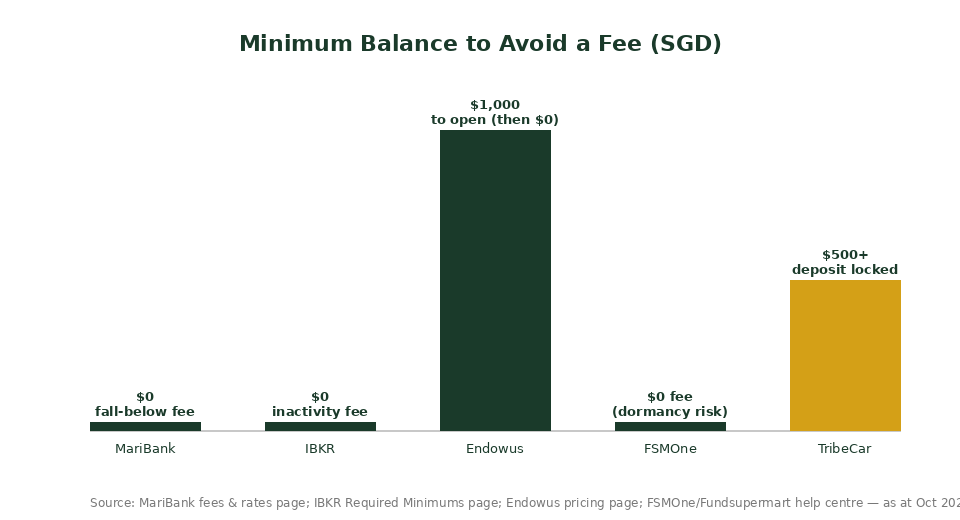
Most people assume that if an account has no activity for a while, something bad eventually happens — a fee, a frozen balance, a closed account. Across TribeCar, Endowus, MariBank, FSMOne and IBKR, that assumption is only true for one of the five. MariBank’s Mari Savings Account carries a published “Fall Below Fee: None,” so a balance of exactly S$0 costs nothing. Interactive Brokers’ Required Minimums page lists an account minimum of US$0 and an inactivity fee of US$0 for individual accounts. Endowus requires S$1,000 to open an investment, but its access fee is a percentage of assets under management — if the balance ever falls toward zero, so does the fee. FSMOne doesn’t publish an explicit dormancy fee, but extended inactivity can suspend your ability to log in or trade until you reactivate. TribeCar sits apart from all four: it isn’t a bank or brokerage, so “minimum balance” doesn’t really apply, but it holds a refundable security deposit that earns no interest while your account is open.
This matters most for the exact situation most readers using this 5-platform stack will hit at some point: a trip overseas, a career break, a season where you’re not actively managing money. Knowing which accounts genuinely cost nothing to leave alone — and which one is quietly holding your cash hostage — changes where you’d want spare money sitting.
All 5 Platforms Compared: Minimum Balance & Fee Rules
Here’s the full picture side by side, based on each platform’s own published fee schedule or help centre documentation.
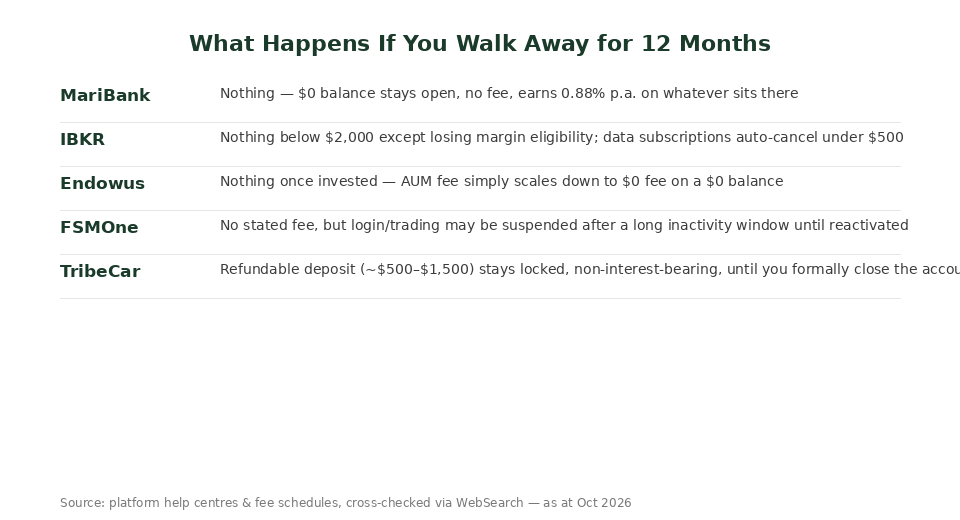
| Platform | Account Minimum | Fall-Below / Inactivity Fee | What Happens at $0 |
|---|---|---|---|
| MariBank | None | None | Account stays open, earns 0.88% p.a. on whatever’s there |
| IBKR | US$0 | US$0 (individual accounts) | Loses margin eligibility below US$2,000; market-data subscriptions auto-cancel below US$500 |
| Endowus | S$1,000 to open | None (fee is % of AUM) | Access fee scales down to near-$0 as balance falls |
| FSMOne | None | No stated fee | Risk of login/trading suspension after long inactivity, reactivation required |
| TribeCar | Not applicable (car-sharing marketplace) | Deposit locked, not a fee | Refundable deposit (~S$500–S$1,500) held, non-interest-bearing, until account closure |
Source: MariBank fees & rates page; Interactive Brokers Required Minimums page; Endowus pricing page; FSMOne/Fundsupermart help centre; TribeCar deposit terms — as at October 2026.
The Zero-Fee Tier: MariBank & IBKR
MariBank and IBKR are the two platforms in this stack you can genuinely walk away from without being penalised. MariBank’s Mari Savings Account fee schedule explicitly lists its fall-below fee as “None” — there’s no minimum balance requirement and no monthly maintenance charge, regardless of how low the balance sits. The account continues earning its flat 0.88% p.a. savings rate on whatever’s in it, even a few dollars, and SDIC deposit insurance up to S$100,000 still applies the entire time.
IBKR is structurally similar but for a different reason. Its Required Minimums page states an account minimum of US$0 and an inactivity fee of US$0 for individual, joint and trust accounts — a policy change from the US$10/month inactivity charge IBKR scrapped back in July 2021. There are two balance-linked consequences worth knowing, though neither is a fee: once your balance falls below US$2,000, MAS and other regulators no longer permit IBKR to extend margin treatment to your positions, and market-data subscriptions are automatically cancelled once your balance drops below US$500. Both are protective guardrails, not charges — you simply can’t use margin or paid data feeds on a near-empty account, which for most readers parking idle cash is a non-issue.
The Threshold Tier: Endowus & FSMOne
Endowus and FSMOne don’t punish a low balance with a fee, but each has its own quirk. Endowus requires S$1,000 to make your first investment and S$100 for subsequent top-ups — that’s a barrier to entry, not an ongoing minimum-balance rule. Once you’re in, Endowus’s access fee is tiered as a percentage of assets under management (0.60% on the first S$200,000 for cash portfolios, stepping down at higher tiers, per Endowus’s published pricing), so a balance that shrinks toward zero simply pays a proportionally smaller fee — there’s no separate penalty layered on top for being “too small.”
FSMOne doesn’t publish an outright dormancy fee either, but the risk here is functional rather than financial. FSMOne’s own help centre documentation describes investment accounts as classified dormant after an extended stretch with no login or transaction activity, at which point access can be suspended until you go through a reactivation process on the Fundsupermart platform. No published figure says you’ll be charged for this — but being locked out of your own account for a period while you sort out reactivation is a real inconvenience most readers wouldn’t expect from a platform with “no minimum balance.”
The Locked-Deposit Tier: TribeCar
TribeCar isn’t a bank or a brokerage, so none of the “minimum balance” language above technically applies to it. But it’s included in this stack for a reason: TribeCar requires a refundable security deposit (typically in the S$500–S$1,500 range depending on the car class) before you can start booking, and that deposit sits with TribeCar — non-interest-bearing — for as long as your account stays open. Unlike MariBank or IBKR, there’s no balance you can simply let sit at zero; the deposit itself is the “idle balance,” and it only comes back to you through a formal account closure and refund process, which in past sessions has taken around 45 days to process.
For someone deliberately skipping car ownership and parking that capital elsewhere instead (the whole premise of several earlier articles in this combo stream), that locked deposit is effectively the one piece of “idle cash” in this 5-platform stack that earns nothing and takes the longest to get back.
Idle-Cash Ranking: Best to Worst
Ranking strictly on “what does it cost me to let this account sit untouched for a year”:
- MariBank — $0 minimum, $0 fall-below fee, keeps earning interest the whole time.
- IBKR — $0 minimum, $0 inactivity fee; only loses margin/data perks at very low balances, which idle cash doesn’t need anyway.
- Endowus — needs S$1,000 to start, but once invested, the fee simply scales down with the balance — no separate penalty.
- FSMOne — no fee, but carries a real risk of login suspension after prolonged inactivity, with a reactivation step to get back in.
- TribeCar — the only platform here where idle money (the deposit) is locked, earns no interest, and takes the longest to retrieve.
How This Should Shape Where You Park Spare Cash
If you’re deliberately letting a balance sit — between jobs, waiting for a better rate, or simply not actively managing money for a few months — MariBank and IBKR are the two accounts in this stack that cost you literally nothing to leave alone, and MariBank keeps paying interest the entire time. Endowus is close behind: the S$1,000 entry bar is a one-time hurdle, not an ongoing cost. FSMOne is fine for active use but isn’t the place to park money you won’t touch for a year or more, given the dormancy-suspension risk. And if you’ve opened a TribeCar account specifically to avoid car ownership costs, remember that your deposit there is doing nothing for you financially — it’s worth comparing that locked amount against what the same sum would earn sitting in MariBank or invested via Endowus instead.
For a broader view of how idle cash fits into a full income strategy, see our guide to passive income in Singapore, and if you’re stacking CPF alongside these platforms, our CPF investment strategy piece covers how to sequence that separately.
Frequently Asked Questions
Does MariBank really charge no fee at all for a low balance?
Based on MariBank’s own fees and rates page, yes — the Mari Savings Account lists its fall-below fee as “None,” with no minimum balance requirement. A S$0 balance earns S$0 in interest but is not charged anything for being low or empty.
Will IBKR close my account if I don't trade for a long time?
No. IBKR’s Required Minimums page lists a US$0 inactivity fee for individual, joint and trust accounts, and there is no stated policy of closing dormant individual accounts purely for inactivity. The practical effects of a very low balance are losing margin eligibility below US$2,000 and automatic cancellation of paid market-data subscriptions below US$500 — neither is a fee or a closure.
What happens if my Endowus balance drops close to zero?
Nothing punitive. Endowus’s access fee is charged as a percentage of assets under management across tiers (0.60% on the first S$200,000 for cash portfolios, stepping down at higher AUM tiers per its published pricing), so a shrinking balance simply pays a proportionally smaller dollar amount in fees — there’s no separate low-balance or dormancy charge layered on top. The S$1,000 minimum only applies when you first invest.
What happens if I stop logging into FSMOne for a long time?
FSMOne’s help centre documentation describes accounts being classified as dormant after an extended period of no login or transaction activity, at which point access can be suspended until you complete a reactivation process through the Fundsupermart platform. No published fee applies for this, but it is a real access inconvenience that MariBank and IBKR don’t carry.
Is TribeCar's security deposit really the same as an account minimum balance?
Not exactly — TribeCar isn’t a bank or brokerage, so there’s no regulated “minimum balance” concept. But functionally, the refundable security deposit (typically S$500–S$1,500 depending on car class) behaves like locked idle cash: it sits with TribeCar, earns no interest, and is only returned through a formal account closure and refund process. That makes it the one platform in this stack where parking money costs you the most in opportunity cost.
Which of these 5 platforms is best for parking spare cash I won't touch for months?
MariBank and IBKR rank highest, since both have zero minimum balance and zero inactivity or fall-below fees — and MariBank keeps paying 0.88% p.a. interest the whole time. Endowus is a close third once you’ve cleared the S$1,000 entry bar. FSMOne works fine for active use but carries dormancy-suspension risk if left untouched too long. TribeCar is the weakest choice for idle cash, since its refundable deposit earns nothing while locked.
Open Your Accounts With Our Referral Codes
Sign up through these links for the current welcome bonuses on each platform.
This article was researched with the help of AI. While we strive to keep all information accurate and up to date, there may be errors. If you notice any discrepancies, please contact us.