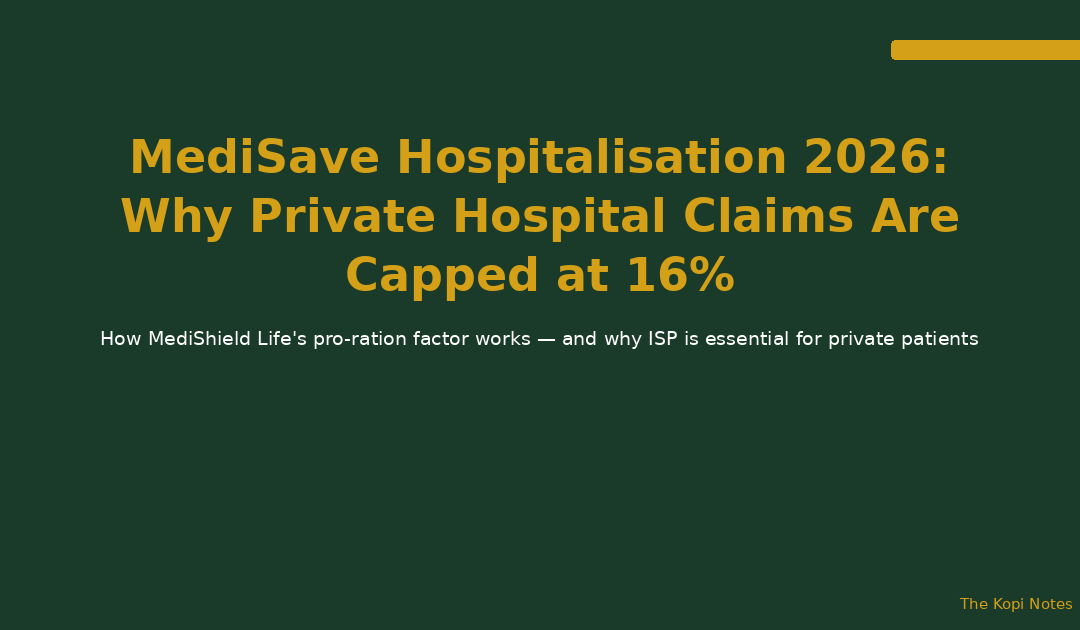
MediSave Hospitalisation 2026: Why Private Hospital Claims Are Capped at 16% — And How ISP Fills the Gap
MediShield Life uses a “pro-ration factor” that dramatically limits what it pays for Class A and private hospital stays. Here’s exactly how much you’re on the hook for — and why an Integrated Shield Plan isn’t optional if you want private care.
If you choose a private hospital or Class A ward in Singapore, MediShield Life will only pay on 16%–27% of your bill — leaving you responsible for the rest. On a $50,000 hospitalisation bill, that means over $40,000 out of pocket with no ISP. The culprit is the pro-ration factor: a government mechanism that applies different coverage percentages to different ward classes to incentivise use of subsidised wards. This guide explains exactly how the pro-ration factor works, what you’ll actually owe at each ward level, and how Integrated Shield Plans (ISP) and the post-April 2026 rider rules change the equation.
Not financial advice. All figures are for educational reference only. Data verified as at 8 October 2026 against CPF Board, MOH official sources, and insurer illustrations.
Table of Contents
What Is the Pro-Ration Factor?
When you’re hospitalised in Singapore, MediShield Life doesn’t simply pay a percentage of your total bill. Instead, it applies a pro-ration factor — a government-set percentage that determines what portion of your hospital bill even counts as the “claimable base” before any deductible or co-insurance calculation begins.
The pro-ration factor exists because MediShield Life was designed primarily to cover subsidised ward stays. When patients choose higher ward classes or private hospitals, they’re electing premium amenities and services that the government doesn’t intend to fully subsidise. The pro-ration factor limits MediShield Life’s exposure accordingly.
Here’s the critical point most Singaporeans miss: if you’re in a private hospital, only 16% of your bill is even eligible for MediShield Life claims. The deductible and co-insurance calculations happen after the pro-ration is applied — not on the full bill amount.
This is why being hospitalised without an ISP in Singapore can be financially devastating for private hospital patients, even though MediShield Life technically covers them.
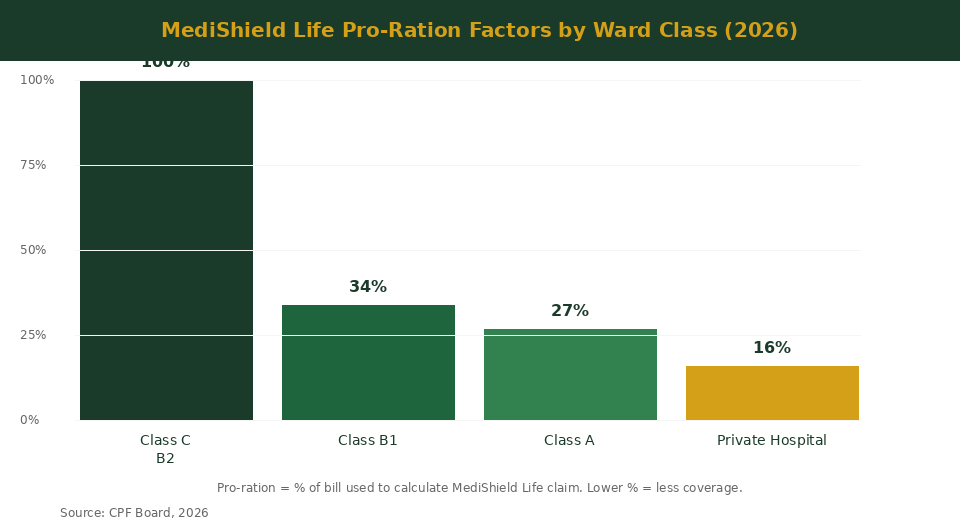
Pro-Ration Factors by Ward Class (2026)
The table below shows the pro-ration factors for Singapore Citizens. Permanent Residents and foreigners have different (lower) rates.
| Ward Class | Pro-Ration Factor | Meaning |
|---|---|---|
| Class C | 100% | Full bill used as claimable base |
| Class B2 / B2+ | 100% | Full bill used as claimable base |
| Class B1 | 34% | Only 34% of your bill counts for MSL claims |
| Class A | 27% | Only 27% of your bill counts for MSL claims |
| Private Hospital | 16% | Only 16% of your bill counts for MSL claims |
Source: CPF Board, 2026. Rates apply to Singapore Citizens for inpatient ward charges.
What You’ll Pay on a $50,000 Bill — By Ward Class
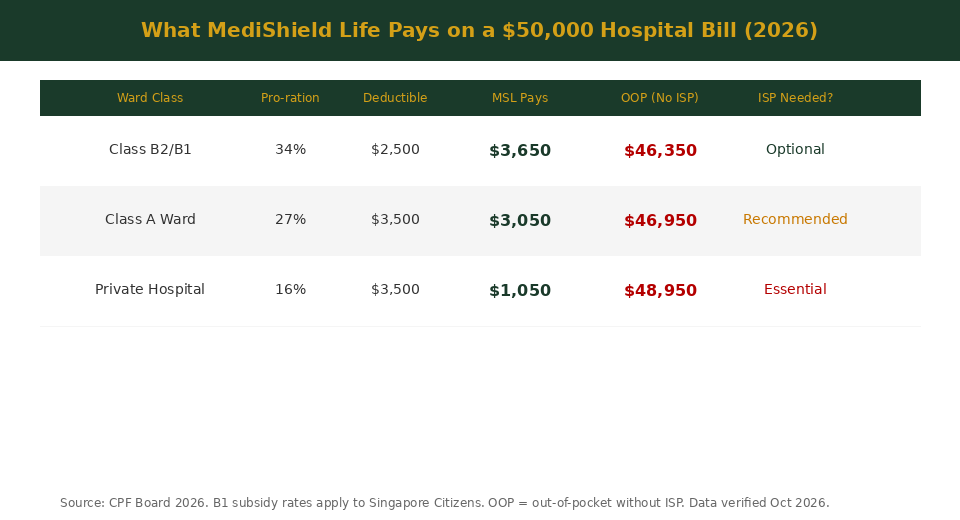
To see how dramatically the pro-ration factor affects your out-of-pocket costs, let’s run a $50,000 hospitalisation bill through the MediShield Life calculation for a Singapore Citizen aged 65 or below across each ward class.
The calculation works in three steps:
- Apply pro-ration factor → claimable base amount
- Subtract deductible (your first-dollar responsibility)
- Apply co-insurance on the balance: 10% on first $5,000, 5% on next $5,000, 3% above $10,000
Class C Ward — $50,000 Bill
| Step | Amount |
|---|---|
| Total bill | $50,000 |
| Pro-ration (100%) → Claimable base | $50,000 |
| Less: Deductible (C ward, age ≤80) | −$2,000 |
| Co-insurance payable by you ($48,000 balance) | −$1,890 |
| MediShield Life pays | $46,110 |
| Your total out-of-pocket | $3,890 (7.8%) |
Class A Ward — $50,000 Bill
| Step | Amount |
|---|---|
| Total bill | $50,000 |
| Pro-ration (27%) → Claimable base | $13,500 |
| Less: Deductible (Class A, age ≤80) | −$3,500 |
| Co-insurance on $10,000 balance | −$750 |
| MediShield Life pays | $9,250 |
| Your total out-of-pocket | $40,750 (81.5%) |
Private Hospital — $50,000 Bill
| Step | Amount |
|---|---|
| Total bill | $50,000 |
| Pro-ration (16%) → Claimable base | $8,000 |
| Less: Deductible (Private hospital, age ≤80) | −$3,500 |
| Co-insurance on $4,500 balance | −$450 |
| MediShield Life pays | $4,050 |
| Your total out-of-pocket | $45,950 (91.9%) |
Source: CPF Board 2026. Singapore Citizen, age ≤80. Co-insurance: 10% on first $5,000 above deductible, 5% on next $5,000, 3% above that.
The contrast is stark: a Class C ward patient retains only 7.8% of a $50,000 bill. A private hospital patient faces 91.9% out of pocket — nearly the entire bill — purely due to the pro-ration effect.
How ISP Fills the Gap (Including New April 2026 Rider Rules)
An Integrated Shield Plan (ISP) top-up extends MediShield Life to cover the gap — the unprorated portion of your bill that MediShield Life doesn’t touch. But the rules governing ISP riders changed significantly on 1 April 2026.
For a full breakdown of your real costs with the new ISP rider 2026 real out-of-pocket costs, we’ve done a detailed 6-month review. The key changes affecting hospitalisation claims:
What Changed on 1 April 2026
| Feature | Legacy Rider (pre-2026) | New Compliant Rider (from Apr 2026) |
|---|---|---|
| Deductible coverage | Fully covered by rider | Not covered — you pay $1,500–$3,500 |
| Annual co-payment cap | $3,000/year | $6,000/year |
| Minimum co-payment | 5% | 5% (unchanged) |
| Average premium vs old rider | Baseline | ~35–40% lower |
Source: MOH press release, April 2026.
Key implications for private hospital patients:
- With a new compliant rider, you’ll pay up to $3,500 (the private hospital deductible) plus 5% co-insurance on claims above that — up to the $6,000 annual co-payment cap
- Once you’ve paid $6,000 in total co-payments for the year, your rider covers the rest
- On a $50,000 private hospital bill, your maximum exposure with a new rider is roughly $6,000 — compared to $45,950 without any ISP
- Legacy riders (bought before 27 November 2025) keep their old terms for now. Those purchased on or after that date must be updated at first renewal after 1 April 2028
For a detailed look at how the new ISP rider 2026 co-payment rules work with real bill scenarios, see our full breakdown guide.
Decision Guide: Is Private Hospital + ISP Worth It?
The MOH data shows 128,200 Singaporeans downgraded or discontinued their ISP in 2025 — and 181,800 cancelled ISP riders. Rising premiums are a key driver. Yet the numbers above show that abandoning your ISP as a private hospital patient exposes you to near-total bill liability.
Here’s a practical framework to think through your decision. For retirees facing premium shock, see our dedicated guide on the best ISP for Singapore retirees 2026.
When Private Hospital + ISP Rider Makes Sense
- You need specialist continuity: Your specialist practises at a private hospital. Shifting to a restructured hospital means starting over with a new doctor.
- Shorter waiting times matter for your condition: Elective procedures at restructured hospitals can involve longer queues.
- You have chronic conditions requiring frequent hospitalisation: The annual co-payment cap ($6,000 with new riders) means your total exposure is bounded even with multiple admissions per year.
- Premium is manageable: New riders cost about 35–40% less than legacy ones — check whether your insurer has migrated you to a compliant product already.
When Downgrading Your ISP Coverage May Make Sense
- You’re comfortable in Class B1 or B2 restructured care: At 34% pro-ration for B1 (versus 16% for private), MediShield Life covers significantly more. A lower-tier ISP at lower premiums can still cap your co-payments effectively.
- You’re in good health with low hospitalisation risk: If you haven’t been hospitalised in years, consider whether the premium cost justifies maintaining A-class or private coverage. You can review how MediSave hospitalisation claims work step-by-step before deciding.
- MediSave can cover the deductible: For subsidised wards, your MediSave balance can handle the lower deductible ($2,000–$2,500), making out-of-pocket exposure manageable without a rider.
What You Should Never Do
Cancel your ISP entirely if you intend to use private or Class A ward care. The pro-ration factor makes MediShield Life-only coverage for private patients economically untenable for any bill above $10,000. A $100,000 private hospital bill without ISP leaves you with approximately $92,000 in out-of-pocket exposure.
If cost is the concern, the better option is to step down your ISP tier (from private to A-class coverage, or from A to B1) rather than cancelling altogether. You can always request a quote for the new compliant rider from your insurer — remember, these now cost about 35–40% less on average. See our integrated shield plan Singapore guide for a full comparison of all 7 ISP insurers’ current offerings.
Key Takeaways
- MediShield Life uses a pro-ration factor that limits the claimable base to 100% (C/B2), 34% (B1), 27% (Class A), or 16% (private hospital) of your total bill.
- On a $50,000 private hospital bill, MediShield Life pays only ~$4,050 — leaving you with $45,950 out of pocket without ISP.
- The same $50,000 bill in a Class C ward leaves only $3,890 out of pocket — the pro-ration system is working as intended for subsidised wards.
- New ISP riders from April 2026 no longer cover deductibles ($1,500–$3,500), and the annual co-payment cap doubled to $6,000. However, premiums are 35–40% lower.
- With a compliant ISP rider, your maximum annual out-of-pocket for private hospital stays is capped at approximately $6,000 — compared to near-total exposure without one.
- 128,200 Singaporeans dropped their ISP in 2025 and 181,800 cancelled riders. If cost is the driver, consider downgrading ISP tier rather than cancelling entirely.
Frequently Asked Questions
What is the pro-ration factor and why does it exist?
The pro-ration factor is a percentage set by MOH that determines what portion of your hospital bill counts as the “claimable base” for MediShield Life calculations. It exists to discourage overconsumption of premium wards by limiting the government subsidy flowing through MediShield Life to higher-cost care settings. Class C and B2 wards get 100% pro-ration (full coverage of the bill), while Class A gets 27% and private hospitals get 16%.
How much does MediShield Life pay for a private hospital stay?
It depends on your bill size, but typically very little relative to the total. On a $50,000 private hospital bill, MediShield Life pays approximately $4,050 — because only 16% of the bill ($8,000) counts as the claimable base, then the $3,500 deductible and 10% co-insurance are applied to the remaining $4,500. Without an ISP, you would pay $45,950 out of pocket.
Does my Integrated Shield Plan cover the part MediShield Life doesn't?
Yes, that’s the primary function of an ISP. Your ISP base plan covers the unprorated portion of your bill — the 84% of the private hospital bill that MediShield Life doesn’t touch. An ISP rider further reduces your out-of-pocket share of the claimable base. With a new compliant rider (post-April 2026), your maximum annual co-payment is capped at $6,000, with the rider covering everything above that.
What changed about ISP riders on 1 April 2026?
Three key changes: (1) New riders can no longer cover MOH’s minimum IP deductibles, which range from $1,500 to $3,500 by ward class — you must pay these out of pocket (or from MediSave). (2) The annual co-payment cap doubled from $3,000 to $6,000. (3) Premiums are approximately 35–40% lower on average than legacy maximum-coverage riders. Riders purchased before 27 November 2025 keep their old terms for now; those bought on or after that date must convert at first renewal after 1 April 2028.
Is the pro-ration factor the same for PRs and foreigners?
No. Permanent Residents have lower pro-ration factors than Singapore Citizens, and foreigners have the lowest rates. This means PRs and foreigners have even higher out-of-pocket exposure from MediShield Life alone at equivalent ward classes. ISP coverage is especially important for PRs choosing Class A or private hospital care.
If I'm 81 or older, how do my deductibles change?
Deductibles increase significantly for policyholders aged 81 and above: Class C rises from $2,000 to $2,750; B2/B1 from $2,500 to $3,500; and Class A/private from $3,500 to $4,500 per policy year. This makes ISP even more important for older Singaporeans, as both the deductible and the pro-ration effect compound to reduce MediShield Life’s effective coverage. See our guide on the best ISP options for Singapore retirees 2026 for age-specific premium and coverage considerations.
Get Free Insurance Advice
Speak with a licensed insurance advisor. No obligation, no cost.
By submitting this form, you agree to our Privacy Policy.
This article was researched with the help of AI. While we strive to keep all information accurate and up to date, there may be errors. If you notice any discrepancies, please contact us.