INTEGRATED SHIELD PLANS — SPECIALIST GUIDE
Panel vs Non-Panel Specialists in Singapore: How Your Doctor Choice Affects Your ISP Bill (2026)
Updated October 2026 | 10 min read
Choosing the wrong specialist could cost you thousands more out-of-pocket — even with an Integrated Shield Plan. In Singapore, ISPs cover specialist care at higher reimbursement rates when you see a panel doctor on your insurer’s approved list. Going non-panel means higher co-payments, no cashless claims (Letter of Guarantee), and potentially paying 30–50% more from your own wallet. This guide shows you exactly what’s different — and how to avoid an expensive surprise.
Not financial advice. All figures are for educational reference only. Data as at October 2026 unless noted.
? In This Guide
- What Is a Panel Specialist Under Your ISP?
- Panel vs Non-Panel: The 5 Key Differences
- Letter of Guarantee — How It Works
- Real Cost Comparison: Panel vs Non-Panel
- Panel Networks by Insurer (2026)
- How to Check If Your Specialist Is on the Panel
- When It Makes Sense to Go Non-Panel
- Frequently Asked Questions
What Is a Panel Specialist Under Your ISP?
A panel specialist is a doctor — typically a consultant or sub-specialist — who has a contractual arrangement with your Integrated Shield Plan insurer. The insurer has agreed to certain fee schedules and billing processes with this doctor’s practice or hospital.
The Ministry of Health accredits specialists in Singapore, but “panel” status is determined by each insurer separately. A cardiologist at Gleneagles could be on AIA’s panel but not on Singlife’s panel — the two lists are different.
Key characteristics of a panel specialist:
- Approved by your specific insurer under your policy tier (e.g. private hospital or restructured hospital ward class)
- Can request a Letter of Guarantee (LOG) on your behalf for planned hospitalisations
- Bills the insurer directly in many cases — reducing your upfront cash outlay
- Your insurer applies standard policy sub-limits and co-payment rates
If you have the best integrated shield plan in Singapore, using a panel specialist ensures you get the maximum coverage your policy allows. Going non-panel unlocks choice — but at a cost.
Panel vs Non-Panel: The 5 Key Differences
The chart below summarises the five most important differences between seeing a panel vs non-panel specialist under your ISP:
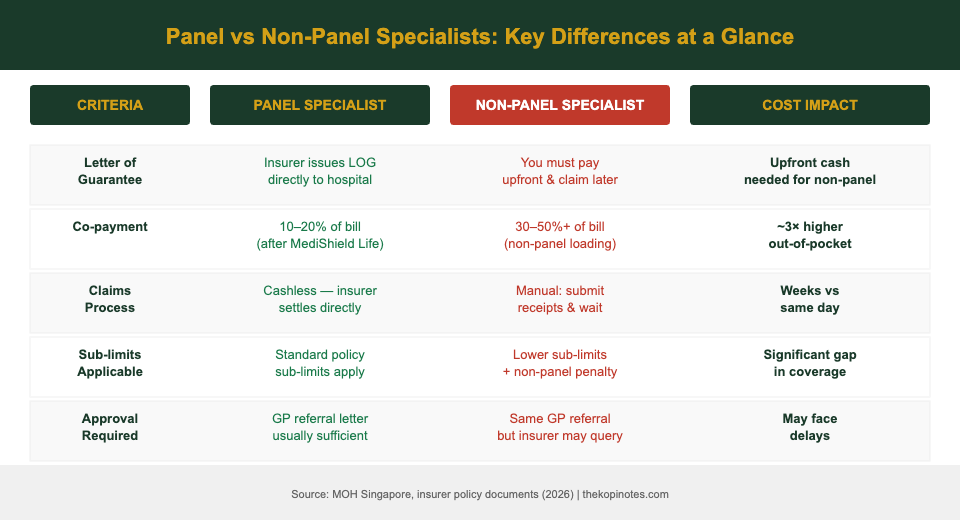
| Aspect | Panel Specialist | Non-Panel Specialist |
|---|---|---|
| Letter of Guarantee | ✔ Issued to hospital | ✘ You pay upfront |
| Co-payment rate | 10–20% of bill | 30–50%+ of bill |
| Claims process | Cashless (direct billing) | Submit receipts & wait |
| Policy sub-limits | Standard sub-limits apply | Lower sub-limits + surcharge |
| Specialist choice | Limited to panel list | Any MOH-accredited specialist |
Source: AIA, AXA, NTUC Income, Prudential, Singlife product disclosure sheets (2026)
The co-payment difference alone can amount to tens of thousands of dollars for a major surgery. For context, an emergency appendectomy at a private hospital in Singapore can cost S$18,000–$35,000 total. Going non-panel on a $25,000 bill might mean you absorb $8,750–$12,500 yourself — vs $2,500–$5,000 on panel. Understanding the full ISP co-payment structure is critical before any planned surgery.
Letter of Guarantee (LOG) — How It Actually Works
A Letter of Guarantee is a financial commitment letter your insurer issues to the hospital, guaranteeing they will pay the covered portion of your treatment costs directly. It’s the mechanism that enables cashless hospitalisation.
For panel specialists: Your panel specialist or the hospital’s billing desk contacts your insurer before or at admission. The insurer reviews the diagnosis and procedure, and issues the LOG to the hospital’s finance department. You only pay your co-payment portion — typically at discharge.
For non-panel specialists: No LOG is issued. You must settle the full bill at the hospital (or upon discharge), then submit a claim to your insurer manually — receipts, discharge summary, specialist memo, and claim form. Reimbursement typically takes 7–30 days depending on the insurer and claim completeness.
⚠️ Cash Flow Warning
A $30,000 hospital bill with a non-panel specialist means you need $30,000 in liquid cash ready before or at admission — even if your ISP eventually reimburses $20,000. Many Singaporeans don’t realise this until the hospital’s billing counter calls. Our ISP claims guide 2026 walks through the full reimbursement process step by step.
Real Cost Comparison: Panel vs Non-Panel (With Numbers)
Let’s use a realistic scenario: a 55-year-old with a private hospital ISP rider undergoing a laparoscopic cholecystectomy (gall bladder removal). Total hospital bill: S$22,000.
| Cost Component | Panel Specialist | Non-Panel Specialist |
|---|---|---|
| Total hospital bill | S$22,000 | S$22,000 |
| MediShield Life covers | ~S$3,800 | ~S$3,800 |
| ISP rider covers | ~S$15,600 | ~S$10,200 (lower sub-limits) |
| Non-panel surcharge (30%) | — | +S$2,160 applied to rider |
| Your out-of-pocket | ~S$2,600 | ~S$8,000 |
| Difference | Non-panel costs ~S$5,400 more out-of-pocket | |
Indicative figures only. Actual amounts depend on specific policy terms, ward type, and insurer. Consult your insurer before admission. Source: Compiled from insurer product disclosure sheets (2026).
That S$5,400 difference is why your choice of specialist is arguably the single most financially impactful decision you make within the private healthcare system. The 2026 ISP rider changes have made understanding this gap even more important — as co-payment minimums increased across most plans.
Panel Networks by Insurer: Who Has the Biggest Panel? (2026)
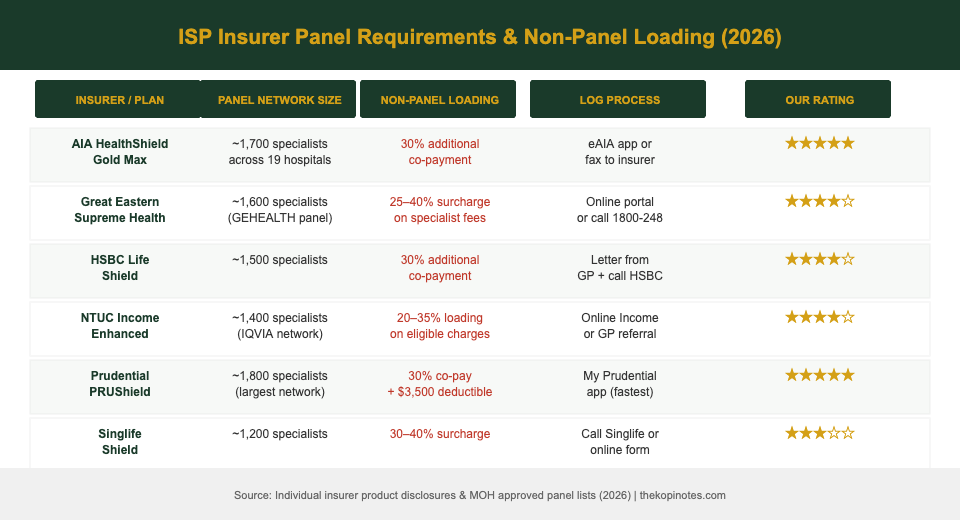
Panel size and non-panel loading vary significantly across Singapore’s seven ISP providers. Here’s what the chart shows:
A few key takeaways from the insurer comparison:
Prudential PRUShield has the largest reported panel network (~1,800 specialists) as of mid-2026, and its PRUShield plan in depth also features the fastest LOG issuance via the MyPrudential app. However, it also applies a $3,500 deductible on non-panel claims in addition to the co-payment surcharge — making non-panel particularly expensive for PRUShield holders.
AIA HealthShield Gold Max and Great Eastern Supreme Health are close behind in panel size, with AIA’s eAIA app enabling same-day digital LOG requests. NTUC IncomeShield has the lowest non-panel loading (20–35%) among the major plans — marginally more generous for those who must see a non-panel specialist. You can find a comprehensive breakdown in the NTUC Income Enhanced IncomeShield review.
How to Check If Your Specialist Is on the Panel
Before any specialist appointment — especially a planned procedure — always verify panel status. Here’s how, by insurer:
- AIA: Use the AIA Find a Doctor portal, searchable by specialty and hospital. Or call 1800 248 8000.
- Great Eastern: Log in to your Great Eastern online portal and use the “Find a Specialist” feature under your policy.
- HSBC Life: Contact HSBC Life at 6225 6111 — the insurer currently lacks a public-facing panel search tool.
- NTUC Income: Use the Income online portal or call 6788 1777. Panel lists are also available at most restructured hospital counters.
- Prudential: Search via the Prudential Find a Specialist tool by specialty, hospital, and your specific PRUShield plan tier.
- Singlife: Call Singlife at 6827 9988 or visit the Singlife website and log in to your account.
Pro tip: Panel status can change when insurer contracts expire (usually annually). Check panel status even if your specialist was panel last year. A 10-minute check can save you thousands.
When It Makes Sense to Go Non-Panel
Despite the extra cost, there are genuine reasons to see a non-panel specialist:
Highly specialised expertise: For rare or complex conditions — certain cancer sub-types, complex neurological issues, rare autoimmune conditions — the best specialist in Singapore may not be on your insurer’s panel. The quality-of-care benefit may outweigh the financial cost.
Established patient-doctor relationship: If you’ve been with a specialist for years and trust them with your care, the continuity of care value is real. Switching to a panel doctor mid-treatment carries clinical risk.
Second opinion: Seeking a second opinion on a major diagnosis doesn’t always need to be cashless. Many patients pay S$200–$400 out-of-pocket for a second-opinion consultation — that’s different from a full surgical admission.
Emergency situations: In a genuine emergency, you don’t choose your specialist. ISPs generally have more flexible provisions for emergency non-panel care. Check your specific policy wording — most plans allow you to seek post-emergency approval within 5–14 days.
If you’re unsure which plan gives you the best balance of panel access and flexibility, our guide to the ISP claims process walks through how to compare plans based on your healthcare usage patterns.
Frequently Asked Questions
Can I see any specialist with my ISP, or only panel doctors?
You can see any MOH-accredited specialist with your Integrated Shield Plan — your ISP doesn’t restrict you to panel only. However, going non-panel means you’ll face higher co-payments (typically 30–50% additional loading), lose access to the cashless Letter of Guarantee process, and may hit lower sub-limits for reimbursement. The choice is always yours, but the financial difference can be substantial.
What happens if I'm admitted in an emergency to a hospital where my specialist is non-panel?
Most ISPs have specific emergency provisions. Generally, if your admission is a genuine emergency (life-threatening or requiring immediate attention), your insurer will apply more lenient non-panel terms or process the claim under emergency provisions. You should notify your insurer within 5–14 days of emergency admission (check your policy’s specific timeframe). Contact your insurer’s 24-hour emergency line as soon as you’re stable.
Can a GP's referral letter guarantee my specialist will be treated as panel?
No. A GP referral letter determines that you have a genuine medical reason to see a specialist — it’s required by most ISPs for non-emergency specialist visits. But whether that specialist is “panel” is entirely determined by whether they appear on your specific insurer’s approved list. You need both a GP referral AND a panel specialist to get the best coverage. Having a referral to a non-panel specialist doesn’t change their panel status.
How quickly does an insurer issue a Letter of Guarantee?
For planned (elective) hospitalisations, most insurers issue a LOG within 1–3 business days of receiving the request from your panel specialist or hospital. Prudential’s MyPrudential app and AIA’s eAIA platform can issue LOGs within hours digitally for straightforward cases. For complex procedures or higher claim amounts, additional medical information may be requested, extending the timeline to 3–7 business days. Emergency LOGs can be issued by phone the same day.
Do panel specialists charge more because the insurer is paying?
Not necessarily. Panel specialists have agreed to certain fee guidelines with the insurer — in theory, this creates downward pressure on fees for insured procedures. However, some private specialists charge “top-up” fees above the insured amount regardless of panel status, and you’ll pay these top-ups out-of-pocket. Always ask your specialist before the procedure: “Is there any portion of your fee that my ISP will not cover?” This is your right as a patient.
Which ISP has the most panel specialists in Singapore?
As of 2026, Prudential PRUShield reportedly has the largest panel specialist network in Singapore, with approximately 1,800 specialists across both private and restructured hospitals. AIA HealthShield Gold Max is second with ~1,700 specialists. Panel networks change as contracts are renewed annually, so always verify your specific specialist’s current panel status directly with your insurer before any procedure.
Can I switch my ISP to one with a bigger panel if I want a specific specialist?
Yes, but with caveats. Switching ISPs is allowed in Singapore (ISPs are portable), but there are important exclusion period rules. If you switch to a new insurer, pre-existing conditions are typically excluded for 12–24 months depending on the insurer and your age. If you have an ongoing medical condition requiring that specific specialist, a mid-treatment insurer switch could leave you uninsured for exactly the condition you’re treating. Consult your Financial Adviser before any ISP switch.
Get Free Insurance Advice
Speak with a licensed insurance advisor. No obligation, no cost.
By submitting this form, you agree to our Privacy Policy.
This article was researched with the help of AI. While we strive to keep all information accurate and up to date, there may be errors. If you notice any discrepancies, please contact us.