Hospitalised Without an ISP in Singapore: What Your Bill Actually Looks Like (2026)
A realistic look at what MediShield Life covers on its own — deductibles, daily limits, and out-of-pocket costs by ward class.
If you are hospitalised in Singapore with only MediShield Life — no Integrated Shield Plan on top — you are still covered, but only up to fixed daily rate caps and annual claim limits. For subsidised Class B2 or C ward stays, out-of-pocket costs are manageable: typically $2,000–$3,600 after the deductible and co-insurance. For Class A wards or private hospitals, MediShield Life’s caps fall well short of the actual bill, and your out-of-pocket can run into tens of thousands of dollars.
Not financial advice. All figures are for educational reference only. MediShield Life deductibles effective 1 June 2026 unless noted. Data verified as at 30 September 2026.
Table of Contents
What MediShield Life Covers Without an ISP
MediShield Life is Singapore’s universal base health insurance scheme — every Singapore citizen and permanent resident is automatically enrolled. It is designed to cover large hospital bills for subsidised ward stays in public hospitals. It does NOT lapse if you fall ill, and it cannot be cancelled by your insurer.
However, MediShield Life operates through hard dollar caps, not percentages of your total bill. The scheme pays up to a fixed daily ward rate of $830 per day for normal wards (plus a $800 top-up for the first two days), and $5,140 per day for ICU. Crucially, these caps are designed around Class B2 ward costs in public hospitals — not Class A or private hospitals, where the actual daily charge can be three to five times higher.
To understand what MediShield Life covers in detail, including outpatient cancer treatment and dialysis, refer to our full guide. For this article, we focus specifically on what happens to an in-patient hospital bill when you have no ISP top-up at all.
The key mechanism is as follows:
- Deductible first: You pay a fixed annual deductible before MediShield Life pays anything. The amount depends on your age and the ward class chosen.
- MediShield Life pays its share: After the deductible, MediShield Life covers a percentage of the claimable amount — up to the daily and annual caps.
- Co-insurance: You pay a percentage of the remaining claimable amount as co-insurance (10%, then 5%, then 3% on progressively larger portions).
- The gap: Any amount above MediShield Life’s daily cap — common in Class A and private hospitals — is entirely your responsibility without an ISP.
2026 Deductibles and Co-Insurance Rates at a Glance
The deductibles below apply to all MediShield Life claims effective 1 June 2026, updated as part of the broader MediShield Life premium and benefit review. For the full MediShield Life claim limits by ward class, including daily caps for ICU, surgical procedures, and community hospital stays, see our detailed breakdown.
| Ward Class | Deductible (Age ≤80) | Deductible (Age 81+) | Notes |
|---|---|---|---|
| Class C (Subsidised) | $2,000 | $2,750 | Once per policy year |
| Class B2 / B1 | $2,500 | $3,500 | Covers public B2 and B1 wards |
| Class A / Private Hospital | $3,500 | $4,500 | Highest deductible tier |
| Day Surgery | $1,500 | $2,000 | Per procedure |
| Selected Outpatient | $500 | $500 | Cancer, dialysis, etc. |
Source: CPF Board, MediShield Life scheme changes effective 1 June 2026.
After the deductible, the co-insurance rates that apply to the remaining claimable amount are:
- 10% on the first $5,000 of claimable amount after deductible
- 5% on the next $5,000 ($5,001 to $10,000)
- 3% on any amount above $10,000
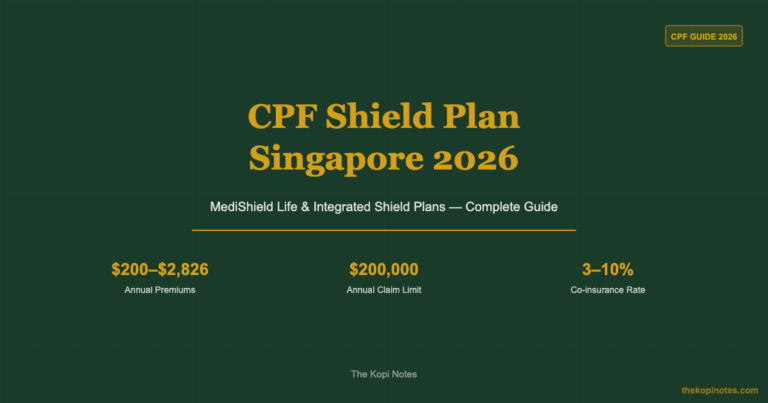
These rates have remained unchanged. The annual claim limit is $200,000 per policy year with no lifetime cap.
Three Real Scenarios: Your Actual Out-of-Pocket Bill
The numbers below use median hospital bill data for a knee replacement procedure across ward classes in Singapore public hospitals, sourced from SmartWealth (citing MOH Bill Amount Information). Knee replacement is used because MOH publishes reliable procedure-specific data. Your actual bill for different procedures will vary — but the relative impact of ward class choice follows the same pattern.
| Scenario | Total Bill (Median) | Deductible You Pay | Co-Insurance You Pay | MediShield Life Pays | Total You Pay |
|---|---|---|---|---|---|
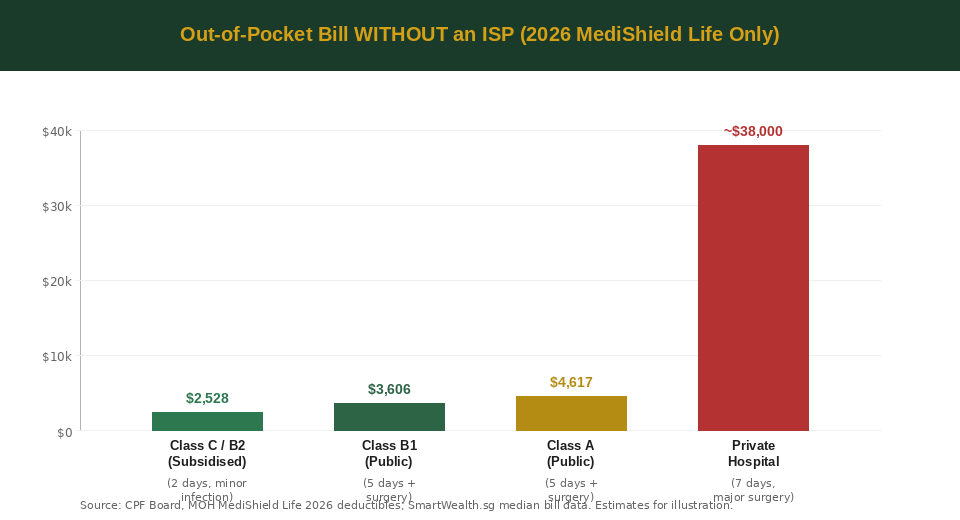
| Class B2 Ward (public) | $7,567 | $2,000 | ~$528 | ~$5,039 | ~$2,528 |
| Class B1 Ward (public) | $24,358 | $2,500 | ~$1,106 | ~$20,752 | ~$3,606 |
| Class A Ward (public) | $25,738 | $3,500 | ~$1,117 | ~$21,121 | ~$4,617 |
| Private Hospital | $48,746 | $3,500 | ~$857 | ~$5,000–$12,000* | ~$36,000–$43,000* |
Source: SmartWealth.sg (citing MOH Bill Amount Information); CPF Board MediShield Life co-insurance rates. *Private hospital figures are estimates — MediShield Life’s daily ward cap of $830/day falls significantly short of private hospital daily rates. Actual out-of-pocket will depend on procedure, hospital, and length of stay.
The first three scenarios reveal a counterintuitive finding: even without an ISP, if you commit to staying in a subsidised ward, your out-of-pocket is bounded. A Class B2 stay with MediShield Life only costs you roughly $2,528 for a knee replacement — significantly less than most people assume. To understand how your hospital bill is split across MediShield Life, ISP, and you, our worked-example guide shows the exact payment flow for each tier.
The Private Hospital Reality Check
The private hospital column in the table above deserves special attention. Without an ISP, a private hospital stay is where your financial exposure becomes severe — not because MediShield Life stops working, but because the gap between MediShield Life’s caps and private hospital charges is enormous.
Here is why. MediShield Life’s daily ward limit is $830 per day for a normal ward. A private hospital in Singapore typically charges between $1,500 and $4,000 per day for an inpatient bed, depending on the hospital and room type. MediShield Life will only pay its cap — the difference is entirely your responsibility.
Additionally, MediShield Life applies a pro-ration factor for higher ward classes, including private hospitals. This means the claimable amount that MediShield Life considers is calculated on a fraction of your total bill — not the full private hospital charge. The remaining fraction is excluded from claims entirely. Combined with the daily cap, the effective MediShield Life payout for a private hospital stay of $48,746 (median knee replacement) can be as low as $5,000–$12,000. You bear the remaining $36,000–$43,000.
This is also why 128,000 Singaporeans who downgraded their Shield Plan in 2025 still maintained their ISP — they downgraded to a lower tier, not cancelled entirely. Cancelling your ISP outright while expecting to use private or Class A care is a high-stakes bet on staying healthy.
What MediShield Life Actually Pays at a Private Hospital (Worked Example)
Consider a 7-day private hospital stay with surgery totalling $50,000:
- MediShield Life ward coverage: $830/day × 7 days = $5,810; plus first-2-day top-up $1,600 = $7,410 total ward
- Surgical procedure claim (approximate): ~$2,000
- Total MediShield Life coverage basis: ~$9,410 (before deductible)
- Your deductible: $3,500
- MediShield Life net payout after deductible and co-insurance: approximately $5,300
- Amount not covered: $50,000 − $9,410 = $40,590 (below MediShield Life’s caps) → you pay this
- Total out-of-pocket: approximately $44,000+
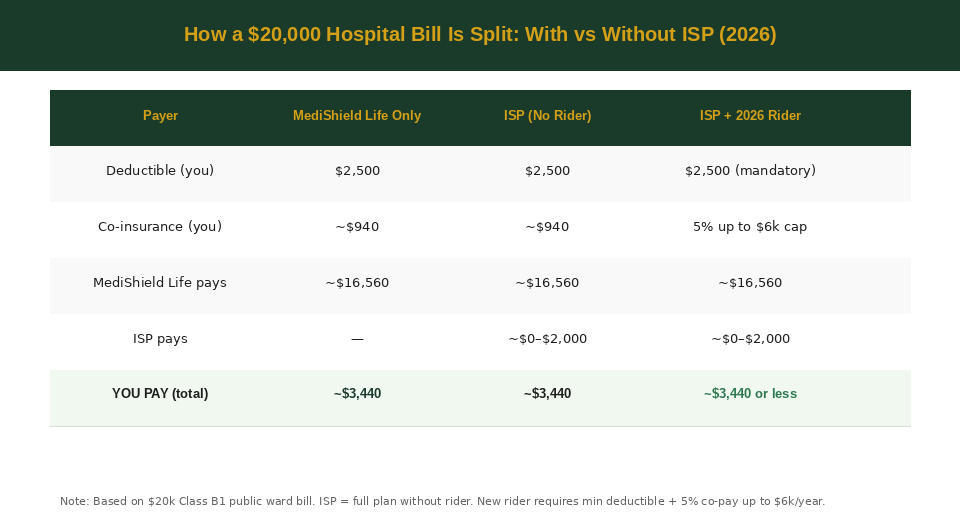
This is not a hypothetical worst case — it is roughly the expected outcome for an unplanned private hospital admission without ISP coverage. An ISP with no rider would cover the lion’s share of this gap. For a detailed look at the ISP co-payment structure in 2026, including the new mandatory deductible and $6,000 co-payment cap, our guide walks through what you’d pay even with full coverage.
Who Can Actually Skip an ISP?
The honest answer is that skipping an ISP works for a narrow profile of Singaporeans. Here are the conditions that must all be true simultaneously:
- You are committed to using subsidised Class B2 or C wards. As the scenarios above show, MediShield Life provides solid coverage in these wards. If you would genuinely accept a four-to-six bedder ward with basic amenities, your out-of-pocket after a major surgery is roughly $2,500–$3,600 — manageable for most working adults.
- You have sufficient savings to cover the deductible and co-insurance. Even for a Class C stay, you need $2,000 in cash or Medisave readily available. For Class B1, budget $3,600. Ensure your Medisave balance is adequate; for inpatient care, Medisave can be used for deductibles and co-insurance.
- You have no strong preference for a specific doctor or specialist. Subsidised ward patients are typically assigned to the hospital’s medical team rather than a named specialist. If continuity of care with a specific consultant matters to you, an ISP (particularly one covering private hospitals or Class A/B1 wards without pro-ration) gives you that flexibility.
- You are younger with lower-risk health conditions. ISP premiums rise sharply with age. For someone in their 20s or early 30s in good health, the annual ISP premium savings ($500–$1,200 per year) can be self-insured through disciplined saving. This equation changes significantly at age 50 and above.
For a comprehensive view of the full coverage comparison, the complete Shield Plan guide compares all five ISP providers side-by-side including premium tables, ward coverage, and claim track records.
When an ISP Still Makes Sense
Despite the reasonable coverage MediShield Life provides for subsidised wards, there are clear situations where an ISP materially improves your financial position:
1. You want access to private or Class A care. Without an ISP, choosing a private hospital or Class A ward exposes you to tens of thousands in uncovered costs. An ISP closes that gap — paying the difference between MediShield Life’s caps and the actual bill up to the ISP’s own limits.
2. You have a family history of complex illnesses. Cardiovascular disease, cancer, and neurosurgical procedures can generate bills in the $100,000+ range. While MediShield Life covers up to $200,000 annually in the subsidised ward, the daily rate caps still leave gaps in complex ICU admissions. An ISP without a rider adds another layer of protection for these tail-risk events.
3. You are approaching 40 or older. ISP premiums increase significantly with each age band. Buying an ISP in your 30s locks you into a lower premium band and avoids the underwriting risk of purchasing at a later age when pre-existing conditions might trigger exclusions or loading. Existing policyholders who stayed enrolled retain full coverage for pre-existing conditions.
4. Children and older parents. Children are often enrolled in ISPs because their hospitalisation risk (accidents, febrile seizures, respiratory illnesses) is disproportionately higher relative to their low premiums. For older parents, Class C is less comfortable and recovery may take longer without adequate rest — making a modest ISP upgrade to B1 a quality-of-life consideration, not just financial.
If you are currently weighing whether to downgrade your ISP rider rather than cancelling the plan entirely, the full hospitalisation claim limits article shows exactly how Medisave withdrawal limits interact with your ISP co-payment obligations.
Frequently Asked Questions
If I have no ISP, does MediShield Life pay for everything in a Class B2 ward?
Not everything, but it covers most of the claimable amount. You pay a deductible of $2,000 first (age ≤80, effective June 2026), then MediShield Life covers approximately 90% of the first $5,000 claimable and progressively more above that. For a $7,567 knee replacement in a B2 ward, you would pay roughly $2,528 out-of-pocket — the deductible plus co-insurance. The remainder is paid by MediShield Life.
What happens to my MediShield Life if I cancel my ISP?
MediShield Life continues automatically — it is a mandatory scheme separate from your ISP. Cancelling your ISP removes only the private insurer’s top-up layer above MediShield Life’s caps. Your base MediShield Life coverage, premiums, and benefits remain fully intact. You cannot opt out of MediShield Life as a Singapore citizen or PR.
Can I use Medisave to pay my deductible without an ISP?
Yes. Medisave can be used to pay the MediShield Life deductible and co-insurance for inpatient hospitalisation and approved day surgeries. This means your out-of-pocket cash impact may be zero if your Medisave balance is sufficient — though you should track your Medisave balance to ensure it can absorb hospital stays without an ISP buffer. Medisave cannot be used for the portion of a bill that exceeds MediShield Life’s coverage limits.
Is going to a private hospital without ISP covered at all by MediShield Life?
MediShield Life does provide some coverage for private hospital stays, but with a significant limitation: its daily ward cap of $830 per day applies regardless of actual charges. Private hospitals typically charge $1,500–$4,000 per day for a standard room, leaving the bulk of the daily room charge uncovered. A pro-ration factor also reduces the claimable basis further. For a $50,000 private hospital bill, MediShield Life might cover $5,000–$12,000, leaving you to pay $38,000–$44,000 out-of-pocket.
How does the 2026 ISP rider change affect people without an ISP?
The April 2026 ISP rider changes directly affect policyholders with ISP riders — riders can no longer fully absorb deductibles, and you must now pay at least 5% co-insurance up to a $6,000 annual cap. For people without an ISP at all, the changes do not directly apply — your MediShield Life deductibles and co-insurance rates are set by CPF Board separately. The rider changes have prompted many to re-evaluate whether a full ISP without a rider remains cost-effective versus MediShield Life alone.
Does the MediShield Life annual $200,000 claim limit reset every year?
Yes. The $200,000 claim limit is per policy year, not lifetime. There is no lifetime cap on MediShield Life claims. If your claimable costs exceed $200,000 in a single policy year — which would require a very prolonged or complex hospitalisation — the excess would be your responsibility or covered by an ISP if you have one. For most Singaporeans with standard hospitalisation events, the $200,000 annual cap is more than sufficient at Class B2 or C ward rates.
Know What You’re Covered For
Understanding your baseline coverage is the first step to making a smart decision about whether an ISP is right for you.
Get Free Insurance Advice
Speak with a licensed insurance advisor. No obligation, no cost.
By submitting this form, you agree to our Privacy Policy.
This article was researched with the help of AI. While we strive to keep all information accurate and up to date, there may be errors. If you notice any discrepancies, please contact us.