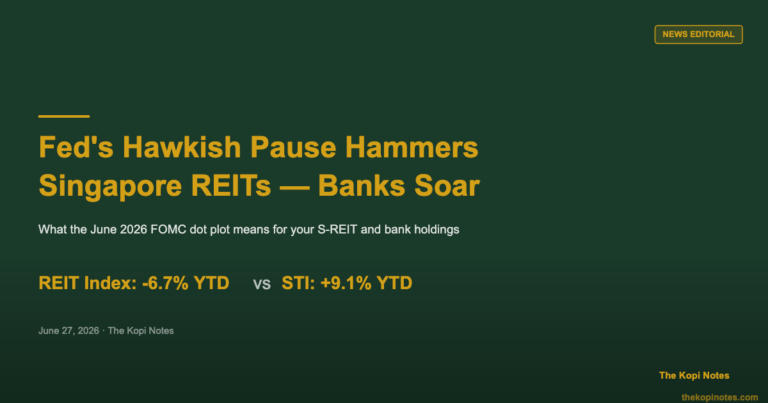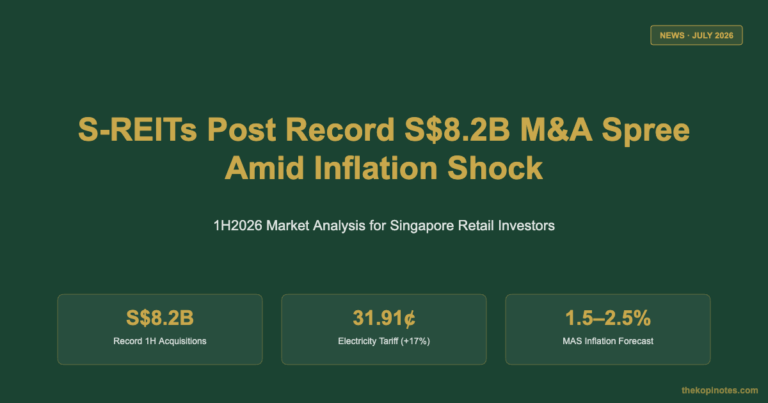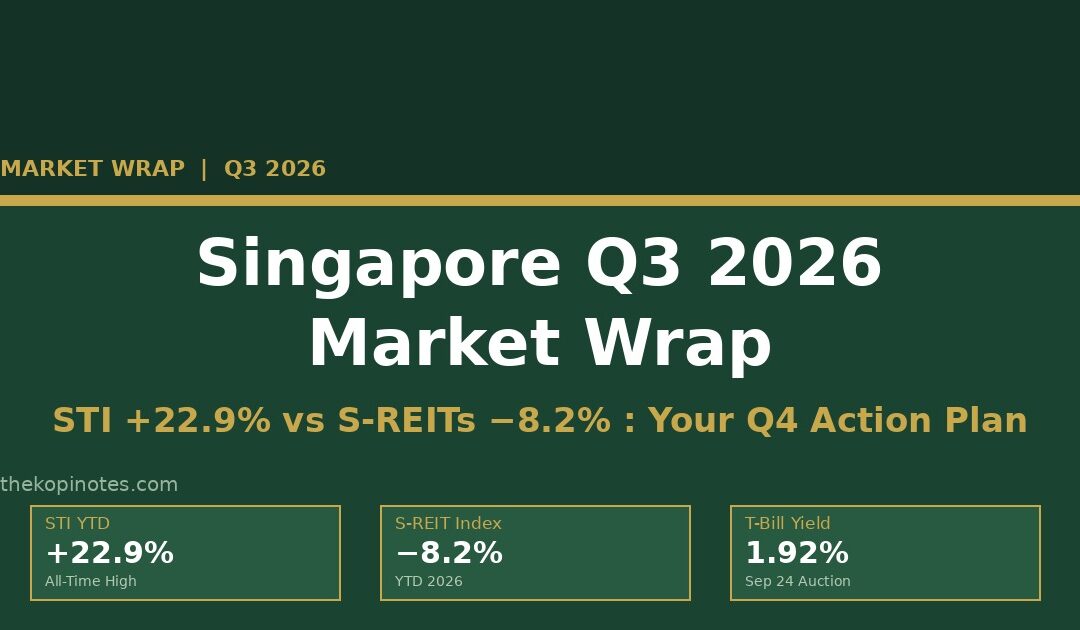
Singapore’s Straits Times Index closed Q3 2026 up 22.9% year-to-date — one of its strongest years on record — yet S-REITs sit 8.2% in the red over the same period. The Federal Reserve’s September rate hike to 3.75–4.00%, surging core inflation at a two-year high of 2.2%, and a rising T-bill yield of 1.92% are reshaping the investment landscape heading into Q4 2026.
This is an editorial analysis. Not financial advice. Data verified as at 30 September 2026.
The STI’s Stellar Q3 Run: What Drove 22.9% YTD Gains
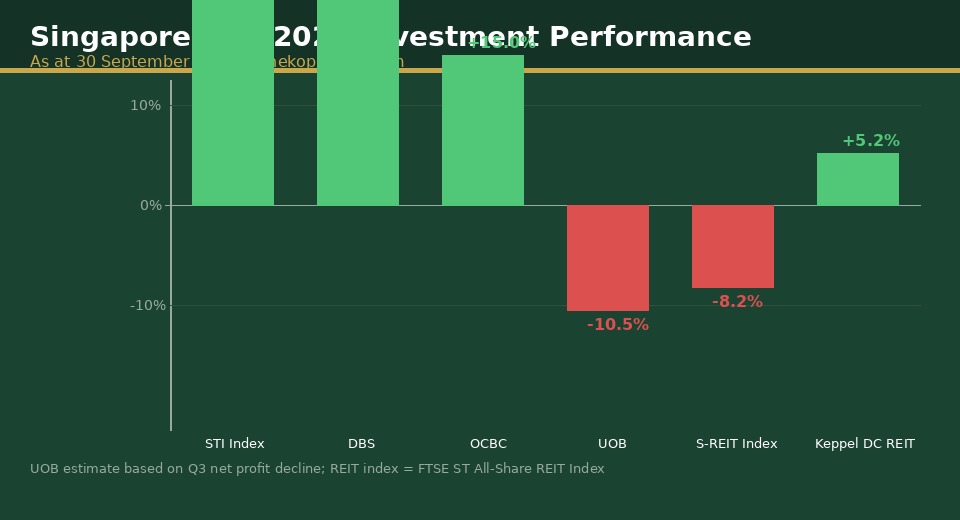
The Straits Times Index reached approximately 5,711 points by late September 2026, representing a remarkable 22.9% year-to-date gain. To put this in context, the STI’s average annual return over the past decade has been roughly 5–7% per year — 2026’s performance is running at triple the historical average.
Three forces drove this rally. First, Singapore’s economy has delivered surprisingly strong growth. GDP expanded 5.9% year-on-year in Q2 2026, well above trend. The Ministry of Trade and Industry subsequently upgraded its full-year 2026 forecast to 4.5–5.5%, citing stronger-than-expected performance in the first half and an accelerating AI-driven capital expenditure cycle that has boosted Singapore’s electronics and semiconductor-adjacent sectors.
Second, the big three banks — which together make up roughly 54% of the STI’s weight — have been significant contributors. DBS is trading near S$55 with a year-to-date return exceeding 25% and a projected dividend yield of around 6%. OCBC has risen approximately 15% year-to-date, driven by a 10.3% increase in non-interest income. UOB is the laggard of the trio; its Q3 net profit fell sharply due to its Greater China commercial real estate exposure, and its share price has underperformed peers significantly.
Third, rising interest rates — while painful for property-linked assets — have temporarily boosted bank net interest margins. Higher rates mean banks earn more on their loan books, even as they begin to compress under the weight of slower credit growth.
| Asset | YTD 2026 Return | Key Driver |
|---|---|---|
| Straits Times Index (STI) | +22.9% | Banks, AI-linked tech, GDP beat |
| DBS Group | ~+25% | Dividend yield, strong NIM |
| OCBC Bank | ~+15% | Non-interest income growth |
| UOB | Negative (laggard) | China RE exposure, Q3 profit drop |
| FTSE ST All-Share REIT Index | −8.2% | Rising rates, cost of debt pressure |
S-REITs: Strong Distributions Can’t Overcome the Rate Headwind
Here’s the 2026 paradox: S-REITs are down 8.2% in share price, yet their underlying distributions have actually grown. This divergence is entirely the story of rising interest rates repricing the sector.
Consider the evidence. Several major REITs posted robust distribution per unit (DPU) growth in their 1H 2026 results:
- Keppel DC REIT: DPU grew 11.3% to 5.714 cents per unit
- Suntec REIT: DPU jumped 24.8% year-on-year to 3.936 cents
- OUE REIT: DPU rose 28.6% to 1.26 cents
- NTT DC REIT: Distributable income beat IPO projections by 10.6%
So why are S-REIT share prices falling even as distributions grow? Because investors are recalibrating the discount rate they apply to future cash flows. When the Singapore 10-year government bond yield climbs — it’s risen roughly 0.53 percentage points over the past year to 2.38% — REIT yields must adjust upward to remain attractive relative to risk-free alternatives. That adjustment happens through share price declines.
The Lion-Philip S-REIT ETF’s forward distribution yield has risen to 5.8%, above its long-term average of 5.1%. The ETF trades at approximately 1.0x price-to-book versus a historical average of 1.16x — meaning S-REITs are now trading at a discount to book value. For patient investors, this is potentially interesting territory, though the rate trajectory needs to stabilise first.
Fixed Income Snapshot: T-Bills at 1.92%, SSB October at 2.32%
For conservative savers and investors, Q3 2026 has quietly delivered some of the best risk-free yields seen in Singapore in years.
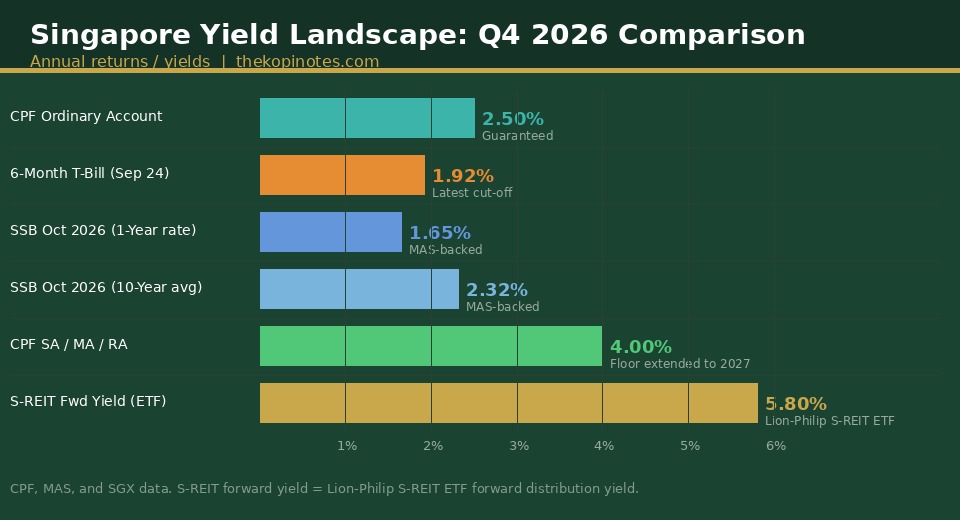
The 6-month T-bill cut-off yield hit 1.92% in the September 24 auction, a 2026 high, with S$15.8 billion in total applications against S$8.4 billion issued. This was a 22-basis-point jump from the September 10 auction (1.70%), driven directly by the Fed’s rate hike. The bid-to-cover ratio was 1.88x, suggesting demand remains healthy even at these levels.
The Singapore Savings Bond (SSB) October 2026 tranche offers a first-year rate of 1.65% and a 10-year average of 2.32% — the highest in 14 months. Unlike T-bills, SSBs carry no price risk (you can redeem at par anytime after the first month) and are backed by the Singapore government.
| Instrument | Current Yield / Rate | Lock-in Period | Min Investment |
|---|---|---|---|
| 6-Month T-Bill (Sep 24) | 1.92% p.a. | 6 months | S$1,000 |
| SSB October 2026 (Year 1) | 1.65% p.a. | Flexible (monthly redemption) | S$500 |
| SSB October 2026 (10-Year avg) | 2.32% p.a. | Up to 10 years | S$500 |
| CPF OA | 2.5% p.a. | CPF rules apply | — |
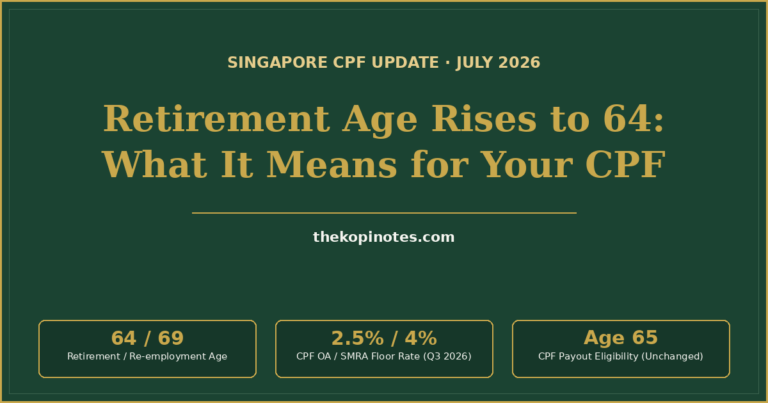
| CPF SA / MA / RA | 4.0% p.a. | Floor until Dec 2027 | — |
On CPF: the government confirmed on 22 September 2026 that the 4% floor on Special, MediSave, and Retirement Account monies is extended to 31 December 2027. This is one of the most predictable guaranteed returns in Singapore — and 4% compounding tax-free for members who have room to top up remains hard to beat.
The Three Forces Shaping Q4 2026
Force 1: Will MAS Tighten in October?
The MAS monetary policy statement is due in October 2026. In the latest MAS survey, 45% of market respondents now expect a third tightening move (another step-up in the S$NEER appreciation slope, likely to ~1.50%). Core inflation at 2.2% — a two-year high — and GDP running above trend are the primary catalysts. Read our full preview: MAS October 2026 Meeting: Third Tightening?
Force 2: Fed Direction
The US Federal Reserve raised rates to 3.75–4.00% on September 16 — its first hike since 2023. Markets are now pricing in the possibility of additional hikes. Higher US rates put upward pressure on Singapore government bond yields, which in turn pressures S-REIT valuations and pushes T-bill yields higher. The Fed’s November and December meetings will be critical signals for Q4.
Force 3: Q3 Corporate Earnings Season
Singapore’s Q3 earnings season kicks off in October. S-REIT managers will begin releasing their Q3 business updates — starting with OUE REIT on October 21. Bank results will follow. UOB’s recovery trajectory after its Q3 net profit decline will be closely watched, as will whether DBS and OCBC can sustain their outperformance. Strong earnings could support the STI’s elevated levels; disappointments could trigger a pullback from near all-time highs.
Your Q4 2026 Action Plan for Singapore Investors
Given the current landscape, here’s how we think retail investors should position across different goals:
For the Risk-Averse Saver: Maximise your CPF SA/RA top-ups for 4% guaranteed (floor locked to December 2027). Apply for SSB October 2026 for the flexible 2.32% 10-year rate. Roll 6-month T-bills for short-term cash parking at 1.92% — these are likely to remain elevated if MAS tightens in October.
For the Dividend Investor: S-REITs at 5.8% forward yield and 1.0x book represent the most attractive valuation since 2022. The case for selective accumulation is building — but wait for signals that the rate cycle is nearing its peak before committing significantly. Data centre REITs (Keppel DC REIT, NTT DC REIT) with their AI-driven growth story offer the best combination of distribution growth and defensive characteristics.
For the Growth Investor: The STI is at all-time highs. Our guide on investing when markets are at record levels applies here. DCA (dollar-cost averaging) into a broad Singapore ETF (like the Lion-OCBC Securities Singapore Low Carbon ETF or the Nikko AM STI ETF) remains sensible. Avoid chasing laggards like UOB without a clear recovery catalyst.
For CPF CPFIS investors: With Singapore equities near all-time highs, consider whether equities or the newly upgraded CPFIS-approved fund options suit your risk profile. The 4% CPF SA floor remains a strong benchmark — any CPFIS investment must credibly beat 4% over time to justify the added risk.
Bottom Line for SG Investors
Q3 2026 has been a tale of two markets. Singapore’s headline economy and large-cap equities — particularly the banks — have delivered outstanding returns, driven by AI-driven growth, strong exports, and rising interest income. Meanwhile, S-REITs have taken the brunt of rate pressure, despite their underlying properties performing well.
Heading into Q4 2026, the key watch points are: the MAS October decision, the Fed’s trajectory, and whether Q3 earnings can justify current valuations. For most retail investors, the practical message is clear: the CPF 4% floor, rising T-bill yields, and improving SSB rates mean risk-free returns are better than they’ve been in years. Build your safe base first, then selectively add risk where the reward compensates — particularly in quality S-REITs that are now trading at a valuation discount.
Frequently Asked Questions
Why is the STI up so much in 2026 while S-REITs are down?
The STI’s gains are driven by bank stocks (DBS, OCBC) and sectors benefiting from Singapore’s strong GDP growth and the AI capital expenditure boom. S-REITs, on the other hand, are inversely sensitive to interest rates — as rates rise, REIT share prices fall even when distributions grow. Higher rates increase REITs’ borrowing costs and make bonds more competitive as income alternatives, compressing REIT valuations.
Is now a good time to buy S-REITs?
S-REITs are at their most attractively valued since 2022, with the sector-wide forward yield at 5.8% and the FTSE ST REIT Index trading at 1.0x book (vs. historical average of 1.16x). However, timing matters — buying before rates peak could mean further price declines. A phased accumulation strategy (e.g., buying in thirds as rate clarity improves) is prudent. Focus on REITs with low gearing and growing distributions, such as data centre REITs.
What is the Singapore T-bill yield as of September 2026?
The latest 6-month T-bill cut-off yield was 1.92% per annum from the September 24, 2026 auction — the highest in 2026. T-bill yields have been rising due to the Fed’s September rate hike to 3.75–4.00% and MAS’s own tightening bias. The next auction will be in early October 2026.
Is the CPF 4% floor still in effect for Q4 2026?
Yes. The Singapore government confirmed on 22 September 2026 that the 4% interest rate floor for CPF Special, MediSave, and Retirement Accounts is extended to 31 December 2027. Ordinary Account interest remains at 2.5% per annum. This makes CPF top-ups (especially via the Retirement Sum Topping-Up Scheme) one of the best risk-free returns available to Singapore residents.
Will MAS tighten again in October 2026?
Market consensus is leaning toward a third tightening in 2026. The September MAS survey showed 45% of respondents expect the MAS to increase the slope of the Singapore dollar’s nominal effective exchange rate (S$NEER) appreciation in October. Core inflation at a two-year high of 2.2% and above-trend GDP of 5.9% in Q2 support the case for further tightening. The outcome will be announced in mid-October 2026.
What should a Singapore retail investor do at the end of Q3 2026?
Prioritise CPF top-ups for the guaranteed 4% (floor confirmed to end-2027). Apply for SSB October 2026 for flexible government-backed savings at 2.32% over 10 years. Continue DCA into diversified ETFs (STI ETF or global ETFs like CSPX/VWRA) rather than trying to time the market. For income investors, begin monitoring S-REIT valuations for selective accumulation opportunities as rate clarity improves in Q4.
This article was researched with the help of AI. While we strive to keep all information accurate and up to date, there may be errors. If you notice any discrepancies, please contact us.