Sabana REIT Is Now Alpha Integrated REIT: 1H2026 Results Show DPU Up 19.4% (SGX: M1GU)
DPU climbs to 2.03 cents as occupancy hits 95% and leverage falls to 34.9% — here’s what changed and what it means for unitholders.
Sabana Industrial REIT is now called Alpha Integrated REIT (SGX: M1GU) after completing its manager internalisation in October 2025. In its first results under the new name, the REIT reported 1H2026 DPU of 2.03 Singapore cents, up 19.4% year-on-year, with occupancy climbing to 95% and leverage falling to 34.9%.
Not financial advice. All figures are for educational reference only. Data as at July/August 2026 unless otherwise noted.
- Sabana REIT rebranded to Alpha Integrated REIT after internalising its manager in October 2025. The ticker M1GU didn’t change — only the name did.
- 1H2026 DPU rose 19.4% year-on-year to 2.03 cents, helped by higher occupancy (95%), positive rental reversions, and a lighter finance cost load.
- Trading near S$0.48-0.50, the REIT yields roughly 8% — one of the higher yields in the S-REIT sector. That’s not automatically a bargain; see the risks section before you buy.
Table of Contents
Contents — Click to expand
- Sabana REIT Is Now Alpha Integrated REIT: What Actually Changed
- 1H2026 Results Breakdown: DPU Jumps 19.4% to 2.03 Cents
- Occupancy Surges to 95%, Positive Rental Reversions
- Balance Sheet: Leverage Down, Interest Coverage Up
- Is Alpha Integrated REIT Worth Buying? Yield and P/NAV
- Risks to Watch
- Frequently Asked Questions
Sabana REIT Is Now Alpha Integrated REIT: What Actually Changed
If you’ve held Sabana Industrial REIT units for a while, you might have opened your brokerage app one day and seen a different name. Nothing was sold. Nothing was delisted. The counter code, M1GU, stayed exactly the same.
What changed is how the REIT is run. On 23 October 2025, Alpha Integrated REIT Management Pte. Ltd. took over as the REIT’s internalised manager, replacing the previous external manager. On 4 November 2025, the REIT itself was renamed from Sabana Industrial REIT to Alpha Integrated REIT.
Internalisation means the people managing your REIT now work for the REIT directly, not for a separate external company that earns a management fee regardless of how the REIT performs. In theory, that aligns management’s incentives more closely with unitholders. In practice, you should judge it the same way you’d judge any manager: by the numbers.
Alpha Integrated REIT owns 18 industrial properties in Singapore, spread across four segments: high-tech industrial, chemical warehouse and logistics, warehouse and logistics, and general industrial. That makes it a pure-play, Singapore-only industrial REIT — smaller and more concentrated than diversified names covered in our guide to mid-cap S-REITs in Singapore.
The official announcement is on SGX’s corporate announcements page, and the REIT now publishes its results and disclosures at ai-reit.com.
1H2026 Results Breakdown: DPU Jumps 19.4% to 2.03 Cents
For the six months from 1 January to 30 June 2026, Alpha Integrated REIT posted gross revenue of S$62.4 million, up 5.2% from S$59.3 million a year earlier. Net property income (NPI) — revenue after property-level operating costs — rose faster, up 10.8% to S$37.2 million.
That gap between revenue growth and NPI growth usually means one thing: costs grew slower than income. Here, tighter cost control at the property level did most of the work.
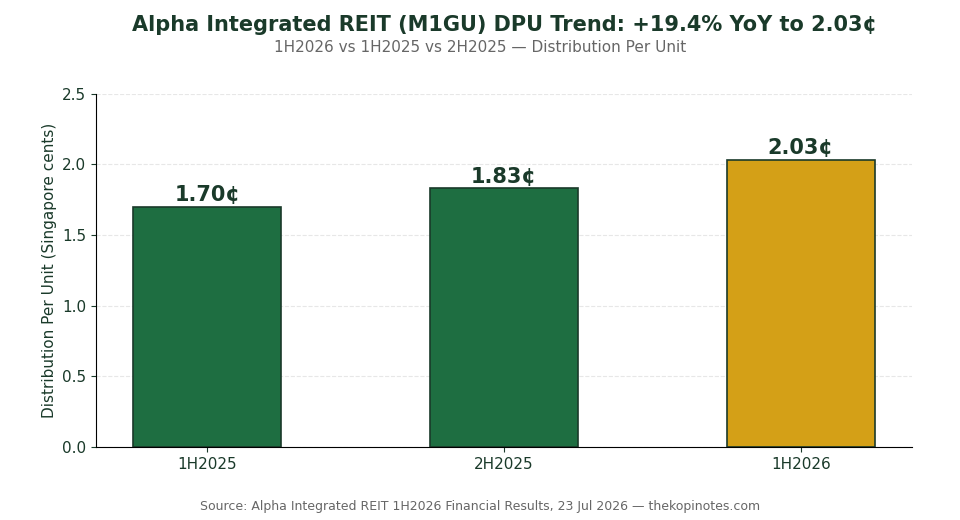
The distribution per unit (DPU) — basically how much cash each unit pays you — came in at 2.03 Singapore cents for 1H2026. That’s up 19.4% from 1.70 cents in 1H2025, and up 10.9% from 1.83 cents in the preceding half (2H2025). Total declared distribution was S$22.8 million, versus S$19.1 million a year ago.
| Metric | 1H2025 | 2H2025 | 1H2026 | YoY |
|---|---|---|---|---|
| Gross Revenue (S$’000) | 59,341 | — | 62,422 | +5.2% |
| Net Property Income (S$’000) | 33,533 | — | 37,157 | +10.8% |
| Total Distribution (S$’000) | 19,126 | — | 22,839 | +19.4% |
| DPU (cents) | 1.70 | 1.83 | 2.03 | +19.4% |
| NAV per Unit (S$) | 0.50 | 0.53 | 0.53 | +6.0% |
Source: Alpha Integrated REIT 1H2026 Financial Results, reported 23 July 2026.
The distribution covers 1 January to 30 June 2026, and is payable on 28 September 2026. For the full data set, see the original 1H2026 results writeup.
Occupancy Surges to 95%, Positive Rental Reversions
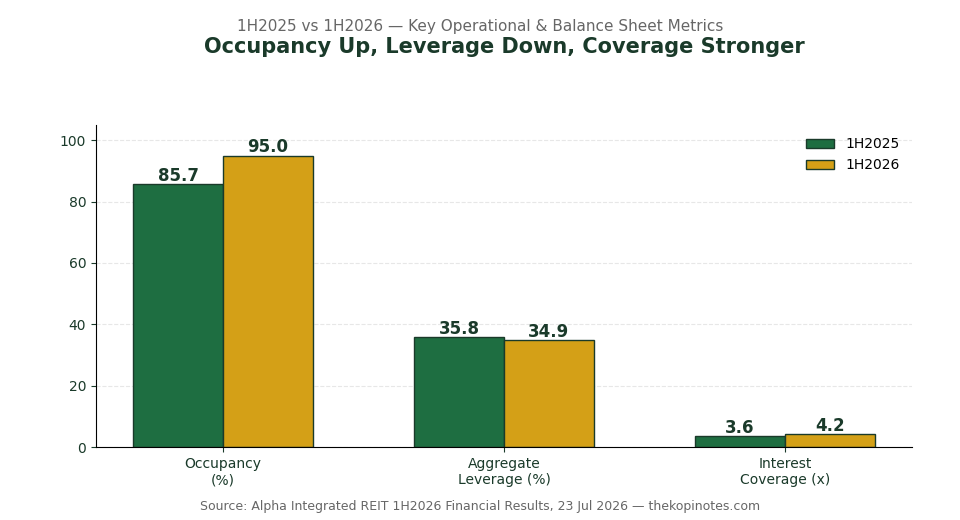
Portfolio committed occupancy jumped to 95.0% in 1H2026, up sharply from 85.7% a year earlier. That’s a meaningful swing for an industrial landlord — every extra percentage point of occupancy flows almost straight through to NPI, since the fixed costs of running the buildings barely change.
Tenant retention held at 92.7%, and rental reversions — the change in rent when a lease renews — averaged +10.9% across the portfolio. In plain terms: when leases came up for renewal, the REIT was mostly able to raise rents, not cut them.
On the leasing front, the REIT secured 62,291 sqm of leases in 1H2026, and had already renewed more than 77% of leases due to expire in FY2026, with early conversations underway for FY2027 renewals. Management is also pushing ahead with Phase 3 Asset Enhancement Initiatives (AEI) at New Tech Park, aimed at unlocking more value from an existing asset rather than buying new ones.
Balance Sheet: Leverage Down, Interest Coverage Up
Aggregate leverage — how much of the portfolio’s value is funded by debt — fell to 34.9%, down from 35.8% a year ago. That’s comfortably below MAS’s 50% regulatory leverage limit for S-REITs, and gives the REIT room to gear up for future acquisitions if it wants to.
Interest coverage ratio (ICR) — how many times over the REIT’s income covers its interest expense — improved to 4.2x, up from 3.6x. A higher ICR means more breathing room if borrowing costs rise. You can run your own numbers on any REIT with our REIT gearing ratio and ICR calculator.
| Metric | 1H2025 | 1H2026 |
|---|---|---|
| Occupancy | 85.7% | 95.0% |
| Tenant Retention | — | 92.7% |
| Rental Reversion (avg) | — | +10.9% |
| Aggregate Leverage | 35.8% | 34.9% |
| Interest Coverage Ratio | 3.6x | 4.2x |
| Avg. Debt Maturity | — | 1.9 years |
Source: Alpha Integrated REIT 1H2026 Financial Results, reported 23 July 2026.
Of its total borrowings, 57.5% are on fixed rates, all portfolio assets are unencumbered (not pledged against any single loan), and debt headroom stands at S$147.6 million. Average debt maturity is 1.9 years, expected to extend to 2.4 years once ongoing refinancing completes — a detail worth watching, since shorter maturities mean more frequent refinancing risk.
Is Alpha Integrated REIT Worth Buying? Yield and P/NAV
Alpha Integrated REIT’s NAV per unit stood at S$0.53 as at end-June 2026. With units trading around S$0.48 to S$0.50, that puts the REIT at roughly 0.91 times NAV — a modest discount to the value of its underlying properties, rather than a premium.
Add up the two most recent half-year distributions — 1.83 cents (2H2025) plus 2.03 cents (1H2026) — and you get a trailing 12-month DPU of about 3.86 cents. At a unit price of roughly S$0.48, that works out to a distribution yield of approximately 8%, broadly in line with the 8.04% yield the REIT itself has cited.
For context, most large-cap S-REITs yield somewhere between 5% and 7%. An 8% yield from a REIT this size usually reflects the market pricing in extra risk — smaller market capitalisation, thinner trading liquidity, and full concentration in one country and one property type. If you’re comparing this against other options, our guide to the best S-REITs in Singapore 2026 ranks REITs across yield, gearing, and stability.
A higher yield isn’t automatically a red flag, and it isn’t automatically a bargain either — it just means you’re being paid more to hold a REIT the market considers riskier. Whether that trade-off suits you depends on how much industrial-sector, single-country concentration you already have elsewhere in your portfolio.
Risks to Watch
Alpha Integrated REIT is a small-cap REIT. Its total distribution of S$22.8 million in 1H2026 is a fraction of what large-cap S-REITs distribute in a single quarter. Smaller REITs tend to see wider price swings and lower trading liquidity, which matters if you ever need to exit a position quickly.
The portfolio is 100% Singapore industrial property. That’s a strength when Singapore’s industrial market is doing well — as it has been, partly on AI-driven semiconductor demand — but it also means there’s no geographic or sector diversification to fall back on if industrial rents soften.
Average debt maturity of 1.9 years is on the shorter side. If refinancing coincides with a period of higher interest rates, financing costs could rise faster than income, squeezing DPU. Management says maturity should extend to 2.4 years post-refinancing — worth checking in the next results release.
Finally, remember this is the REIT’s first results release under new, internalised management. One strong half-year is encouraging, but it’s one data point. Give it two or three more reporting periods before drawing firm conclusions about whether the improved numbers reflect a genuine operational turnaround or a temporary catch-up in occupancy.
Frequently Asked Questions
What happened to Sabana REIT? Is it still listed?
Sabana Industrial REIT is still listed on SGX under the same counter code, M1GU. It was renamed Alpha Integrated REIT on 4 November 2025 after internalising its manager. No units were delisted, merged, or cancelled — only the name and manager changed.
Why did Sabana REIT change its name to Alpha Integrated REIT?
The REIT completed a manager internalisation on 23 October 2025, meaning its management team now works directly for the REIT instead of an external manager. The name change to Alpha Integrated REIT, effective 4 November 2025, reflects this new internally-managed structure.
What is Alpha Integrated REIT's dividend yield in 2026?
Based on trailing 12-month DPU of about 3.86 cents (1H2026 plus 2H2025) and a unit price of roughly S$0.48 to S$0.50, Alpha Integrated REIT yields approximately 8%, which the REIT itself has cited as 8.04% based on its own calculation.
Is Alpha Integrated REIT's DPU growth sustainable?
The 19.4% DPU growth in 1H2026 was driven by a genuine jump in occupancy (from 85.7% to 95.0%) and positive rental reversions, not one-off items. That said, occupancy can’t keep climbing indefinitely once it nears 95-100%, so future DPU growth will likely depend more on rental reversions and cost management than further occupancy gains.
When is Alpha Integrated REIT's next dividend payment?
The 1H2026 distribution of 2.03 cents per unit, covering 1 January to 30 June 2026, is payable on 28 September 2026.
Is Alpha Integrated REIT safe to invest in?
Its 1H2026 balance sheet looks healthier than a year ago, with leverage down to 34.9% and interest coverage up to 4.2x, both comfortably within MAS limits. But it remains a small-cap REIT fully concentrated in Singapore industrial property, which carries more concentration risk than a diversified, large-cap S-REIT. Weigh that against the higher yield before deciding how much to allocate.
How does Alpha Integrated REIT compare to other industrial S-REITs?
At roughly 8% yield, Alpha Integrated REIT yields meaningfully more than larger industrial names like Mapletree Industrial Trust or CapitaLand Ascendas REIT, which typically yield 5-6%. The trade-off is smaller size, lower liquidity, and full Singapore-only concentration versus the geographic diversification larger industrial S-REITs offer.
The Bottom Line
Alpha Integrated REIT’s first results under its new name and internalised management were genuinely strong: DPU up 19.4%, occupancy up nearly 10 percentage points, and a healthier balance sheet all round. The roughly 8% yield reflects real risk — small size, single-country, single-sector concentration — but the fundamentals moved in the right direction this half.
If you’re building a diversified income portfolio around S-REITs, this is one name to track rather than a core holding on its own. For broader income strategies, see our guide to passive income in Singapore, and use our Singapore retirement calculator to see how REIT income fits into your longer-term plan. If you’re looking to fund a brokerage account to buy S-REITs directly, check the Syfe referral code and sign-up bonus for one low-cost way to get started.
This article was researched with the help of AI. While we strive to keep all information accurate and up to date, there may be errors. If you notice any discrepancies, please contact us.