How to Invest in Singapore After a Retrenchment or Job Loss: Government Support, Cutting Costs, and Protecting Your Portfolio (2026)
Your salary and CPF contributions can stop overnight — here’s how to respond without wrecking your long-term plan.
Losing your job means your salary and CPF contributions stop immediately, but that’s not a reason to panic-sell your portfolio. In Singapore, the right response is to freeze new investments (not sell what you already hold), apply for the SkillsFuture Jobseeker Support scheme worth up to SGD 6,000, check whether you’re owed a retrenchment payout, and stretch your emergency fund before touching CPF or SRS.
Not financial advice. All figures are for educational reference only. Data verified as at 8 August 2026.
- The SkillsFuture Jobseeker Support scheme pays up to $6,000 over 6 months if you’re involuntarily unemployed and meet the income and residency criteria.
- Your CPF contributions stop the day your salary does — there’s no automatic “pause” that protects your MediSave or retirement account growth.
- Don’t sell your existing portfolio to cover a few months of bills. Lean on your emergency fund first and pause new contributions instead.
Table of Contents
Contents — Click to expand
- Why Losing Your Job Hits Your Finances Differently Than a Market Dip
- SkillsFuture Jobseeker Support: Up to $6,000 in Government Support
- Do You Get a Retrenchment Payout? MOM’s Rules Explained
- What Happens to Your CPF and MediSave When You Stop Working
- Step 1: Freeze New Investments, Don’t Sell Existing Ones
- Step 2: Cut Your Burn Rate and Stretch Your Runway
- A Worked Example: Surviving 6 Months on a SGD 30,000 Buffer
- Rebuilding: What to Do Once You’re Back on Payroll
- What to Do This Week
- Frequently Asked Questions
Why Losing Your Job Hits Your Finances Differently Than a Market Dip
A market crash is scary, but your investments usually still exist — they’ve just dropped in value. A job loss is different. Your income goes to zero, and two things you probably took for granted disappear with it: your employer’s CPF contribution and the steady cash flow that let you invest every month without thinking about it.
That combination — no income plus no CPF growth — means the financial clock is now ticking in a way it wasn’t before. You’re not just managing a portfolio anymore. You’re managing a runway.
Here’s why so what does this mean for you? The moves that protect you here are almost the opposite of what you’d do during a market crash. In a crash, the advice is usually “stay invested, don’t sell.” After a job loss, the advice is “stay invested, but also urgently shore up your cash position” — both at once.
SkillsFuture Jobseeker Support: Up to $6,000 in Government Support
Before you touch your savings or investments, check if you qualify for the SkillsFuture Jobseeker Support (JS) scheme. It’s a temporary government payout designed exactly for this situation.
The scheme provides up to SGD 6,000 in total support over 6 months, front-loaded so you get more help early — $1,500 in the first month — then tapering down over the following months as you complete job-search activities like career coaching sessions and job applications, tracked through a points system.
To qualify, you generally need to be:
- A Singapore Citizen aged 21 and above, or a Permanent Resident aged 21 and above
- Earning an average of $5,000 or less a month over the past 12 months (excluding employer CPF contributions), and living in a property with an Annual Value of $31,000 or less
- Previously employed in Singapore for at least 6 months in the past 12 months
- Unemployed for an involuntary reason — retrenchment, company closure, or dismissal due to illness, injury, or accident (not resignation)
- Someone who hasn’t received a payout from this scheme in the past 3 years
Apply through WSG (Workforce Singapore) as soon as you’re unemployed — the points-based system rewards early, active job searching, so the sooner you start, the more of the support you can unlock.
Do You Get a Retrenchment Payout? MOM’s Rules Explained
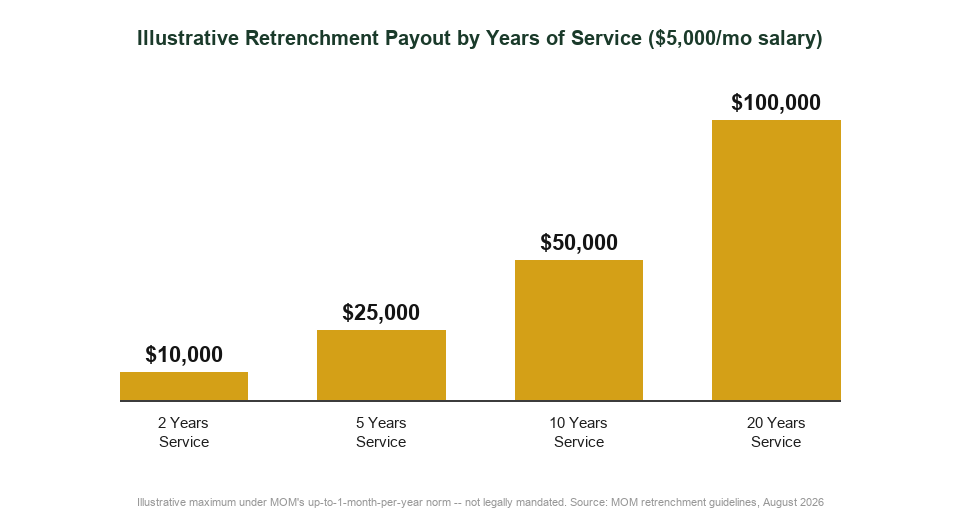
Here’s something a lot of people get wrong: a retrenchment payout is not automatically guaranteed by law in Singapore. It depends on your employment contract, any collective agreement, or what’s negotiated at the point of retrenchment.
The Ministry of Manpower (MOM) sets an advisory norm, not a legal requirement, of 2 weeks to 1 month of salary for each year of service, and this norm generally applies to employees who have completed at least 2 years of service. In unionised companies where a collective agreement specifies the amount, the norm is usually the higher end — 1 month of salary per year of service.
If you have less than 2 years of service, or your contract is silent on retrenchment benefits, you may not be entitled to anything beyond your notice period pay and any accrued leave. Check your employment contract first — don’t assume a payout is coming.
What Happens to Your CPF and MediSave When You Stop Working
Your CPF contributions are tied directly to your salary. No salary means no employee or employer CPF contribution — there’s no automatic top-up or pause-and-resume feature that keeps your Ordinary Account (OA) or Special Account (SA) growing while you’re between jobs. Any interest you already earned stays, and CPF Board’s official Q3 2026 rate notice confirms the OA floor of 2.5% p.a. and SA/MA/RA floor of 4% p.a. remain unchanged through 31 December 2026 — but that’s interest on your existing balance, not new contributions.
MediShield Life premiums, however, don’t stop. They’re deducted automatically from your MediSave Account (MA) each year regardless of your employment status. If your MA balance runs low, family members such as your parents, spouse, or siblings can help pay using their own MediSave. If you genuinely can’t afford it even after government subsidies and family support, Additional Premium Support (APS) exists specifically so nobody loses MediShield Life coverage over an inability to pay.
| While Employed | While Unemployed |
|---|---|
| Employer + employee CPF contributions (up to 37% combined for under-55s) | $0 — no contributions unless you top up voluntarily |
| MediShield Life premiums auto-deducted from MediSave | Still auto-deducted — watch your MA balance |
| OA 2.5% / SA-MA-RA 4% interest floor | Same floor rates, but only on your existing balance |
Source: CPF Board official Q3 2026 interest rate notice; MOH MediShield Life premium payment guidance. August 2026.
Step 1: Freeze New Investments, Don’t Sell Existing Ones
Your first instinct might be to sell your ETFs or stocks for cash. Resist that unless you’ve genuinely run out of other options. Selling investments during a low-income period locks in whatever price the market happens to be at that moment — and if it’s a bad time to sell, you’ve turned a temporary income problem into a permanent investment loss.
Instead, pause new contributions — cancel or reduce your monthly regular savings plan (RSP) for now — and let your existing portfolio sit untouched. Our market crash survival guide covers the same discipline of not selling in a downturn, and it applies here too, just triggered by your income rather than the market.
If you have high-interest debt like credit card balances, prioritise clearing that over any investment decision — credit cards typically charge 26-28% p.a., far more than any realistic investment return. Our debt vs investing guide walks through how to think about that trade-off.
Step 2: Cut Your Burn Rate and Stretch Your Runway
Think of your emergency fund as your “runway” — how many months you can survive before you run out of cash. Two levers stretch that runway: reducing your monthly spending, and adding income from support schemes or freelance work.
Go through your expenses and separate them into “essential” (housing, food, insurance, transport) and “everything else” (subscriptions, dining out, discretionary shopping). Cut the second category hard for now — this isn’t forever, just until you’re re-employed.
The usual “3-6 months of expenses” emergency fund guideline assumes a normal situation. Once you’re actually unemployed, that buffer is being drawn down in real time, so if you can extend toward 6-12 months of essential expenses through a combination of savings, JobSeeker Support, and any retrenchment payout, you’ll have far more breathing room to find the right next role instead of taking the first offer out of desperation.
A Worked Example: Surviving 6 Months on a SGD 30,000 Buffer
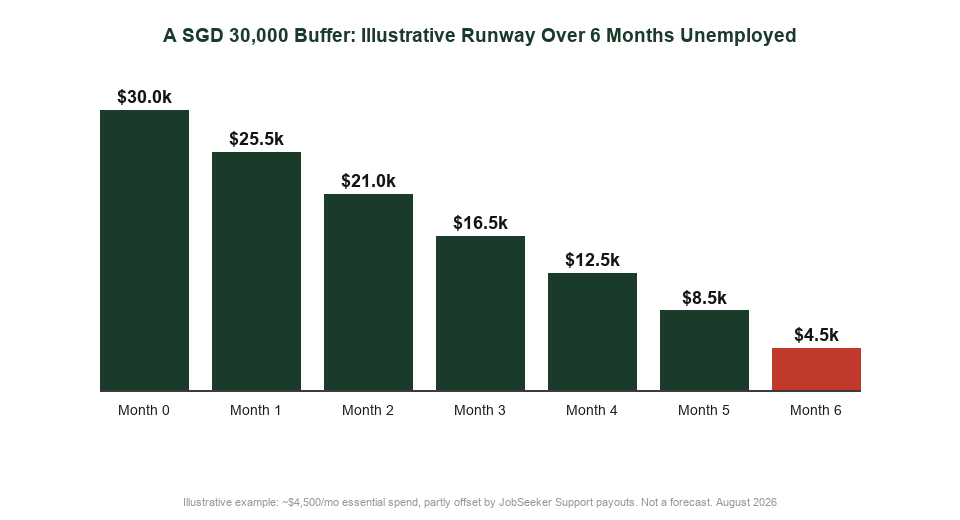
Say you’re retrenched with a $30,000 emergency fund and roughly $4,500 a month in essential expenses. Here’s an illustrative view of how that buffer might hold up, assuming you also receive some SkillsFuture Jobseeker Support along the way.
| Month | Buffer Remaining | Notes |
|---|---|---|
| Month 1 | $25,500 | Highest JobSeeker Support payout partly offsets spend |
| Month 3 | $16,500 | Support payouts taper as points requirements shift |
| Month 6 | $4,500 | Buffer nearly depleted — re-employment becomes urgent |
Illustrative example only, not a forecast. Actual runway depends on your spend, support eligibility, and any retrenchment payout received.
Notice the pattern: even with government support, a six-figure emergency fund can shrink to nearly nothing within half a year. That’s precisely why freezing new investments and cutting discretionary spend early — rather than waiting until month 4 or 5 — makes such a meaningful difference to how much runway you actually have.
Rebuilding: What to Do Once You’re Back on Payroll
Once you land a new role, resist the urge to immediately resume every habit exactly where you left off. Rebuild in order.
First, restore your emergency fund back to at least 3-6 months of expenses before increasing investment contributions. You just learned first-hand how fast a buffer can drain — don’t leave yourself exposed again.
Second, resume your regular investment plan at your prior contribution level, or slightly lower if you’re still catching up on the buffer. Our goal-based investing guide is a useful way to re-anchor your contributions to specific goals rather than just picking a number.
Third, consider a CPF catch-up top-up if you can afford it, since your CPF growth paused during unemployment. Our CPF investment strategy guide explains how RSTU top-ups and CPFIS both work.
Your Singapore retirement planning calculator can help you see how much a few months of paused contributions actually moves your long-term numbers — for most people, it’s a smaller dent than it feels like in the moment, provided you get back on track within a year or so.
What to Do This Week
Step 1: Check your eligibility for SkillsFuture Jobseeker Support and apply through WSG as soon as possible — the points system rewards early action.
Step 2: Review your employment contract to see if you’re owed a retrenchment payout, and confirm the amount and timing with HR in writing.
Step 3: Pause your regular investment plan and any CPF/SRS voluntary top-ups — don’t sell your existing portfolio.
Step 4: Cut discretionary spending hard, watch your MediSave balance for MediShield Life deductions, and aim to stretch your buffer toward 6-12 months of essential expenses.
Not financial advice. Every situation is different — consider speaking with a licensed financial adviser about your specific circumstances. Data verified as at 8 August 2026.
Frequently Asked Questions
How much does SkillsFuture Jobseeker Support actually pay out?
Up to SGD 6,000 in total over 6 months, front-loaded with $1,500 in the first month and tapering afterward. Payouts are tied to completing job-search activities each month, tracked via a points system.
Am I guaranteed a retrenchment payout in Singapore?
No. Retrenchment benefits are not mandated by law — MOM sets an advisory norm of 2 weeks to 1 month of salary per year of service, generally for those with at least 2 years of service, but the actual amount depends on your employment contract or collective agreement.
Do my CPF contributions continue while I'm unemployed?
No. CPF contributions are tied to salary, so both employer and employee contributions stop the moment your income does. Your existing CPF balance still earns interest (OA 2.5%, SA/MA/RA 4% floor through 31 December 2026), just without new contributions being added.
Should I sell my ETFs or stocks to cover living expenses after a job loss?
Generally, no — not unless you’ve exhausted your emergency fund, government support, and other options. Selling locks in whatever price the market happens to be at that moment. Pause new contributions instead of selling existing holdings.
What happens if I can't afford my MediShield Life premiums while unemployed?
Premiums are auto-deducted from your MediSave first. If your balance is insufficient, family members can help pay using their own MediSave, and government premium subsidies plus Additional Premium Support exist so nobody loses coverage due to an inability to pay.
How big an emergency fund should I aim for after losing a job?
The usual guideline of 3-6 months of expenses is a starting point, but once you’re actually unemployed, aim to stretch that toward 6-12 months by cutting discretionary spending and combining it with any government support or retrenchment payout you qualify for.
Ready to Rebuild Your Investment Plan?
When you’re back on payroll, open a brokerage or robo-advisor account through our referral links for sign-up bonuses.
This article was researched with the help of AI. While we strive to keep all information accurate and up to date, there may be errors. If you notice any discrepancies, please contact us.