How to Invest in Singapore at Every Age: A Life-Stage Guide (2026)
What to actually do with your money in your 20s, 30s, 40s, 50s and 60s — with verified 2026 CPF, SRS and platform data.
How you invest in Singapore should change as you age. In your 20s, you take more equity risk with small, regular sums. By your 40s, CPF and SRS tax relief start to matter as much as stock picks. From 55, your Retirement Account and CPF LIFE payouts take over. This guide breaks down what to actually do at each life stage, using verified 2026 CPF, SRS and platform data — and builds on our guide to the best investments in Singapore with a decade-by-decade plan.
Not financial advice. All figures are for educational reference only. Data verified as at 21 July 2026 against CPF Board, MOM, IRAS, Syfe and Endowus official sources unless otherwise stated.
- Your 20s and 30s: take more equity risk and dollar-cost average — time in the market is your biggest edge.
- From 55: your CPF Special and Ordinary Account savings form your Retirement Account, capped at the Full Retirement Sum of $220,400 in 2026.
- Singapore’s statutory retirement age rose to 64 on 1 July 2026 — this also pushed the default SRS penalty-free withdrawal age to 64 for anyone opening an account from that date onward.
Investing in Your 20s: Start Small, Take More Risk
Your 20s is the best decade to take equity risk. You have 30 to 40 years before you need this money, so short-term dips matter far less than they will later. The goal isn’t to pick winning stocks — it’s to start early and stay consistent.
First, build a small emergency fund of 3 to 6 months of expenses. Park it in a Singapore Savings Bond or a T-bill rather than letting it sit idle in a low-interest savings account. Once that’s in place, start investing what’s left every month.
A globally diversified equity portfolio through a robo-advisor like Syfe Equity100 or Endowus Flagship is a reasonable starting point — you don’t need to pick individual stocks to get broad market exposure. If you’re unsure how much risk to take, match your allocation using our risk profile guide for Singapore investors.
Leave your CPF alone at this stage. Your Ordinary Account already earns 2.5% and your Special Account earns up to 4%, both risk-free — that beats most fixed deposits, and you’ll likely need the OA later for a home. SRS usually isn’t urgent in your 20s unless you’re already in a meaningful tax bracket.
Investing in Your 30s: Balancing Growth With Big-Ticket Goals
Your 30s bring bigger financial decisions: a wedding, a BTO or resale flat, maybe children. Each competes with your investing budget, so this decade is about balance rather than maximum growth.
If you’re buying a flat, you’ll likely use CPF Ordinary Account savings for the downpayment and monthly instalments. That’s a reasonable trade-off — just try not to drain your OA to zero, since it’s also part of your future Retirement Account.
This is usually the decade to open a Supplementary Retirement Scheme (SRS) account if your income has crossed into a meaningful tax bracket — say, 7% marginal rate and above. Every dollar contributed, up to $15,300 a year for citizens and PRs, reduces your taxable income directly.
Keep your cash investments diversified and automated. A regular savings plan into a broad equity fund, rebalanced once or twice a year, beats most attempts at market timing. If housing and family costs eat into your budget some months, that’s fine — resume contributions when cash flow allows.
Investing in Your 40s: Peak Earning Years, Peak CPF Contributions
Your 40s are usually your highest-earning years. This is when maximising tax-advantaged accounts starts to matter more than chasing returns.
Max out your SRS contribution if you can. On the full $15,300 annual contribution, someone in the 15% marginal tax bracket saves roughly $2,295 in tax for the year — before any investment growth on top. That’s a return no portfolio can promise you outright.
With CPF’s Ordinary Wage ceiling now $8,000 a month, up from $7,400 in 2025, higher earners are contributing more to CPF than before. Combined with SRS, this is the decade to lean into structured, tax-efficient saving rather than adding more risk to your cash portfolio.
It’s also a good time to start layering in income-generating assets — dividend stocks, S-REITs, or income-focused unit trusts — alongside your growth holdings. You’re still 15 to 20 years from CPF payouts, but building the passive income habit now makes the transition into your 50s and 60s far smoother. Our passive income Singapore guide breaks down how much S-REIT and dividend exposure makes sense at this stage.
Investing in Your 50s and the Run-Up to 55
Turning 55 is a milestone for every CPF member. On your 55th birthday, a new Retirement Account (RA) opens automatically. Your Special Account savings move into it first, followed by your Ordinary Account, up to the current Full Retirement Sum (FRS) — $220,400 in 2026.
You don’t need to hit the FRS. If you fall short, you’ll still receive CPF LIFE payouts from age 65, just at a lower monthly amount. If you want a higher payout, you can voluntarily top up your RA — anyone aged 55 and above can top up to the current Enhanced Retirement Sum (ERS), which is $440,800 in 2026.
On investment mix, start gliding — not jumping — toward lower volatility. Treat your CPF savings as the bond-like portion of your net worth; you can afford to keep a meaningful equity allocation in your cash and SRS portfolios well past 55, since CPF LIFE already provides a guaranteed income floor for life. Use our retirement planning calculator to check whether your current savings rate gets you to your target retirement income.
Investing in Your 60s and Beyond: From Growing Wealth to Living Off It
By your 60s, the job shifts from accumulating wealth to living off it. CPF LIFE payouts typically start from age 65, though you can defer them for roughly a 7% increase in payout for every year you delay, up to age 70.
Outside CPF, this is the decade to lean harder into income-generating assets: dividend-paying S-REITs, income unit trusts, and short-duration instruments like Singapore T-bills for the portion of your portfolio you’ll need in the next 1 to 3 years. Keep some equity exposure — retirement in your 60s can easily last 25 to 30 more years, and inflation will erode a portfolio that’s entirely cash or bonds.
With Singapore’s re-employment age now 69, raised from 68 on 1 July 2026, many Singaporeans are choosing to keep working part-time well into their late 60s. If that’s you, there’s less urgency to draw down your portfolio aggressively — you can afford to keep more growth assets for longer.
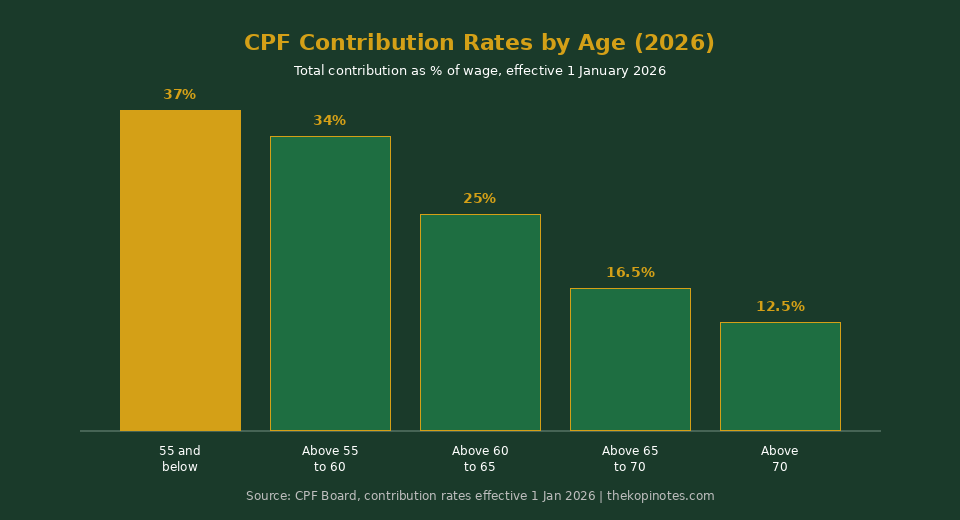
CPF Contribution Rates by Age (2026)
CPF contribution rates step down as you age, reflecting lower income growth needs later in your career. Here’s the current schedule, effective 1 January 2026, for Singapore Citizens and Permanent Residents (from their third year of PR status) earning above $750 a month. For the full breakdown of employer versus employee shares and how the changes affect your take-home pay, see our complete guide to CPF contribution rates and caps.
| Age (years) | Employer | Employee | Total |
|---|---|---|---|
| 55 and below | 17% | 20% | 37% |
| Above 55 to 60 | 16% | 18% | 34% |
| Above 60 to 65 | 12.5% | 12.5% | 25% |
| Above 65 to 70 | 9% | 7.5% | 16.5% |
| Above 70 | 7.5% | 5% | 12.5% |
Source: CPF Board, contribution rates effective 1 January 2026 (Singapore Citizens/PRs, 3rd year PR onward, monthly wage above $750).
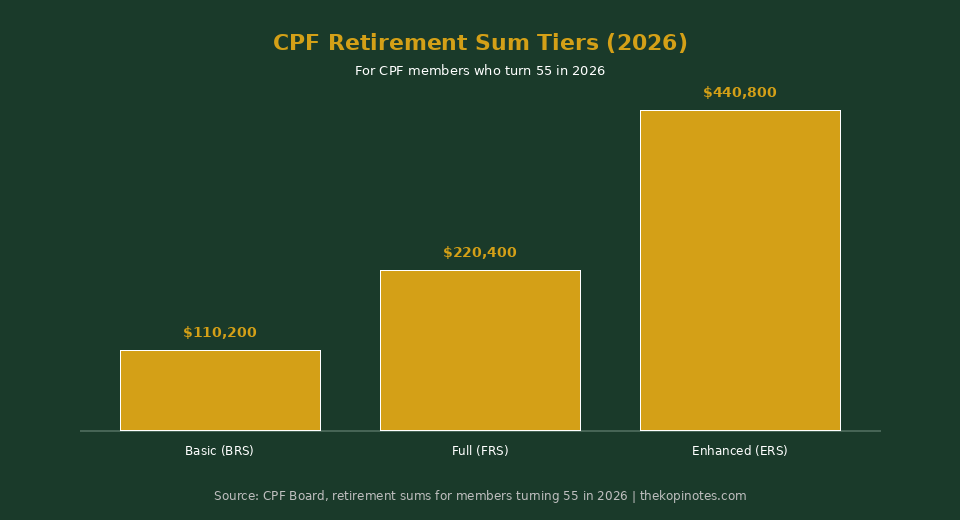
CPF Retirement Sums 2026: BRS, FRS, ERS
The retirement sum isn’t a target you must hit before 55 — it’s a reference point for how CPF LIFE calculates your monthly payout. There are three tiers.
| Tier | Amount (2026) | Est. Monthly Payout from Age 65* |
|---|---|---|
| Basic Retirement Sum (BRS) | $110,200 | ~$950 |
| Full Retirement Sum (FRS) | $220,400 | ~$1,780 |
| Enhanced Retirement Sum (ERS) | $440,800 | ~$3,440 |
*Standard Plan, illustrative only, for members turning 55 in 2026, assuming a 4% CPF interest rate. Source: CPF Board.
The CPF Ordinary Wage ceiling — the portion of your monthly salary subject to CPF contributions — also rose to $8,000 in 2026, up from $7,400 in 2025, as part of a phased increase first announced in Budget 2023.
Choosing a Platform for Your Life Stage
The right investing platform changes as your portfolio grows. Here’s how the numbers stack up in 2026.
Starting out (20s to early 30s, smaller balances): Robo-advisors keep things simple. Syfe’s Equity100 portfolio charges 0.65% a year on balances with no minimum (use code SRPRFFFCD for sign-up perks via our Syfe referral link), while Endowus charges up to 0.60% depending on what you invest in (use code 2V343 via our Endowus referral link). Both fees fall automatically as your balance grows.
Growing balances (30s to 40s): Once you cross $50,000 to $250,000, Syfe’s fee drops to 0.55% then 0.45%; Endowus drops to 0.50% above $200,000. At this stage it’s worth comparing whether a managed portfolio still beats a DIY approach on a broad-market ETF, net of fees.
DIY investors and larger portfolios: Interactive Brokers (IBKR) offers some of the lowest commissions and FX spreads for buying global stocks and ETFs directly — use code jianxiong368 via our IBKR referral link. FSMOne is a strong alternative for unit trusts and regular savings plans with no platform fee on many funds — use code P0544985 via our FSMOne referral link.
| Tier | Syfe Managed Portfolios | Endowus (Flagship/Income/ESG) |
|---|---|---|
| Entry | No minimum — 0.65% | Below $200,000 — up to 0.60% |
| Mid | $50,000+ — 0.55% | $200,000–$1,000,000 — 0.50% |
| Higher | $250,000+ — 0.45% | $1,000,000–$5,000,000 — 0.35% |
| High | $1,000,000+ — 0.35% | — |
| Top | $5,000,000+ — 0.25% | $5,000,000+ — 0.25% |
Source: Syfe official pricing page (as at 1 Jan 2026); Endowus official pricing page (verified 21 Jul 2026). Excludes underlying fund-level fees (TER), charged on top by fund managers.
The 2026 Retirement Age Change and What It Means for You
Singapore’s statutory retirement age rose from 63 to 64 on 1 July 2026, with the re-employment age moving from 68 to 69 at the same time. Both are on a legislated path to 65 and 70 respectively by 2030.
This change has a quieter side effect for investors: your SRS penalty-free withdrawal age is fixed at the statutory retirement age in force on the date of your first SRS contribution. Anyone who opened an SRS account before 30 June 2026 locked in age 63. Anyone opening one from 1 July 2026 onward is now locked in at age 64 instead.
If you’re in your 40s or 50s and haven’t opened an SRS account, this doesn’t change whether you should — the tax relief is still worth roughly your marginal tax rate on every dollar contributed. It just means your money is locked in for one year longer than it would have been for someone who opened an account before July 2026. Nothing about your CPF investment strategy or retirement sum changes because of this.
Ready to Start Investing at Your Life Stage?
Open an account and use these referral codes for sign-up perks on your first qualifying deposit.
Frequently Asked Questions
What's the best way to start investing in Singapore in my 20s?
How much CPF do I need to reach the Full Retirement Sum by 55?
Is it too late to start investing in my 40s or 50s in Singapore?
What happened to the SRS withdrawal age in 2026?
Should I invest my CPF Ordinary Account instead of leaving it at 2.5% interest?
Which robo-advisor is cheapest for a small portfolio in Singapore?
Not financial advice. Figures verified as at 21 July 2026 against CPF Board, MOM, IRAS, Syfe and Endowus official sources and are subject to change — always verify current rates before acting. The Kopi Notes may earn referral fees when you sign up using our codes.
This article was researched with the help of AI. While we strive to keep all information accurate and up to date, there may be errors. If you notice any discrepancies, please contact us.