Australia REIT ETF Singapore: How to Buy VAP & SLF for A-REIT Exposure (2026 Guide)
A complete Singapore investor’s guide to buying Australian REIT ETFs on the ASX — fees, yields, withholding tax and step-by-step broker instructions.
VAP (Vanguard Australian Property Securities Index ETF) and SLF (SPDR S&P/ASX 200 Listed Property ETF) are the two main ASX-listed ETFs giving you direct exposure to Australian REITs, or A-REITs. Singapore investors buy them through brokers with ASX access, such as Tiger Brokers, Interactive Brokers or Saxo. The main appeal: diversification away from S-REITs, quarterly AUD distributions, and a lower expense ratio than most actively managed property funds.
Not financial advice. All figures are for educational reference only. Data as at 31 July 2026 unless otherwise noted.
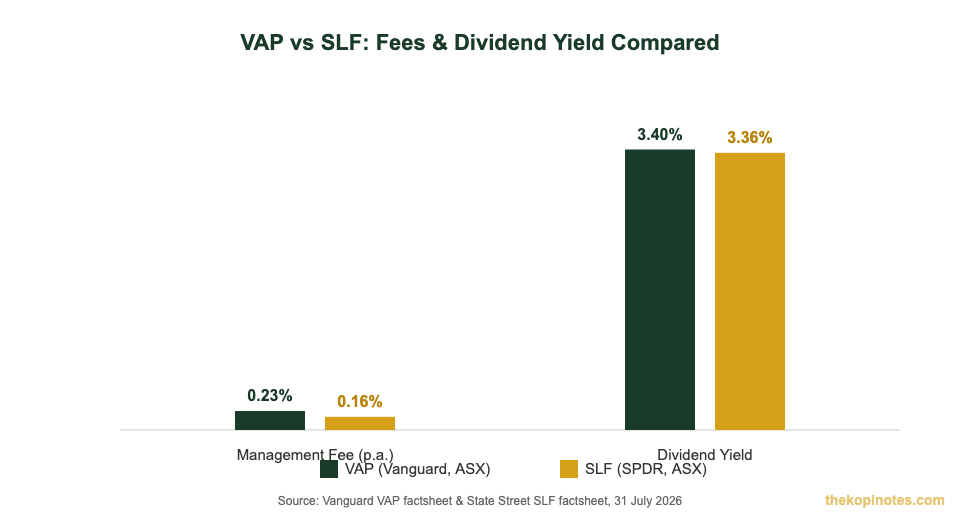
- VAP charges 0.23% p.a. and holds 28 A-REITs; SLF charges 0.16% p.a. and holds 18 — both yield roughly 3.4% before tax.
- Australia typically withholds 15% tax on your distributions under the concessional MIT rate, though some components can be taxed at 30%.
- You need a broker with ASX access. moomoo Singapore doesn’t offer this — Tiger Brokers, IBKR and Saxo do.
Table of Contents
Contents — Click to expand
What Is an Australia REIT ETF?
An Australia REIT ETF, or A-REIT ETF, is a fund that holds a basket of Australian real estate investment trusts listed on the Australian Securities Exchange (ASX). Instead of picking individual A-REITs like Goodman Group or Scentre Group yourself, you buy one ticker and get instant diversification across the sector.
The two main options for Singapore investors are VAP and SLF. VAP tracks the S&P/ASX 300 A-REIT Index and holds 28 property trusts. SLF tracks the narrower S&P/ASX 200 A-REIT Index and holds 18. Both funds pay distributions quarterly and are denominated in Australian dollars (AUD).
Here’s why this matters for you: Singapore’s own S-REIT market is excellent for dividend income, but it’s concentrated in a small handful of sponsors and sectors. A-REITs give you exposure to a different set of property cycles, tenants and currency — mainly industrial, retail and diversified real estate in a resource-driven economy.
VAP vs SLF: Key Facts at a Glance
| Metric | VAP | SLF |
|---|---|---|
| Full Name | Vanguard Australian Property Securities Index ETF | SPDR S&P/ASX 200 Listed Property ETF |
| Ticker (ASX) | VAP | SLF |
| Index Tracked | S&P/ASX 300 A-REIT Index | S&P/ASX 200 A-REIT Index |
| Management Fee | 0.23% p.a. | 0.16% p.a. |
| Number of Holdings | 28 | 18 |
| Dividend Yield | 3.4% | 3.36% |
| ETF Size | AUD 3.02 billion | Smaller, part of SPDR’s ASX suite |
| Inception Date | 11 October 2010 | 15 February 2002 |
| Distribution Frequency | Quarterly | Quarterly |
Source: Vanguard VAP factsheet and State Street SLF factsheet, both dated 31 July 2026.
Both funds are dominated by the same handful of large-cap trusts. Goodman Group, Scentre Group, Charter Hall Group, Stockland, Vicinity Centres, GPT Group, Mirvac and Dexus appear in the top 10 of both funds — SLF is simply a more concentrated version, with Goodman Group alone making up close to 39% of the fund as at July 2026. If you want to avoid single-stock concentration risk, VAP’s broader 28-holding base spreads that exposure more evenly.
Why Singapore Investors Buy Australian REIT ETFs
Here’s the case for adding A-REITs on top of your S-REIT holdings. Singapore’s REIT market is roughly S$100 billion in size and dominated by three or four large sponsor groups. Australia’s listed property sector is larger and covers a different tenant base — logistics warehouses serving Australian e-commerce, shopping centres in a market without GST-exempt online competition, and office towers in Sydney and Melbourne.
You also get AUD currency exposure, which behaves differently from SGD and USD. That’s a genuine diversification benefit if your portfolio is currently all S-REITs and part of your broader passive income Singapore plan built around CSPX or VWRA.
The trade-off is real, though. A-REITs come with a foreign withholding tax drag that S-REITs don’t have, and the AUD has historically been more volatile against SGD than you might expect from a developed-market currency. This isn’t a “better” REIT market than Singapore’s — it’s a different one that can smooth out concentration risk if you already hold a lot of S-REITs.
MIT Withholding Tax: What You Actually Pay
This is the section most guides skip, and it’s the one that actually changes your net return. Australian REITs are structured as Managed Investment Trusts (MITs). When a MIT pays a distribution to a foreign resident in a country that has an information-exchange agreement with Australia — Singapore qualifies — most of that distribution is taxed at a concessional withholding rate of 15%.
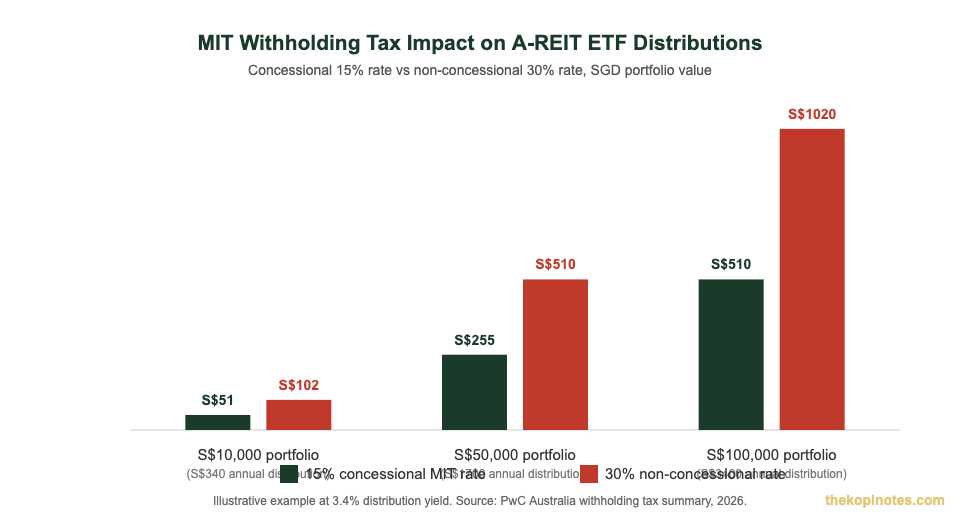
However, not every dollar of your distribution gets the concessional rate. Certain components — income from a trading business, and (since transitional relief ended on 1 July 2026) MIT trading trust and non-infrastructure cross-staple arrangement income — are taxed at the higher 30% rate instead. In practice, most straightforward A-REIT rental income falls under the 15% rate, but you should check the annual distribution statement each fund issues, and refer to the PwC Australia withholding tax summary, since the exact split varies year to year.
Here’s what that looks like in real numbers. Say you hold S$50,000 in VAP, yielding 3.4% before tax. That’s about S$1,700 a year in distributions. At the 15% concessional rate, you’d lose S$255 to Australian withholding tax. If any portion falls under the 30% non-concessional rate instead, that same slice of income loses double the tax. This withholding tax is deducted at source — you don’t need to file anything in Australia to receive it net of tax.
Unlike US-domiciled ETFs, A-REIT ETFs carry no US estate tax exposure, since neither the fund nor its underlying holdings are US assets. That’s one less thing to worry about if you’re already holding CSPX or VWRA and thinking about total estate exposure.
How to Buy VAP or SLF in Singapore
The one thing that trips people up here: not every Singapore broker offers ASX trading. moomoo Singapore, for example, gives you SGX, US and Hong Kong markets, but not the ASX. Here’s what actually works.
Tiger Brokers
Tiger Brokers is the most commonly used platform among Singapore retail investors specifically because it supports ASX alongside SGX, US, Hong Kong and China A-shares. Fund your account in SGD, convert to AUD (or let the platform handle it at execution), search “VAP” or “SLF”, select the ASX listing, and place your order on the ASX during trading hours (Singapore time, roughly 8am to 2pm, with a later close during Australian daylight saving).
Interactive Brokers (IBKR)
IBKR gives you ASX access as part of its broader global market coverage. It tends to work out cheaper for larger, less frequent trades because of its low flat commissions, though its interface has a steeper learning curve than Tiger Brokers.
Saxo Markets
Saxo also offers ASX access and is a reasonable middle ground if you already hold other assets there. Its ASX commissions are typically higher than Tiger’s for small trade sizes, so it suits investors consolidating a bigger portfolio on one platform rather than someone buying a single small VAP position.
Whichever broker you use, you’ll need to hold or convert to AUD, since VAP and SLF trade and distribute in Australian dollars. Factor in the FX spread on every conversion — it eats into a 3.4% yield faster than most people expect.
VAP vs SLF vs Alternatives
If you’re deciding between the two direct ASX options, the choice mostly comes down to concentration versus cost. If you’d rather not choose a single country and want broader Asia-Pacific property diversification instead, our CFA REIT ETF guide and Japan REIT ETF guide cover SGX- and Tokyo-listed alternatives that spread risk across several markets at once.
| ETF | Fee | Market | Holdings | Best For |
|---|---|---|---|---|
| VAP | 0.23% | ASX | 28 A-REITs | Broader, less concentrated A-REIT exposure |
| SLF | 0.16% | ASX | 18 A-REITs | Lower cost, comfortable with Goodman Group concentration |
| CFA (SGX) | ~0.50% | SGX | Asia ex-Japan REITs | SRS/no ASX access, broader Asia diversification |
| S-REITs (direct) | Brokerage only | SGX | Varies | Home-market familiarity, 10% concessionary WHT for eligible investors |
Source: Vanguard, State Street factsheets (31 July 2026); TER for SGX-listed REIT ETFs approximate, verify current figures before investing.
Who Should Buy Australian REIT ETFs?
VAP or SLF make sense if you already hold a concentrated S-REIT portfolio and want geographic diversification, you’re comfortable managing an AUD position and its FX swings, and you have a broker with ASX access set up already for other reasons.
Consider alternatives if you want CPF-eligible property exposure — VAP and SLF are ASX-listed and not CPFIS-approved, unlike some SGX-listed S-REIT ETFs covered in our Singapore REIT ETF guide. They’re also not the simplest starting point if you don’t already have a multi-market broker — in that case, a globally diversified fund bought through a platform like Syfe may be easier to manage. If you’re weighing this against your overall retirement income plan, our Singapore retirement calculator can help you see how a 3.4% distribution yield fits into your broader numbers, and our Tiger Brokers review covers the fees and account setup in more detail if that’s the broker you’re leaning toward.
Frequently Asked Questions
What is an Australia REIT ETF and why would Singapore investors buy one?
An Australia REIT ETF, such as VAP or SLF, holds a basket of ASX-listed real estate investment trusts. Singapore investors buy them for diversification away from a concentrated S-REIT market, gaining exposure to Australian industrial, retail and office property along with AUD currency exposure.
What is the difference between VAP and SLF?
VAP tracks the broader S&P/ASX 300 A-REIT Index with 28 holdings and charges 0.23% a year. SLF tracks the narrower S&P/ASX 200 A-REIT Index with 18 holdings and charges 0.16% a year but is more concentrated, with Goodman Group alone making up close to 39% of the fund as at July 2026.
Can I buy VAP or SLF using my CPF or SRS funds?
No. VAP and SLF are ASX-listed ETFs and are not on the CPFIS list of approved investments. They can potentially be bought through an SRS-linked brokerage account if your broker supports ASX trading within SRS, but you should confirm this directly with your broker before assuming it’s possible.
How much withholding tax do Singapore investors pay on VAP or SLF distributions?
Most A-REIT distributions to Singapore residents are taxed at Australia’s concessional Managed Investment Trust (MIT) withholding rate of 15%. Certain distribution components, such as trading business income, can attract the higher 30% non-concessional rate instead, so check your annual distribution statement for the exact split.
Which broker should Singapore investors use to buy VAP or SLF?
You need a broker with ASX market access. Tiger Brokers, Interactive Brokers and Saxo Markets all support ASX trading from Singapore. moomoo Singapore does not currently offer ASX access, so it isn’t an option for buying VAP or SLF directly.
Are Australian REIT ETFs safe? What are the risks?
VAP and SLF are diversified across dozens of established Australian property trusts, but both funds are concentrated in industrial and retail REITs and carry AUD currency risk against SGD. Interest rate movements in Australia also affect REIT valuations directly, similar to how rate changes affect S-REITs.
Ready to Diversify Beyond S-REITs?
Open a brokerage account with ASX access and add Australian REIT exposure to your portfolio today.
This article was researched with the help of AI. While we strive to keep all information accurate and up to date, there may be errors. If you notice any discrepancies, please contact us.