How to Invest in Singapore as a Foreigner: Complete Guide for EP, SP and DP Holders (2026)
SGX stocks, ETFs, S-REITs, SRS, robo-advisors — what you can access, what you can’t, and how to build wealth while you’re here.
If you’re working in Singapore on an Employment Pass, S Pass, or Dependent’s Pass, you can build a strong investment portfolio here. You get full access to SGX stocks, S-REITs, LSE-listed ETFs, and robo-advisors like Syfe, Endowus, and FSMOne. Your biggest tax-saving advantage: the Supplementary Retirement Scheme (SRS) with an annual cap of $35,700 — more than double what citizens and PRs receive.
Not financial advice. All figures are for educational reference only. Data verified as at 20 September 2026 unless noted.
- You can invest in ETFs, stocks, REITs, and robo-advisors without restriction — Singapore has no capital gains or dividend tax for individuals
- The SRS lets you shelter up to $35,700/year from income tax — a bigger cap than the $15,300 limit for citizens and PRs
- You cannot access CPF or Singapore Savings Bonds (SSBs), but T-bills, fixed deposits, and SGS bonds are available through your bank or broker
Table of Contents
Contents — Click to expand
- The Good News: Singapore Welcomes Foreign Investors
- What You Can (and Cannot) Access as a Foreigner
- The SRS: Your #1 Tax-Saving Tool
- ETFs and Stocks: The Core of Your Portfolio
- Brokerage Accounts in Singapore for Foreigners
- Fixed Deposits and T-Bills: Safe Parking Options
- When You Leave Singapore: Protecting Your Investments
- Your Starter Plan: First $10,000 as a Foreigner
- Frequently Asked Questions
The Good News: Singapore Welcomes Foreign Investors
Singapore imposes no capital gains tax. When your ETF rises in value, you keep all the profits. There’s also no dividend tax for individuals. When your S-REIT pays a distribution, every dollar lands in your account — the Singapore government doesn’t take a cut at your level.
This makes Singapore one of the most investment-friendly environments in the world. As a foreigner on an EP, SP, or DP, you benefit from the same rules as citizens. You’re not taxed differently on investment income. The restrictions that do exist are limited to specific government schemes designed for long-term residents — CPF and Singapore Savings Bonds — not on investment returns themselves.
The Monetary Authority of Singapore (MAS) licenses all the major platforms you’ll use, so the regulatory environment is robust and well-governed. This protects you as an investor. Singapore’s legal system also gives you strong property rights over your investments, which matters when you’re building a portfolio far from home.
What You Can (and Cannot) Access as a Foreigner
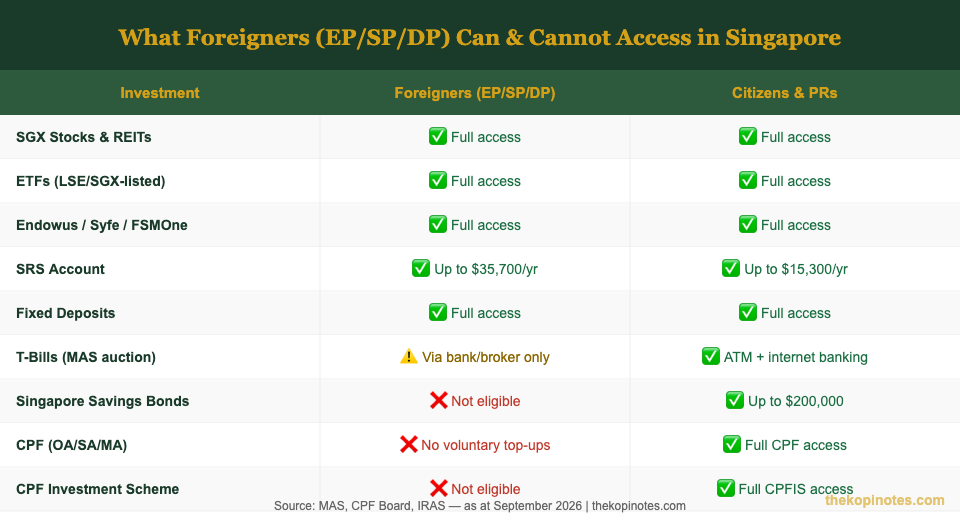
Here’s the honest picture. As a foreigner on a long-term pass, you have access to almost everything except CPF and Singapore Savings Bonds.
The chart below shows what’s available to you versus what’s restricted. Study it carefully before deciding how to structure your portfolio.
Source: MAS, CPF Board, IRAS — as at September 2026
The two main gaps are CPF and SSBs. CPF’s OA currently earns 2.5% guaranteed and the SA earns 4% — these are rates that are hard to beat elsewhere for low-risk returns. Not having CPF access is a genuine disadvantage, but it’s partly offset by the higher SRS cap that foreigners enjoy (more on this in the next section).
T-bills are available to foreigners, but the application channel is slightly different. You’ll need to apply through your bank or a broker rather than the ATM/internet banking routes that citizens and PRs use. The yield is identical — you’re not disadvantaged in terms of returns, just in terms of convenience.
The SRS: Your #1 Tax-Saving Tool
The Supplementary Retirement Scheme (SRS) is a voluntary savings account that lets you reduce your income tax bill today while building a retirement nest egg. It’s available to both foreigners and Singapore citizens and PRs — but foreigners get a significantly higher annual contribution cap.
Here’s how SRS works in practice:
- Open an SRS account with DBS, OCBC, or UOB (takes about 10 minutes online if you’re an existing customer)
- Transfer up to $35,700 from your bank account into the SRS account before December 31
- Claim the full $35,700 as personal income tax relief when you file with IRAS the following year
- Invest the money inside SRS — stocks, ETFs, unit trusts, fixed deposits, or T-bills are all eligible
- At Singapore’s statutory retirement age (64, raised from 63 in July 2026), withdraw with only 50% of each withdrawal taxable, spread over up to 10 years
The tax math is compelling. If you’re in the 22% income tax bracket and you contribute the full $35,700 this year, you save $7,854 in income tax. A citizen or PR contributing $15,300 at the same rate saves only $3,366. That’s a $4,488 annual advantage — just from the higher cap.
| Tax Bracket | Foreigner SRS Saving ($35,700 cap) |
Citizen/PR SRS Saving ($15,300 cap) |
Foreigner Advantage |
|---|---|---|---|
| 24% (income >$1M) | $8,568 | $3,672 | +$4,896 |
| 22% ($160k–$1M) | $7,854 | $3,366 | +$4,488 |
| 18% ($80k–$120k) | $6,426 | $2,754 | +$3,672 |
| 15% ($40k–$80k) | $5,355 | $2,295 | +$3,060 |
Source: IRAS Singapore income tax rates 2026. Tax savings are estimates rounded to the nearest dollar. Consult a tax advisor for your specific circumstances.
What can you invest in inside SRS? Almost everything available in a regular cash account: Singapore stocks, REITs, ETFs listed on SGX, unit trusts, T-bills via your SRS bank, and fixed deposits at your SRS operator bank. Note that foreigners cannot buy Singapore Savings Bonds even inside an SRS account — this product is restricted to citizens and PRs regardless of the account type.
For hands-off SRS investing, Endowus referral code is one of the few robo-advisors in Singapore that accepts SRS funds for professionally managed portfolios. Their Core portfolio invests in low-cost index funds across global equities and bonds — a good starting point if you don’t want to pick your own ETFs inside SRS.
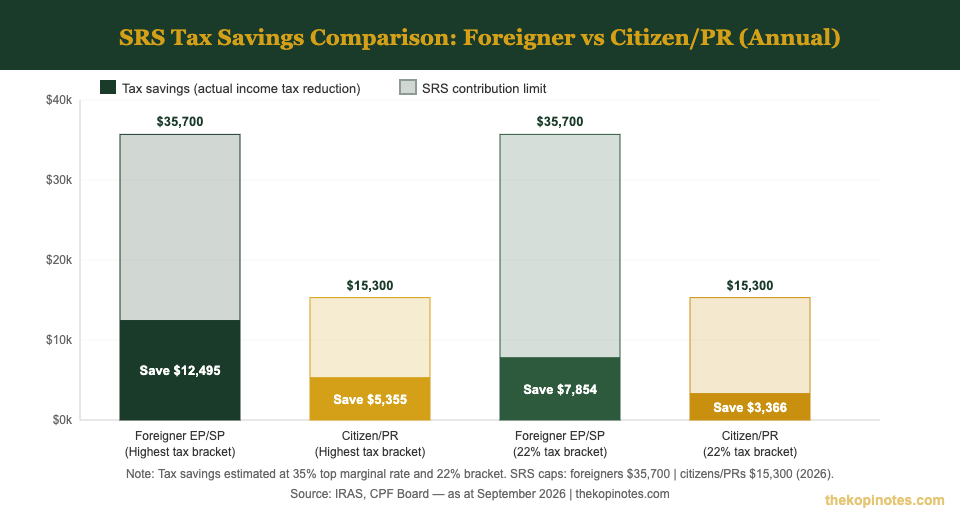
Source: IRAS Singapore income tax rates, CPF Board SRS contribution limits — as at September 2026
ETFs and Stocks: The Core of Your Portfolio
For most foreigners building long-term wealth in Singapore, a low-cost diversified ETF strategy is the most effective core approach. But there’s one critical tax consideration you need to know before you buy: US estate tax.
Avoid US-listed ETFs as your main holding. If your total investment in US-listed securities exceeds USD 60,000, you’re exposed to US estate tax as a non-US person. The US taxes the estates of non-US persons on any US-sited assets above USD 60,000 at rates up to 40%. This applies even to people who’ve never set foot in the US. Your US-listed ETF (like SPY or VOO) counts as a US-sited asset.
The solution: buy Ireland-domiciled UCITS ETFs listed on the London Stock Exchange. These give you the same market exposure with two key advantages:
- No US estate tax exposure, regardless of how large your portfolio grows
- Lower dividend withholding tax: 15% via the Ireland-US tax treaty vs 30% for US-domiciled ETFs
Two ETFs every Singapore investor should know:
- CSPX (iShares Core S&P 500 UCITS ETF, LSE) — tracks the S&P 500, TER 0.07%, accumulating
- VWRA (Vanguard FTSE All-World UCITS ETF, LSE) — tracks ~3,700 stocks globally, TER 0.22%, accumulating
Both are accumulating ETFs — dividends are reinvested automatically rather than paid out. This is efficient for Singapore investors because you avoid the administrative burden of reinvesting dividends yourself, and there’s no immediate tax event from dividend payments.
For S-REIT exposure, you can build a passive income portfolio Singapore through direct REIT purchases on SGX or via a Singapore REIT ETF for instant diversification. Check the Singapore REIT ETF guide for a full breakdown of the best options, and the best S-REITs in Singapore 2026 if you prefer direct REIT holdings.
Brokerage Accounts in Singapore for Foreigners
All major Singapore brokerages accept foreigners on valid long-term passes. Here’s a quick comparison of the main options:
| Broker | Min Commission | LSE ETF Access | Best For |
|---|---|---|---|
| Interactive Brokers (IBKR) | USD 1.00 | ✅ | Cost-conscious, larger portfolios |
| Syfe Brokerage | SGD 2.00 | ✅ | Simplicity, integration with Syfe robo |
| FSMOne | SGD 10.00 | ✅ | Unit trusts + ETFs, T-bill access |
| moomoo Singapore | SGD 0.99 | ✅ | US stocks (keep under USD 60k limit) |
| Saxo Markets | SGD 3.00 | ✅ | Wide global market access |
Source: Broker websites, September 2026. Commission rates subject to change. Always verify current rates on the broker’s official site before opening an account.
For SRS investing, the channel is your SRS operator bank (DBS, OCBC, or UOB). You can invest in SGX stocks and ETFs through the bank’s brokerage arm, or use Endowus (which plugs into your SRS account electronically) for a managed portfolio approach.
For beginners, using the Syfe referral code to open a brokerage account is a smooth starting point. Syfe’s interface is clean and straightforward. For those focused on minimising costs over a longer horizon, IBKR is consistently the most cost-effective for LSE ETF purchases. Use the FSMOne referral code if you also want T-bill subscriptions and unit trust access through the same platform.
Fixed Deposits and T-Bills: Safe Parking Options
For cash you need to keep safe — an emergency fund or funds waiting to be deployed — here are the key short-term options available to foreigners in September 2026:
Fixed deposits are fully accessible. Best rates as at September 2026:
- HL Bank: up to 1.80% p.a. (12-month, minimum $10,000)
- GXS Bank Boost Pocket: 1.75% p.a. (12-month, minimum $100)
- UOB: 1.55% p.a. (12-month, minimum $10,000)
- OCBC: 1.50% p.a. (12-month online, minimum $20,000)
- DBS: lower rates for most standard tenors — not competitive currently
T-bills are available to foreigners, though the application channel differs. You cannot use the ATM or internet banking routes designed for CPF-linked accounts. Instead, apply through your bank (most local banks have a T-bill subscription process for non-CPF customers) or through a broker like FSMOne. The yield is identical regardless of channel:
- 6-month T-bill: 1.70% p.a. (BS26118E auction, September 10, 2026)
- 1-year T-bill: 1.68% p.a. (BY26102T, July 23, 2026)
For more detail on T-bills including the application process and upcoming auction schedule, the MAS T-bills page has current auction calendars. TKN’s guide on Singapore T-bills 2026 covers the step-by-step process in more detail.
SGS Bonds are longer-tenor government bonds (2 to 30 years) available to foreigners via CDP-linked accounts or primary dealer banks. The 10-year SGS bond yield is approximately 2.45% as at September 18, 2026. These make sense if you expect to remain in Singapore for an extended period and want a locked-in yield for a specific horizon.
Singapore Savings Bonds (SSBs): Not for foreigners. The October 2026 SSB offers a Year 1 rate of 1.65% and a 10-year average of 2.32% — attractive numbers, especially with the step-up structure and full capital flexibility. But SSBs are only available to Singapore citizens and PRs. If you become a PR in the future, apply for SSBs immediately — they’re one of the few truly no-risk, flexible options with a decent yield.
When You Leave Singapore: Protecting Your Investments
This is the question every foreigner asks. Here’s what happens to your portfolio if you leave Singapore.
Stocks, REITs, and ETFs: You can leave these in your brokerage account. Most Singapore and international brokerages (IBKR, Saxo, FSMOne) service clients globally. You’ll continue to pay applicable custody or activity fees and can trade as before. There’s no requirement to liquidate your portfolio when your pass expires.
SRS account — the key decision: When you leave Singapore permanently, you face a choice:
- Early withdrawal: 5% penalty plus 100% of the withdrawn amount is taxable as Singapore income in the year of withdrawal. This is painful if your balance is large.
- Leave it invested until retirement age: If you wait until Singapore’s statutory retirement age (currently 64), only 50% of each withdrawal is taxable, and you can spread withdrawals over 10 years. Your SRS money can keep growing tax-deferred in the meantime.
The right answer depends on your tax rate at withdrawal versus today, how long until you reach 64, and what happens to the investments inside SRS in the interim. This is genuinely worth getting professional tax advice on before you decide.
Tax clearance: When you leave Singapore permanently, your employer must notify IRAS and withhold your final salary for tax clearance. IRAS checks that all outstanding taxes are paid before releasing the funds. This applies to your employment income — your investment income from Singapore sources (SGX stocks, ETFs, REITs) is generally not subject to additional tax at departure, since Singapore doesn’t impose capital gains tax.
Use the Singapore retirement calculator to model how your SRS and cash portfolio projects over your expected Singapore tenure — whether that’s 3, 5, or 10+ years.
Your Starter Plan: First $10,000 as a Foreigner in Singapore
If you’re new to investing in Singapore, here’s a practical starting framework based on what most foreigners on EP/SP should prioritise:
Step 1 — Emergency fund (2–3 months of expenses): Keep this in a high-yield savings account or short-term fixed deposit. Don’t invest your emergency fund in ETFs. Market timing is unpredictable and you need this money accessible.
Step 2 — Open an SRS account before December 31: Even a small contribution this year counts. Every dollar reduces your taxable income. If you’re in the 22% bracket and you can spare $10,000, that’s $2,200 in tax savings on your next IRAS filing.
Step 3 — Invest your SRS in a diversified portfolio: The simplest approach is VWRA (global equities) inside your SRS account at the bank, or an Endowus Core portfolio if you prefer hands-off management. Don’t leave SRS money in cash — the deposit interest inside SRS is taxable on withdrawal, while investment gains are not taxed until withdrawal and even then only 50%.
Step 4 — Open a cash brokerage account for the rest: Use IBKR for the lowest costs on LSE ETF purchases, or Syfe Brokerage if you prefer a simpler interface. Buy CSPX or VWRA — not VOO, SPY, or any US-listed ETF — to stay clear of US estate tax exposure.
Step 5 — Automate and hold: Set up a monthly transfer to your brokerage and buy on a regular schedule. Dollar-cost averaging removes the stress of market timing. Review once a year — no need to check daily.
The most important thing is to start. A foreigner who maxes their SRS for just three years and invests in VWRA has meaningfully better outcomes than one who waits until everything is “figured out.” The tax savings compound with the investment returns — start early, even if the amounts feel small.
Disclaimer: The above is a general framework and not financial advice tailored to your personal circumstances. Please consult a licensed financial advisor or tax professional for personalised guidance.
Frequently Asked Questions
Can foreigners invest in Singapore stocks and ETFs?
Can foreigners open an SRS account in Singapore?
Can foreigners buy Singapore Savings Bonds (SSBs)?
Can foreigners apply for Singapore T-bills?
What happens to my SRS account when I leave Singapore?
Are foreigners exposed to US estate tax when investing in Singapore?
Which robo-advisor in Singapore is best for foreigners?
This article was researched with the help of AI. While we strive to keep all information accurate and up to date, there may be errors. If you notice any discrepancies, please contact us.