VWRD vs VWRA: Which Vanguard All-World ETF Should You Buy? (2026)
Same index, same fees, different cash flow — here’s how Singapore investors should choose between Vanguard’s distributing and accumulating FTSE All-World ETFs.
VWRD and VWRA are both Vanguard FTSE All-World UCITS ETFs listed on the London Stock Exchange, tracking the same index with the same 0.14% TER. The only real difference: VWRD pays you quarterly cash dividends, while VWRA reinvests them automatically. For most Singapore investors building long-term wealth, VWRA’s auto-compounding is simpler — but VWRD suits you if you want passive income you can spend or redeploy yourself.
Not financial advice. All figures are for educational reference only. Data as at 30 June 2026 unless noted.
- VWRD and VWRA track the identical FTSE All-World Index, with identical 0.14% p.a. fees — the choice is about cash flow, not cost.
- VWRA (Accumulating) is larger by AUM and better for investors who want to “set and forget” — no manual reinvestment needed.
- VWRD (Distributing) pays cash every quarter — useful if you want visible income, but you’ll need to reinvest it yourself to keep compounding.
Table of Contents
Quick Answer: VWRD vs VWRA
VWRD and VWRA are the same fund in every way that matters — except one. Both are share classes of the Vanguard FTSE All-World UCITS ETF, an Ireland-domiciled, UCITS-compliant fund tracking the FTSE All-World Index. Both hold around 3,757 stocks across developed and emerging markets. Both charge a Total Expense Ratio (TER) of 0.14% per year.
The difference is what happens to dividends. VWRA (Accumulating) reinvests every dividend straight back into the fund, so your unit price grows without you lifting a finger. VWRD (Distributing) pays those dividends out to you in cash every quarter, which you then choose to spend, save, or reinvest yourself.
For a Singapore investor with no capital gains tax and no dividend tax to worry about, the decision comes down to convenience and cash flow — not tax efficiency. If you’re still accumulating wealth and don’t need the cash, VWRA saves you the hassle of manually reinvesting four times a year. If you want a visible income stream from your portfolio — for example, to fund living expenses in early retirement — VWRD delivers that directly.
Key Differences at a Glance
Here’s how the two share classes stack up side by side. Notice that almost every row is identical — that’s expected, since they’re the same underlying fund.
| Feature | VWRD (Distributing) | VWRA (Accumulating) |
|---|---|---|
| Full Name | Vanguard FTSE All-World UCITS ETF (USD) Distributing | Vanguard FTSE All-World UCITS ETF (USD) Accumulating |
| ISIN | IE00B3RBWM25 | IE00BK5BQT80 |
| LSE Ticker (USD) | VWRD | VWRA |
| Index Tracked | FTSE All-World Index | FTSE All-World Index |
| Domicile | Ireland (UCITS) | Ireland (UCITS) |
| TER (Expense Ratio) | 0.14% p.a. | 0.14% p.a. |
| Distribution | Quarterly cash payout | None — auto-reinvested |
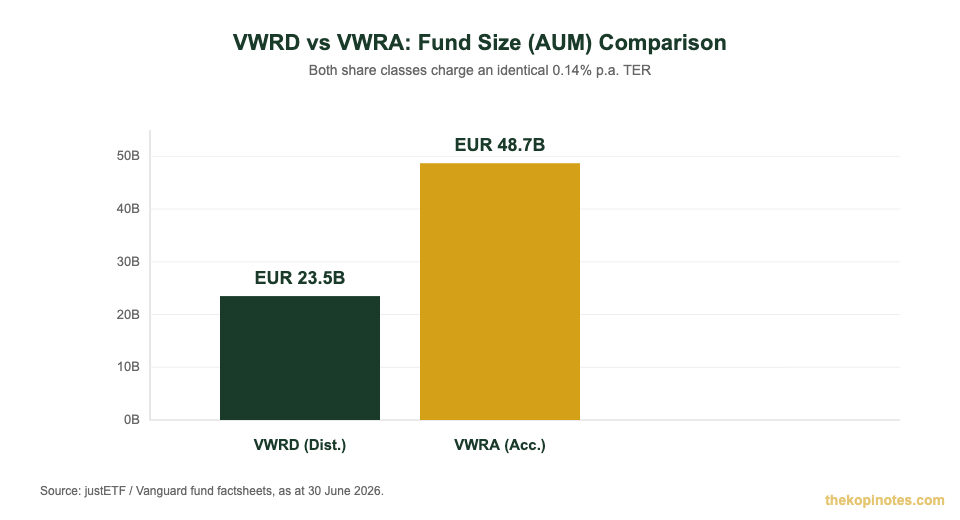
| Fund Size (AUM) | EUR 23.5 billion | EUR 48.7 billion |
| Inception Date | 22 May 2012 | 23 July 2019 |
| Number of Holdings | ~3,757 | ~3,757 |
| Replication | Physical (optimised sampling) | Physical (optimised sampling) |
Source: justETF / Vanguard fund factsheets, data as at 30 June 2026.
Tax and Withholding — Does Acc vs Dist Actually Matter?
Here’s a common misconception worth clearing up. Some investors assume that an accumulating share class is more “tax-efficient” than a distributing one. For a Singapore investor, that’s not quite right.
Withholding Tax (WHT) on US-sourced dividends inside the fund is applied at the fund level, before any distribution decision is made. Because both VWRD and VWRA are domiciled in Ireland, both benefit from the same US-Ireland tax treaty rate of 15% on US dividend income — instead of the 30% rate that applies to US-domiciled ETFs like VT. This 15% haircut happens whether the fund distributes the cash to you or reinvests it. Choosing VWRA over VWRD does not reduce this withholding tax.
The real advantage of Ireland domicile over a US-listed fund is twofold: the lower 15% WHT rate, and the fact that neither VWRD nor VWRA exposes you to US estate tax, which can apply to US-situs assets above USD 60,000 held by non-resident aliens. Singapore has no capital gains tax and no tax on dividends received by individuals, so beyond the WHT question, there’s no additional local tax angle to weigh.
| ETF | Domicile | US Dividend WHT | US Estate Tax Risk |
|---|---|---|---|
| VWRD / VWRA (LSE) | Ireland | 15% | None |
| VT (US-listed equivalent) | USA | 30% | Yes (above USD 60k) |
Source: IRS estate tax rules and US-Ireland double taxation treaty, referenced August 2026.
Performance Comparison
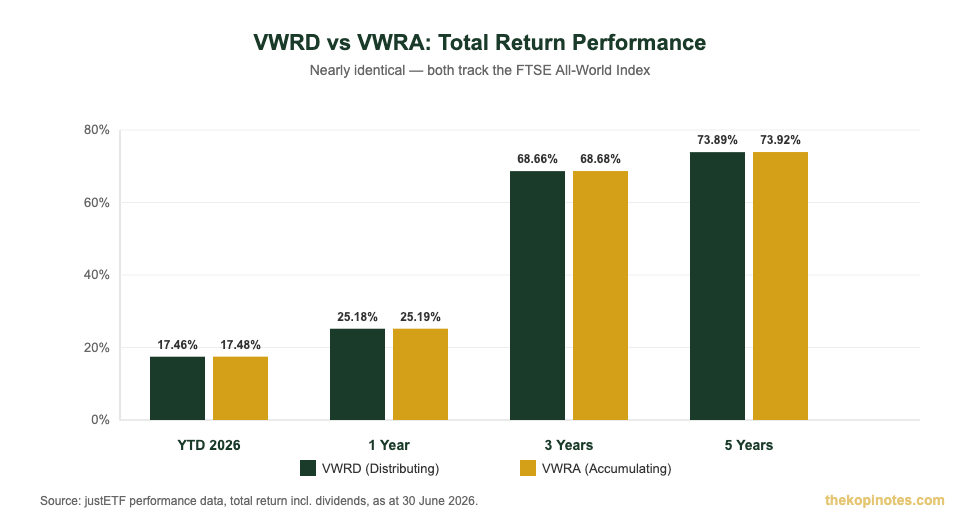
Because VWRD and VWRA track the same index, their total returns — including reinvested or paid dividends — are nearly identical over time. Small gaps show up due to distribution timing drag on VWRD (cash sits briefly before it’s reinvested) and minor tracking differences between share classes.
| Period | VWRD (Distributing) | VWRA (Accumulating) |
|---|---|---|
| YTD 2026 | +17.46% | +17.48% |
| 1 Year | +25.18% | +25.19% |
| 3 Years | +68.66% | +68.68% |
| 5 Years | +73.89% | +73.92% |
Source: justETF performance data, total return including dividends, as at 30 June 2026. Past performance does not indicate future results.
Notice the gap between VWRD and VWRA is fractions of a percent — well within normal tracking variance. Don’t pick a share class based on this tiny historical gap; it reflects distribution mechanics, not stock selection skill.
Total Cost of Ownership
Since both share classes charge an identical 0.14% TER, the cost difference comes down to what you do with your quarterly distributions from VWRD. If you manually reinvest each payout, you may pay brokerage commissions and absorb a bid-ask spread four times a year — a cost VWRA investors simply don’t incur.
For example, if you hold a SGD 50,000 position in VWRD and reinvest each of the four quarterly distributions through a broker charging a flat USD 2 commission per trade, that’s roughly SGD 11 a year in extra reinvestment costs — small, but not zero. VWRA avoids this entirely because reinvestment happens inside the fund at no extra transaction cost to you.
If your broker offers fractional share reinvestment or a dividend reinvestment plan (DRIP) at no cost, this gap narrows to nearly zero. Check your broker’s policy before assuming VWRD carries a meaningful cost penalty.
Who Should Pick Which?
VWRA (Accumulating) is ideal if: you’re in the wealth-building phase and want a true “buy and forget” ETF. You don’t need cash income from this portfolio right now. You want the largest, most liquid share class — VWRA’s EUR 48.7 billion AUM makes it more than twice the size of VWRD. You’d rather not deal with quarterly reinvestment decisions or idle cash sitting in your brokerage account.
VWRD (Distributing) is ideal if: you want visible passive income — useful if you’re semi-retired or retired and rely on your portfolio for spending money. You prefer to control where your dividends go each quarter, rather than have them automatically reinvested. You’re combining this ETF with a broader Singapore REIT ETF income strategy and want all your holdings paying out on a predictable schedule.
Neither VWRD nor VWRA is approved under the CPF Investment Scheme (CPFIS) or generally available for SRS investment, since both schemes are largely restricted to SGX-listed instruments and specific approved funds. If you want to use your Singapore retirement calculator projections and CPF/SRS-eligible ETFs, you’ll want to look at SGX-listed alternatives separately — LSE-listed ETFs like VWRD and VWRA are for cash brokerage accounts only.
If you’re weighing US-listed exposure too, our CSPX guide and VWRA dividend guide cover the S&P 500-only alternative and the accumulating share class in more depth respectively. For developed-markets-only exposure, see our IWDA guide.
Frequently Asked Questions
What is the main difference between VWRD and VWRA?
VWRD pays out dividends to you in cash every quarter, while VWRA automatically reinvests dividends back into the fund. Both track the same FTSE All-World Index and charge the same 0.14% TER — the only difference is how income is handled.
Which has lower fees — VWRD or VWRA?
Neither. Both share classes charge an identical Total Expense Ratio of 0.14% per year, as at the June 2026 Vanguard factsheet. Fees are not a factor in choosing between them.
For Singapore investors, is VWRA more tax-efficient than VWRD?
Not really. Singapore does not tax capital gains or dividends for individuals, and the 15% US withholding tax on underlying dividends applies equally to both share classes at the fund level, regardless of whether the cash is distributed or reinvested. The choice is about cash flow convenience, not tax savings.
Can I switch from VWRD to VWRA without triggering tax?
Switching means selling one ETF and buying the other, which is a taxable disposal in some jurisdictions — though Singapore does not tax capital gains for individual investors. You would, however, pay brokerage commissions and a bid-ask spread on both the sale and the new purchase, so factor in these transaction costs before switching.
Which is better for a long-term retirement portfolio?
During your accumulation years, VWRA is usually simpler because it reinvests automatically without any action from you. Closer to or during retirement, VWRD’s quarterly cash distributions can double as a source of spending income, which some investors find more practical than manually selling units.
Can I buy VWRD or VWRA using CPF or SRS funds?
No. Neither VWRD nor VWRA is approved under the CPF Investment Scheme, and they are not generally available through SRS-linked brokerage accounts, since both schemes are largely restricted to SGX-listed instruments. You would need a standard cash brokerage account that provides access to the London Stock Exchange.
Ready to Start Investing in Global ETFs?
Open a brokerage account and buy your first global ETF today. Use our referral links for exclusive sign-up bonuses.
This article was researched with the help of AI. While we strive to keep all information accurate and up to date, there may be errors. If you notice any discrepancies, please contact us.