How to Invest in Singapore When You’re Leaving for Good: CPF, SRS and Tax Clearance If You Emigrate (2026)
Renouncing your citizenship or PR unlocks your full CPF at any age — but your SRS savings and tax clearance follow a different, stricter set of rules.
If you renounce your Singapore Citizenship or PR and leave permanently, you can withdraw your full CPF savings at any age — something you can’t do while still a citizen or PR under 55. But your SRS account doesn’t unlock the same way: early withdrawal still means a 5% penalty and 100% taxable amount unless you meet a strict 10-year non-residency test. Your employer also owes IRAS a tax clearance filing before your final pay is released.
Not financial advice. All figures are for educational reference only. Data verified as at 11 August 2026.
- Renouncing your Singapore Citizenship or PR and leaving permanently lets you withdraw your full CPF savings at any age — you don’t need to wait until 55.
- Renouncing citizenship does NOT automatically unlock cheap SRS withdrawal. Without meeting a 10-year non-residency test, you still face a 5% penalty and 100% taxable withdrawal.
- If you’re a PR or foreign employee, your employer must file IRAS Form IR21 and withhold your final pay before you can leave. Singapore Citizens are not subject to IR21.
Table of Contents
Contents — Click to expand
- Why Emigrating Changes the Rules for Your CPF, SRS and Investments
- How to Withdraw Your CPF in Full When Leaving Singapore Permanently
- The SRS Withdrawal Trap: Why Renouncing Doesn’t Unlock Cheap Withdrawals
- Tax Clearance (Form IR21): What Your Employer Must Do Before You Leave
- What Happens to Your CPFIS and Brokerage Investments
- A Worked Example: Withdrawing $300,000 CPF and $100,000 SRS
- What to Sort Out Before You Emigrate: A Checklist
- Frequently Asked Questions
Why Emigrating Changes the Rules for Your CPF, SRS and Investments
Every other article in this series has been about building up your CPF, SRS and brokerage accounts. This one is about winding them down — because if you’re emigrating for good, the standard rules for these accounts no longer apply to you in the way they apply to someone staying in Singapore.
Here’s the part that surprises people: leaving Singapore permanently unlocks your CPF savings faster than turning 55 does. But it does the opposite for your SRS account, where early withdrawal is still expensive unless you clear a specific 10-year test. And if you’re a Permanent Resident (PR) or foreign employee, your employer has its own legal duty to IRAS before your final paycheque can be released.
Getting the order of operations wrong here is costly. Withdraw your SRS too early and you could hand over a chunk of it in penalties and tax you didn’t need to pay. Miss the CPF renunciation paperwork and your funds sit idle, earning less, for months longer than necessary. This guide walks through each account, in the order you’ll actually deal with them.
How to Withdraw Your CPF in Full When Leaving Singapore Permanently
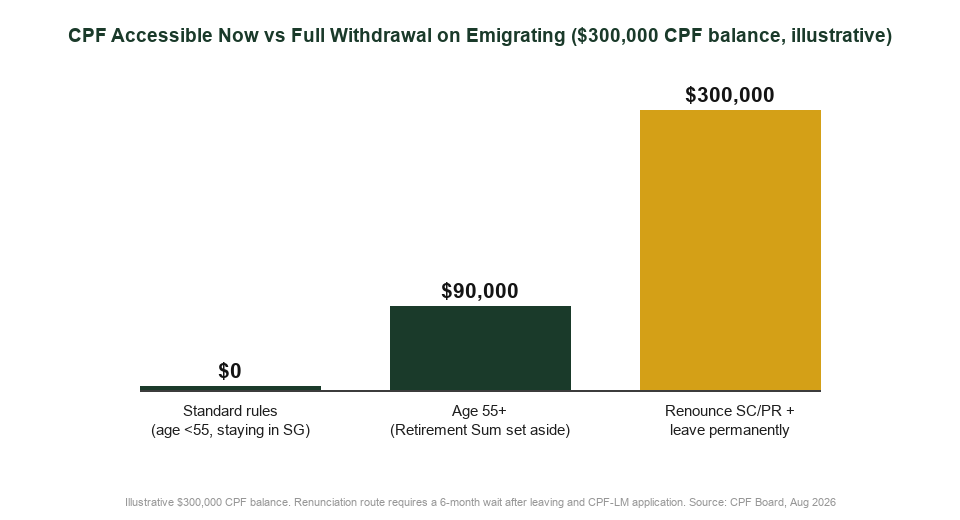
Normally, you can’t touch most of your CPF savings until age 55, and even then a chunk gets set aside in your Retirement Account to fund CPF LIFE payouts from age 65. That changes completely if you’re leaving Singapore and West Malaysia permanently.
CPF Board allows members who are leaving for good — with no intention of returning for employment or residence — to withdraw their entire CPF balance, at any age, once they’ve renounced (or are in the process of renouncing) their Singapore Citizenship or PR status. This is a materially different pathway from the standard age-55 withdrawal that applies if you’re staying in Singapore.
| Situation | What You Can Withdraw |
|---|---|
| Staying in Singapore, under 55 | Generally none, except for specific approved uses (housing, CPFIS, insurance) |
| Staying in Singapore, 55 and above | Amount above your Retirement Sum, which stays locked in for CPF LIFE payouts from 65 |
| Renouncing SC/PR, leaving permanently | Full CPF balance, at any age |
Source: CPF Board, “Closing your account when you leave Singapore,” fetched August 2026
The process runs through a specific form: “Application to Withdraw CPF on Ground of Leaving Singapore and West Malaysia Permanently” (Form CPF-LM). It needs to be witnessed and stamped by an officer at a Singapore Overseas Mission, along with certified copies of your proof of renunciation and your overseas address.
Two timing details matter. First, you can only apply for full withdrawal 6 months after you’ve actually left Singapore — CPF Board uses this as a waiting period to confirm you genuinely don’t intend to return. Second, processing isn’t instant: CPF Board’s own website notes an average processing duration of about 18 weeks to close an account and disburse funds as at August 2026, citing a recent surge in applications (older guides cite a shorter ~12-week average, so build in extra buffer when planning your finances around this).
If you don’t formally close your account yourself, CPF Board will automatically close it the month after your citizenship or PR renunciation is finalised. As a transitional concession, uncollected savings will keep earning interest similar to commercial bank rates until 31 March 2027, rather than stopping immediately.
The SRS Withdrawal Trap: Why Renouncing Doesn’t Unlock Cheap Withdrawals
Here’s the mistake many emigrating Singaporeans make: assuming that because renouncing citizenship unlocks their full CPF, it must do the same for their Supplementary Retirement Scheme (SRS) account. It doesn’t — and getting this wrong is expensive.
SRS withdrawals made before your prescribed retirement age (locked in based on the year of your first SRS contribution) are, by default, fully taxable and carry a 5% penalty on top — regardless of why you’re withdrawing. Emigrating and renouncing citizenship, by itself, does not exempt you from this.
There is a genuine concession, but it’s narrower than most people assume. You may withdraw without the 5% penalty and with only 50% of the amount taxable, if: you are neither a Singapore Citizen nor a PR on the date of withdrawal, and you have been neither for a continuous period of 10 years before that date, and your SRS account has been open for at least 10 years from your first contribution. All three conditions need to be met.
In practice, that means if you renounce citizenship and withdraw your SRS shortly after leaving, you get none of this relief — you’re still in “early withdrawal” territory: 100% taxable, 5% penalty. The concession is really built for long-term foreign SRS holders who’ve already spent a decade outside Singapore, not for a citizen who just renounced and wants to cash out quickly.
At the point of withdrawal, the SRS operator (your bank) withholds tax at the prevailing non-resident rate of 24%. This withheld amount is a credit against your actual final tax liability, not necessarily the final bill itself — any excess is refunded once IRAS assesses your actual liability, and any shortfall becomes payable.
Tax Clearance (Form IR21): What Your Employer Must Do Before You Leave
If you’re still employed when you emigrate, there’s a step that isn’t up to you at all — it’s your employer’s legal obligation. This is Form IR21, IRAS’s tax clearance process.
IR21 applies when a non-Singapore Citizen employee — meaning a PR or a foreign employee — ceases employment, goes on overseas posting, or plans to leave Singapore for more than three months. Your employer must file the form with IRAS at least one month before you leave and, critically, must withhold all monies due to you (salary, bonuses, leave pay, allowances, any lump sum) from the point they’re notified of your departure. That money can’t be released until IRAS issues a clearance directive. Employers who file late risk a fine of up to $5,000.
If you’re a Singapore Citizen emigrating and renouncing your citizenship, IR21 does not apply to you in the same way — the tax clearance regime is specifically for foreign and PR employees. As a citizen, you’d typically continue filing your income tax the normal way for your final year of Singapore-sourced income, via your usual Notice of Assessment process, rather than through employer-withheld clearance.
Practically, this means the sequencing differs by status. If you’re a PR quitting your job to emigrate, tell your employer as early as possible — the one-month IR21 notice period is a minimum, and your final pay is frozen until clearance comes through, which can take several weeks. If you’re a citizen, this isn’t a blocker for your final paycheque, but you should still square away your last year of tax filing before or shortly after you leave.
What Happens to Your CPFIS and Brokerage Investments
Withdrawing your CPF in full also means unwinding anything you hold through the CPF Investment Scheme (CPFIS). Unit trusts, ETFs, or stocks bought with CPF Ordinary Account or Special Account money above the $20,000 and $40,000 set-aside thresholds need to be liquidated or transferred before your CPF account can be closed and the cash disbursed — CPF Board cannot simply “hand over” fund units sitting inside CPFIS.
Outside CPF, your regular brokerage and SRS-linked investments (ETFs, S-REITs, stocks bought through Interactive Brokers, Syfe, Endowus, FSMOne, and similar platforms) are a separate matter entirely from CPF and don’t require the same renunciation process to access. However, many Singapore brokers require a local address and residency status for account maintenance, so check each platform’s terms before you move: some allow you to keep the account open under a foreign address, while others may require you to close it or transfer holdings to an international broker that serves your new country of residence.
If you hold US-listed shares or ETFs, moving countries can also change your tax exposure — our US stocks tax guide for Singapore investors covers the 30% dividend withholding tax and US estate tax threshold that may look different once you’re no longer filing as a Singapore tax resident.
A Worked Example: Withdrawing $300,000 CPF and $100,000 SRS
Take a 40-year-old Singapore Citizen with $300,000 across their CPF Ordinary and Special Accounts, plus $100,000 in an SRS account, who renounces citizenship and emigrates permanently.
CPF: Because they’re leaving Singapore and West Malaysia permanently and have renounced citizenship, they can apply to withdraw the full $300,000 — not just the amount above their Retirement Sum, which is all they’d get at age 55 if they stayed. This is roughly $210,000 more accessible than the standard age-55 pathway would allow at this balance level, illustratively speaking.
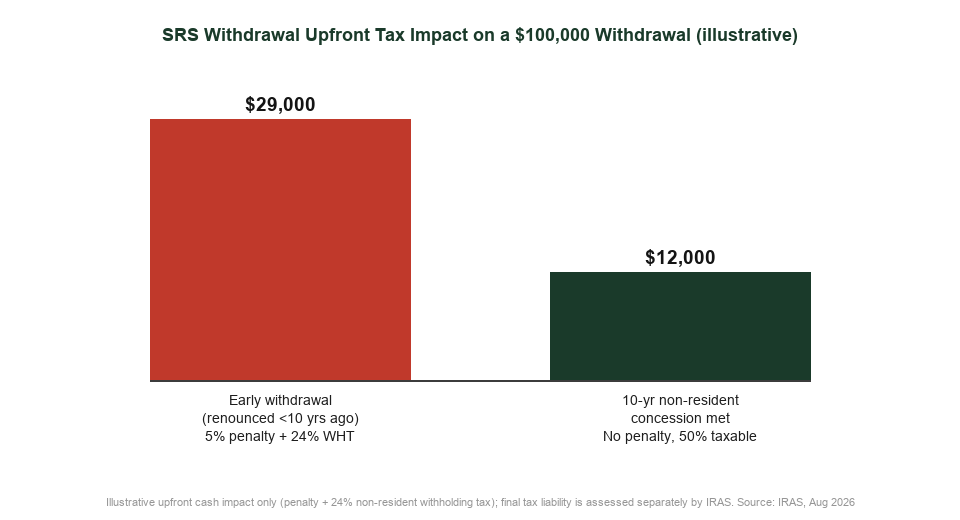
SRS: Since they’ve just renounced citizenship, they have not yet been a non-citizen for a continuous 10 years, so the 50%-taxable concession does not apply. Withdrawing the $100,000 immediately means the standard early-withdrawal treatment: 100% of it taxable, plus a 5% penalty ($5,000). At the point of withdrawal, the bank withholds tax at the 24% non-resident rate ($24,000) as a credit against final tax payable. Combined, that’s roughly $29,000 in immediate cash impact (penalty plus withholding) on a $100,000 SRS balance — before any final assessment adjustment.
| Account | Balance | Standard Rules (staying, under 55) | On Emigrating + Renouncing |
|---|---|---|---|
| CPF (OA+SA) | $300,000 | $0 accessible | $300,000 accessible, any age |
| SRS | $100,000 | 100% taxable + 5% penalty if withdrawn early | Same treatment applies unless the 10-year non-residency test is met |
Source: Author’s illustrative calculation applying CPF Board and IRAS rules verified August 2026. Not a substitute for a formal tax computation.
The practical takeaway: CPF rewards emigrating with genuine, immediate access. SRS punishes an early exit exactly the same way it would punish someone withdrawing early for any other reason. If you can structure your departure so your SRS withdrawal happens after you’ve genuinely been a non-resident for 10 years — for example, by leaving the SRS account untouched and only withdrawing once that clock runs out — you convert a $29,000 upfront hit into roughly $12,000 (no penalty, only 50% of the amount taxable at 24%). That’s a decision worth planning years in advance if you already know you intend to emigrate eventually.
What to Sort Out Before You Emigrate: A Checklist
A few deliberate steps make this process far less painful than discovering the rules after the fact.
Sequence your SRS withdrawal deliberately, not reflexively. Don’t withdraw the moment you leave just because you can. If you’re years away from the 10-year non-residency mark, consider whether leaving the funds invested until you qualify makes a meaningful financial difference for your situation.
Understand which account order actually applies to your goals — our CPF, SRS or cash first guide covers the standard sequencing question, though this emigration scenario reverses much of that logic.
Start the CPF-LM application early and expect months, not weeks. Between the 6-month post-departure waiting period and an average ~18-week processing time, plan for the better part of a year between leaving and receiving your funds.
If you’re a PR employee, give your employer maximum notice. The one-month IR21 filing window is a floor, not a target — more notice reduces the risk of your final pay being held up.
Liquidate or transfer CPFIS holdings before applying to close your account. Units held through CPFIS need to be sold or otherwise dealt with; they can’t simply be transferred out as-is in most cases.
Check each broker’s residency requirements separately. Some Singapore brokerage and SRS-linked platforms allow overseas addresses; others don’t. Confirm this before you move, not after.
Get a proper tax opinion for large SRS balances. The 10-year concession calculation and final tax assessment are genuinely complex — for anything beyond a modest SRS balance, a qualified tax advisor is worth the fee. See our broader CPF investment strategy guide for how CPF fits into your wider plan, and the how to invest in Singapore pillar guide if you’re mapping out your finances more broadly before you go.
Frequently Asked Questions
Can I withdraw my full CPF savings if I emigrate from Singapore?
Yes, if you renounce your Singapore Citizenship or PR status and leave Singapore and West Malaysia permanently with no intention of returning for employment or residence. This lets you withdraw your entire CPF balance at any age, unlike the standard age-55 rules that apply if you remain a citizen or PR.
Does renouncing my citizenship let me withdraw my SRS savings tax-free?
No. Renouncing citizenship alone doesn’t change your SRS tax treatment. Early withdrawal is still 100% taxable plus a 5% penalty, unless you’ve also been a non-citizen/non-PR for a continuous 10 years and held the SRS account for at least 10 years, in which case the penalty is waived and only 50% is taxable.
How long does it take to withdraw CPF after leaving Singapore permanently?
You can only apply 6 months after you’ve left Singapore. From there, CPF Board’s own website cites an average processing time of about 18 weeks to close the account and disburse funds as at August 2026, though this can vary with application volumes.
Does IRAS Form IR21 tax clearance apply to Singapore Citizens who emigrate?
No. IR21 tax clearance applies specifically to non-Singapore Citizen employees — Permanent Residents and foreign employees. Singapore Citizens who emigrate continue to file their final year of tax the normal way, without the employer-withholding process IR21 requires.
What happens to my CPF Investment Scheme (CPFIS) holdings if I close my CPF account?
You generally need to liquidate or otherwise deal with any unit trusts, ETFs, or stocks held through CPFIS before your CPF account can be closed and the cash disbursed — fund units can’t simply be handed over as-is in most cases.
Can I keep my Singapore brokerage or SRS account open after I emigrate?
It depends on the platform. Some Singapore brokers and banks allow accounts to remain open with a foreign address, while others require Singapore residency to maintain the account. Check each platform’s specific terms before you leave, since policies differ.
Get Your CPF, SRS and Investments in Order
Whether you’re just planning ahead or actively emigrating, sort out the sequencing before you renounce anything.
Not financial advice. All figures are for educational reference only and were verified against official CPF Board and IRAS sources as at 11 August 2026. The Kopi Notes may earn a referral fee if you sign up through the links below.
This article was researched with the help of AI. While we strive to keep all information accurate and up to date, there may be errors. If you notice any discrepancies, please contact us.