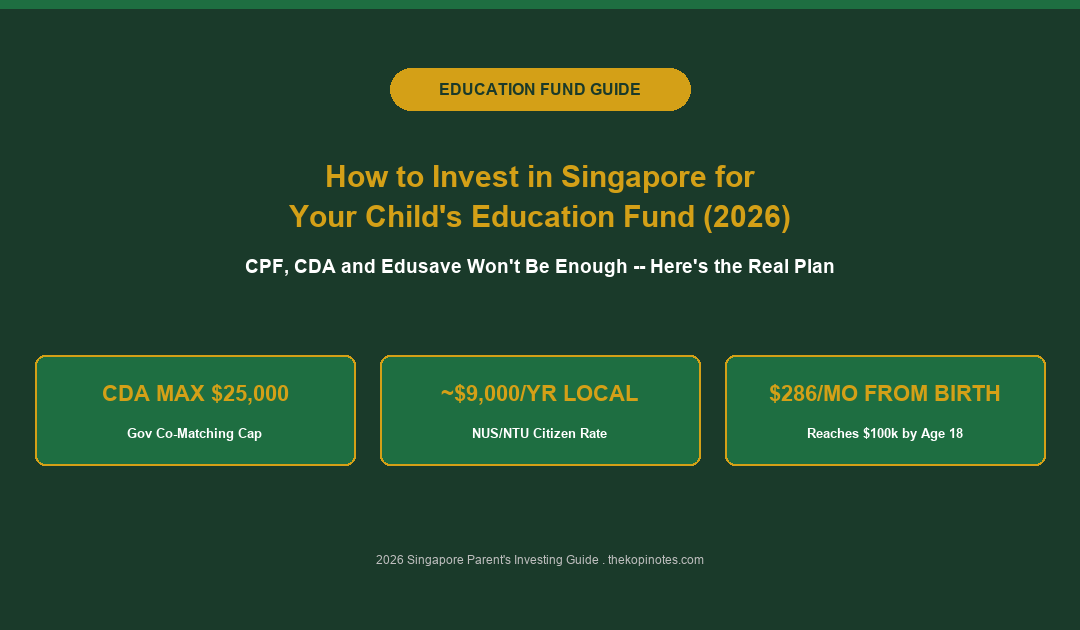
How to Invest in Singapore for Your Child’s Education Fund (2026)
CDA, Edusave and PSEA help — but they were never designed to cover a full degree. Here’s the real plan.
Table of Contents
Contents -- Click to expand
Singapore parents get real help from CDA, Edusave and PSEA — but combined, these government schemes typically top out well under the cost of a single local degree, let alone one overseas. Investing separately, starting as early as possible, is how most parents actually close that gap, using custodial accounts, broad-market ETFs, and a glide path that gets safer as university approaches.
Not financial advice. All figures are for educational reference only. Data verified as at 2 August 2026 unless otherwise noted.
- CDA tops out at $25,000 (for a 5th child) and can only be spent on childcare and healthcare, not investments — it closes when your child turns 12.
- A local NUS/NTU degree costs roughly $8,000-$11,000 a year for citizens; an overseas degree can easily run into the hundreds of thousands. Neither is fully covered by Edusave or PSEA.
- Starting an investment plan from birth needs roughly $286 a month to reach $100,000 by age 18 — waiting until age 10 nearly triples that to about $849 a month.
Why Government Schemes Alone Won’t Be Enough
Every Singaporean parent has heard of the Child Development Account (CDA), Edusave, and the Post-Secondary Education Account (PSEA). These schemes are genuinely generous, and you should absolutely use every dollar of government co-matching you’re entitled to.
But here’s what most parents don’t realise until much later: none of these schemes are designed to fund a full university education, and none of them let you invest the money in the stock market. They hold cash, earn modest interest, and are restricted to specific approved uses. That’s fine for what they’re meant to do — covering preschool fees, school-related costs, and a portion of post-secondary expenses. It’s not enough on its own for a four-year degree, and it’s nowhere close to enough for an overseas one.
That gap is exactly what a separate, dedicated investment fund for your child is meant to close. This guide builds on our beginner investing guide for Singapore and goal-based investing framework, but focuses specifically on the numbers, accounts, and timeline that matter when the goal is your child’s education.
Understanding CDA, Edusave and PSEA
Before you build an investment plan, it helps to know exactly what each government scheme already gives you — and where its limits are.
The Child Development Account (CDA) opens when your child is born and closes on 31 December of the year they turn 12. Every dollar you deposit is matched by the government up to a cap that depends on birth order: a first child receives a $5,000 First Step Grant plus up to $4,000 in co-matching (total $9,000), a second child gets $12,000, and third or later children born on or after 18 February 2025 can receive up to $19,000 to $25,000 under the Large Families Scheme. The catch: CDA funds can only be spent at Approved Institutions such as childcare centres, kindergartens and healthcare providers. You cannot withdraw it as cash, and you cannot invest it.
Edusave is simpler: every Singapore Citizen student automatically receives $230 a year in primary school and $290 a year in secondary school, credited by the Ministry of Education. You cannot top this up yourself. Unused Edusave funds transfer into the Post-Secondary Education Account (PSEA) in the year your child turns 17, or when they leave an MOE-funded school, whichever is later.
The PSEA earns interest pegged to the CPF Ordinary Account rate — currently 2.5% per annum — and can be used for approved post-secondary programmes or to repay government education loans. It closes around the middle of the year the account holder turns 31.
| Scheme | What You Get | Can You Invest It? |
|---|---|---|
| CDA | $9,000-$25,000 total (grant + co-matching, by birth order); closes at age 12 | No — cash only, approved expenses only |
| Edusave | $230/yr (primary), $290/yr (secondary); automatic | No — school-related fees only |
| PSEA | Rolled-over CDA/Edusave balances; earns 2.5% p.a. | No — approved post-sec programmes or loan repayment only |
Source: LifeSG (CDA) and MOE (Edusave, PSEA) official pages — verified 2 August 2026.
The Real Cost of a Degree: Local vs Overseas
Here’s why the gap matters. Singapore Citizens pay heavily subsidised tuition at NUS and NTU — most undergraduate programmes cost roughly $8,000 to $11,000 a year, so a four-year general degree runs about $32,000 to $44,000 in total. Specialised courses cost far more: Medicine runs about $32,000 a year at NUS (over $160,000 across five years), and Dentistry and Law aren’t far behind.
Send your child overseas instead, and the numbers change completely. Combining tuition and living costs across popular destinations like the UK, US and Australia, a three to four-year degree can easily land somewhere in the SGD 150,000 to 300,000-plus range, before accounting for currency swings between now and when your child actually enrols.
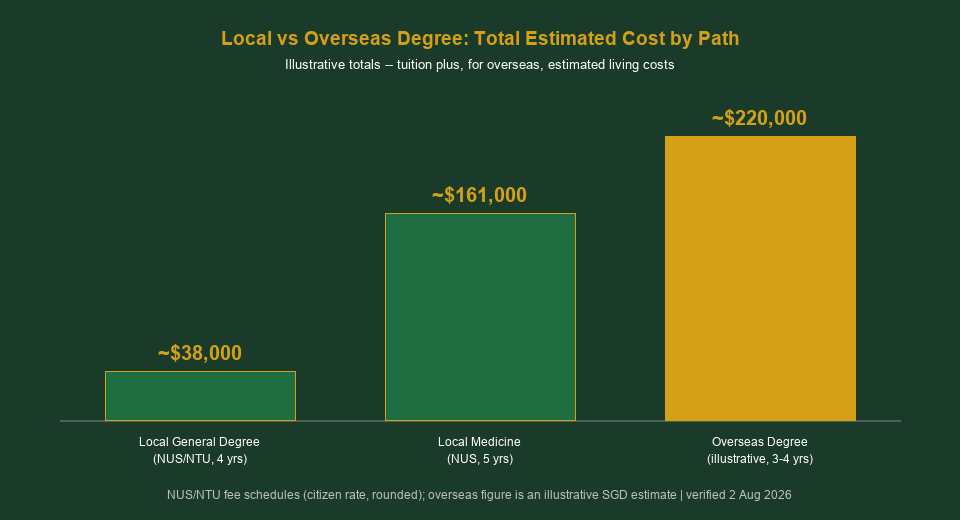
Even a $25,000 maximum CDA payout for a fifth child, plus a few thousand dollars of Edusave and PSEA balances, covers only a fraction of either path. That’s not a criticism of the schemes — they were designed to help with earlier childhood costs, not to fully fund a degree a decade or two later. It just means the rest genuinely has to come from somewhere else, and starting early is what makes that “somewhere else” realistic instead of stressful.
How to Open an Investment Account for Your Child
A minor under 18 cannot open a brokerage account in their own name in Singapore. That doesn’t stop you from investing on their behalf — it just means the account needs to sit under you, structured for their benefit.
Most Singapore parents use one of two approaches. The first is a custodial or “beneficiary” account, offered by platforms like FSMOne, which sits under your main account but is earmarked for your child. You can set up a Regular Savings Plan (RSP) from as little as $50 a month per unit trust or ETF into this account — a similar minimum to what we cover in our guide to minimum investment amounts in Singapore. The money is legally still under your control until you decide to hand it over, which for many parents is exactly the point.
The second, simpler approach is to just invest under your own name and mentally (or in a separate spreadsheet) earmark a portion of your portfolio as “the kids’ fund.” It’s easier to set up, but it comes with a trade-off: the money is legally part of your own estate and portfolio, not cleanly separated for your child, which matters if you’re thinking about estate planning or want a hard boundary between your own retirement savings and your child’s education fund.
Whichever structure you use, the underlying investment choices are the same ones covered in our risk profile guide — broad-market equity ETFs for a long runway, shifting toward safer instruments as the goal date nears.
Building a Glide Path as University Approaches
A newborn gives you an 18-year runway. That’s long enough to invest mostly in broad-market equity ETFs, similar to the long-term bucket in our goal-based investing guide, and ride out the inevitable ups and downs along the way.
The risk shows up later. If your entire education fund is still 100% in equities the year your child sits for their A-Levels, a market downturn right before enrolment — exactly the kind of scenario in our market-crash playbook — could force you to sell at a loss just when the tuition bill actually arrives. That’s called sequence-of-returns risk, and unlike your own retirement, you usually can’t just wait out the recovery.
The fix is a glide path: gradually shift the fund from equities into safer, more predictable instruments as university gets closer. A common approach is to start de-risking around three to five years before enrolment, moving a portion into Singapore Savings Bonds or T-bills each year so that, by the time tuition is due, most of the fund sits somewhere it can’t crash 30% overnight.
Worked Example: Starting Early vs Starting Late
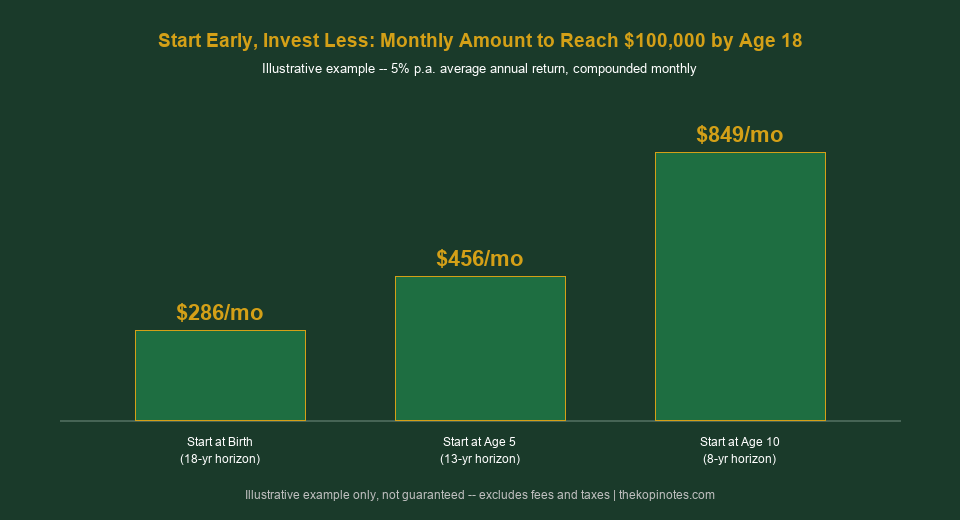
Here’s what the “start early” advice actually looks like in dollar terms. The table below shows the monthly investment needed to reach a $100,000 education fund by the time your child turns 18, assuming an illustrative 5% average annual return, compounded monthly.
| When You Start | Years to Invest | Monthly Amount Needed* |
|---|---|---|
| At birth | 18 years | ~$286/month |
| At age 5 | 13 years | ~$456/month |
| At age 10 | 8 years | ~$849/month |
*Illustrative example only, assuming a 5% p.a. average annual return compounded monthly, before fees and taxes. Not a guarantee of future returns.
Waiting five years increases the monthly commitment needed by about 60%; waiting ten years very nearly triples it. That’s the entire case for starting an education fund the moment your CDA and Baby Bonus paperwork is sorted, even if it’s a modest $100-$200 a month to begin with — you can always increase contributions later using our account-sequencing guide to decide whether CPF, SRS or a custodial account should come first.
Mistakes Parents Make When Investing for a Child’s Education
Mistake 1: Assuming CDA or PSEA money can be invested. Both are cash-only schemes restricted to approved uses. If you want market returns, you need a separate custodial or beneficiary account.
Mistake 2: Leaving the whole fund in a children’s savings account. Bank interest on kids’ accounts is typically well under 1% — barely keeping pace with inflation over an 18-year horizon, let alone growing the fund.
Mistake 3: Staying 100% in equities right up to enrolment. Without a glide path, a downturn in your child’s final pre-university years can force you to sell at a loss exactly when tuition is due.
Mistake 4: Waiting for a “better time” to start. As the worked example above shows, every year you delay meaningfully raises the monthly amount needed later. Even a small amount started early beats a larger amount started late.
Mistake 5: Ignoring SRS as part of the plan. If you’re a working parent, contributing to your own SRS account (up to $15,300 a year as a citizen or PR) and investing it for the long term can double as both a tax-relief tool and a source of future funds for family expenses, including education.
Ready to Start Your Child’s Education Fund?
A custodial account and a small monthly amount is all it takes to begin. Use these referral codes for sign-up perks on your first qualifying deposit.
Frequently Asked Questions
Can I invest my child's CDA or PSEA money?
No. CDA funds can only be spent at Approved Institutions for childcare and healthcare, and PSEA funds can only pay for approved post-secondary programmes or government loan repayment. Neither can be invested in the stock market.
How much does the CDA give in total?
It depends on birth order: $9,000 for a first child, $12,000 for a second, and up to $19,000-$25,000 for a third child or later born on or after 18 February 2025 under the Large Families Scheme.
What's the cheapest way to start investing for my child?
A custodial or beneficiary account with a Regular Savings Plan, such as FSMOne’s, lets you start from as little as $50 a month into a single unit trust or ETF.
Should I invest 100% in equities for my child's education fund?
Only while the time horizon is long. As university approaches — typically three to five years out — gradually shift a growing share into safer instruments like Singapore Savings Bonds or T-bills to protect against a market downturn right before tuition is due.
Is it better to start small early, or wait and invest more later?
Starting early wins in almost every case. Reaching $100,000 by age 18 needs roughly $286 a month starting from birth, versus about $849 a month if you wait until your child turns 10, thanks to compounding.
Does an overseas degree really cost that much more than a local one?
Usually, yes. A local NUS or NTU general degree for a citizen runs roughly $32,000-$44,000 in total tuition, while an overseas degree including living costs can run into the hundreds of thousands of Singapore dollars, depending on the country and university.
Not financial advice. CDA, Edusave and PSEA figures verified as at 2 August 2026 against LifeSG’s and MOE’s official pages. The $10,000 CDA First Step Grant and higher Large Families Scheme co-matching caps apply to third and subsequent Singapore Citizen children born on or after 18 February 2025; children born earlier receive a $5,000 grant and lower total CDA amounts. NUS/NTU tuition figures are rounded citizen-rate estimates corroborated across NUS’s official fee schedule and independent Singapore education-cost publications. The overseas degree cost range is an illustrative SGD estimate based on published UK, US and Australian tuition and living-cost data, and varies significantly by country, institution and currency movements. CPF interest rates (2.5% OA, 4% SMRA) and SRS contribution caps ($15,300 citizen/PR, $35,700 foreigner) reconfirmed against CPF Board’s and IRAS’s official pages. All worked-example figures are simplified, illustrative compounding estimates, not guaranteed returns. The Kopi Notes may earn referral fees when you sign up using our codes.
This article was researched with the help of AI. While we strive to keep all information accurate and up to date, there may be errors. If you notice any discrepancies, please contact us.