Using MediSave to Pay Your Integrated Shield Plan Premiums (2026 Guide)
Additional Withdrawal Limits by age, the April 2026 rider changes, and what you actually pay out of pocket.
MediSave can pay for your Integrated Shield Plan (ISP) premium, but not all of it. MediShield Life premiums are covered in full. The private insurance top-up is capped by an Additional Withdrawal Limit (AWL) of $300 to $900 a year, depending on your age. Anything above that, your insurer collects from you in cash — and the new April 2026 rider rules change how much that gap can be.
Not financial advice. All figures are for educational reference only. Data as at July 2026 unless otherwise stated. Data verified as at 31 July 2026 against CPF Board and Ministry of Health (MOH) sources.
- MediShield Life premiums are fully MediSave-payable. The private ISP top-up is capped by your Additional Withdrawal Limit (AWL) — $300, $600, or $900 a year depending on your age.
- From 1 April 2026, new IP riders no longer cover your deductible, and the co-payment cap rose from $3,000 to at least $6,000 a year. Premiums are about 30% lower to offset this.
- Check your AWL against your actual premium at every renewal so a cash top-up doesn’t catch you off guard.
Table of Contents
Contents — Click to expand
- Can MediSave Pay for Your Integrated Shield Plan?
- MediSave Additional Withdrawal Limits (AWL), Explained
- How the April 2026 Rider Changes Affect What You Pay
- Worked Example: A $56,900 Hospital Bill, Before and After
- Managing the Cash Gap When MediSave Runs Out
- Does This Differ Across Insurers?
- What You Should Do Before Your Next Renewal
- Frequently Asked Questions
Can MediSave Pay for Your Integrated Shield Plan?
Yes, but only up to a point. Your Integrated Shield Plan (IP) sits on top of MediShield Life, Singapore’s basic national health insurance. Your IP premium is really two premiums bundled into one bill: the MediShield Life (MSL) component, and an additional private insurance component charged by your private insurer (AIA, Great Eastern, Prudential, Singlife, NTUC Income, or Raffles Health Insurance).
The MSL component can be paid fully using MediSave. There’s no cap on this part. It’s the private insurance component — the part that gets you into a Class A ward or a private hospital — that’s restricted. For a refresher on how MediSave works more broadly, including the Basic Healthcare Sum and top-up rules, see our complete guide to MediSave in Singapore.
This cap exists for a reason. If MediSave could pay for unlimited private insurance premiums, everyone would over-insure. That drains the pool of savings you’re meant to keep for your own healthcare costs later in life. CPF Board and MOH call this cap the Additional Withdrawal Limit, or AWL.
Every MediSave-approved IP works this way, regardless of which insurer you’re with. Your Central Provident Fund (CPF) statement shows your total MediSave balance, but it won’t automatically tell you how much of your annual premium is MediSave-payable versus cash-payable. You need to check your IP renewal notice or ask your insurer directly, since the split depends on your age and your plan’s private component premium.
One more distinction worth knowing early: the AWL governs your premium payments. A separate set of withdrawal limits governs your claim payments — the deductible and co-payment you owe when you’re actually treated. We’ll come back to that difference later, because mixing the two up is where most of the confusion happens.
MediSave Additional Withdrawal Limits (AWL), Explained
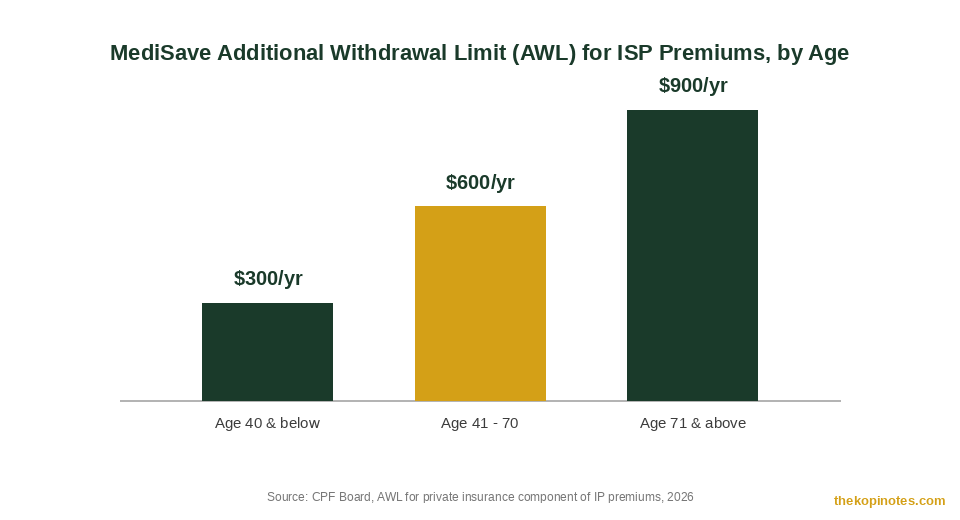
The AWL sets how much MediSave you can put toward the private insurance component of your IP premium each year. It rises with age, because premiums rise with age too. Here’s the exact table from CPF Board.
| Age Next Birthday | Additional Withdrawal Limit (AWL) |
|---|---|
| 1 – 40 | $300 per year |
| 41 – 70 | $600 per year |
| 71 and above | $900 per year |
Source: CPF Board, Additional Withdrawal Limits for IP premiums, 2026.
Here’s what that looks like in practice. Say you’re 45 years old and your private hospital IP costs $900 a year for the private component (on top of the MSL portion, which is fully MediSave-payable). Your AWL is $600. MediSave covers $600. You pay the remaining $300 in cash.
The chart below shows the three AWL bands side by side.
How the April 2026 Rider Changes Affect What You Pay
Many IP holders don’t stop at the base plan. They add a rider, which reduces what you pay when you’re actually hospitalised. Riders used to offer near-total coverage — pay almost nothing out of pocket. That drove up claims and premiums. MOH stepped in.
From 1 April 2026, every new IP rider sold in Singapore must follow two new rules. First, riders can no longer cover your policy’s minimum deductible — you must pay that yourself (or via MediSave, subject to separate claim withdrawal limits). Second, the annual co-payment cap rose from a minimum of $3,000 (set in 2018) to a minimum of $6,000, excluding the deductible. The minimum 5% co-payment rate hasn’t changed.
In exchange, new riders are cheaper. MOH estimates premiums for new riders are about 30% lower on average than the old maximum-coverage riders — roughly $600 a year in savings for private hospital rider holders, and about $200 a year for public hospital rider holders.
The size of your deductible depends on the ward class your IP targets. Here’s MOH’s official table.
| Ward Class | Minimum IP Deductible |
|---|---|
| Class A / Private | $3,500 |
| Class B1 | $2,500 |
| Class B2 | $2,000 |
| Class C | $1,500 |
| Day Surgery (Non-Subsidised) | $2,000 |
| Day Surgery (Subsidised) | $1,500 |
Source: Ministry of Health, New Requirements for IP Riders, Annex A, 26 November 2025.
If you bought your rider before 27 November 2025, your existing benefits are grandfathered for now. Insurers must transition you to a compliant rider no later than your first policy renewal after 1 April 2028. If you’re buying or renewing a rider today, you’re already on the new design. For the full policy background, read our breakdown of the 2026 Integrated Shield Plan rider changes.
Worked Example: A $56,900 Hospital Bill, Before and After
Numbers are easier to follow with a real scenario. MOH published this case study alongside its rider announcement: a 60-year-old Singaporean (“Mr A”) switches from an old maximum-coverage rider to a new one in April 2026, then undergoes knee joint replacement surgery three years later.
His hospital bill comes to $56,900. Here’s what changes.
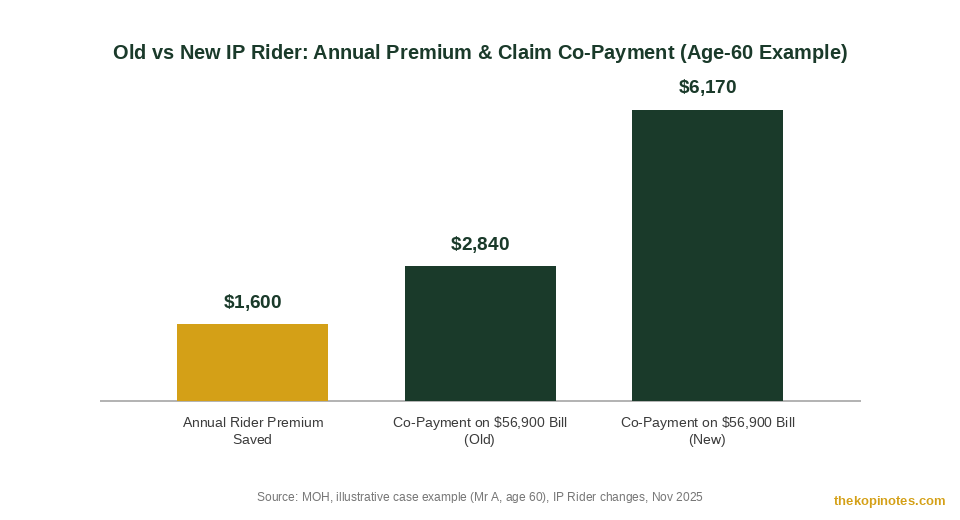
By switching to the new rider, Mr A saved $1,600 in cash premiums over three years. When his bill arrives, he pays the $3,500 deductible plus 5% of the balance, totalling $6,170. Under his old rider, the equivalent payout would have cost him $2,840. He pays $3,330 more at claim time — but that amount is covered by MediSave, subject to the prevailing claim withdrawal limits (a separate allowance from the AWL used for premiums, and it doesn’t reduce your AWL).
Net-net for Mr A: the cash he saved on premiums ($4,800 by year three) outweighs the extra he pays when he actually claims, especially since an average 60-year-old is hospitalised only about twice in the next 10 years.
Managing the Cash Gap When MediSave Runs Out
Two different MediSave allowances matter here, and mixing them up is the most common mistake IP holders make.
The AWL caps how much MediSave pays toward your annual private insurance premium. The claim withdrawal limits are separate. They cap how much MediSave pays toward your deductible and co-payment when you actually get treated. Exceeding either one means paying the rest in cash.
For premiums specifically: once your private component premium exceeds your AWL, your insurer bills you directly for the shortfall in cash. This usually shows up as a split charge on your renewal notice — part MediSave, part card or bank transfer.
A simple way to plan for this: check your renewal letter every year. If your rider premium plus base IP premium’s private component is higher than your AWL, budget the gap as a fixed annual cash expense, the same way you’d budget for road tax or home insurance.
To make this concrete, here’s how the cash gap works out at a few premium levels, using the official AWL figures above. This is a simplified calculation to illustrate the mechanic — your actual premium depends on your insurer, plan, and rider.
| Private Component Premium | Age 40 & Below (AWL $300) | Age 41–70 (AWL $600) | Age 71 & Above (AWL $900) |
|---|---|---|---|
| $500/year | $200 cash | $0 cash (fully covered) | $0 cash (fully covered) |
| $800/year | $500 cash | $200 cash | $0 cash (fully covered) |
| $1,200/year | $900 cash | $600 cash | $300 cash |
Calculation: cash payable = private component premium − applicable AWL (floored at $0). AWL figures per CPF Board, 2026.
Notice the pattern: as you age into a higher AWL band, MediSave absorbs more of a given premium. But premiums themselves also climb with age, often faster than the AWL steps up — which is why the cash gap tends to widen, not shrink, later in life.
Does This Differ Across Insurers?
The AWL itself doesn’t change by insurer — it’s a CPF Board rule that applies to every MediSave-approved IP, whether you’re with AIA, Great Eastern, Prudential, Singlife, NTUC Income, or Raffles Health Insurance. What differs is the premium you’re being asked to pay against that fixed AWL.
A younger, healthier applicant on a leaner plan might have a private component premium under $300 a year, meaning MediSave covers it in full. An older policyholder on a Class A plan with a rider could easily see a private component well above $900, meaning a meaningful cash gap every year regardless of insurer.
If you’re deciding between insurers, don’t just compare headline premiums. Compare premium minus your AWL — that’s your real annual cash outlay. Our Integrated Shield Plan comparison across 7 insurers breaks down premiums by insurer and ward class if you want to run these numbers for your own plan.
What You Should Do Before Your Next Renewal
Start with your CPF statement. It shows your MediSave balance and, over time, how much of it goes toward insurance premiums. Compare that against your latest IP renewal notice to see your actual cash outlay this year.
If you bought your rider before 27 November 2025, ask your insurer when your policy transitions to the new design — it must happen no later than your first renewal after 1 April 2028, but many insurers are moving policyholders sooner. Ask what your premium and co-payment cap will look like under the new terms before you agree to switch.
If you’re topping up MediSave voluntarily to cover healthcare costs, remember the AWL is a hard cap on the premium side regardless of your account balance — a fatter MediSave account doesn’t raise your AWL. For a broader view of MediSave limits and how top-ups work, see our 2026 MediSave limit and withdrawal guide, and our note on how CPF interacts with your Shield Plan more broadly.
Finally, factor this cash gap into your retirement budget, not just this year’s expenses. Premiums and cash co-payments generally rise as you age, right as your AWL band moves from $600 to $900. Our Singapore retirement planning calculator can help you model healthcare costs alongside the rest of your retirement number.
Frequently Asked Questions
Can I use MediSave to pay my full Integrated Shield Plan premium?
Only partly. The MediShield Life portion of your premium is fully MediSave-payable. The additional private insurance portion is capped by your Additional Withdrawal Limit (AWL), which ranges from $300 to $900 a year depending on your age. Any premium above your AWL is billed to you in cash by your insurer.
What is the MediSave Additional Withdrawal Limit (AWL) for ISP premiums?
The AWL is $300 a year if you’re 40 or below (age next birthday), $600 a year if you’re 41 to 70, and $900 a year if you’re 71 or above. It applies specifically to the private insurance component of your Integrated Shield Plan premium, as set by CPF Board.
What changed for Integrated Shield Plan riders from April 2026?
From 1 April 2026, new IP riders can no longer cover your policy’s minimum deductible, and the annual co-payment cap rose from a minimum of $3,000 to a minimum of $6,000 (excluding the deductible). In exchange, new rider premiums are roughly 30% lower on average than the old maximum-coverage riders.
Do I still need to pay cash if my premium exceeds the AWL?
Yes. Once your private insurance component premium goes above your AWL, your insurer collects the remaining amount from you directly in cash. This is a fixed rule that applies regardless of how much money you have in your MediSave account.
Can MediSave pay my rider's deductible and co-payment when I make a claim?
Yes, deductibles and co-payments at claim time can be paid using MediSave, subject to the prevailing claim withdrawal limits. This is a separate allowance from the AWL, which only applies to your annual premium, not to what you pay when you’re actually hospitalised.
Will my existing rider be affected by the new rules?
If you bought your rider before 27 November 2025, your existing benefits are grandfathered for now. Your insurer must transition you to a rider that meets the new requirements no later than your first policy renewal after 1 April 2028. Speak to your insurer or financial advisor to understand your specific timeline.
Check Your MediSave Numbers Before You Renew
Know your AWL, know your gap, and plan the cash portion of your Shield Plan premium ahead of time.
Get Free Insurance Advice
Speak with a licensed insurance advisor. No obligation, no cost.
By submitting this form, you agree to our Privacy Policy.
This article was researched with the help of AI. While we strive to keep all information accurate and up to date, there may be errors. If you notice any discrepancies, please contact us.