Endowment Plan vs T-Bills Singapore 2026: Which Gives Better Guaranteed Returns?
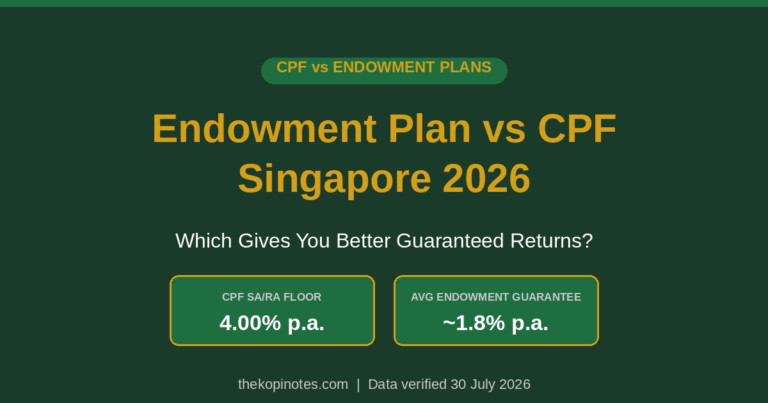
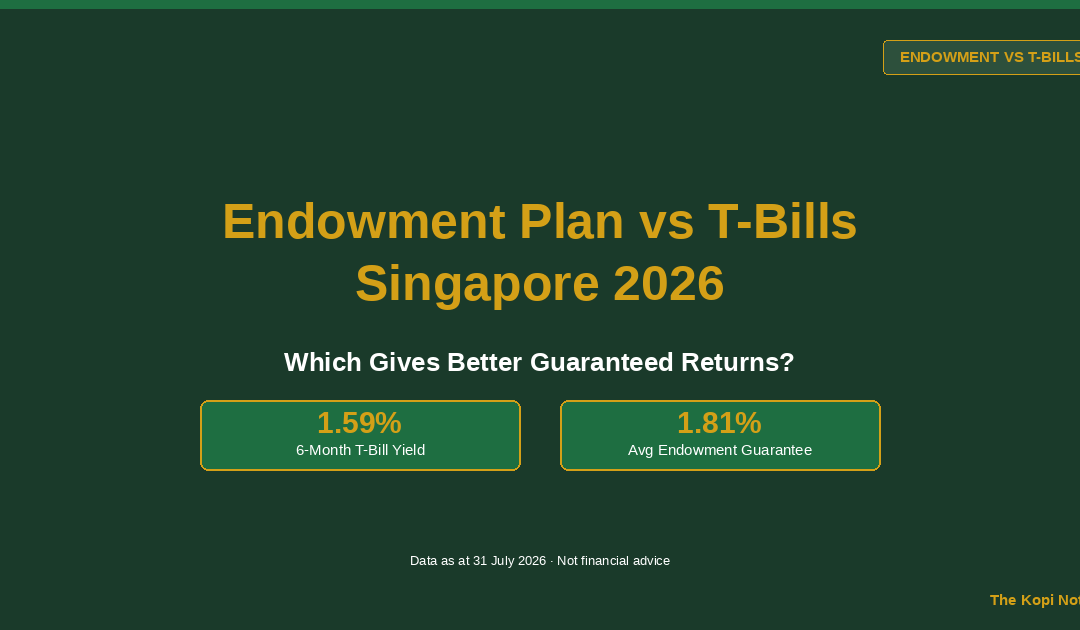
The 6-month T-bill’s yield has risen for three straight auctions, hitting 1.59% p.a. on 30 July. The average Singapore endowment plan still guarantees more, at 1.81% p.a. But one of these rates is locked in for years — the other resets every few months.
The 6-month Singapore T-bill (BS26115N) cleared at 1.59% p.a. in its 30 July 2026 auction, its third consecutive rise. The average guaranteed rate across the 13 Singapore endowment plans we’ve reviewed is about 1.81% p.a. Endowment plans guarantee slightly more on paper, but that rate locks in today for years, while a T-bill’s rate resets at every new auction — so the “better” choice depends heavily on your time horizon.
Not financial advice. All figures are for educational reference only. Data verified as at 31 July 2026 against MAS auction results, cpf.gov.sg, and each insurer’s own product pages.
- The 6-month T-bill (BS26115N, 30 Jul 2026) yields 1.59% p.a.; the 1-year T-bill (BY26102T, 28 Jul 2026) yields 1.68% p.a. Both are 100% Singapore Government-guaranteed, but the rate only applies to that one tenor — it resets at every new auction.
- The average Singapore endowment plan we’ve reviewed guarantees ~1.81% p.a. (range: 0.70%-2.80%) — a lower ceiling on paper for the highest-guaranteed T-bill, but that rate is locked in for the full policy term, however many years it runs.
- T-bills are eligible for both CPFIS-OA and CPFIS-SA (confirmed on CPF Board’s own product list) with no 35%/10% investment cap, unlike stocks or gold — making them one of the most flexible low-risk options for CPF savers.
This is the fourth and final leg of our guaranteed-return comparison series — see how endowment plans stack up against CPF and Singapore Savings Bonds in our other comparisons.
Table of Contents
Contents — Click to expand
- What T-Bills Actually Guarantee You
- What Singapore Endowment Plans Actually Guarantee
- Endowment Plan vs T-Bill: Side-by-Side Comparison
- The Reinvestment Risk T-Bills Have (And Endowment Plans Don’t)
- What S$20,000 Actually Earns: 6 Months vs 10 Years
- Can You Use CPF or SRS to Buy T-Bills?
- The Real Trade-off: Liquidity, Auctions & Lock-In
- When an Endowment Plan Might Still Make Sense
- How to Decide: A Simple 3-Step Framework
- Pros and Cons
What T-Bills Actually Guarantee You
Singapore Treasury bills (T-bills) are short-term debt securities issued by the Singapore Government and auctioned by the Monetary Authority of Singapore (MAS). You buy them at a discount to their face value, then receive the full face value at maturity — the difference is your return, expressed as an annualised “cut-off yield”.
Two tenors are auctioned regularly: 6-month T-bills (roughly every two weeks) and 1-year T-bills (a handful of times a year). Because both are backed by the Singapore Government — one of the few sovereigns in the world still rated AAA — the yield is as close to risk-free as retail investors can get in Singapore Dollar terms.
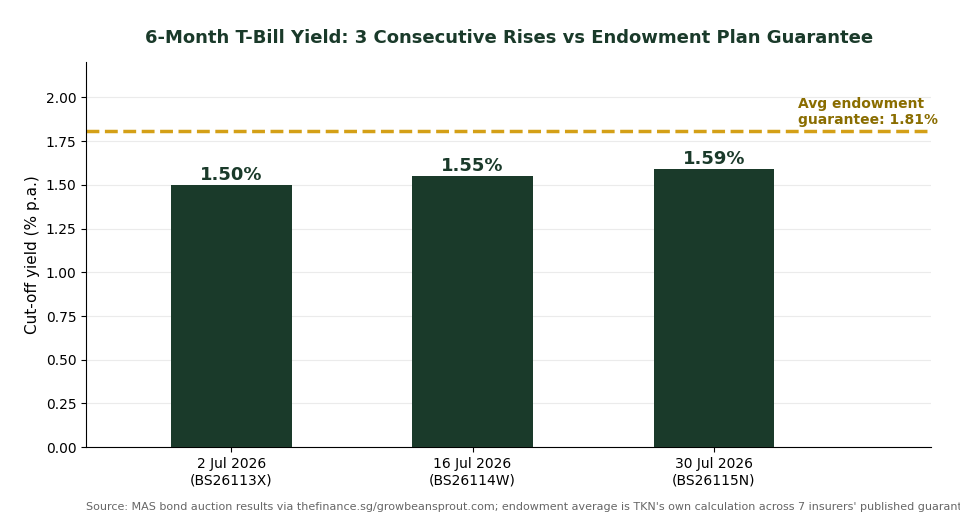
Here’s what’s actually happened recently. The 6-month T-bill (BS26115N) cleared at 1.59% p.a. in its 30 July 2026 auction — its highest level since the start of the year, and the third consecutive rise, up from 1.55% on 16 July (BS26114W) and 1.50% on 2 July (BS26113X). The 1-year T-bill (BY26102T), auctioned 28 July 2026, cleared slightly higher at 1.68% p.a., reflecting a small premium for the longer tenor.
Crucially, that yield only applies for the tenor you bought — six months or a year. Once your T-bill matures, you get your principal plus interest back, and you’d need to bid again at whatever the next auction’s cut-off yield happens to be. There’s no compounding built in, and no guarantee the next auction lands anywhere near today’s rate. You can check the latest cut-off yields directly via MAS’s own T-bill information page.
What Singapore Endowment Plans Actually Guarantee
Endowment plans market themselves on “guaranteed returns,” but the actual guaranteed component — as opposed to non-guaranteed bonuses illustrated at 3.00% or 4.25% p.a. scenarios — is usually smaller than most buyers expect, and it’s fixed for the entire policy term the day you sign up.
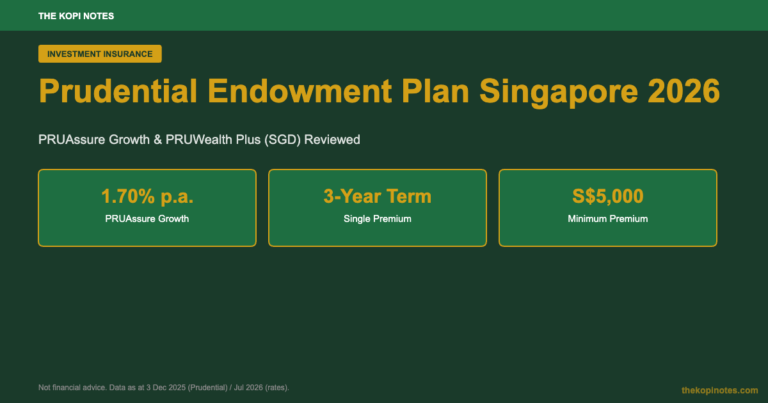
We’ve individually reviewed and fact-checked 13 endowment plans from Singapore’s major insurers against their own official product pages. Of these, 7 publish a clean, comparable guaranteed percentage rate: AIA (2.80%), OCBC (~2.80%, campaign rate), Prudential (1.70%), Etiqa (1.65%), FWD (1.60%), Manulife (1.44%), and Great Eastern (0.70%). Averaging these 7 published rates gives ~1.81% p.a. — our own calculation, not a figure published by any single insurer.
Unlike a T-bill, this rate doesn’t reset. Whatever guaranteed rate is written into your policy contract at the point of purchase is locked in for the plan’s full term — commonly 2 to 30 years — regardless of where T-bill auctions, CPF rates, or bank fixed deposits move in the meantime. For the full insurer-by-insurer breakdown, see our complete endowment plan comparison guide.
Endowment Plan vs T-Bill: Side-by-Side Comparison
| Factor | T-Bill (6-month / 1-year) | Endowment Plan (typical) |
|---|---|---|
| Guaranteed rate | 1.59% (6-mo) / 1.68% (1-yr), resets every auction | ~1.81% average (range 0.70%-2.80%), locked for the full term |
| Who guarantees it | Singapore Government (AAA-rated sovereign) | The insurer, backed by SDIC Policy Owners’ Protection Scheme up to prescribed limits |
| Rate lock-in | Only for the 6 or 12-month tenor | 2-30 years, fixed at purchase |
| Upside beyond guarantee | None — the cut-off yield is the return | Non-guaranteed bonuses (illustrated at 3.00%-4.25% scenarios, not promised) |
| Liquidity | Tradeable on SGX before maturity, though retail secondary volume is thin; most investors hold to maturity | Locked for the policy term; early surrender usually means a real loss |
| Insurance component | None | Small death benefit built in (typically 101%-105% of premium) |
| Minimum outlay | S$1,000, in S$1,000 increments | Typically S$5,000-S$10,000 minimum single premium |
Sources: MAS auction results (BS26113X, BS26114W, BS26115N, BY26102T, Jul 2026); endowment figures from TKN’s own fact-checked insurer reviews, linked throughout this article.
The Reinvestment Risk T-Bills Have (And Endowment Plans Don’t)
This is the part most comparisons skip. A T-bill’s headline yield only tells you what you’ll earn until it matures — it says nothing about what happens after that.
If you hold a 6-month T-bill today at 1.59%, you’ll get your money back with interest in six months. At that point, you have to decide what to do next: bid for a new T-bill at whatever the next auction’s cut-off yield turns out to be, which could be higher or lower. This is called reinvestment risk, and it’s the trade-off for a T-bill’s short lock-in period.
Right now, that risk is working in savers’ favour — yields have risen for three consecutive auctions. But rates move both ways. In 2024-2025, several 6-month auctions cleared meaningfully lower than mid-2026 levels, and there’s no way to know today whether the next auction in mid-August continues rising, flattens, or reverses.
An endowment plan removes this risk entirely for its guaranteed component. Whatever rate is written into your policy on day one is the rate for the plan’s full term, whether that’s 5 years or 25. You give up the flexibility to exit every six months, but in exchange, you’re insulated from a future run of falling T-bill auctions.
What S$20,000 Actually Earns: 6 Months vs 10 Years
Percentages are easy to skim past. Here’s what the numbers look like in dollars, using S$20,000 as a working example — the amount you’d need to set aside in CPF OA before investing further, making it a realistic illustrative figure.
Over a single 6-month T-bill at 1.59% p.a., S$20,000 earns about S$158.56 in interest. Over a single 1-year T-bill at 1.68% p.a., the same S$20,000 earns about S$336.00. Both are guaranteed for that one tenor only — you’d need to reinvest to keep earning beyond that.
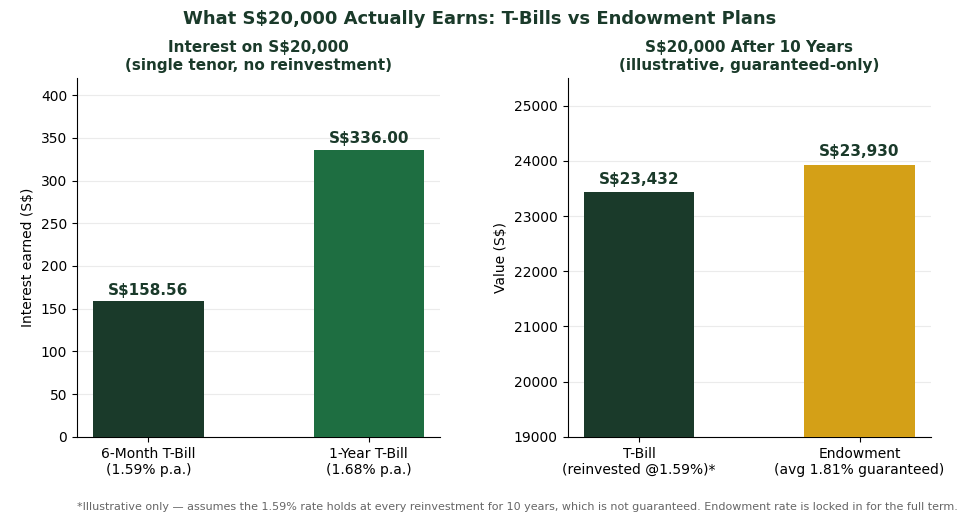
Now stretch the horizon to 10 years. If you kept reinvesting a 6-month T-bill at a constant 1.59% p.a. every single auction for a decade — an illustrative assumption only, since future auctions are not guaranteed to match today’s rate — S$20,000 would grow to roughly S$23,432. Over the same 10 years, at the average endowment guaranteed rate of 1.81% p.a. compounded annually, S$20,000 grows to S$23,930 — a gap of about S$498 in the endowment plan’s favour, purely on the locked-in guarantee.
That gap is small, and it flips entirely if T-bill yields keep climbing (as they have for three straight auctions) or shrinks further if they fall. This is the real difference between the two products: an endowment plan’s 10-year projection is a real guarantee you can bank on today, while a T-bill’s 10-year projection is only ever a guess about 20 future auctions you haven’t seen yet.
Can You Use CPF or SRS to Buy T-Bills?
Yes, on both counts — and T-bills are treated more generously here than most other CPFIS investment options. CPF Board’s own published CPFIS product list confirms Treasury Bills are approved for both CPFIS-OA and CPFIS-SA.
| Requirement | CPFIS-OA | CPFIS-SA |
|---|---|---|
| Minimum balance to set aside first | S$20,000 in OA | S$40,000 in SA |
| Need a CPF Investment Account? | Yes, opened with DBS, OCBC, or UOB | Apply directly through your agent bank — check current requirements, as SA eligibility has narrowed since the SA closure at age 55 took effect from January 2025 |
| Subject to 35%/10% stock & gold caps? | No — T-bills, SGS bonds, fixed deposits, and endowment policies sit outside those caps | No |
This is a meaningful practical difference from stocks, property funds, corporate bonds, and gold, which are capped at 35% and 10% of your investible OA savings respectively. T-bills carry no such cap, since CPF Board treats them as one of the lowest-risk products on the approved list — alongside SGS bonds, fixed deposits, and, notably, endowment policies themselves.
Outside of CPF, T-bills are also eligible for Supplementary Retirement Scheme (SRS) funds, and of course cash. Applications go through DBS, OCBC, or UOB (for cash, SRS, and CPFIS-OA) via ATM or internet banking, or through your CPF agent bank directly for CPFIS-SA. Most retail applicants use a non-competitive bid, which guarantees allotment at the auction’s eventual cut-off yield rather than risking rejection at a self-chosen rate.
The Real Trade-off: Liquidity, Auctions & Lock-In
T-bills are technically tradeable on the SGX secondary market before maturity, but retail trading volume is thin, and the price you’d get reflects prevailing rates at the time — you could sell at a gain or a loss versus your original cost. In practice, most retail holders simply wait the six or twelve months to maturity, then decide whether to reinvest.
Endowment plans lock your capital for a fixed policy term instead — commonly 2 to 30 years, depending on the product. Surrender before maturity typically returns less than what you paid in, sometimes significantly less in the early years, as detailed in our insurance surrender value guide. There’s no secondary market escape hatch — early exit is simply a loss.
The practical difference in liquidity is stark: a T-bill ties up your money for, at most, a year at a time, with a clear exit date you chose yourself at purchase. An endowment plan ties up your money for years, with an exit date fixed by the contract, not by you.
When an Endowment Plan Might Still Make Sense
Given how easy T-bills are to access and reinvest, why would anyone still choose a multi-year endowment plan? A few genuine reasons come up repeatedly across the plans we’ve reviewed:
You want today’s rate locked in for years, not just months. If you believe interest rates could fall meaningfully over the next 5-10 years, an endowment plan lets you lock in ~1.81% (or higher, for the better-guaranteeing insurers) today, insulating you from a future run of lower T-bill auctions. A T-bill offers no such protection beyond its own tenor.
You want a built-in forced-savings contract with a small insurance kicker. A regular-premium endowment plan penalises you for stopping payments, which some savers deliberately use as a discipline mechanism — something a T-bill, bought and forgotten, doesn’t replicate.
You’re chasing the non-guaranteed upside, not just the floor. Some plans illustrate total returns (guaranteed plus bonus) of 3.00%-4.25% p.a. at their stated scenarios — well above where T-bills sit today, if the insurer’s participating fund actually delivers. That’s a real possibility, not a guarantee.
You don’t want to actively manage reinvestment every few months. T-bills require you to reapply at every maturity if you want to stay invested. An endowment plan is a “set and forget” contract for its full term — convenient, though that convenience is also what locks you in.
How to Decide: A Simple 3-Step Framework
Step 1: Check your time horizon. If you’re parking money for under two years, or want to stay flexible, T-bills’ short tenor and comparable (sometimes higher) yield usually wins on practicality alone. If you’re comfortable locking money away for 5+ years, an endowment plan’s fixed-for-term guarantee becomes more relevant.
Step 2: Decide how you feel about rate uncertainty. T-bill yields have risen three auctions running as at 31 July 2026 — but they’ve fallen before, and can again. If you’d rather lock in a known rate today than gamble on where the next 10-20 auctions land, that favours the endowment plan’s guarantee, even at a similar or slightly higher headline rate.
Step 3: Model your own numbers. Run your own amount and horizon through our retirement planning calculator, and check the latest cut-off yields against our T-bill auction results tracker before each application, since yields shift every auction.
Pros and Cons
| Choosing T-Bills | Choosing an Endowment Plan |
|---|---|
| + Short 6-12 month lock-in, high flexibility | + Rate locked in for the full term, no reinvestment risk |
| + Government-guaranteed, no insurer credit risk | + Possible non-guaranteed upside beyond the floor |
| + Low S$1,000 minimum, no CPFIS investment caps | + Small built-in life insurance component |
| – Rate resets every auction — no long-term certainty | – Capital locked for years; early surrender usually means a real loss |
| – Requires active reinvestment to stay invested | – Guaranteed rate can still trail a rising-rate T-bill environment |
Frequently Asked Questions
What is the latest Singapore T-bill yield in 2026?
The 6-month T-bill (BS26115N) cleared at 1.59% p.a. in its 30 July 2026 auction, its third consecutive rise. The 1-year T-bill (BY26102T) cleared at 1.68% p.a. in its 28 July 2026 auction. Both yields change at every new auction, roughly every two weeks for the 6-month tenor.
Do T-bills or endowment plans give a better guaranteed return?
On the headline numbers, the average Singapore endowment plan we’ve reviewed guarantees about 1.81% p.a., slightly above the current 6-month T-bill’s 1.59%. But the endowment rate is locked in for the full policy term (years), while the T-bill rate only applies to its own 6 or 12-month tenor and resets at every auction — so which is “better” depends heavily on your time horizon and view on future rates.
Can I use my CPF to buy T-bills?
Yes. Treasury Bills are approved investments under both CPFIS-OA and CPFIS-SA, per CPF Board’s own published product list. For CPFIS-OA, you need at least S$20,000 in your OA and a CPF Investment Account with DBS, OCBC, or UOB. For CPFIS-SA, you need at least S$40,000 in your SA and apply through your agent bank, though SA eligibility has narrowed since the CPF Special Account closure at age 55 took effect from January 2025.
Are T-bills subject to the CPFIS 35%/10% investment limits?
No. The 35% cap applies to shares, property funds, and corporate bonds combined, and the 10% cap applies to gold products. Treasury Bills, Singapore Government Bonds, fixed deposits, and endowment policies all sit outside these caps, so you can generally allocate more of your investible CPF savings to them.
Can I use SRS funds to buy T-bills?
Yes. Supplementary Retirement Scheme (SRS) funds can be used to apply for T-bills, alongside cash and CPFIS funds, through DBS, OCBC, or UOB.
What happens when my T-bill matures — do I need to do anything?
Your principal and interest are automatically credited back to the account you applied from (bank account, CPF account, or SRS account) at maturity. If you want to stay invested, you’ll need to actively apply again for a new T-bill at the next auction — it doesn’t automatically roll over.
How much does S$20,000 earn in a 6-month T-bill?
At the 30 July 2026 cut-off yield of 1.59% p.a., S$20,000 in a 6-month T-bill earns approximately S$158.56 in interest over the 6-month tenor. At the 1-year T-bill’s 1.68% p.a., the same amount earns approximately S$336.00 over a full year.
Is my money safer in a T-bill or an endowment plan?
T-bills are backed directly by the Singapore Government, which holds a AAA credit rating. Endowment plan guarantees are backed by the individual insurer and protected under the Policy Owners’ Protection Scheme administered by the Singapore Deposit Insurance Corporation (SDIC), up to prescribed limits. Both are considered very safe in the Singapore context, but they rest on different legal guarantees.
What's the minimum amount to invest in a T-bill versus an endowment plan?
T-bills have a S$1,000 minimum, in S$1,000 increments. Endowment plans typically require a S$5,000-S$10,000 minimum single premium, though this varies by insurer and product.
Want More Options Beyond T-Bills and Endowment Plans?
If you’re comparing guaranteed-return products because you want your money to work harder over the long run, a low-cost robo-adviser lets you invest SRS or cash savings directly — with sign-up bonuses on top.
Get Free Insurance Advice
Speak with a licensed insurance advisor. No obligation, no cost.
By submitting this form, you agree to our Privacy Policy.
This article was researched with the help of AI. While we strive to keep all information accurate and up to date, there may be errors. If you notice any discrepancies, please contact us.