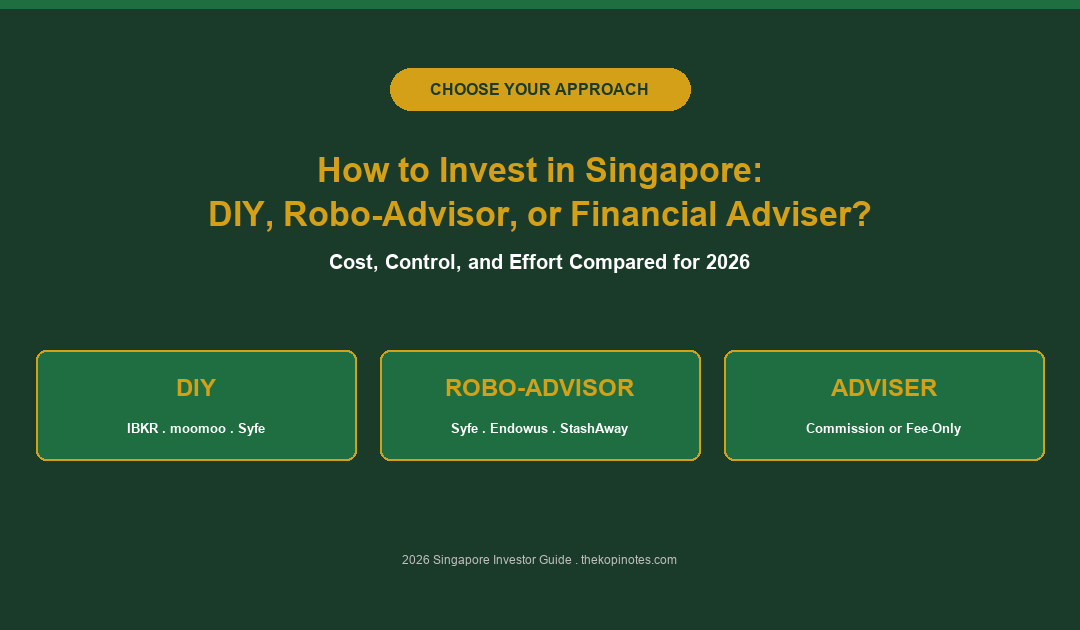
How to Invest in Singapore: DIY, Robo-Advisor, or Financial Adviser? (2026)
Before you pick a single stock or fund, decide who’s actually going to manage your money — you, an algorithm, or a licensed human.
Table of Contents
How you invest in Singapore matters as much as what you invest in. You can build your own portfolio through a self-directed broker like IBKR or moomoo, hand it to a robo-advisor like Syfe or Endowus for a management fee, or work with a licensed financial adviser who charges commission or a flat fee. Each path suits a different budget, time commitment, and comfort level.
Not financial advice. All figures are for educational reference only. Data verified as at 30 July 2026 unless otherwise noted.
- DIY investing is cheapest (0.03%-0.08% per SGX trade) but needs the most time and knowledge.
- Robo-advisors cost more (0.2%-0.8% a year) but handle diversification and rebalancing for you.
- Financial advisers charge commission (often 4%-7% embedded in a product) or a flat fee ($2,000-$8,000) — useful for complex needs, but you must ask how they’re paid.
Why How You Invest Matters as Much as What You Invest In
Most “how to invest in Singapore” guides jump straight to picking a portfolio — CPF, SRS, ETFs, REITs, robo-advisor recommendations. But there’s a decision that comes before all of that: who is actually going to research, choose, and manage your investments?
You have three realistic options. You can do it yourself through a self-directed brokerage. You can outsource the portfolio-building to a robo-advisor’s algorithm. Or you can pay a licensed human financial adviser to guide you. Each comes with a different cost structure, a different amount of effort required from you, and a different level of control.
Get this choice wrong, and the rest of your investing plan suffers. Someone with no time to research individual stocks who picks the DIY path often ends up with a neglected, poorly diversified portfolio. Someone who could easily manage a simple ETF portfolio themselves but pays a commission-based adviser 5% upfront is giving up returns for advice they didn’t need.
This guide builds on our beginner investing guide for Singapore and risk profile framework — but focuses on the one decision those guides don’t cover in depth: which approach fits how you actually want to invest.
The Three Paths at a Glance
Here’s the simplest version of the decision, before we go deep into each path.
| Approach | Who Decides | Typical Ongoing Cost | Minimum to Start | Best For |
|---|---|---|---|---|
| DIY (self-directed broker) | You | ~0.03%-0.08% per SGX trade | $0 | Investors with time to research and manage their own portfolio |
| Robo-Advisor | Algorithm / model portfolio | ~0.2%-0.8% p.a. of AUM | $0-$1,000 | Investors who want diversification without picking individual holdings |
| Financial Adviser | Licensed human | Commission (~4%-7% embedded) or fee-only ($2,000-$8,000 flat) | Varies by firm | Complex needs — insurance, estate, and investment planning together |
Source: IBKR SG, moomoo SG, Syfe, StashAway, Endowus official pricing pages; MAS Financial Advisers Act guidance; Ascenta Wealth and financialadvisor.com.sg industry commentary — verified 30 July 2026.
Note that these aren’t mutually exclusive — more on combining approaches in the hybrid section below. But most Singaporeans start by picking one primary approach, so let’s look at each in detail.
Path 1: DIY Investing With a Self-Directed Broker
DIY investing means opening a brokerage account yourself, researching what to buy, and placing your own trades. You, not an algorithm or an adviser, decide what goes into the portfolio.
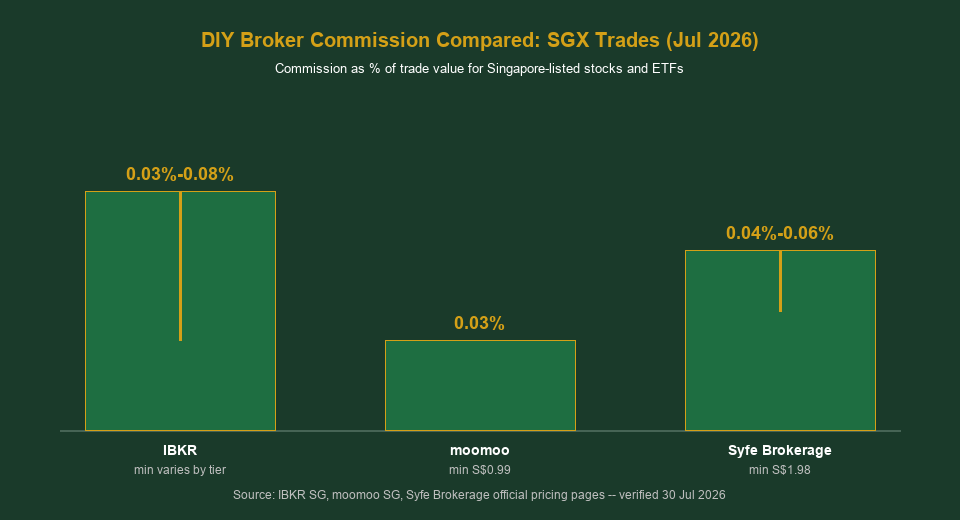
The main appeal is cost. Interactive Brokers (IBKR) charges tiered commissions from roughly 0.03% to 0.08% on Singapore-listed shares, with no platform fee or custody fee, and offers $0 commission on eligible US stocks under its Lite tier. To reach the lowest 0.05% SGX tier, however, you generally need at least S$2.5 million in monthly trading volume — most retail investors sit at the higher end of that range.
moomoo Singapore charges 0.03% of trade value on SGX stocks, with a S$0.99 minimum per order, and currently runs a one-year zero-commission promotion for SGX trades. US stocks are commission-free, though a US$0.99 platform fee applies per US order.
Syfe Brokerage charges between 0.04% and 0.06% on SGX trades depending on your account tier, with a S$1.98 minimum per trade, plus $0 platform, deposit, or withdrawal fees. US stocks are commission-free, with a monthly cap on free trades depending on tier.
Tiger Brokers is another popular option for Singapore DIY investors — see our Tiger Brokers fees guide for a full breakdown of its commission structure.
| Broker | SGX Commission | US Stocks | Platform Fee |
|---|---|---|---|
| IBKR | ~0.03%-0.08% (tiered by volume) | $0 (Lite, eligible accounts) | None |
| moomoo | 0.03% (min S$0.99) | $0 (+ US$0.99/order) | Per-order US fee only |
| Syfe Brokerage | 0.04%-0.06% (min S$1.98) | $0 (monthly free-trade cap) | None |
Source: IBKR Singapore official commissions page, moomoo Singapore Help Centre, Syfe Brokerage official pricing page — verified 30 July 2026. Fees subject to change; check each provider directly before trading.
DIY works well if you’re comfortable researching what to buy, checking in on your portfolio periodically, and handling your own rebalancing. It’s the cheapest path on paper — but only if you actually put in the time. A neglected DIY portfolio can underperform a low-cost robo-advisor by a wide margin.
Path 2: Robo-Advisors — Professionally Built Portfolios, Minimal Effort
A robo-advisor builds and manages a diversified portfolio for you, based on your risk profile and goals. You answer a questionnaire, deposit money, and the platform handles fund selection, diversification, and rebalancing automatically.
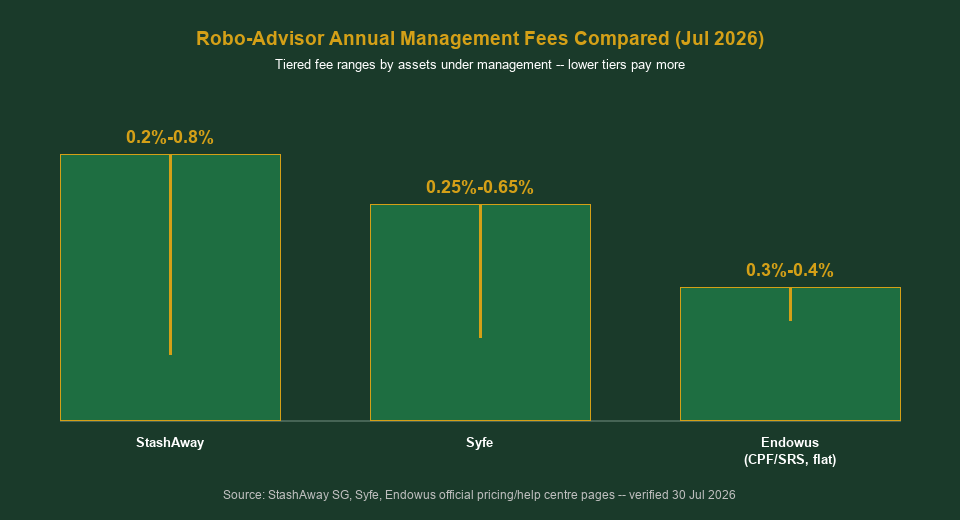
StashAway charges an annual management fee from 0.2% to 0.8%, tiered so larger portfolios pay a lower rate, on top of the underlying ETF expense ratios (roughly 0.2% p.a. for most portfolios).
Syfe‘s managed portfolios charge between roughly 0.25% and 0.65% a year, tiered by how much you have invested, with no lock-in and no withdrawal fees.
Endowus charges a flat 0.40% fee for CPF-invested funds and 0.30% for SRS-invested funds — notably flat rather than tiered by AUM, which sets it apart from Syfe and StashAway for CPF/SRS money specifically. Cash portfolios use a separate, tiered fee structure — check Endowus’s current pricing page for your exact bracket.
| Robo-Advisor | Annual Fee Range | Fee Structure |
|---|---|---|
| StashAway | 0.2%-0.8% p.a. | Tiered by AUM |
| Syfe | 0.25%-0.65% p.a. | Tiered by AUM |
| Endowus (CPF/SRS) | 0.30%-0.40% p.a. | Flat by account type |
Source: StashAway Singapore official pricing/help centre, Syfe official pricing, Endowus official pricing page — verified 30 July 2026.
Robo-advisors suit investors who want a diversified, professionally rebalanced portfolio without picking individual stocks or ETFs themselves. The trade-off is cost: even a 0.5% annual fee compounds meaningfully over 20-30 years compared to a 0.05% DIY commission. For a deeper comparison of specific platforms, see our Singapore robo-advisor guide.
Path 3: Financial Advisers — Human Advice, Two Different Cost Models
A financial adviser is a licensed individual who can recommend specific products and build a broader financial plan — often covering insurance and estate planning alongside investments, not just a portfolio. Under the Financial Advisers Act, which the Monetary Authority of Singapore (MAS) administers, advisers must disclose how they’re compensated.
There are two common models. Commission-based advisers are paid by the product provider when you buy something, commonly an insurance-linked or investment-linked policy. Commission levels on these products often run in the 4%-7% range, embedded in the product rather than billed to you directly — which is exactly why it’s easy to miss.
Fee-only advisers charge you directly — hourly, as a flat project fee, or as a retainer — and take no commission from the products they recommend. A comprehensive financial plan from a fee-only adviser in Singapore typically costs between $2,000 and $8,000, a one-time or periodic charge rather than an ongoing percentage of your portfolio.
Fee-only advisers are legally and ethically required to put your interests first, since they have no product-commission incentive. That said, most advisory firms in Singapore still operate primarily on the commission model — fee-only remains a smaller, growing segment of the market.
Before working with any adviser, ask directly: “How are you compensated for this recommendation?” A licensed adviser is required to be able to answer that question clearly.
How to Decide: A Simple 3-Question Framework
You don’t need a complicated flowchart. Answer these three questions honestly, and the right starting path becomes fairly clear.
1. How much time can you realistically commit each month? If it’s less than an hour, DIY is risky — your portfolio will likely get neglected. A robo-advisor or adviser-guided plan removes that burden.
2. How complex are your finances? If you just want a diversified investment portfolio, a robo-advisor or low-cost DIY ETF portfolio covers it. If you also need help with insurance coverage, estate planning, or a full financial plan, a human adviser adds value a robo-advisor can’t.
3. How much are you starting with, and how cost-sensitive are you? Smaller amounts make percentage-based robo-advisor fees feel less painful in dollar terms, but also make a flat-fee adviser plan relatively more expensive. Larger, long-term amounts make even small percentage differences compound significantly — which is when DIY’s lower cost starts to matter most.
If you’re still unsure how much to invest each month before choosing an approach, our minimum investment amounts guide and retirement planning calculator are useful starting points.
Can You Mix Approaches? Yes — Most Singaporeans Do
This isn’t an all-or-nothing decision. A common setup among Singapore investors: a DIY broker like IBKR or Syfe Brokerage for a core low-cost ETF portfolio, a robo-advisor like Endowus for CPF and SRS money where the flat fee is competitive, and a one-off consultation with a fee-only adviser for insurance and estate planning specifically.
If you’re following the account-sequencing order we recommend — CPF, then SRS, then cash — it’s entirely reasonable to use a different approach for each account, since each has different rules, tax treatment, and time horizons.
The key is intentionality: know why you’re using each approach for each pot of money, rather than defaulting to whichever platform or adviser you happened to hear about first.
Common Mistakes When Choosing How to Invest
Mistake 1: Choosing DIY without the time to actually use it. The lowest commission in Singapore is worthless if the portfolio behind it never gets reviewed or rebalanced. Be honest about how much time you’ll actually spend.
Mistake 2: Assuming robo-advisor fees are “free” because there’s no per-trade commission. A 0.5%-0.65% annual fee is still a real, ongoing cost — it’s simply bundled into the platform instead of charged per trade.
Mistake 3: Not asking a financial adviser how they’re compensated. Under MAS’s Financial Advisers Act, advisers must be able to disclose this. If an adviser is vague about commission versus fee, that’s a warning sign, not a technicality to skip past.
Mistake 4: Paying commission-based adviser fees for advice a robo-advisor could give more cheaply. If your only need is a diversified investment portfolio — no insurance or estate complexity — a 4%-7% embedded commission is a lot to pay for something a 0.3%-0.65% robo-advisor fee already covers.
Ready to Pick Your Approach?
Open an account and use these referral codes for sign-up perks on your first qualifying deposit.
Frequently Asked Questions
Which is cheaper: DIY, a robo-advisor, or a financial adviser in Singapore?
DIY is usually cheapest on paper, at roughly 0.03%-0.08% per SGX trade with brokers like IBKR, moomoo, or Syfe Brokerage. Robo-advisors cost more, typically 0.2%-0.8% a year. Financial advisers vary widely — commission-based advice can be 4%-7% embedded in a product, while fee-only plans run $2,000-$8,000 flat.
Can I use more than one approach at the same time?
Yes. Many Singapore investors use a DIY broker for a core ETF portfolio, a robo-advisor for CPF or SRS money, and a one-off fee-only adviser consultation for insurance or estate planning. There’s no rule requiring you to pick just one.
Do financial advisers in Singapore have to disclose how they're paid?
Yes. Under the Financial Advisers Act, which MAS administers, licensed advisers must be able to disclose whether they earn commission from product providers or charge fees directly. Always ask this question before acting on their recommendation.
Is a robo-advisor's fee worth it compared to DIY investing?
It depends on how much time and confidence you have. A robo-advisor’s 0.2%-0.8% annual fee buys you automatic diversification and rebalancing. If you would otherwise leave a DIY portfolio unmanaged, that fee is often worth it — but if you’re comfortable researching and rebalancing yourself, DIY is materially cheaper over time.
What is the minimum I need to start with a financial adviser in Singapore?
There’s no universal minimum — it varies by firm and by whether you’re buying a commission-based product or paying for a fee-only plan. Fee-only comprehensive plans typically cost $2,000-$8,000 regardless of portfolio size, so they make more sense once your finances are complex enough to justify that flat cost.
Should a beginner start with DIY or a robo-advisor?
Most beginners do better starting with a robo-advisor or a simple, low-cost DIY ETF portfolio — both are manageable without deep investing knowledge. Reserve individual stock-picking DIY investing for once you’ve built some experience and are comfortable doing your own research.
Are robo-advisor fees the same for CPF, SRS, and cash investments?
No. Endowus, for example, charges a flat 0.40% fee for CPF-invested funds and 0.30% for SRS-invested funds, which differs from its separate, tiered cash portfolio fee structure. Always check the specific fee schedule for the account type you’re funding.
Not financial advice. Data verified as at 30 July 2026 against IBKR Singapore, moomoo Singapore, Syfe, StashAway, and Endowus official pricing pages, and MAS Financial Advisers Act guidance. Commission and fee-only figures for financial advisers reflect general industry ranges reported by financialadvisor.com.sg and Ascenta Wealth and may vary by firm. Fee structures are subject to change — always confirm current pricing directly with each provider before committing. The Kopi Notes may earn referral fees when you sign up using our codes.
This article was researched with the help of AI. While we strive to keep all information accurate and up to date, there may be errors. If you notice any discrepancies, please contact us.